Thank you for visiting SNEWPapers!
Sign up free
Story
March 2, 1844
New York Daily Tribune
New York, New York County, New York
What is this article about?
Transcript from American Institute meeting on Feb. 15, 1844, covering properties and uses of woods like Acacia, Hickory, Oak varieties for shipbuilding, construction, barrels, and worm resistance in tropical waters.
Clipping
OCR Quality
75%
Good
Full Text
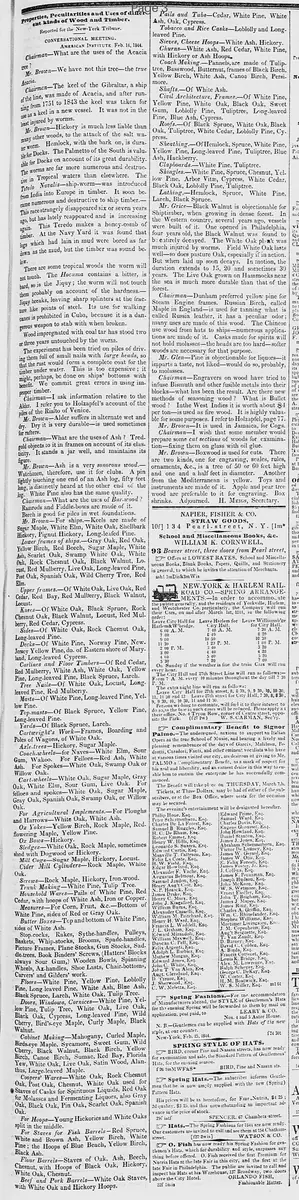
Properties, Peculiarities and Uses of different kinds of Wood and Timber.
Reported for the New-York Tribune.
CONVERSATIONAL MEETING.
Chairman—What are the uses of the Acacia tree?
Mr. Brown—We have not this tree—the true Acacia.
Chairman—The keel of the Gibraltar, a ship running from 1751 to 1843, the keel was made of Acacia and after running was taken for use as a keel in a new vessel. It was not in the least injured by worms.
Mr. Brown—Hickory is much less liable than before to docks. The Palmetto of the South is valuable for docks on account of its great durability.
The worms are far more numerous and destructive in tropical waters than elsewhere. The Teredo Navalis—ship-worm—was introduced from India into Europe in timber. It soon became numerous and destructive to ship timber. This race strangely disappeared six or seven years ago, but has lately reappeared and is increasing again.
This Teredo makes a honey-comb of timber. At the Navy Yard it was found that logs which had lain in mud were bored as far down as the mud, but the timber was sound below.
There are some tropical woods the worm will not touch. The Hocuma contains a bitter, is hard, so is the Jiquy; the worm will not touch them probably on account of the hardness. Jiquy breaks, leaving sharp splinters at the fracture like points of steel. Its use for walking canes is prohibited in Cuba, because it is a dangerous weapon to stab with when broken.
Wood impregnated with coal tar has stood two or three years untouched by the worm.
The experiment has been tried on piles of driving them full of small nails with large heads, so that the rust would form a complete coat for the timber under water. This might, perhaps, be done on ships' bottoms with benefit. We commit great errors in using improper timber.
Chairman—I ask information relative to the Alder. I refer you to Holzapfel's account of the piles of the Rialto of Venice.
Mr. Brown—Alder suffers in alternate wet and dry. Dry it is very durable—is used sometimes for rafters.
Chairman—What are the uses of Ash? Tredgold objects to it in frames on account of its elasticity. It stands a jar well, and maintains its figure.
Mr. Brown—Ash is a very sonorous wood. Watchmen, therefore, use it for clubs. A pin lightly touching one end of an Ash log, fifty feet long, is distinctly heard at the other end of the log. White Pine also has the same quality.
Chairman—What are the uses of Bar-wood? Ramrods and Fiddle-bows are made of it.
Beech is good for piles in wet foundations.
Mr. Brown—For ships.—Keels are made of Segar Maple, White Elm, White Oak, Shellbark Hickory, Pignut Hickory, Long-leaved Pine.
Lower frames of ships.—Gray Oak, Red Oak, Yellow Birch, Red Beech, Sugar Maple, White Ash, Scarlet Oak, Swamp White Oak, White Oak, Rock Chestnut Oak, Black Walnut, Locust, Red Mulberry, Live Oak, Long-leaved Pine, Post Oak, Spanish Oak, Wild Cherry Tree, Red Elm.
Upper frames.—Of White Oak, Live Oak, Red Cedar, Red Bay, Red Mulberry, Black Walnut, Locust.
Knees—Of White Oak, Black Spruce, Rock Chestnut Oak, Black Walnut, Locust, Red Mulberry, Red Cedar, Cypress.
Sides—Of White Oak, Rock Chestnut Oak, Long-leaved Pine.
Decks—Of White Pine, Norway Pine, New Jersey Yellow Pine, do. of Eastern shore of Maryland, Long-leaved Cypress.
Carlines and Floor Timbers—Of Red Cedar, Red Mulberry, White Ash, White Oak, Yellow Pine, Long-leaved Pine, Black Spruce, Larch.
Tree Nails—Of White Oak, Locust, Long-leaved Pine, Red Mulberry.
Masts—Of White Pine, Long-leaved Pine, Yellow Pine.
Top-masts—Of Black Spruce, Yellow Pine, Long-leaved Pine.
Yards—Of Black Spruce, Larch.
Cartwright's Work—Frames, Boarding and Poles of Wagons, of White Oak.
Axle-trees—Hickory. Sugar Maple.
Coach-wheels—for Naves—White Elm, Sour Gum, Wakoo. For Felloes—Red Ash, White Ash. For Spokes—White Oak, Swamp Oak or Willow Oak.
Oak, White Elm, Sour Gum, Live Oak. For Cart-wheels—White Oak, Sugar Maple, Gray Oak, felloes and spokes—White Oak, Sugar Maple, Gray Oak, Spanish Oak, Swamp Oak, or Willow Oak.
For Agricultural Implements.—For Ploughs and Harrows—White Oak, White Ash.
Ox Yokes—Yellow Birch, Rock Maple, Red-flowering Maple, Yellow Pine.
Ox Bows—Hickory.
Sledges—White Oak, Rock Maple, sometimes shod with Dogwood or Hickory.
Mill Cogs Sugar Maple, Hickory, Locust.
Cider Mill Cylinders—Rock Maple, White Oak.
Screws—Rock Maple, Hickory, Iron-wood.
Trunk Making—White Pine, Tulip Tree.
Household Wares Pails of White Pine, Red Cedar, with hoops of White Ash, Iron or Copper.
Measures—For Corn, Fruit, &c.—Bottom of White Pine, sides of Red or Gray Oak.
Butter Boxes—Top and bottom of White Pine, sides of White Ash.
Stop-cocks, Rakes, Scythe-handles, Pulleys, Baskets, Whip-stocks, Brooms, Spade-handles, Picture Frames, Plane Stocks, Gun Stocks, Saddle-trees, Book Binders' Screws, (Hatters' Blocks always Sour Gum,) Wooden Bowls, Spinning Wheels, Ax-handles, Shoe Lasts, Chair-bottoms Carvers' and Gilders' work.
Floors—White Pine, Yellow Pine, Loblolly Pine, Long-leaved Pine, White Ash, Blue Ash, Black Spruce, Larch, White Oak, Tulip Tree.
Doors, Windows, Cornices—White Pine, Yellow Pine, Tulip Tree, White Oak, Live Oak, Black Oak, Cypress, Long-leaved Pine, Wild Cherry, Bird's-eye Maple, Curly Maple, Black Walnut.
Cabinet Making—Mahogany, Curled Maple Birds-eye Maple, Sycamore, Sweet Gum, Wild Birch, Canoe Birch, Sumac, Red Bay, Florida Cherry Yew, White Oak, Live Oak, Satin Wood, Ailanthus, Large leaved Maple.
Coopers' Wares—White Oak, Rock Chestnut Oak, Post Oak, Chestnut, White Oak used for Staves of Casks for Spirituous Liquids, Red Oak for Molasses and Fermenting Liquors, also Gray Oak, Black Oak, Pin Oak, Scarlet Oak, Spanish Oak.
For Hoops—Young Hickories and White Oaks split in the middle.
For Staves for Fish Barrels—Red Spruce, White and Brown Ash, Yellow Birch, White Pine; the Hoops of Blue Beech, Yellow Birch, Black Ash.
Flour Barrels—Staves of Oak, Ash, Beech, Chestnut, with Hoops of Black Oak, Hickory, White Oak, Chestnut.
Beef and Pork Barrels—White Oak Staves, with hoops.
Pails and Tubs—Cedar, White Pine, White Ash, Oak, Cypress.
Tobacco and Rice Casks—Loblolly and Long-leaved Pine.
Sieves, Cheese Hoops—White Ash, Hickory.
Churns—White Ash, Red Cedar, White Pine, with Hickory or Ash Hoops.
Coach Making.—Pannels, are made of Tulip-tree, Basswood, Butternut, frames of Black Birch, Yellow Birch, White Ash, Canoe Birch, Persimmon.
Shafts.—Of White Ash.
Civil Architecture, Frames.—Of White Pine, Yellow Pine, White Oak, Black Oak, Sweet Gum, Loblolly Pine, Tulip tree, Long-leaved Pine, Blue Ash, Cypress.
Roofs.—Of Black Spruce, White Oak, Black Oak, Tulip tree, White Cedar, Loblolly Pine, Cypress.
Sheathing.—Of Hemlock, Spruce, White Pine, Yellow Pine, Long-leaved Pine, Tulip tree, Blue Ash, Hackberry.
Clapboards. White Pine, Tulip tree.
Shingles.—White Pine, Spruce, Chestnut, Yellow Pine, Arbor Vitae, Cypress, White Cedar, Black Oak, Loblolly Pine, Tulip tree.
Lathing,—Hemlock, Spruce, White Pine Larch, Black Spruce.
Mr. Grice—Black Walnut is objectionable for Shiptimber, when growing in dense forest. In the Western country, several years ago, vessels were built of it. One opened in Philadelphia, four years old, the Black Walnut was found to be entirely decayed. The White Oak plank was much injured by worms. Field White Oak lasts well—so does pasture Oak, especially if in action. But when laid up soon decays. In motion, the duration extends to 15, 20 and sometimes 30 years. The Live Oak grown on Hammocks near the sea is much more durable than that of the forest.
Chairman—Dunham preferred yellow pine for Steam Engine frames. Russian Birch, called Maple in England—is used for tanning what is called Russia leather, it has a peculiar odor; many uses are made of this wood. The Chinese use wood from hats to ships—numerous applications are made of it. Casks made for spirits will not hold molasses—the heads are too hard—softer woods are necessary for that purpose.
Mr. Glen—Pine is objectionable for liquors—it imparts a taste, not liked—would do so, probably, to molasses.
Chairman—Engravers on wood have tried to infuse Bismuth and other fusible metals into their blocks—what has been the result. Are there new methods of seasoning wood? What is Bullet wood? In the West Indies it is worth about $4 per ton—is used as fire wood. It is highly valuable for some purposes. I refer to Holzapfel, page 77.
Mr. Brown—It is used in Jamaica, for Cogs.
Chairman—I wish that some member would prepare some cut sections of woods for examination—fixing them on glass with oil glue.
Mr. Brown—Boxwood is used for cuts. There are two kinds, one for engraving, scales, rules, ornaments, &c., is a tree of 50 or 60 feet high and one and a half feet in diameter. Another from the Mediterranean is yellow. Toys and instruments are made of it. Apple and pear tree wood are preferable to it for engraving. Box shrinks. Adjourned. H. Meigs, Secretary.
Reported for the New-York Tribune.
CONVERSATIONAL MEETING.
Chairman—What are the uses of the Acacia tree?
Mr. Brown—We have not this tree—the true Acacia.
Chairman—The keel of the Gibraltar, a ship running from 1751 to 1843, the keel was made of Acacia and after running was taken for use as a keel in a new vessel. It was not in the least injured by worms.
Mr. Brown—Hickory is much less liable than before to docks. The Palmetto of the South is valuable for docks on account of its great durability.
The worms are far more numerous and destructive in tropical waters than elsewhere. The Teredo Navalis—ship-worm—was introduced from India into Europe in timber. It soon became numerous and destructive to ship timber. This race strangely disappeared six or seven years ago, but has lately reappeared and is increasing again.
This Teredo makes a honey-comb of timber. At the Navy Yard it was found that logs which had lain in mud were bored as far down as the mud, but the timber was sound below.
There are some tropical woods the worm will not touch. The Hocuma contains a bitter, is hard, so is the Jiquy; the worm will not touch them probably on account of the hardness. Jiquy breaks, leaving sharp splinters at the fracture like points of steel. Its use for walking canes is prohibited in Cuba, because it is a dangerous weapon to stab with when broken.
Wood impregnated with coal tar has stood two or three years untouched by the worm.
The experiment has been tried on piles of driving them full of small nails with large heads, so that the rust would form a complete coat for the timber under water. This might, perhaps, be done on ships' bottoms with benefit. We commit great errors in using improper timber.
Chairman—I ask information relative to the Alder. I refer you to Holzapfel's account of the piles of the Rialto of Venice.
Mr. Brown—Alder suffers in alternate wet and dry. Dry it is very durable—is used sometimes for rafters.
Chairman—What are the uses of Ash? Tredgold objects to it in frames on account of its elasticity. It stands a jar well, and maintains its figure.
Mr. Brown—Ash is a very sonorous wood. Watchmen, therefore, use it for clubs. A pin lightly touching one end of an Ash log, fifty feet long, is distinctly heard at the other end of the log. White Pine also has the same quality.
Chairman—What are the uses of Bar-wood? Ramrods and Fiddle-bows are made of it.
Beech is good for piles in wet foundations.
Mr. Brown—For ships.—Keels are made of Segar Maple, White Elm, White Oak, Shellbark Hickory, Pignut Hickory, Long-leaved Pine.
Lower frames of ships.—Gray Oak, Red Oak, Yellow Birch, Red Beech, Sugar Maple, White Ash, Scarlet Oak, Swamp White Oak, White Oak, Rock Chestnut Oak, Black Walnut, Locust, Red Mulberry, Live Oak, Long-leaved Pine, Post Oak, Spanish Oak, Wild Cherry Tree, Red Elm.
Upper frames.—Of White Oak, Live Oak, Red Cedar, Red Bay, Red Mulberry, Black Walnut, Locust.
Knees—Of White Oak, Black Spruce, Rock Chestnut Oak, Black Walnut, Locust, Red Mulberry, Red Cedar, Cypress.
Sides—Of White Oak, Rock Chestnut Oak, Long-leaved Pine.
Decks—Of White Pine, Norway Pine, New Jersey Yellow Pine, do. of Eastern shore of Maryland, Long-leaved Cypress.
Carlines and Floor Timbers—Of Red Cedar, Red Mulberry, White Ash, White Oak, Yellow Pine, Long-leaved Pine, Black Spruce, Larch.
Tree Nails—Of White Oak, Locust, Long-leaved Pine, Red Mulberry.
Masts—Of White Pine, Long-leaved Pine, Yellow Pine.
Top-masts—Of Black Spruce, Yellow Pine, Long-leaved Pine.
Yards—Of Black Spruce, Larch.
Cartwright's Work—Frames, Boarding and Poles of Wagons, of White Oak.
Axle-trees—Hickory. Sugar Maple.
Coach-wheels—for Naves—White Elm, Sour Gum, Wakoo. For Felloes—Red Ash, White Ash. For Spokes—White Oak, Swamp Oak or Willow Oak.
Oak, White Elm, Sour Gum, Live Oak. For Cart-wheels—White Oak, Sugar Maple, Gray Oak, felloes and spokes—White Oak, Sugar Maple, Gray Oak, Spanish Oak, Swamp Oak, or Willow Oak.
For Agricultural Implements.—For Ploughs and Harrows—White Oak, White Ash.
Ox Yokes—Yellow Birch, Rock Maple, Red-flowering Maple, Yellow Pine.
Ox Bows—Hickory.
Sledges—White Oak, Rock Maple, sometimes shod with Dogwood or Hickory.
Mill Cogs Sugar Maple, Hickory, Locust.
Cider Mill Cylinders—Rock Maple, White Oak.
Screws—Rock Maple, Hickory, Iron-wood.
Trunk Making—White Pine, Tulip Tree.
Household Wares Pails of White Pine, Red Cedar, with hoops of White Ash, Iron or Copper.
Measures—For Corn, Fruit, &c.—Bottom of White Pine, sides of Red or Gray Oak.
Butter Boxes—Top and bottom of White Pine, sides of White Ash.
Stop-cocks, Rakes, Scythe-handles, Pulleys, Baskets, Whip-stocks, Brooms, Spade-handles, Picture Frames, Plane Stocks, Gun Stocks, Saddle-trees, Book Binders' Screws, (Hatters' Blocks always Sour Gum,) Wooden Bowls, Spinning Wheels, Ax-handles, Shoe Lasts, Chair-bottoms Carvers' and Gilders' work.
Floors—White Pine, Yellow Pine, Loblolly Pine, Long-leaved Pine, White Ash, Blue Ash, Black Spruce, Larch, White Oak, Tulip Tree.
Doors, Windows, Cornices—White Pine, Yellow Pine, Tulip Tree, White Oak, Live Oak, Black Oak, Cypress, Long-leaved Pine, Wild Cherry, Bird's-eye Maple, Curly Maple, Black Walnut.
Cabinet Making—Mahogany, Curled Maple Birds-eye Maple, Sycamore, Sweet Gum, Wild Birch, Canoe Birch, Sumac, Red Bay, Florida Cherry Yew, White Oak, Live Oak, Satin Wood, Ailanthus, Large leaved Maple.
Coopers' Wares—White Oak, Rock Chestnut Oak, Post Oak, Chestnut, White Oak used for Staves of Casks for Spirituous Liquids, Red Oak for Molasses and Fermenting Liquors, also Gray Oak, Black Oak, Pin Oak, Scarlet Oak, Spanish Oak.
For Hoops—Young Hickories and White Oaks split in the middle.
For Staves for Fish Barrels—Red Spruce, White and Brown Ash, Yellow Birch, White Pine; the Hoops of Blue Beech, Yellow Birch, Black Ash.
Flour Barrels—Staves of Oak, Ash, Beech, Chestnut, with Hoops of Black Oak, Hickory, White Oak, Chestnut.
Beef and Pork Barrels—White Oak Staves, with hoops.
Pails and Tubs—Cedar, White Pine, White Ash, Oak, Cypress.
Tobacco and Rice Casks—Loblolly and Long-leaved Pine.
Sieves, Cheese Hoops—White Ash, Hickory.
Churns—White Ash, Red Cedar, White Pine, with Hickory or Ash Hoops.
Coach Making.—Pannels, are made of Tulip-tree, Basswood, Butternut, frames of Black Birch, Yellow Birch, White Ash, Canoe Birch, Persimmon.
Shafts.—Of White Ash.
Civil Architecture, Frames.—Of White Pine, Yellow Pine, White Oak, Black Oak, Sweet Gum, Loblolly Pine, Tulip tree, Long-leaved Pine, Blue Ash, Cypress.
Roofs.—Of Black Spruce, White Oak, Black Oak, Tulip tree, White Cedar, Loblolly Pine, Cypress.
Sheathing.—Of Hemlock, Spruce, White Pine, Yellow Pine, Long-leaved Pine, Tulip tree, Blue Ash, Hackberry.
Clapboards. White Pine, Tulip tree.
Shingles.—White Pine, Spruce, Chestnut, Yellow Pine, Arbor Vitae, Cypress, White Cedar, Black Oak, Loblolly Pine, Tulip tree.
Lathing,—Hemlock, Spruce, White Pine Larch, Black Spruce.
Mr. Grice—Black Walnut is objectionable for Shiptimber, when growing in dense forest. In the Western country, several years ago, vessels were built of it. One opened in Philadelphia, four years old, the Black Walnut was found to be entirely decayed. The White Oak plank was much injured by worms. Field White Oak lasts well—so does pasture Oak, especially if in action. But when laid up soon decays. In motion, the duration extends to 15, 20 and sometimes 30 years. The Live Oak grown on Hammocks near the sea is much more durable than that of the forest.
Chairman—Dunham preferred yellow pine for Steam Engine frames. Russian Birch, called Maple in England—is used for tanning what is called Russia leather, it has a peculiar odor; many uses are made of this wood. The Chinese use wood from hats to ships—numerous applications are made of it. Casks made for spirits will not hold molasses—the heads are too hard—softer woods are necessary for that purpose.
Mr. Glen—Pine is objectionable for liquors—it imparts a taste, not liked—would do so, probably, to molasses.
Chairman—Engravers on wood have tried to infuse Bismuth and other fusible metals into their blocks—what has been the result. Are there new methods of seasoning wood? What is Bullet wood? In the West Indies it is worth about $4 per ton—is used as fire wood. It is highly valuable for some purposes. I refer to Holzapfel, page 77.
Mr. Brown—It is used in Jamaica, for Cogs.
Chairman—I wish that some member would prepare some cut sections of woods for examination—fixing them on glass with oil glue.
Mr. Brown—Boxwood is used for cuts. There are two kinds, one for engraving, scales, rules, ornaments, &c., is a tree of 50 or 60 feet high and one and a half feet in diameter. Another from the Mediterranean is yellow. Toys and instruments are made of it. Apple and pear tree wood are preferable to it for engraving. Box shrinks. Adjourned. H. Meigs, Secretary.
What sub-type of article is it?
Curiosity
Historical Event
What themes does it cover?
Nature
What keywords are associated?
Wood Properties
Timber Uses
Shipbuilding
Worm Resistance
Durability
American Institute
What entities or persons were involved?
Chairman
Mr. Brown
Mr. Grice
Mr. Glen
H. Meigs
Where did it happen?
American Institute, New York
Story Details
Key Persons
Chairman
Mr. Brown
Mr. Grice
Mr. Glen
H. Meigs
Location
American Institute, New York
Event Date
Feb. 15, 1844
Story Details
Transcript of a conversational meeting discussing properties, peculiarities, and uses of various woods and timbers, including durability against worms, applications in shipbuilding, construction, household wares, and more.