Thank you for visiting SNEWPapers!
Sign up free
Toledo Union Journal
Toledo, Lucas County, Ohio
What is this article about?
The Toledo Labor-Management-Citizens Committee, directed by Jerome Gross, focuses on education via university institutes and school programs to foster understanding, while mediating disputes to avert strikes. In 1956, cases rose to 72, averting losses, with the committee serving as a model studied nationally and internationally since 1946.
Merged-components note: The story on page 1 explicitly states 'Continued on Page 10', and the component on page 10 is the direct continuation. The image on page 10 is referenced in the text as 'Here is a photo...', so included in the merge for completeness.
Clippings
1 of 2
OCR Quality
Full Text
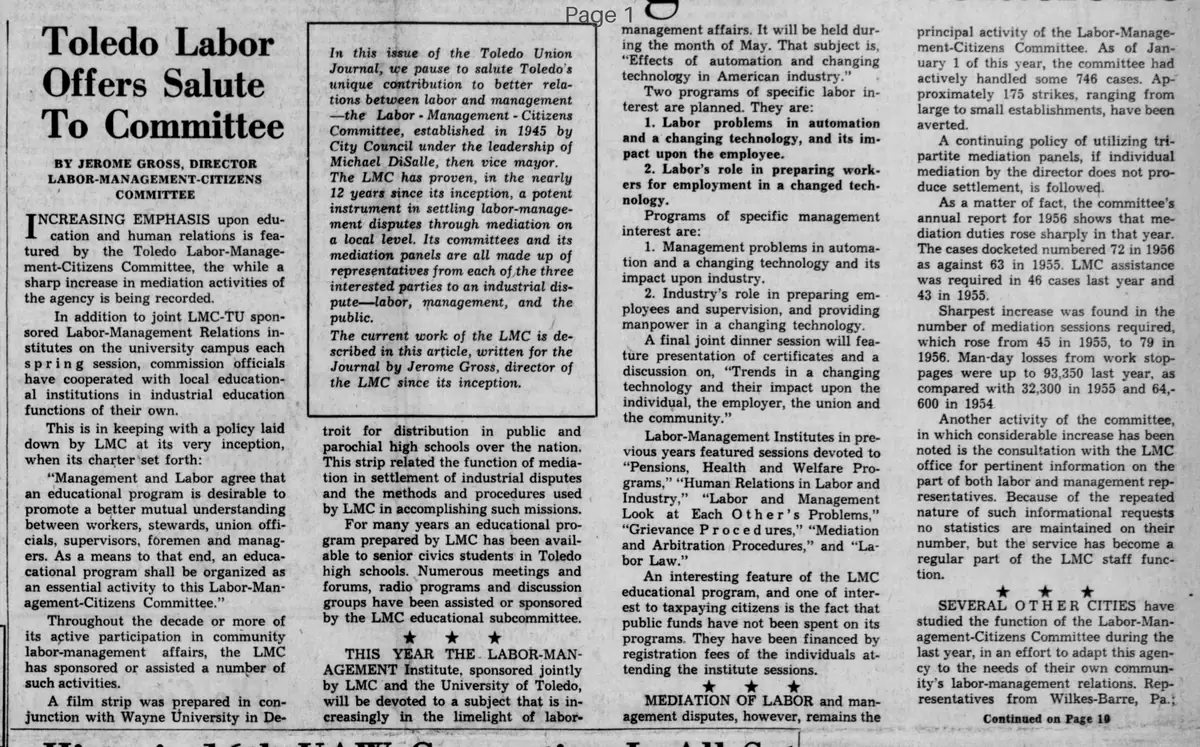
BY JEROME GROSS, DIRECTOR LABOR-MANAGEMENT-CITIZENS COMMITTEE
INCREASING EMPHASIS upon education and human relations is featured by the Toledo Labor-Management-Citizens Committee, the while a sharp increase in mediation activities of the agency is being recorded.
In addition to joint LMC-TU sponsored Labor-Management Relations institutes on the university campus each spring session, commission officials have cooperated with local educational institutions in industrial education functions of their own.
This is in keeping with a policy laid down by LMC at its very inception, when its charter set forth:
"Management and Labor agree that an educational program is desirable to promote a better mutual understanding between workers, stewards, union officials, supervisors, foremen and managers. As a means to that end, an educational program shall be organized as an essential activity to this Labor-Management-Citizens Committee."
Throughout the decade or more of its active participation in community labor-management affairs, the LMC has sponsored or assisted a number of such activities.
A film strip was prepared in conjunction with Wayne University in Detroit for distribution in public and parochial high schools over the nation.
This strip related the function of mediation in settlement of industrial disputes and the methods and procedures used by LMC in accomplishing such missions.
For many years an educational program prepared by LMC has been available to senior civics students in Toledo high schools. Numerous meetings and forums, radio programs and discussion groups have been assisted or sponsored by the LMC educational subcommittee.
THIS YEAR THE LABOR-MANAGEMENT Institute, sponsored jointly by LMC and the University of Toledo, will be devoted to a subject that is increasingly in the limelight of labor-management affairs. It will be held during the month of May. That subject is, "Effects of automation and changing technology in American industry."
Two programs of specific labor interest are planned. They are:
1. Labor problems in automation and a changing technology, and its impact upon the employee.
2. Labor's role in preparing workers for employment in a changed technology.
Programs of specific management interest are:
1. Management problems in automation and a changing technology and its impact upon industry.
2. Industry's role in preparing employees and supervision, and providing manpower in a changing technology.
A final joint dinner session will feature presentation of certificates and a discussion on, "Trends in a changing technology and their impact upon the individual, the employer, the union and the community."
Labor-Management Institutes in previous years featured sessions devoted to "Pensions, Health and Welfare Programs," "Human Relations in Labor and Industry," "Labor and Management Look at Each Other's Problems," "Grievance Procedures," "Mediation and Arbitration Procedures," and "Labor Law."
An interesting feature of the LMC educational program, and one of interest to taxpaying citizens is the fact that public funds have not been spent on its programs. They have been financed by registration fees of the individuals attending the institute sessions.
MEDIATION OF LABOR and management disputes, however, remains the principal activity of the Labor-Management-Citizens Committee. As of January 1 of this year, the committee had actively handled some 746 cases. Approximately 175 strikes, ranging from large to small establishments, have been averted.
A continuing policy of utilizing tripartite mediation panels, if individual mediation by the director does not produce settlement, is followed.
As a matter of fact, the committee's annual report for 1956 shows that mediation duties rose sharply in that year.
The cases docketed numbered 72 in 1956 as against 63 in 1955. LMC assistance was required in 46 cases last year and 43 in 1955.
Sharpest increase was found in the number of mediation sessions required, which rose from 45 in 1955, to 79 in 1956. Man-day losses from work stoppages were up to 93,350 last year, as compared with 32,300 in 1955 and 64,600 in 1954.
Another activity of the committee, in which considerable increase has been noted is the consultation with the LMC office for pertinent information on the part of both labor and management representatives. Because of the repeated nature of such informational requests no statistics are maintained on their number, but the service has become a regular part of the LMC staff function.
SEVERAL OTHER CITIES have studied the function of the Labor-Management-Citizens Committee during the last year, in an effort to adapt this agency to the needs of their own community's labor-management relations. Representatives from Wilkes-Barre, Pa.;
Continued on Page 10
Toledo Labor Offers Salute To Committee
Continued from Page 1
Monroe, Mich., and Pittsburgh, Pa., visited Toledo.
Inquiries as to our operation were received from Johannesburg, South Africa; Windsor, Ont.; Portsmouth, Akron, Cincinnati and Columbus, Ohio, and South Bend, and Evansville, Ind.
Another interested visitor studying LMC activities, following an article in the "London Economist" recommending our operation, was Denys Holland, labor attache to the British Consulate-General, who visited Toledo and has since engaged in extending correspondence with the LMC office on behalf of an inquiry from the British Home Secretary's office.
Approximately 1,600 copies of the booklet, "The Toledo Plan for Industrial Harmony," have been distributed to individuals and organizations here and abroad, who have requested them. Some 400 have been placed in public and university libraries. Two groups of foreign visitors touring the nation studied LMC operations and approximately 35 addresses on labor-management relations were made locally and in other cities by LMC members and the director.
A RECAPITULATION Of strike losses since LMC's inception show 1945 with total losses of 420,000 man-days-local 235,650, and industry-wide 184,350; 1946, total 233,000 local 106,995, and industry-wide 126,005; 1947, total 160,000-local 100,837, and industry-wide 59,163; 1948, total 85,400 local 65,576, and industry-wide 19,824; 1949, total 16,400-local 15,170, and industry-wide 1,230; 1950, total 181,000--local 172,551, and industry-wide 8,449; 1951, total 117,000-local 110,300, and industry-wide 6,700; 1952, total 176,000 local 117,373, and industry-wide 58,627; 1953, total 64,600-local 64,200, and industry-wide 200; 1954, total 32,300 local 14,075, and industry-wide 18,225, and 1955, total 93,350.
It may be interesting to note that, according to the U. S. Labor Department Bureau of Labor Statistics, Toledo ranked fourth nationally in strike losses in 1944, but by 1946, our first year of operation, had dropped to 49th place. This occurred in a year which labor department statisticians revealed as the worst year for production losses caused by industrial strike since compilation of statistics started.
The LMC: Model For Labor-Management Relations
Much of the LMC's success in settling labor-management disputes came through informal conferences and friendly debates. Here is a photo of one of the earlier steering committees of LMC, listening to a humorous point made by Jules Lippmann, second from right, a management representative on the LMC. Left to right are Jerome Gross, LMC director, standing; Rabbi Morton Goldberg, public member; Richard Gosser and William Sturm, labor members; Joseph Tillman and Jules Lippmann, management members, and Michael V. DiSalle, public member and then LMC chairman.
LMC Photo
THE LMC RECORD in 1956 shows 72 cases docketed, nine more than 1955. The record shows:
1. Strikes averted in eight disputes by LMC intervention.
2. No man-days lost from strikes where panel hearings were held prior to work stoppages.
A considerable number of LMC cases docketed were referrals from the federal mediation service, cited as not affecting interstate commerce, which the federal service declined to handle and which were referred to LMC for mediation. Five of 1956's 72 cases were pending at year's end and carried over into the 1957 file.
Division of the 1956 case load shows:
Six cases of mediation by LMC panels.
Fourteen cases of mediation by the LMC director.
Three arbitration cases.
Two recognition elections.
Nineteen cases settled with only minor LMC assistance, in which panel hearings or hearings with the LMC director were not required, merely consultation.
What sub-type of article is it?
What themes does it cover?
What keywords are associated?
What entities or persons were involved?
Where did it happen?
Story Details
Key Persons
Location
Toledo, Ohio
Event Date
1945 1957
Story Details
The Toledo Labor-Management-Citizens Committee emphasizes education and human relations through institutes on topics like automation, sponsors programs in schools, and has mediated 746 cases averting 175 strikes since inception, with increasing activities and national interest.