Thank you for visiting SNEWPapers!
Sign up free
Litchfield Enquirer
Litchfield, Litchfield County, Connecticut
What is this article about?
Detailed description of Brussels as a major city in Flanders with 80,000 inhabitants, sharing capital status with The Hague. Covers its history of French bombardments and occupations (1695, 1748, revolutionary war until 1814), manufacturing (lace employing 10,000, carpets, camblets, carriages), canal-assisted commerce, proximity to Waterloo attracting travelers, spacious new streets, splendid buildings, unique frog market, fine park, promenades, and gratuitous lectures at Philosophical College.
Clipping
OCR Quality
Full Text
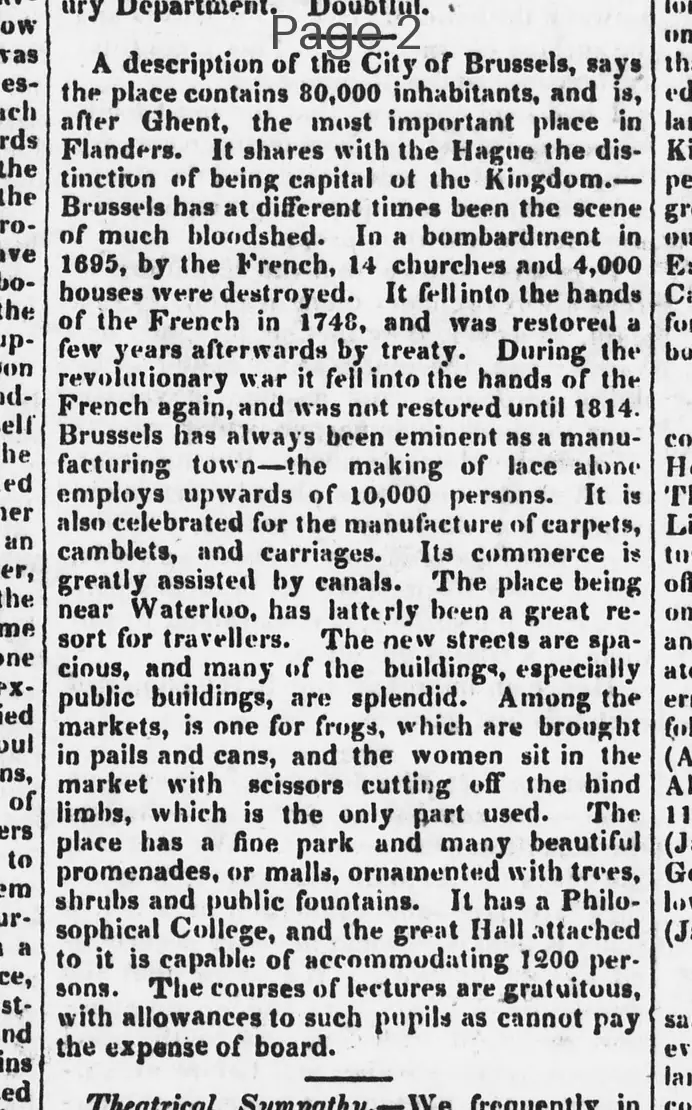
Brussels has always been eminent as a manufacturing town—the making of lace alone employs upwards of 10,000 persons. It is also celebrated for the manufacture of carpets, camblets, and carriages. Its commerce is greatly assisted by canals. The place being near Waterloo, has latterly been a great resort for travellers. The new streets are spacious, and many of the buildings, especially public buildings, are splendid. Among the markets, is one for frogs, which are brought in pails and cans, and the women sit in the market with scissors cutting off the hind limbs, which is the only part used. The place has a fine park and many beautiful promenades, or malls, ornamented with trees, shrubs and public fountains. It has a Philosophical College, and the great Hall attached to it is capable of accommodating 1200 persons. The courses of lectures are gratuitous, with allowances to such pupils as cannot pay the expense of board.
What sub-type of article is it?
What keywords are associated?
Where did it happen?
Foreign News Details
Primary Location
Brussels
Outcome
in 1695 bombardment: 14 churches and 4,000 houses destroyed. occupied by french in 1748, restored by treaty; reoccupied during revolutionary war, restored in 1814.
Event Details
Brussels, with 80,000 inhabitants, is the most important place in Flanders after Ghent and shares capital status with the Hague. It has history of bloodshed including French bombardment in 1695 destroying 14 churches and 4,000 houses, falling to French in 1748 and during revolutionary war until 1814 restoration. Eminent for manufacturing: lace employs over 10,000, also carpets, camblets, carriages. Commerce aided by canals. Near Waterloo, attracts travelers. Spacious new streets, splendid public buildings. Frog market where women cut off hind limbs. Fine park, beautiful promenades with trees, shrubs, fountains. Philosophical College with hall for 1200, gratuitous lectures and allowances for pupils.