Thank you for visiting SNEWPapers!
Sign up free
Alexandria Daily Gazette, Commercial & Political
Alexandria, Virginia
What is this article about?
Population statistics for the French Empire in 1811 from almanacs and official sources, listing speakers of various languages, departmental additions, city populations in a table, and notes on cotton imports and benefits from excluding British manufactures.
Merged-components note: Table lists city populations as part of the French Empire population report; subsequent text continues on trade permissions, forming a single foreign news article on French demographics and policy with spatial overlap and sequential reading order.
Clipping
OCR Quality
Full Text
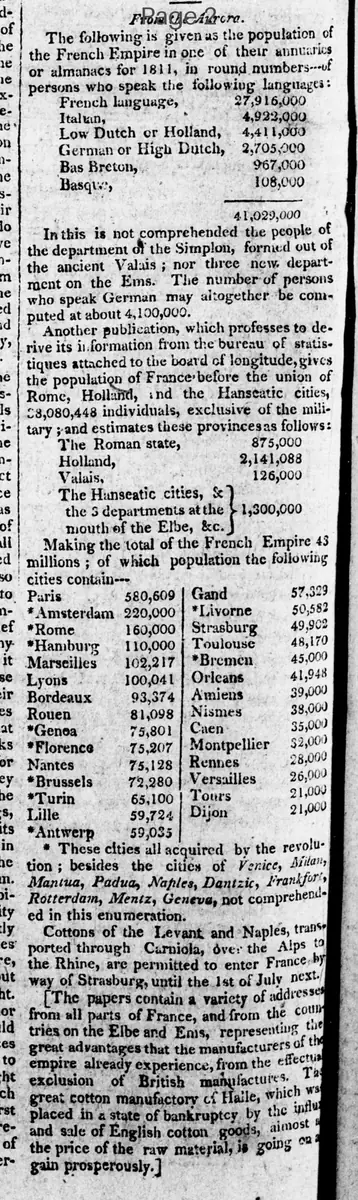
The following is given as the population of the French Empire in one of their almanacs for 1811, in round numbers--of persons who speak the following languages:
French language, 27,916,000
Italian, 4,922,000
Low Dutch or Holland, 4,411,000
German or High Dutch, 2,705,000
Bas Breton, 967,000
Basque, 108,000
41,029,000
In this is not comprehended the people of the department of the Simplon, formed out of the ancient Valais ; nor three new departments on the Ems. The number of persons who speak German may altogether be computed at about 4,100,000.
Another publication, which professes to derive its information from the bureau of statistics attached to the board of longitude, gives the population of France before the union of Rome, Holland, and the Hanseatic cities, 28,080,448 individuals, exclusive of the military ; and estimates these provinces as follows:
The Roman state, 875,000
Holland, 2,141,088
Valais, 126,000
The Hanseatic cities, & the 3 departments at the mouth of the Elbe, &c. 1,300,000
Making the total of the French Empire 43 millions ; of which population the following
* These cities all acquired by the revolution; besides the cities of Venice, Milan Mantua, Padua, Naples, Dantzic, Frankfort, Rotterdam, Mentz, Geneve, not comprehended in this enumeration.
| Paris | 580,609 | Gand | 57,329 |
| *Amsterdam | 220,000 | *Livorne | 50,582 |
| *Rome | 160,000 | Strasburg | 49,909 |
| *Hamburg | 110,000 | Toulouse | 48,170 |
| Marseilles | 102,217 | *Bremen | 45,000 |
| Lyons | 100,041 | Orleans | 41,948 |
| Bordeaux | 93,374 | Amiens | 39,000 |
| Rouen | 81,098 | Nismes | 38,000 |
| *Genoa | 75,801 | Caen | 35,000 |
| *Florence | 75,207 | Montpellier | 32,000 |
| Nantes | 75,128 | Rennes | 28,000 |
| *Brussels | 72,280 | Versailles | 26,000 |
| *Turin | 65,100 | Tours | 21,000 |
| Lille | 59,724 | Dijon | 21,000 |
| *Autriche | 50,025 |
Cottons of the Levant and Naples, transported through Carniola, over the Alps to the Rhine, are permitted to enter France by way of Strasburg, until the 1st of July next.
[The papers contain a variety of addresses from all parts of France and from the countries on the Elbe and Ems, representing the advantages that the manufacturers of the empire already experience, from the effectual exclusion of British manufactures. The great cotton manufactory at Haile, which was placed in a state of bankruptcy by the influx and sale of English cotton goods, is going on again prosperously.]
What sub-type of article is it?
What keywords are associated?
Where did it happen?
Foreign News Details
Primary Location
French Empire
Event Date
1811
Outcome
total population estimated at 41,029,000 to 43,000,000, including annexed territories; cotton imports permitted until july 1; manufacturing revival due to exclusion of british goods.
Event Details
Almanac reports population by language speakers in the French Empire: French 27,916,000, Italian 4,922,000, Low Dutch 4,411,000, German 2,705,000, Bas Breton 967,000, Basque 108,000, totaling 41,029,000, excluding Simplon and Ems departments; German speakers about 4,100,000. Another source gives pre-union France 28,080,448, plus Roman state 875,000, Holland 2,141,088, Valais 126,000, Hanseatic cities and Elbe departments 1,300,000, totaling 43 million. Table lists populations of major cities. Cottons from Levant and Naples allowed entry via Strasburg until July 1. Addresses highlight benefits to empire manufacturers from excluding British goods; Haile cotton manufactory revived after bankruptcy from English imports.