Thank you for visiting SNEWPapers!
Sign up free
Martinsburg Gazette And Public Advertiser
Martinsburg, Berkeley County, West Virginia
What is this article about?
Biographical notice of Judge Richard Peters, highlighting his Revolutionary War contributions as War Commissioner, including securing ammunition in 1779 and aiding the Yorktown campaign shift in 1781 through Robert Morris' support, plus his long judicial tenure.
Clipping
OCR Quality
Full Text
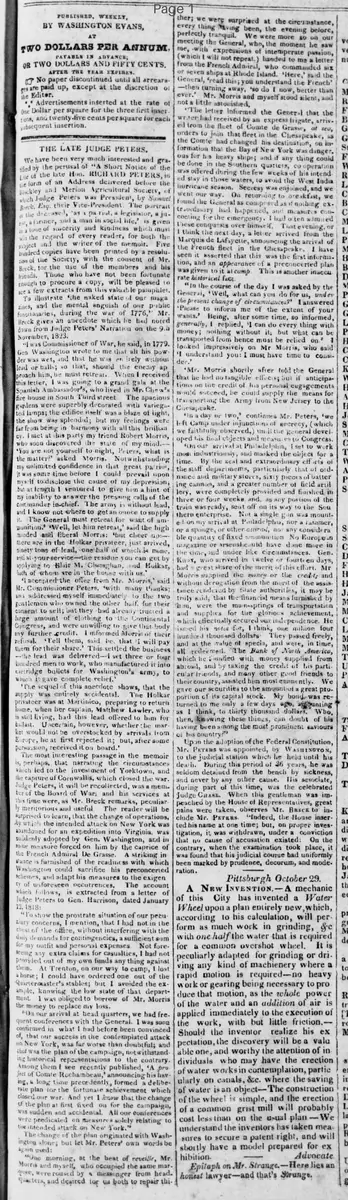
We have been very much interested and gratified by the perusal of "A Short Notice of the Life of the late Hon. RICHARD PETERS, in the form of an Address delivered before the Blockley and Merion Agricultural Society, of which Judge Peters was President, by Samuel Breck, Esq. their Vice-President. The portrait of the deceased, as a patriot, a legislator, a judge, a farmer, and a man in social life, is given in a tone of sincerity and kindness which must win the regard of every reader, for both the subject and the writer of the memoir. Five hundred copies have been printed by a resolution of the Society, with the consent of Mr. Breck, for the use of the members and his friends. Those who have not been fortunate enough to procure a copy, will be pleased to see a few extracts from this valuable pamphlet.
To illustrate the naked state of our magazines, and the mental anguish of our public functionaries, during the war of 1776," Mr. Breck gives an anecdote which he had noted down from Judge Peters' Narration on the 9th November, 1823.
"I was Commissioner of War, he said, in 1779. Gen. Washington wrote to me that all his powder was wet, and that he was entirely without lead or balls; so that, should the enemy approach him, he must retreat. When I received this letter, I was going to a grand gala at the Spanish Ambassador's, who lived in Mr. Chew's fire house in South Third street. The spacious gardens were superbly decorated with variegated lamps; the edifice itself was a blaze of light, the show was splendid; but my feelings were far from being in harmony with all this brilliancy. I met at this party my friend Robert Morris, who soon discovered the state of my mind.-- "You are not yourself to-night, Peters, what is the matter?" asked Morris. Notwithstanding my unlimited confidence in that great patriot, it was some time before I could prevail upon myself to disclose the cause of my depression; but at length I ventured to give him a hint of my inability to answer the pressing calls of the commander in-chief. "The army is without lead, and I know not where to get an ounce to supply it. The General must retreat for want of ammunition." "Well, let him retreat," said the high minded and liberal Morris: "but cheer up:-- there are in the Holkar privateer, just arrived, ninety tons of lead, one half of which is mine, and at your service--the residue you can get by applying to Blair M. Clanaghan, and Holkar, both of whom were in the house with us."
"I accepted the offer from Mr. Morris," said Mr. Commissioner Peters, "with many thanks; and addressed myself immediately to the two gentlemen who owned the other half, for their consent to sell; but they had already trusted a large amount of clothing to the Continental Congress, and were unwilling to give that body any further credit. I informed Morris of their refusal. "Tell them," said he, "that I will pay them for their share." This settled the business--the lead was delivered--I set three or four hundred men to work, who manufactured it into cartridge bullets for Washington's army, to which it gave complete relief."
"The sequel of this anecdote shows, that the supply was entirely accidental. The Holkar privateer was at Martinico, preparing to return home, when her captain, Matthew Lawler, who is still living, had this lead offered to him for ballast. Uncertain, however, whether the market would not be overstocked by arrivals from Europe, he at first rejected it; but, after some persuasion, received it on board."
The most interesting passage in the memoir is, perhaps, that narrating the circumstances which led to the investment of Yorktown, and the capture of Cornwallis, which closed the war. Judge Peters, it will be recollected, was a member of the Board of War; and his services at this time were, as Mr. Breck remarks, peculiarly meritorious and useful. The reader will be surprised to learn, that the change of operations, by which the intended attack on New York was abandoned for an expedition into Virginia, was suddenly adopted by Gen. Washington, and in some measure forced on him by the caprice of the French Admiral De Grasse. A striking instance is furnished of the readiness with which Washington could sacrifice his preconceived schemes, and adapt his measures to the exigency of unforeseen occurrences. The account which follows, is extracted from a letter of Judge Peters to Gen. Harrison, dated January 12, 1818:
"To show the prostrate situation of our military concerns, I mention, that I had not in the chest of the office, without interfering with the daily demands for contingencies, a sufficient sum for my outfit and personal expenses. Not foreseeing any extra claims for casualties, I had not provided out of my own funds any thing against them. At Trenton, on our way to camp, I lost a horse; I could have ordered one out of the Quartermaster's stables; but I avoided the example, knowing the low state of that department. I was obliged to borrow of Mr. Morris the money to replace my loss.
"On our arrival at head quarters, we had frequent conferences with the General. I was soon confirmed in what I had before been convinced of, that our success in the contemplated attack on New York, was far worse than doubtful; and that was the plan of the campaign, notwithstanding historical representations to the contrary. Among them I see recently published, 'A project of Comte Rochambeau,' announcing his having, a long time precedently, formed a deliberate plan for the fortunate achievement which closed our war. And yet I know that the change of the plan at first fixed on for the campaign, was sudden and accidental. All our conferences were predicated on measures solely relating to the intended attack on New York."
The change of the plan originated with Washington alone; but let Mr. Peters' own words be again used:
"One morning, at the beat of reveille, Mr. Morris and myself, who occupied the same marquee, were roused by a messenger from head quarters, and desired for us both to repair thither; we were surprised at the circumstance, every thing having been, the evening before, perfectly tranquil. We were more so on our meeting the General, who, the moment he saw me, with expressions of intemperate passion, (which I will not repeat,) handed to me a letter from the French Admiral, who commanded six or seven ships at Rhode Island. "Here," said the General, "read this; you understand the French"--then turning away, "so do I now, better than ever." Mr. Morris and myself stood silent, and not a little astonished.
"The letter informed the General that the writer had received by an express frigate, arrived from the fleet of Comte de Grasse, at sea, orders to join that fleet in the Chesapeake, as the Comte had changed his destination, on information that the Bay of New York was dangerous for his heavy ships; and if any thing could be done in the Southern quarters, co-operation was offered during the few weeks of his intended stay in those waters, to avoid the West India hurricane season. Secrecy was enjoined, and we went our way. On returning to breakfast, we found the General as composed as if nothing extraordinary had happened, and measures concocting for the emergency. I had often admired these conquests over himself. That evening, or I think the next day, a letter arrived from the Marquis de Lafayette, announcing the arrival of the French fleet in the Chesapeake. I have seen it asserted that this was the first information, and an appearance of a preconcerted plan was given to it at camp. This is another inaccurate historical fact.
"In the course of the day I was asked by the General, "Well, what can you do for us, under the present change of circumstances?" I answered "Please to inform me of the extent of your wants." Being, after some time, so informed, generally, I replied, "I can do every thing with money; nothing without it; but what can be transported from hence must be relied on." I looked impressively on Mr. Morris, who said "I understand you: I must have time to consider."
"Mr. Morris shortly after told the General that he had no tangible effects; but if anticipations on the credit of his personal engagements would succeed, he could supply the means for transporting the Army from New Jersey to the Chesapeake.
"In a day or two, continues Mr. Peters, we left Camp under injunctions of secrecy, (which we faithfully observed,) until the general developed his final objects and measures to Congress.
"On our arrival at Philadelphia, I set to work most industriously, and masked the object for a time. By the zeal and extraordinary efforts of the staff departments, particularly that of ordnance and military stores, sixty pieces of battering cannon, and a greater number of field artillery, were completely provided and finished in three or four weeks, and, as any portion of the train was ready, sent off on its way to the Southern enterprise. Not a single gun was mounted on my arrival at Philadelphia, nor a rammer, or a sponge, or other-utensil, nor any considerable quantity of fixed ammunition. No European magazine or arsenal could have done more in the time, and under like circumstances. Gen. Knox, who arrived in twelve or fourteen days, had a great share of the merit of this effort. Mr. Morris supplied the money or the credit; and without derogation from the merit of the assistance rendered by State authorities, it may be truly said, that the financial means furnished by him, were the main-springs of transportation and supplies for the glorious achievement, which effectually secured our independence. He issued his notes for, I think, one million four hundred thousand dollars: They passed freely, and at the value of specie, and were, in time, all redeemed. The Bank of North America, which he founded with money supplied from abroad, and by taxing the credit of his particular friends, and many other good friends to their country, assisted him most eminently. We gave our securities to the amount of a great proportion of its capital stock. My bond was returned to me only a few days ago, amounting as I think, to thirty thousand dollars."
Who, then, knowing these things, can doubt of his having been among the most prominent saviours of his country?
Upon the adoption of the Federal Constitution, Mr. Peters was appointed, by Washington, to the judicial station which he held until his death. "During this period of 36 years, he was seldom detained from the bench by sickness, and never by any other cause. His associate, during part of this time, was the celebrated Judge Chase. When this gentleman was impeached by the House of Representatives, great pains were taken, observes Mr. Breck, to include Mr. Peters. "Indeed, the House inserted his name at one time; but, on proper investigation, it was withdrawn, under a conviction that no cause of accusation existed: On the contrary, when the examination took place, it was found that his judicial course had uniformly been marked by prudence, decorum, and moderation."
What sub-type of article is it?
What themes does it cover?
What keywords are associated?
What entities or persons were involved?
Where did it happen?
Story Details
Key Persons
Location
Philadelphia, South Third Street, Chesapeake, New York, Virginia, Martinico
Event Date
1779, 1781, 1818, 1823
Story Details
Memoir excerpts detail Judge Richard Peters' role as War Commissioner in 1779, securing lead for Washington's army via Robert Morris; the sudden shift from New York to Yorktown campaign in 1781 due to French fleet movements, enabled by Morris' financing; and his 36-year judicial service marked by prudence.