Thank you for visiting SNEWPapers!
Sign up free
The Enquirer
Richmond, Henrico County, Virginia
What is this article about?
An anonymous letter urges careful selection of Virginia's next governor amid Republican party divisions. It evaluates candidates including George Wythe, William B. Giles, Wilson C. Nicholas, John Taylor, John Harvie, Alexander McRae, William Foushee, and strongly endorses Richard Brent for his unifying qualities, eloquence, and service.
Merged-components note: This is a single long letter to the editor discussing candidates for governor of Virginia, continuing across columns on page 3.
Clipping
OCR Quality
Full Text
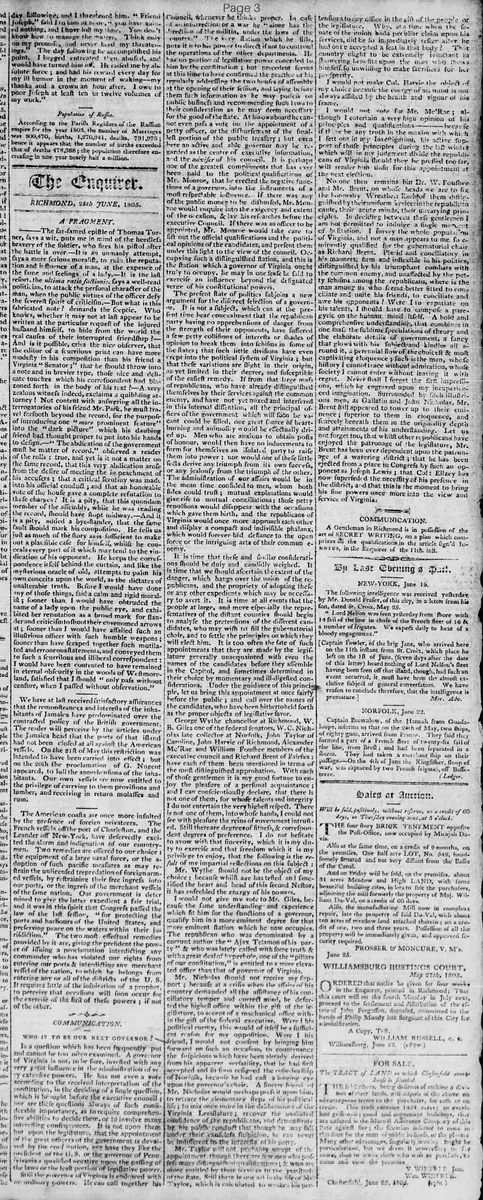
WHO IS TO BE OUR NEXT GOVERNOR?
Is a question which has been frequently put and cannot be too often examined. "A governor of Virginia is not, to be sure, invested with any very great influence in the administration of very extensive powers. He has not even a vote according to the received interpretation of the constitution, in the deciding of a single question, which is brought before the executive council; nor are these questions always of such considerable importance, as to require comprehensive abilities to decide them, or to involve many interesting consequences. It is not upon them but upon the legislature, that the appointment of the great officers of the government is devolved by the constitution, nor have they like the president of the U. S. or the governor of Pennsylvania a qualified negative upon the passing of the laws or the least portion of legislative power.
Still the governor of Virginia is endowed with no ordinary powers. He can call together his Council, whenever he thinks proper. In case of an insurrection: or a war he "alone has the direction of the militia, under the laws of the country." The very station which he fills, puts it in his power to direct if not to controul the operations of the other departments. He has no portion of legislative power conceded to him by the constitution: but precedent seems at this time to have confirmed the practice of his regularly addressing the two houses of assembly at the opening of their session, and laying before them such information as he may possess on public business and recommending such laws to their consideration as he may deem necessary for the good of the state. At his own board he cannot even pass a vote on the appointment of a petty officer, or the disbursement of the smallest portion of the public treasury: but even here an active and able governor may be regarded as the centre of executive information, and the adviser of his council. It is perhaps one of the greatest compliments that has ever been paid to the political qualifications of Mr. Monroe, that he erected the negative functions of a governor. into the instruments of a most respectable influence. If there was any of the public money to be disbursed, Mr. Monroe would enquire into the exigency and extent of the occasion, & lay his researches before the executive Council. If there was an officer to be appointed, Mr. Monroe would take care to sift out the official qualifications and the political opinions of the candidates, and present them under this light to the view of the council. Occupying such a distinguished station, and this is the station which a governor of Virginia ought truly to occupy, he may in one sense be said to exercise an influence beyond the designated verge of his constitutional powers.
The present state of politics subjoins a new argument for the discreet selection of a governor. It is not a subject, which can at the present time bear concealment that the republican party having no apprehensions of danger from the strength of their opponents, have suffered a few petty collisions of interests or shades of opinion to break them into schisms in some of the states; that such little divisions have even crept into the political system of Virginia; but that these variations are slight in their origin, as yet limited in their degree, and susceptible of the easiest remedy. If from that large mass of republicans, who have already distinguished themselves by their services against the common enemy, and have not yet mixed and interfered in this internal dissention, all the principal offices of the government which will soon be vacant could be filled, one great source of heart-burning and animosity would be effectually dried up. Men who are anxious to obtain posts of honour, would then have no inducements to form for themselves an isolated party to raise them into power: nor would one of these little sects derive any triumph from its own success, or any jealousy from the triumph of the other. The administration of our affairs would be in the mean time confided to men, whom both sides could trust; mutual explanations would give rise to mutual conciliations; those petty repulsions would disappear with the occasions which gave them birth, and the republicans of Virginia would once more approach each other and display a compact and indivisible phalanx, which would forever bid defiance to the open force or the intriguing arts of their common enemy.
It is time that these and similar considerations should be duly and candidly weighed. It is time that we should ascertain the extent of the danger, which hangs over the union of the republicans, and the propriety of adopting these or any other expedients which may be necessary to avert it. It is time at all events that the people at large, and more especially the representatives of the distant counties should begin to analyse the pretensions of the different candidates, who may wish to fill the gubernatorial chair, and to settle the principles on which they will elect him. It is too often the fate of such appointments that they are made by the legislature generally unacquainted with even the names of the candidates before they assemble in the Capitol, and sometimes determined in their choice by momentary and ill-digested considerations. Under the guidance of this principle, let us bring this appointment at once fairly before the public; and call over the names of the candidates. who have been hitherto held forth as the proper objects of legislative favor.
George Wythe chancellor at Richmond, W. B. Giles one of the federal senators, W. C. Nicholas late collector at Norfolk, John Taylor of Caroline, John Harvie of Richmond, Alexander McRae and William Foushee members of the executive council and Richard Brent of Fairfax: have each of them been mentioned in terms of the most distinguished approbation. With each of those gentlemen it is my good fortune to enjoy the pleasure of a personal acquaintance; and I can conscientiously declare, that there is not one of them, for whose talents and integrity I do not entertain the very highest respect. There is not one of them, into whose hands, I could not see with pleasure the reins of government intrusted. Still there are degrees of fitness, & correspondent degrees of preference. I do not hesitate to avow with that sincerity, which it is my duty to exercise and that freedom which it is my privilege to enjoy, that the following is the result of my impartial reflections on this subject:
Mr. Wythe should not be the object of my choice: because whilst age has tested and sanctified the heart and head of this second Nester. it has enfeebled the energy of his powers.
I would not give my vote to Mr. Giles, because the same understanding and experience which fit him for the functions of a governor, qualify him in a more eminent degree for that more eminent station which he now occupies. The republican who was denominated by a corrupt author the "Ajax Telamon of his party" & who was lately called with some truth & with a great deal of hyperbole, one of the "pillars of our constitution," is entitled to a more elevated office than that of governor of Virginia.
Mr. Nicholas should not receive my support: because at a crisis when the affairs of his country demanded all the assistance of his conciliatory temper and correct mind. he deserted the highest office within the gift of the legislature, to accept of a menial office within the gift of the federal executive. Were I his political enemy, this would of itself be a sufficient reason for my opposition. Were I his friend, I would not consent by bringing him forward on such an occasion, to countenance the suspicions which have been already derived from his apparent versatility, that he had first accepted and so soon resigned the collectorship of Norfolk, because he had cast a longing eye upon the governor's chair. A sincere friend of Mr. Nicholas would perhaps press it upon him, to retrace the elementary steps of his political life: to mix once more in the deliberations of the Virginia Legislature: recover the unabated confidence of the republicans, and demonstrate by his public conduct that though he may fall under their causeless suspicion, he can never be indifferent to the interests of his party.
Mr. Taylor will not probably accept of the appointment. though there are few men who possess more distinguished qualifications: & who are more entitled by their services to the gratitude of the state. Still there is one act in the life of Mr. Taylor, which is calculated to weaken his pretensions to any office in the gift of the people of the legislature. Why at a time when the senate of the union had a peculiar claim upon his services, did he so immediately resign after he had once accepted a seat in that body? That country ought to be extremely reluctant in showering benefits upon the man who thus shews himself so unwilling to make sacrifices for her prosperity.
I would not make Col. Harvie the object of my choice because the energy of his mind is not always assisted by the health and vigour of his frame.
I would not vote for Mr. McRae: although I entertain a very high opinion of his principles and qualifications---because if there be any truth in the maxim with which I set out in my Investigation, his active support of those principles during the last winter which will in my judgment divide the republicans of Virginia should they be pressed too far, will render him unfit for this appointment at the next election.
No one then remains but Dr. W. Foushee and Mr. Brent. on whose heads we are to fix the honorary wreath. Each of them distinguished by their uniform services in the republican cause, their acute minds, their unwavering principles. In deciding between these gentlemen I am not permitted to indulge a single moment of hesitation. I survey the whole popular of Virginia, and not a man appears to me so eminently qualified for the gubernatorial chair as Richard Brent. Placid and conciliatory in his manners; firm and inflexible in his politics, distinguished by his triumphant combats with the common enemy, and unaffected by the petty schisms among the republicans, where is the man among us who seems better fitted to conciliate and unite his friends, to conciliate and awe his opponents? Were I to expatiate on his talents, I should have to compose a panegyric on the human mind itself. A bold and comprehensive understanding, that combines in one man the sublime speculations of theory and the elaborate details of government, a fancy that glows with his subject and kindles all around it, a perennial flow of the choicest & most captivating eloquence; such is the man, whose history I cannot trace without admiration, whose society I cannot enter without leaving it with regret. Never shall I forget the first impressions, which he engraved upon my inexperienced imagination. Surrounded by such illustrious men, as Gallatin and John Nicholas, Mr. Brent still appeared to tower up to their eminence; superior to them in eloquence, and scarcely beneath them in the originality depth and attainments of his understanding. Let us not forget too, that whilst other republicans have enjoyed the patronage of the legislature, Mr. Brent has been ever dependent upon the patronage of a wavering district; that he has been ejected from a place in Congress by such an opponent as Joseph Lewis; that Col: Elzey has now superceded the necessity of his presence in the district, and that this is the moment to bring his fine powers once more into the view and service of Virginia.
What sub-type of article is it?
What themes does it cover?
What keywords are associated?
Letter to Editor Details
Main Argument
the author evaluates several candidates for virginia's governorship and strongly recommends richard brent as the most qualified to unite the republican party and exercise effective influence, critiquing others for various reasons including age, current positions, past resignations, and party divisions.
Notable Details