Thank you for visiting SNEWPapers!
Sign up free
The Dickinson Press
Dickinson, Stark County, North Dakota
What is this article about?
W. B. Jelly unearthed mammoth ribs while excavating a watering place on his Amaranth farm last summer. John Jelly of Shelburne led further digs, recovering additional bones and a 12-foot-8-inch tusk, with excavation ongoing in muck and marl layers indicating a watery or glacial past.
Clipping
OCR Quality
Full Text
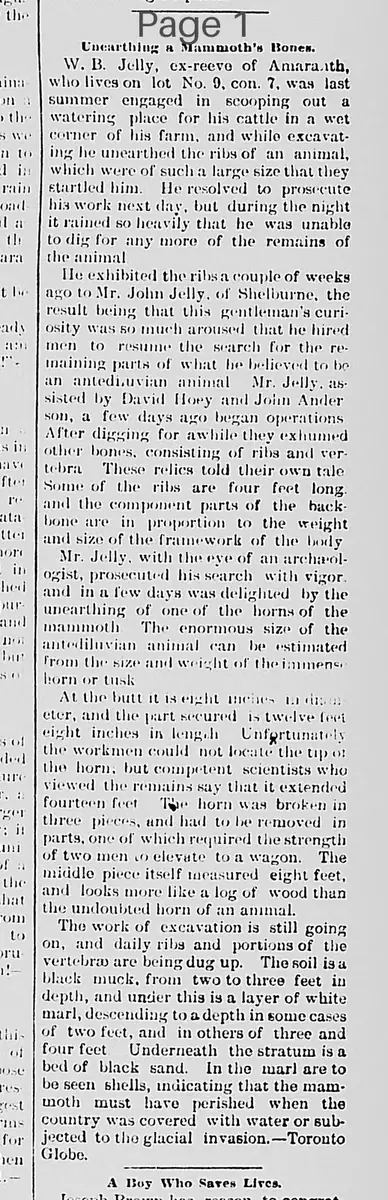
W. B. Jelly, ex-reeve of Amaranth, who lives on lot No. 9, con. 7, was last summer engaged in scooping out a watering place for his cattle in a wet corner of his farm, and while excavating he unearthed the ribs of an animal which were of such a large size that they startled him. He resolved to prosecute his work next day, but during the night it rained so heavily that he was unable to dig for any more of the remains of the animal. He exhibited the ribs a couple of weeks ago to Mr. John Jelly, of Shelburne, the result being that this gentleman's curiosity was so much aroused that he hired men to resume the search for the remaining parts of what he believed to be an antediluvian animal. Mr. Jelly, assisted by David Joey and John Anderson, a few days ago began operations. After digging for awhile they exhumed other bones, consisting of ribs and vertebrae. These relics told their own tale. Some of the ribs are four feet long and the component parts of the back bone are in proportion to the weight and size of the framework of the body. Mr. Jelly, with the eye of an archaeologist, prosecuted his search with vigor and in a few days was delighted by the unearthing of one of the horns of the mammoth. The enormous size of the antediluvian animal can be estimated from the size and weight of the immense horn or tusk. At the butt it is eight inches in diameter, and the part secured is twelve feet eight inches in length. Unfortunately the workmen could not locate the tip of the horn, but competent scientists who viewed the remains say that it extended fourteen feet. The horn was broken in three pieces, and had to be removed in parts, one of which required the strength of two men to elevate to a wagon. The middle piece itself measured eight feet, and looks more like a log of wood than the undoubted horn of an animal. The work of excavation is still going on, and daily ribs and portions of the vertebra are being dug up. The soil is a black muck, from two to three feet in depth, and under this is a layer of white marl, descending to a depth in some cases of two feet, and in others of three and four feet. Underneath the stratum is a bed of black sand. In the marl are to be seen shells, indicating that the mammoth must have perished when the country was covered with water or subjected to the glacial invasion.—Toronto Globe.
What sub-type of article is it?
What keywords are associated?
What entities or persons were involved?
Where did it happen?
Domestic News Details
Primary Location
Amaranth
Event Date
Last Summer
Key Persons
Outcome
excavation ongoing; bones including ribs, vertebrae, and a 12-foot-8-inch tusk recovered; scientists estimate full tusk length at 14 feet; no casualties.
Event Details
W. B. Jelly discovered large animal ribs while digging a cattle watering place on his farm in a wet corner. Heavy rain delayed further work. He showed the ribs to John Jelly of Shelburne, who hired David Joey and John Anderson to excavate more. They found additional ribs (up to 4 feet long), vertebrae, and a mammoth horn/tusk (8 inches diameter at butt, broken into three pieces). Soil layers include black muck, white marl with shells, and black sand, suggesting the animal perished in water or glacial conditions.