Thank you for visiting SNEWPapers!
Sign up free
Dodgeville Chronicle
Dodgeville, Iowa County, Wisconsin
What is this article about?
Biography of Benjamin F. Wade, born in 1800 in Massachusetts to a poor Revolutionary War veteran's family. Details his boyhood hardships, self-education, manual labors including farming, cattle driving, and Erie Canal work, journey westward, and start in law in Ohio.
Clipping
OCR Quality
Full Text
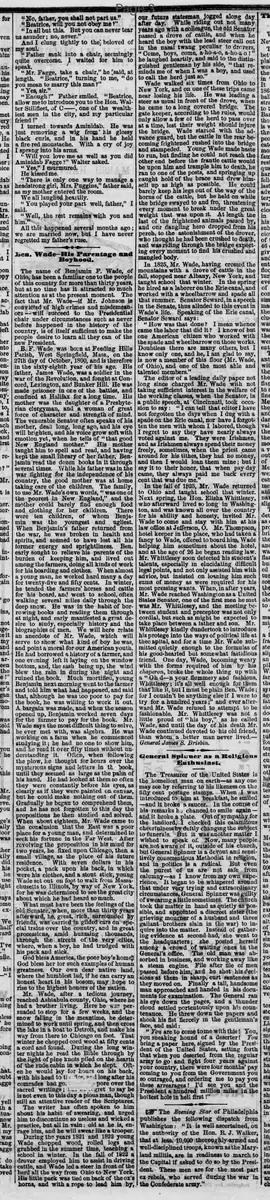
The name of Benjamin F. Wade, of Ohio, has been a familiar one to the people of this country for more than thirty years, but at no time has it attracted so much attention as at the present moment. The fact that Mr. Wade—if Mr. Johnson is convicted of high crimes and misdemeanors—will succeed to the Presidential chair under circumstances such as never before happened in the history of the country, is of itself sufficient to make the people desire to learn all they can of the new President.
B. F. Wade was born at Feeding Hills Parish, West Springfield, Mass., on the 27th day of October, 1800, and is therefore in the sixty-eighth year of his age. His father, James Wade, was a soldier in the war of the Revolution, and fought at Concord, Lexington, and Bunker Hill. He was made prisoner in one of the battles, and confined at Halifax for a long time. His mother was the daughter of a Presbyterian clergyman, and a woman of great force of character and strength of mind. The venerable Senator often speaks of his mother, dead long, long ago, and his eye will brighten, and his voice grow soft with emotion yet, when he tells of "that good New England mother." His mother taught him to spell and read, and having kept the small library of her father, Benjamin read the dozen books in it through several times. While his father was in the war fighting for the independence of his country, the good mother was at home taking care of the children. The family, to use Mr. Wade's own words, "was one of the poorest in New England," and the mother could barely find enough food and clothing for her children. There were ten children, of whom Benjamin was the youngest and ugliest.
When Benjamin's father returned from the war, he was broken in health and spirits, and seemed to have lost all his former energy and sprightliness. Ben. early sought to relieve his parents of the burden of keeping him, and lived out among the farmers, doing all kinds of work for his boarding and clothes. When almost a young man, he worked hard many a day for twenty-five and fifty cents. In winter, he tended the farmers' horses and cattle for his board, and went to school, often walking several miles daily through the deep snow. He was in the habit of borrowing books and reading them through at night, and early manifested a great desire to study, especially history and the biographies of men. We will here relate an anecdote of Mr. Wade, which will serve to show what kind of boy he was, and point a moral for our American youth.
He had borrowed a history of a farmer, and one evening left it laying on the window bottom, and, the sash being up, the wind blew the rain in during the night and ruined the book. Much mortified, young Benjamin next morning went to the farmer and told him what had happened, and said that, although he was too poor to pay for the book, he was willing to work it out. A bargain was made, and when the season opened up, Benjamin worked seven days for the farmer to pay for the book. Mr. Wade says the most difficult thing to solve, he ever met with, was algebra. He was working on a farm when he commenced studying it; he had no one to show him, and he read it over fifty times without understanding it. Often, when following the plow, he thought for hours over the mysterious signs and letters in the book, until they seemed as large as the palm of his hand. He had looked at them so often they were constantly before his eyes, as clearly as if they were painted on canvas, but he could make nothing out of them. Gradually he began to comprehend them, and he has not forgotten to this day the propositions he then studied and solved.
When about eighteen, Mr. Wade came to the conclusion that the East was a poor place for a young man, and determined to seek his fortune in the Far West. After revolving the proposition in his mind for two years, he fixed upon Chicago, then a small village, as the place of his future residence. With seven dollars in his pocket, a pack upon his back, in which were his clothes, and a stout stick, young Wade set out on foot to walk from Massachusetts to Illinois, by way of New York, for he was determined to see the great city about which he had heard so much. What must have been the feelings of the old Senator, when, more than thirty years afterward, he, great, rich, surrounded by friends, was carried in gilded cars on special trains over the country, and in great processions, amid huzzaing thousands, through the streets of the very cities where, when a boy, he had trudged with his pack and stick.
God bless America, the poor boy's home—God bless her for such examples of human greatness. Our own dear native land, where the humblest lad, if he can carry an honest heart in his bosom, may hope to rise to the highest honors of the nation.
Mr. Wade, after a tedious journey, reached Ashtabula county, Ohio, where he had a brother living. Here he was persuaded to stop for a few weeks, and the snow falling in the meantime, he determined to work until spring, and then cross the lake in a boat to Detroit, and make his way from there to Chicago on foot. That winter he chopped cord wood at fifty cents a cord and found. During the long winter nights he read the Bible through by the light of pine knots piled on the hearth of the rude cabin in which he slept. Often he would lay for hours on his back, with his head to the fire, and long after his comrades had gone, pore over the sacred writings; I regret to say he is not even to this day a pious man, though still an attentive reader of the Scriptures. The writer has often spoken to him about his habit of swearing, and urged him to discontinue so useless and wicked a practice, but all in vain: old as he is, enrage him, and he will swear like a trooper.
During the years 1821 and 1822 young Wade chopped wood, rolled logs and grubbed in the summer time, teaching a school in winter. In the fall of 1823 a drover employed him to assist in driving cattle, and Wade led a steer in front of the herd all the way from Ohio to New York. His little pack was tied on back of the ox's horns, and with a rope to lead him by. Our future statesman jogged along day after day. While riding out not many years ago with a colleague, the old Senator passed a drove of cattle, and when he heard the boy with the lead steer call out in the nasal twang peculiar to drovers, "Come, boys, come, a-ho-a-o, a-ho-ao!" he laughed heartily, and said to the distinguished gentleman by his side, "that reminds me of when I was a boy, and used to call the herd just so."
Wade walked six times from Ohio to New York, and on one of these trips came near losing his life. He was leading a steer as usual in front of the drove, when he came to a long covered bridge. The gate keeper, according to the rules, would only allow a few of the herd to pass over at a time, lest their weight should injure the bridge. Wade started with the advance guard, but the cattle in the rear becoming frightened rushed into the bridge and stampeded. Young Wade made haste to run, but finding he could not reach the other end before the frantic cattle would be upon him and trample him to death, he ran to one of the posts, and springing up caught hold of the brace and drew himself up as high as possible. He could barely keep his legs out of the way of the horns of the cattle, but he held on while the bridge swayed to and fro, threatening every moment to break under the great weight that was upon it. At length the last of the frightened animals passed by, and our dangling hero dropped from his perch, to the astonishment of the drover, who thought he had been crushed to death, and was riding through the bridge expecting every moment to find his crushed and mangled body.
In 1825, Mr. Wade, having crossed the mountains with a drove of cattle in the fall, stopped near Albany, New York, and taught school that winter. In the spring he hired as a laborer on the Erie canal, and worked with a wheelbarrow and spade all that summer. Senator Seward, in a speech in the Senate, thus alluded to this event in Wade's life. Speaking of the Erie canal Senator Seward says:
"How was that done? I mean whence came the labor that did it? I know of but one American citizen who worked with the spade and wheelbarrow on those works. Doubtless there are many others, but I know only one, and he, I am glad to say, is now a member of this floor (Mr. Wade, of Ohio), and one of the most able and talented members."
The editor of a leading daily paper not long since charged Mr. Wade with not taking sufficient interest in the welfare of the working classes, when the Senator, in a public speech, at Cincinnati, took occasion to say: "I can tell that editor I have not forgotten the days when I dug with a spade on the Erie canal, nor have I forgotten the men with whom I labored, though I regret to say they have nearly always voted against me. They were Irishmen, and as Irishmen always spend their money freely, sometimes, when the priest came around for his tithes, they had no money, and then I would loan them mine; but I say it to their honor, that when pay-day came, they always paid me back every cent that was due me."
In the fall of 1825, Mr. Wade returned to Ohio and taught school that winter. Next spring, the Hon. Elisha Whittlesey, who afterward lived so long in Washington, and was known all over the country for his ability and honesty, invited Mr. Wade to come and stay with him at his law office at Jefferson, O. Mr. Thompson, hotel keeper in the place, who had taken a fancy to Wade, offered to board him, Wade helping him sometimes about the hotel, and at the age of 26 he began reading law.
Mr. Whittlesey soon detected his student's talents, especially in elucidating difficult legal points, and not only assisted him with advice, but insisted on loaning him such sums of money as were required for his most pressing wants. When, in after years Mr. Wade reached Washington as a United States Senator, one of the first men he met was Mr. Whittlesey, and the meeting between student and preceptor was not only cordial, but such as might be expected to take place between a father and son. Mr. Whittlesey kindly undertook to introduce his protege into the ways of political life at the capital, and for a time Mr. Wade submitted quietly enough to the formulas of his good-hearted but somewhat fastidious friend. One day, Wade, becoming weary with the forms required of him by his chaperon, broke the whole thing up with a "Oh d—n your flummery and fashions, Whittlesey; it's all well enough for them that like it, but I must be plain Ben. Wade; for I couldn't be anything else if I were to try for a hundred years;" and ever afterward Mr. Wade refused to attempt to be fashionable. Mr. Whittlesey was not a little proud of "his boy," as he called Wade, and until the day of his death Mr. Wade continued devoted to his old friend, than whom a better man never lived.—General James S. Brisbin.
What sub-type of article is it?
What themes does it cover?
What keywords are associated?
What entities or persons were involved?
Where did it happen?
Story Details
Key Persons
Location
West Springfield, Mass.; Ohio; New York; Erie Canal
Event Date
October 27, 1800 To 1826
Story Details
Born into poverty in Massachusetts in 1800 as the youngest of ten children to a Revolutionary War veteran father and strong-willed mother. Self-taught through borrowed books while performing hard farm labor for minimal pay. Journeyed on foot to the West with little money, worked chopping wood, driving cattle, teaching school, and on the Erie Canal. Narrowly escaped death in a cattle stampede. Began studying law at age 26 under Elisha Whittlesey in Ohio.