Thank you for visiting SNEWPapers!
Sign up free
Story
August 4, 1874
The Daily Dispatch
Richmond, Virginia
What is this article about?
Account of colored cadet Smith at West Point failing exam and being dropped, with implications of racial prejudice influencing the decision against commissioning a black officer.
Clipping
OCR Quality
98%
Excellent
Full Text
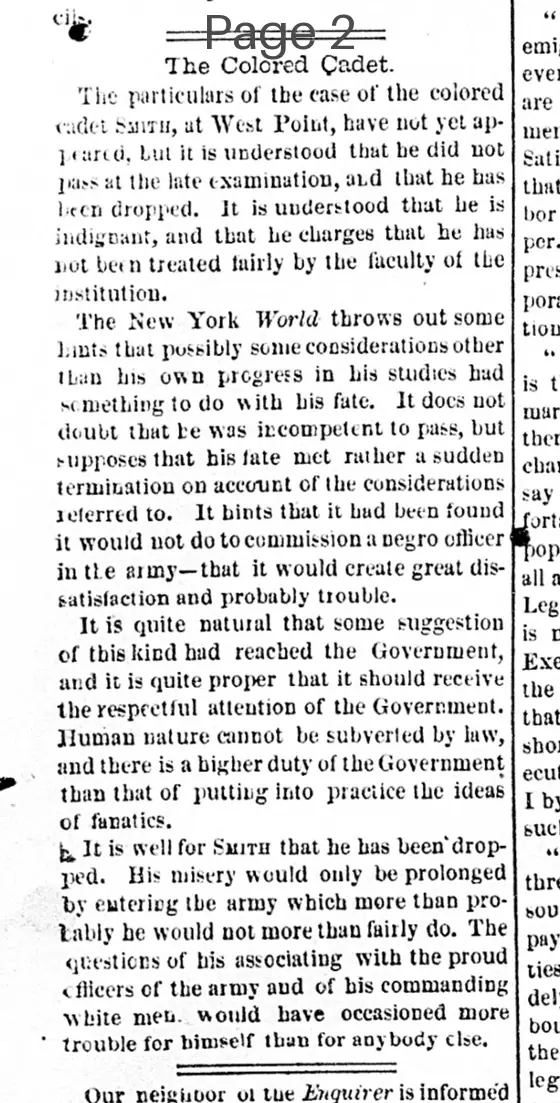
The Colored Cadet.
The particulars of the case of the colored cadet Smith, at West Point, have not yet appeared, but it is understood that he did not pass at the late examination, and that he has been dropped. It is understood that he is indignant, and that he charges that he has not been treated fairly by the faculty of the institution.
The New York World throws out some hints that possibly some considerations other than his own progress in his studies had something to do with his fate. It does not doubt that he was incompetent to pass, but supposes that his fate met rather a sudden termination on account of the considerations referred to. It hints that it had been found it would not do to commission a negro officer in the army—that it would create great dissatisfaction and probably trouble.
It is quite natural that some suggestion of this kind had reached the Government, and it is quite proper that it should receive the respectful attention of the Government. Human nature cannot be subverted by law, and there is a higher duty of the Government than that of putting into practice the ideas of fanatics.
It is well for Smith that he has been dropped. His misery would only be prolonged by entering the army which more than probably he would not more than fairly do. The questions of his associating with the proud officers of the army and of his commanding white men would have occasioned more trouble for himself than for anybody else.
The particulars of the case of the colored cadet Smith, at West Point, have not yet appeared, but it is understood that he did not pass at the late examination, and that he has been dropped. It is understood that he is indignant, and that he charges that he has not been treated fairly by the faculty of the institution.
The New York World throws out some hints that possibly some considerations other than his own progress in his studies had something to do with his fate. It does not doubt that he was incompetent to pass, but supposes that his fate met rather a sudden termination on account of the considerations referred to. It hints that it had been found it would not do to commission a negro officer in the army—that it would create great dissatisfaction and probably trouble.
It is quite natural that some suggestion of this kind had reached the Government, and it is quite proper that it should receive the respectful attention of the Government. Human nature cannot be subverted by law, and there is a higher duty of the Government than that of putting into practice the ideas of fanatics.
It is well for Smith that he has been dropped. His misery would only be prolonged by entering the army which more than probably he would not more than fairly do. The questions of his associating with the proud officers of the army and of his commanding white men would have occasioned more trouble for himself than for anybody else.
What sub-type of article is it?
Historical Event
Biography
What themes does it cover?
Social Manners
Justice
Misfortune
What keywords are associated?
Colored Cadet
West Point
Racial Bias
Military Examination
Unfair Treatment
What entities or persons were involved?
Smith
Where did it happen?
West Point
Story Details
Key Persons
Smith
Location
West Point
Story Details
Colored cadet Smith fails examination at West Point and is dropped, charging unfair treatment by faculty; hints suggest racial considerations prevented commissioning a black officer to avoid dissatisfaction in the army.