Thank you for visiting SNEWPapers!
Sign up free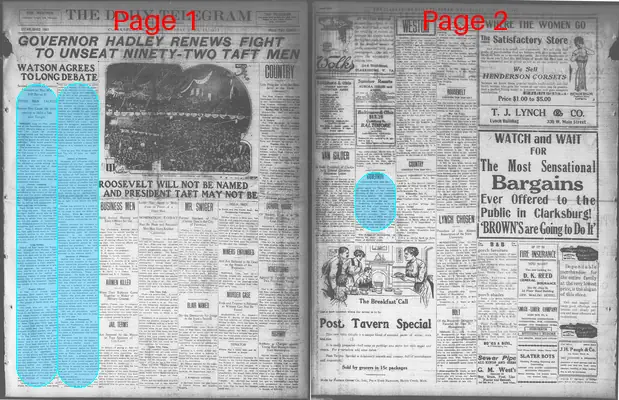
The Daily Telegram
Clarksburg, Harrison County, West Virginia
What is this article about?
On June 19 in Chicago, the Republican national convention's second day featured intense debate over seating contested delegates between Taft and Roosevelt factions. Governor Hadley moved to substitute Roosevelt delegates for 92 Taft-seated ones, leading to prolonged arguments and potential night session. Prayer by Rev. Joseph Stolz opened proceedings.
Merged-components note: Continuation of Republican national convention story across pages based on explicit '(Continued on page two)' and matching content about Governor Hadley debate
Clippings
1 of 2
OCR Quality
Full Text
Predicted by Men Who
Will Bet on It.
THIRD MAN TALKED
Debate May Cause the Convention to Hold a Session Tonight.
CHICAGO, June 19.—The second day of the Republican national convention officially began at 11 o'clock with ten hours of stubborn fighting ahead and the outcome of the contest for the presidential nomination no nearer the eye than it was yesterday. Four major possibilities loomed large in the foreground:
The re-nomination of President Taft, the nomination of Roosevelt, the nomination of a third candidate and the possibility of a second or double convention.
Scores of men could be found in the convention crowds willing and ready to back any one of these propositions with hard cash.
The Taft, Roosevelt and third candidate partisans each claimed the advantage as a result of yesterday's election of Senator Elihu Root as temporary chairman.
Crowds Assembled
Long before the appointed hour for the convention to meet, crowds assembled in the vicinity of the coliseum and the police arrangements were even more elaborate than Tuesday. Officers were everywhere, but fear of rioting had disappeared and there was less nervousness.
Many things were uncertain, but one thing was sure. That was that Governor Hadley would take up the fight for Roosevelt by renewing his motion to strike from the temporary roll the names of ninety-two Taft delegates seated by the national committee and substitute Roosevelt men.
Then it seemed certain that the Taft men would move to refer Hadley's motion to the credentials committee, and of this there would be a roll call of all the delegates individually.
Long Debate.
Hadley, as floor leader for Roosevelt, arranged with Watson, Taft floor leader, for an hour and a half debate by each side on the question, thus carrying the bitter fight into the late afternoon. This it was stated would necessitate a night session.
With interest so intense as to preclude applause, the convention at noon was in the midst of a three-hour argument on the motion of Governor Hadley to purge the temporary roll of ninety-two delegates contested by the Roosevelt faction, but seated by the national committee.
Prayer Offered
It was 11:15 o'clock before Chairman Root rapped for order and the convention was opened with prayer by the Rev. Joseph Stolz.
The prayer of Rabbi Stolz was as follows:
"Oh Lord, who art the loving Father of all mankind, the just Ruler of the nations, the everlasting God whose counsel of righteousness and truth prevaileth over the waves of passion and the tumult of voices, we bless Thee that Thou hast set our nation high among the peoples of the earth and has been our strength in every conflict, our present help in every time of need.
"In Thy bounty Thou hast given us this land flowing with milk and honey; and in Thy gracious providence, Thou hast destined it to become the promised land of liberty and equality, the home of the free, the refuge of the oppressed, the goal of the strong and the aspiring who would share our inheritance of law and order. And we praise Thee for the multitude who have found blessing within our borders; we thank Thee for every beneficent institution established within our domain, for what of justice has become the common law of the land, for our goodly heritage of tolerance and peace.
"And we beseech Thee, Lord of Hosts, be with us, as Thou hast been with our fathers, Help us to prove ourselves worthy of Thy blessings. Make us mindful of our duties as well as our rights, our responsibilities as well as our privileges. Grant us the insight that a people perisheth where there is no vision, and the understanding that a great nation maketh its rulers righteousness and its officers peace. Seeketh leaders who despise the gain of oppression and withhold their hands from bribes. Maketh chief those whose glory is to serve mankind by justice, fidelity and truth. Bestow upon the delegates assembled the spirit of wisdom and understanding, of counsel and might, that they decide in justice and equity and not after the sight of their eyes or the hearing of their ears, and that they guide themselves by the truth that righteousness exalteth a nation and injustice is a reproach to any people.
"And so may Thy Kingdom come and Thy will be done on earth.
Amen."
Hadley is Cheered.
Delegates and alternates and the remainder of the vast assemblage stood up while Divine guidance was invoked.
Chairman Root announced the unfinished business as the motion of Taft leader Watson that the convention proceed to the appointment of committees and the substitute motion of Hadley that the Roosevelt list of delegates be substituted for the temporary roll.
It had been agreed in advance that there should be no parliamentary points of order against the Roosevelt motion, the Taft forces agreeing to fight it out before the delegates.
Hadley was greeted by a round of cheers as he advanced to the front of the stage to open the debate on his motion. When the tumult subsided, Hadley began an explanation of the situation confronting the convention.
Hadley reviewed the incidents of yesterday's session, and read an "indictment" of the national committee uttered Monday night by Colonel Roosevelt in his auditorium speech.
"It may be true that many persons do not agree with us that Theodore Roosevelt should be our candidate for president," he said, "but there can be no difference of opinion that his voice today is the greatest in the western world."
Question of Principle.
Hadley then read a statement from fourteen members of the national committee protesting against the action of the majority in seating many of the delegates, particularly those from California, Texas and Washington.
He made an earnest plea that personalities be left out of the debate, declaring that the question was clearly one of principle. It was not a question of any man's candidacy, he said, but a question of the next campaign, embracing the existence of the Republican party.
Hadley was given the closest attention, and at the close he declared that when the vote on the substitute roll is submitted only votes of those delegates whose seats were not contested be allowed to vote.
"All law, all precedents agree," he said, "that no man shall be judge of his own case."
Committee Denounced.
Hadley was followed by W. T. Dovell of Washington, who argued in favor of Taft.
"The declaration is recklessly false," he said "that the state of Washington was carried by Roosevelt."
The clerk read for the information of the convention the names of the delegates Hadley would have stricken from the roll, and Henry J. Allen, of Kansas, spoke for Roosevelt.
He denounced Dovell's statement as flimsy, and was jeered by the Taft men.
A delegate from the floor amid great confusion demanded to know if Allen would support the nominee of the convention, and after trying to answer he was allowed to say he would if the nomination was not accomplished by fraud and corruption.
He denounced the national committee.
Allen was followed by former Senator Hemenway, of Indiana, who
(Continued on page two.)
GOVERNOR
(Continued from page one.)
argued against the Hadley motion.
He declared that of the fourteen
members of the national committee
protesting against the committee
roll all but two had been retired
from the committee this year.
Hemenway, of Indiana, in the debate
said they might condemn Penrose
but he said Penrose was above
Flinn every time. There was great
confusion. Root interrupted and
said if Flinn wanted to commend his
cause to decent people he must listen
respectfully. Flinn arose amid great
confusion and was immediately
ordered to sit down. He did.
What sub-type of article is it?
What themes does it cover?
What keywords are associated?
What entities or persons were involved?
Where did it happen?
Story Details
Key Persons
Location
Chicago Coliseum
Event Date
June 19
Story Details
The Republican convention debates seating of contested delegates; Hadley moves to replace 92 Taft delegates with Roosevelt ones, sparking hours of argument on principles and fraud claims, opened by prayer invoking justice and righteousness.