Thank you for visiting SNEWPapers!
Sign up free
Story
February 14, 1919
The Herald And News
Newberry, Newberry County, South Carolina
What is this article about?
Poultry experts at New York State College of Agriculture explain how artificial light boosts egg production by mimicking spring's equal day-night lengths, reducing inactivity and improving feed use during long winter nights.
Clipping
OCR Quality
98%
Excellent
Full Text
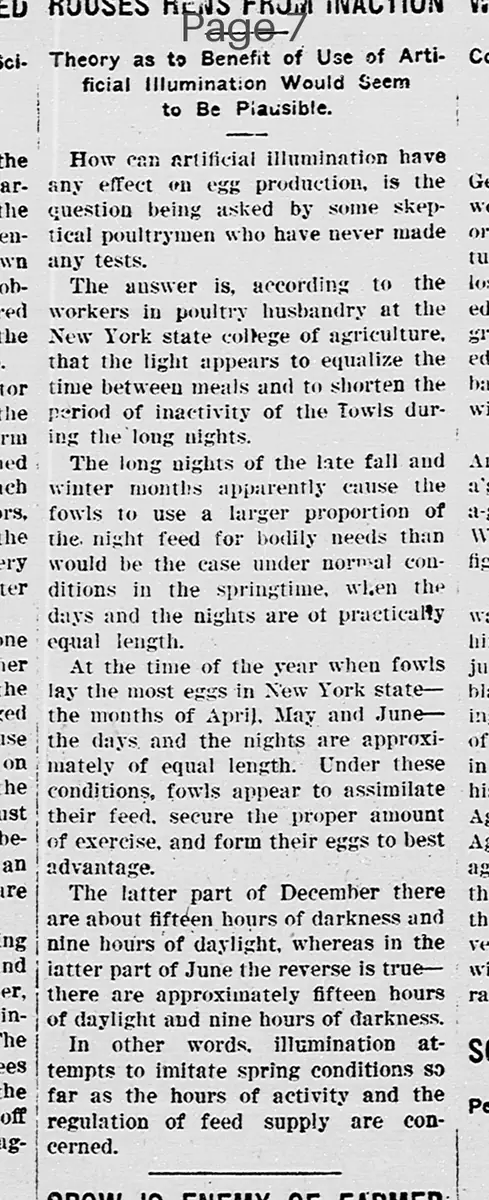
Theory as to Benefit of Use of Artificial Illumination Would Seem to Be Plausible.
How can artificial illumination have any effect on egg production, is the question being asked by some skeptical poultrymen who have never made any tests.
The answer is, according to the workers in poultry husbandry at the New York state college of agriculture, that the light appears to equalize the time between meals and to shorten the period of inactivity of the fowls during the long nights.
The long nights of the late fall and winter months apparently cause the fowls to use a larger proportion of the night feed for bodily needs than would be the case under normal conditions in the springtime, when the days and the nights are of practically equal length.
At the time of the year when fowls lay the most eggs in New York state--the months of April, May and June--the days and the nights are approximately of equal length. Under these conditions, fowls appear to assimilate their feed, secure the proper amount of exercise, and form their eggs to best advantage.
The latter part of December there are about fifteen hours of darkness and nine hours of daylight, whereas in the latter part of June the reverse is true--there are approximately fifteen hours of daylight and nine hours of darkness. In other words, illumination attempts to imitate spring conditions so far as the hours of activity and the regulation of feed supply are concerned.
How can artificial illumination have any effect on egg production, is the question being asked by some skeptical poultrymen who have never made any tests.
The answer is, according to the workers in poultry husbandry at the New York state college of agriculture, that the light appears to equalize the time between meals and to shorten the period of inactivity of the fowls during the long nights.
The long nights of the late fall and winter months apparently cause the fowls to use a larger proportion of the night feed for bodily needs than would be the case under normal conditions in the springtime, when the days and the nights are of practically equal length.
At the time of the year when fowls lay the most eggs in New York state--the months of April, May and June--the days and the nights are approximately of equal length. Under these conditions, fowls appear to assimilate their feed, secure the proper amount of exercise, and form their eggs to best advantage.
The latter part of December there are about fifteen hours of darkness and nine hours of daylight, whereas in the latter part of June the reverse is true--there are approximately fifteen hours of daylight and nine hours of darkness. In other words, illumination attempts to imitate spring conditions so far as the hours of activity and the regulation of feed supply are concerned.
What sub-type of article is it?
Curiosity
What themes does it cover?
Nature
What keywords are associated?
Artificial Illumination
Egg Production
Poultry Husbandry
Winter Nights
Spring Conditions
Where did it happen?
New York State
Story Details
Location
New York State
Story Details
Artificial illumination equalizes meal times and shortens inactivity for fowls during long winter nights, mimicking spring conditions to improve feed assimilation, exercise, and egg production, as explained by New York State College of Agriculture experts.