Thank you for visiting SNEWPapers!
Sign up free
Story
May 28, 1936
Marion Progress
Marion, Mcdowell County, North Carolina
What is this article about?
Sea turtles lay thousands of eggs on warmer American beaches, but natives dig them up for sale, and surviving hatchlings face predation by birds, coyotes, and other animals before reaching the sea.
Clipping
OCR Quality
98%
Excellent
Full Text
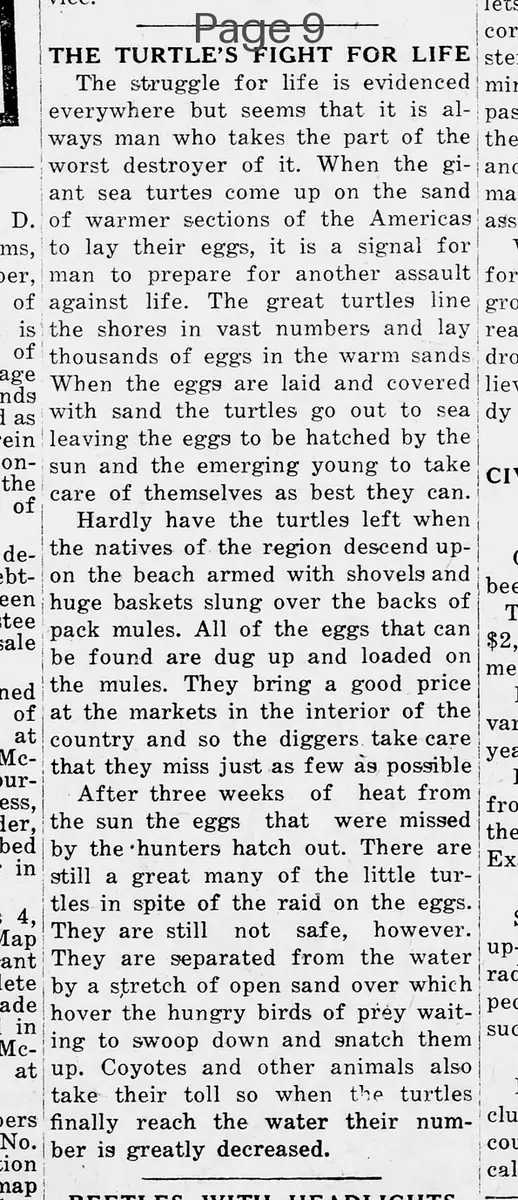
THE TURTLE'S FIGHT FOR LIFE
The struggle for life is evidenced everywhere but seems that it is always man who takes the part of the worst destroyer of it. When the giant sea turtles come up on the sand of warmer sections of the Americas to lay their eggs, it is a signal for man to prepare for another assault against life. The great turtles line the shores in vast numbers and lay thousands of eggs in the warm sands.
When the eggs are laid and covered with sand the turtles go out to sea leaving the eggs to be hatched by the sun and the emerging young to take care of themselves as best they can.
Hardly have the turtles left when the natives of the region descend upon the beach armed with shovels and huge baskets slung over the backs of pack mules. All of the eggs that can be found are dug up and loaded on the mules. They bring a good price at the markets in the interior of the country and so the diggers take care that they miss just as few as possible.
After three weeks of heat from the sun the eggs that were missed by the hunters hatch out. There are still a great many of the little turtles in spite of the raid on the eggs. They are still not safe, however.
They are separated from the water by a stretch of open sand over which hover the hungry birds of prey waiting to swoop down and snatch them up. Coyotes and other animals also take their toll so when the turtles finally reach the water their number is greatly decreased.
The struggle for life is evidenced everywhere but seems that it is always man who takes the part of the worst destroyer of it. When the giant sea turtles come up on the sand of warmer sections of the Americas to lay their eggs, it is a signal for man to prepare for another assault against life. The great turtles line the shores in vast numbers and lay thousands of eggs in the warm sands.
When the eggs are laid and covered with sand the turtles go out to sea leaving the eggs to be hatched by the sun and the emerging young to take care of themselves as best they can.
Hardly have the turtles left when the natives of the region descend upon the beach armed with shovels and huge baskets slung over the backs of pack mules. All of the eggs that can be found are dug up and loaded on the mules. They bring a good price at the markets in the interior of the country and so the diggers take care that they miss just as few as possible.
After three weeks of heat from the sun the eggs that were missed by the hunters hatch out. There are still a great many of the little turtles in spite of the raid on the eggs. They are still not safe, however.
They are separated from the water by a stretch of open sand over which hover the hungry birds of prey waiting to swoop down and snatch them up. Coyotes and other animals also take their toll so when the turtles finally reach the water their number is greatly decreased.
What sub-type of article is it?
Animal Story
Curiosity
Survival
What themes does it cover?
Misfortune
Nature
Survival
What keywords are associated?
Sea Turtles
Egg Harvesting
Hatchling Survival
Wildlife Predation
Human Impact
Where did it happen?
Warmer Sections Of The Americas
Story Details
Location
Warmer Sections Of The Americas
Story Details
Giant sea turtles lay eggs on beaches in warmer Americas; natives dig up and sell most eggs; surviving hatchlings face birds, coyotes, and other predators crossing sand to reach sea, greatly reducing their numbers.