Thank you for visiting SNEWPapers!
Sign up free
Story
June 12, 1885
The Warner Weekly Sun
Warner, Brown County, South Dakota
What is this article about?
Commander Schley's 1884 account details the poignant rescue of Adolphus Greely's starving Arctic expedition survivors, including first contact with Sergeant Long and feeding the emaciated group in their squalid tent near the Proteus wreck site.
Clipping
OCR Quality
98%
Excellent
Full Text
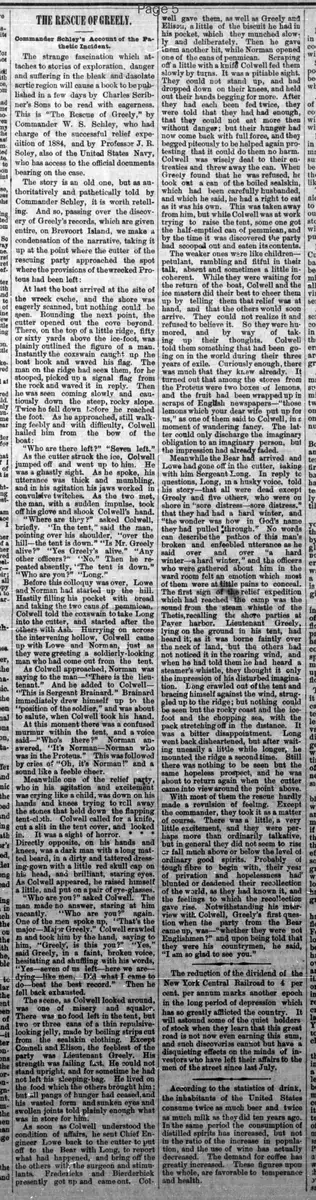
THE RESCUE OF GREELY.
Commander Schley's Account of the Pathetic Incident.
The strange fascination which attaches to stories of exploration, danger and suffering in the bleak and desolate Arctic region will cause a book to be published in a few days by Charles Scribner's Sons to be read with eagerness.
This is "The Rescue of Greely," by Commander W. S. Schley, who had charge of the successful relief expedition of 1884, and by Professor J. R. Soley, also of the United States Navy, who has access to the official documents bearing on the case.
The story is an old one, but as authoritatively and pathetically told by Commander Schley, it is worth retelling. And so, passing over the discovery of Greely's records, which are given entire, on Brevoort Island, we make a condensation of the narrative, taking it up at the point where the cutter of the rescuing party approached the spot where the provisions of the wrecked Proteus had been left:
At last the boat arrived at the site of the wreck cache, and the shore was eagerly scanned, but nothing could be seen. Rounding the next point, the cutter opened out the cove beyond.
There, on the top of a little ridge, fifty or sixty yards above the ice-foot, was plainly outlined the figure of a man.
Instantly the coxswain caught up the boat hook and waved his flag. The man on the ridge had seen them, for he stooped, picked up a signal flag from the rock and waved it in reply. Then he was seen coming slowly and cautiously down the steep, rocky slope.
Twice he fell down before he reached the foot. As he approached, still walking feebly and with difficulty, Colwell hailed him from the bow of the boat:
"Who are there left?" "Seven left."
As the cutter struck the ice, Colwell jumped off and went up to him. He was a ghastly sight. As he spoke, his utterance was thick and mumbling, and in his agitation his jaws worked in convulsive twitches. As the two met, the man, with a sudden impulse, took off his glove and shook Colwell's hand.
"Where are they?" asked Colwell, briefly. "In the tent," said the man, pointing over his shoulder, "over the hill—the tent is down." "Is Mr. Greely alive?" "Yes, Greely's alive." "Any other officers?" "No." Then he repeated absently, 'The tent is down.' "Who are you?" "Long."
Before this colloquy was over, Lowe and Norman had started up the hill. Hastily filling his pocket with bread and taking the two cans of pemmican, Colwell told the coxswain to take Long into the cutter, and started after the others with Ash. Hurrying on across the intervening hollow, Colwell came up with Lowe and Norman, just as they were greeting a soldierly-looking man who had come out from the tent.
As Colwell approached, Norman was saying to the man—"There is the lieutenant." And he added to Colwell— "This is Sergeant Brainard." Brainard immediately drew himself up to the "position of the soldier," and was about to salute, when Colwell took his hand.
At this moment there was a confused murmur within the tent, and a voice said "Who's there?" Norman answered, "It's Norman—Norman who was in the Proteus." This was followed by cries of "Oh, it's Norman!" and a sound like a feeble cheer.
Meanwhile one of the relief party, who in his agitation and excitement was crying like a child, was down on his hands and knees trying to roll away the stones that held down the flapping tent-cloth. Colwell called for a knife, cut a slit in the tent cover, and looked in. It was a sight of horror.
Directly opposite, on his hands and knees, was a dark man with a long matted beard, in a dirty and tattered dressing-gown with a little red skull cap on his head, and brilliant, staring eyes.
As Colwell appeared, he raised himself a little, and put on a pair of eye-glasses.
"Who are you?" asked Colwell. The man made no answer, staring at him vacantly.
"Who are you?" again.
One of the men spoke up, "That's the major—Major Greely." Colwell crawled in and took him by the hand, saying to him, "Greely, is this you?" "Yes," said Greely, in a faint, broken voice, hesitating and shuffling with his words. "Yes—seven of us left—here we are—dying like men. Did what I came to do—beat the best record." Then he fell back exhausted.
The scene, as Colwell looked around, was one of misery and squalor. There was no food left in the tent, but two or three cans of a thin repulsive-looking jelly, made by boiling strips cut from the sealskin clothing. Except Connell and Elison, the feeblest of the party was Lieutenant Greely. His strength was failing fast. He could not stand upright, and for some time he had not left his sleeping-bag. He lived on the food which the others brought him; but all pangs of hunger had ceased, and his wasted form and sunken eyes and swollen joints told plainly enough what was in store for him.
As soon as Colwell understood the condition of affairs, he sent Chief Engineer Lowe back to the cutter to put off to the Bear with Long, to report what had happened, and bring off the others with the surgeon and stimulants. Fredericks and Benderbick presently got up and came out. Colwell gave them, as well as Greely and Elison, a little of the biscuit he had in his pocket, which they munched slowly and deliberately. Then he gave them another bit, while Norman opened one of the cans of pemmican. Scraping off a little with a knife Colwell fed them slowly by turns. It was a pitiable sight.
They could not stand up, and had dropped down on their knees, and held out their hands begging for more. After they had each been fed twice, they were told that they had had enough, that they could not eat more then without danger: but their hunger had now come back with full force, and they begged piteously to be helped again protesting that it could do them no harm.
Colwell was wisely deaf to their entreaties and threw away the can. When Greely found that he was refused, he took out a can of the boiled sealskin, which had been carefully husbanded, and which he said, he had a right to eat as it was his own. This was taken away from him, but while Colwell was at work trying to raise the tent, some one got the half-emptied can of pemmican, and by the time it was discovered the party had scooped out and eaten its contents.
The weaker ones were like children—petulant, rambling and fitful in their talk, absent and sometimes a little incoherent. While they were waiting for the return of the boat, Colwell and the ice masters did their best to cheer them up by telling them that relief was at hand, and that the others would soon arrive. They could not realize it and refused to believe it. So they were humored, and by way of taking up their thoughts. Colwell told them something that had been going on in the world during their three years of exile. Curiously enough, there was much that they knew already. It turned out that among the stores from the Proteus were two boxes of lemons, and the fruit had been wrapped up in scraps of English newspapers—"those lemons which your dear wife put up for us," as one of them said to Colwell, in a moment of wandering fancy. The latter could only discharge the imaginary obligation to an imaginary person, but the impression had already faded.
Meanwhile the Bear had arrived and Lowe had gone off in the cutter, taking with him Sergeant Long. In reply to questions, Long, in a husky voice, told his story—that all were dead except Greely and five others, who were on shore in "sore distress—sore distress." that they had had a hard winter, and "the wonder was how in God's name they had pulled through." No words can describe the pathos of this man's broken and enfeebled utterance as he said over and over "a hard winter—a hard winter," and the officers who were gathered about him in the ward room felt an emotion which most of them were at little pains to conceal.
The first sign of the relief expedition which had reached the camp was the sound from the steam whistle of the Thetis, recalling the shore parties at Payer harbor. Lieutenant Greely, lying on the ground in his tent, had heard it; as it was borne faintly over the neck of land, but the others had not noticed it in the roaring wind, and when he had told them he had heard a steamer's whistle, they thought it only the impression of his disturbed imagination. Long crawled out of the tent and bracing himself against the wind, struggled up to the ridge; but nothing could be seen but the rocky coast and the ice-foot and the chopping sea, with the pack stretching off in the distance. It was a bitter disappointment. Long went back disheartened, but after waiting uneasily a little while longer, he mounted the ridge a second time. Still there was nothing to be seen but the same hopeless prospect, and he was about to return again when the cutter came into view around the point above.
With most of them the rescue hardly made a revulsion of feeling. Except the commander, they took it as a matter of course. There was a little, a very little excitement, and they were perhaps more than ordinarily talkative, but in general they did not seem to rise or fall much above or below the level of ordinary good spirits. Probably of tough fibre to begin with, their year of privation and hopelessness had blunted or deadened their recollection of the world, as they had known it, and the feelings to which the recollection gave rise. Notwithstanding his interview with Colwell, Greely's first question when the party from the Bear came up, was—"whether they were not Englishmen?" and upon being told that they were his countrymen, he said, "I am so glad to see you."
Commander Schley's Account of the Pathetic Incident.
The strange fascination which attaches to stories of exploration, danger and suffering in the bleak and desolate Arctic region will cause a book to be published in a few days by Charles Scribner's Sons to be read with eagerness.
This is "The Rescue of Greely," by Commander W. S. Schley, who had charge of the successful relief expedition of 1884, and by Professor J. R. Soley, also of the United States Navy, who has access to the official documents bearing on the case.
The story is an old one, but as authoritatively and pathetically told by Commander Schley, it is worth retelling. And so, passing over the discovery of Greely's records, which are given entire, on Brevoort Island, we make a condensation of the narrative, taking it up at the point where the cutter of the rescuing party approached the spot where the provisions of the wrecked Proteus had been left:
At last the boat arrived at the site of the wreck cache, and the shore was eagerly scanned, but nothing could be seen. Rounding the next point, the cutter opened out the cove beyond.
There, on the top of a little ridge, fifty or sixty yards above the ice-foot, was plainly outlined the figure of a man.
Instantly the coxswain caught up the boat hook and waved his flag. The man on the ridge had seen them, for he stooped, picked up a signal flag from the rock and waved it in reply. Then he was seen coming slowly and cautiously down the steep, rocky slope.
Twice he fell down before he reached the foot. As he approached, still walking feebly and with difficulty, Colwell hailed him from the bow of the boat:
"Who are there left?" "Seven left."
As the cutter struck the ice, Colwell jumped off and went up to him. He was a ghastly sight. As he spoke, his utterance was thick and mumbling, and in his agitation his jaws worked in convulsive twitches. As the two met, the man, with a sudden impulse, took off his glove and shook Colwell's hand.
"Where are they?" asked Colwell, briefly. "In the tent," said the man, pointing over his shoulder, "over the hill—the tent is down." "Is Mr. Greely alive?" "Yes, Greely's alive." "Any other officers?" "No." Then he repeated absently, 'The tent is down.' "Who are you?" "Long."
Before this colloquy was over, Lowe and Norman had started up the hill. Hastily filling his pocket with bread and taking the two cans of pemmican, Colwell told the coxswain to take Long into the cutter, and started after the others with Ash. Hurrying on across the intervening hollow, Colwell came up with Lowe and Norman, just as they were greeting a soldierly-looking man who had come out from the tent.
As Colwell approached, Norman was saying to the man—"There is the lieutenant." And he added to Colwell— "This is Sergeant Brainard." Brainard immediately drew himself up to the "position of the soldier," and was about to salute, when Colwell took his hand.
At this moment there was a confused murmur within the tent, and a voice said "Who's there?" Norman answered, "It's Norman—Norman who was in the Proteus." This was followed by cries of "Oh, it's Norman!" and a sound like a feeble cheer.
Meanwhile one of the relief party, who in his agitation and excitement was crying like a child, was down on his hands and knees trying to roll away the stones that held down the flapping tent-cloth. Colwell called for a knife, cut a slit in the tent cover, and looked in. It was a sight of horror.
Directly opposite, on his hands and knees, was a dark man with a long matted beard, in a dirty and tattered dressing-gown with a little red skull cap on his head, and brilliant, staring eyes.
As Colwell appeared, he raised himself a little, and put on a pair of eye-glasses.
"Who are you?" asked Colwell. The man made no answer, staring at him vacantly.
"Who are you?" again.
One of the men spoke up, "That's the major—Major Greely." Colwell crawled in and took him by the hand, saying to him, "Greely, is this you?" "Yes," said Greely, in a faint, broken voice, hesitating and shuffling with his words. "Yes—seven of us left—here we are—dying like men. Did what I came to do—beat the best record." Then he fell back exhausted.
The scene, as Colwell looked around, was one of misery and squalor. There was no food left in the tent, but two or three cans of a thin repulsive-looking jelly, made by boiling strips cut from the sealskin clothing. Except Connell and Elison, the feeblest of the party was Lieutenant Greely. His strength was failing fast. He could not stand upright, and for some time he had not left his sleeping-bag. He lived on the food which the others brought him; but all pangs of hunger had ceased, and his wasted form and sunken eyes and swollen joints told plainly enough what was in store for him.
As soon as Colwell understood the condition of affairs, he sent Chief Engineer Lowe back to the cutter to put off to the Bear with Long, to report what had happened, and bring off the others with the surgeon and stimulants. Fredericks and Benderbick presently got up and came out. Colwell gave them, as well as Greely and Elison, a little of the biscuit he had in his pocket, which they munched slowly and deliberately. Then he gave them another bit, while Norman opened one of the cans of pemmican. Scraping off a little with a knife Colwell fed them slowly by turns. It was a pitiable sight.
They could not stand up, and had dropped down on their knees, and held out their hands begging for more. After they had each been fed twice, they were told that they had had enough, that they could not eat more then without danger: but their hunger had now come back with full force, and they begged piteously to be helped again protesting that it could do them no harm.
Colwell was wisely deaf to their entreaties and threw away the can. When Greely found that he was refused, he took out a can of the boiled sealskin, which had been carefully husbanded, and which he said, he had a right to eat as it was his own. This was taken away from him, but while Colwell was at work trying to raise the tent, some one got the half-emptied can of pemmican, and by the time it was discovered the party had scooped out and eaten its contents.
The weaker ones were like children—petulant, rambling and fitful in their talk, absent and sometimes a little incoherent. While they were waiting for the return of the boat, Colwell and the ice masters did their best to cheer them up by telling them that relief was at hand, and that the others would soon arrive. They could not realize it and refused to believe it. So they were humored, and by way of taking up their thoughts. Colwell told them something that had been going on in the world during their three years of exile. Curiously enough, there was much that they knew already. It turned out that among the stores from the Proteus were two boxes of lemons, and the fruit had been wrapped up in scraps of English newspapers—"those lemons which your dear wife put up for us," as one of them said to Colwell, in a moment of wandering fancy. The latter could only discharge the imaginary obligation to an imaginary person, but the impression had already faded.
Meanwhile the Bear had arrived and Lowe had gone off in the cutter, taking with him Sergeant Long. In reply to questions, Long, in a husky voice, told his story—that all were dead except Greely and five others, who were on shore in "sore distress—sore distress." that they had had a hard winter, and "the wonder was how in God's name they had pulled through." No words can describe the pathos of this man's broken and enfeebled utterance as he said over and over "a hard winter—a hard winter," and the officers who were gathered about him in the ward room felt an emotion which most of them were at little pains to conceal.
The first sign of the relief expedition which had reached the camp was the sound from the steam whistle of the Thetis, recalling the shore parties at Payer harbor. Lieutenant Greely, lying on the ground in his tent, had heard it; as it was borne faintly over the neck of land, but the others had not noticed it in the roaring wind, and when he had told them he had heard a steamer's whistle, they thought it only the impression of his disturbed imagination. Long crawled out of the tent and bracing himself against the wind, struggled up to the ridge; but nothing could be seen but the rocky coast and the ice-foot and the chopping sea, with the pack stretching off in the distance. It was a bitter disappointment. Long went back disheartened, but after waiting uneasily a little while longer, he mounted the ridge a second time. Still there was nothing to be seen but the same hopeless prospect, and he was about to return again when the cutter came into view around the point above.
With most of them the rescue hardly made a revulsion of feeling. Except the commander, they took it as a matter of course. There was a little, a very little excitement, and they were perhaps more than ordinarily talkative, but in general they did not seem to rise or fall much above or below the level of ordinary good spirits. Probably of tough fibre to begin with, their year of privation and hopelessness had blunted or deadened their recollection of the world, as they had known it, and the feelings to which the recollection gave rise. Notwithstanding his interview with Colwell, Greely's first question when the party from the Bear came up, was—"whether they were not Englishmen?" and upon being told that they were his countrymen, he said, "I am so glad to see you."
What sub-type of article is it?
Historical Event
Survival
Heroic Act
What themes does it cover?
Bravery Heroism
Survival
Triumph
What keywords are associated?
Greely Rescue
Arctic Survival
Expedition Relief
Starvation
Historical Rescue
What entities or persons were involved?
Greely
Schley
Colwell
Long
Brainard
Norman
Lowe
Where did it happen?
Arctic Region
Story Details
Key Persons
Greely
Schley
Colwell
Long
Brainard
Norman
Lowe
Location
Arctic Region
Event Date
1884
Story Details
The relief expedition led by Commander Schley discovers the last seven survivors of Greely's Arctic expedition in a state of starvation and exhaustion near the site of the wrecked Proteus. They make first contact with Sergeant Long, enter the squalid tent, feed the emaciated men including Greely, and transport them to safety aboard the Bear.