Thank you for visiting SNEWPapers!
Sign up free
New York Tribune
New York, New York County, New York
What is this article about?
James Ritchie, a former insurance agent turned junk-shop keeper, was tried in New York for receiving 20,520 pounds of stolen coffee from Wm. Merle's Front Street store in 1840-41. Accomplices Thomas Ritchie, George Rankin, and George Griffin confessed to the thefts at his behest. Ritchie was found guilty; additional charges pending.
Clipping
OCR Quality
Full Text
Judges Lynch and Noah, and Aldermen Lee and Pollock,
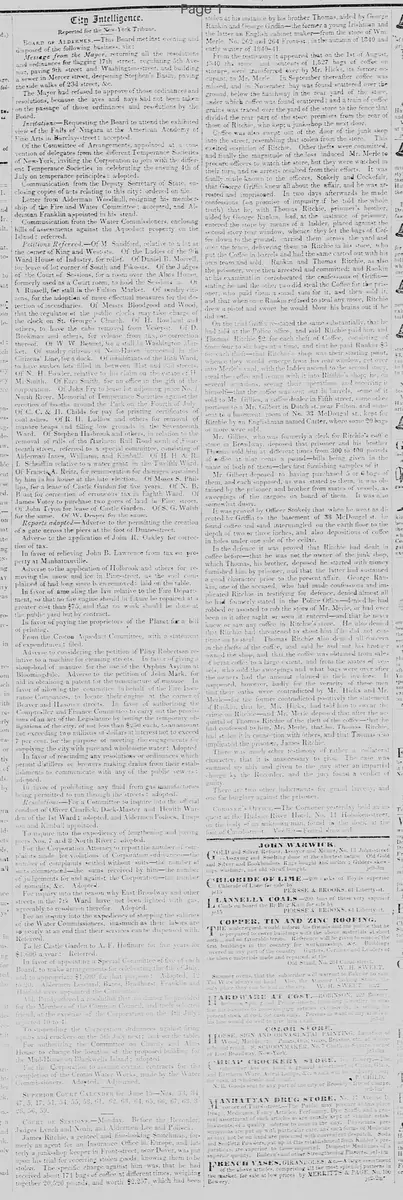
James Ritchie, a genteel and fine-looking Scotchman, formerly an agent for an Insurance Office in Europe, and latterly a junk-shop keeper in Front-street, near Dover, was put upon his trial for receiving stolen goods, knowing them to be stolen. The specific charge against him was, that he had received about 171 bags of coffee at different times, weighing together 20,520 pounds, and worth $2,257, which had been stolen at his instance by his brother Thomas, aided by George Rankin and George Griffin--the former a young Irishman and the latter an English cabinet maker--from the store of Wm. Merle, Nos. 262 and 264 Front-st., in the autumn of 1840 and early winter of 1840-41.
From the testimony it appeared that on the 1st of August, 1840, the store, and contents of 1,827 bags of coffee on storage, were transferred over by Mr. Hicks, its former occupant, to Mr. Merle. In September thereafter coffee was missed, and in November hay was found scattered over the ground, below the hatchway in the rear yard of the store, under which coffee was found scattered; and a train of coffee grains was traced over the yard of the store to the fence that divided the rear part of the store premises from the rear of those of Ritchie, who kept a junk-shop the next door.
Coffee was also swept out of the door of the junk shop into the street, resembling that stolen from the store. This excited suspicion of Ritchie. Other thefts were committed, and finally the magnitude of the loss induced Mr. Merle to procure officers to watch the store, but they were watched in their turn, and no arrests resulted from their efforts. It was finally made known to the officers, Stokely and Cockefair, that George Griffin knew all about the affair, and he was arrested and imprisoned. In two days afterwards he made confessions (on promise of impunity if he told the whole truth) that he, with Thomas Ritchie, prisoner's brother, aided by George Rankin, had, at the instance of prisoner, entered the store by means of a ladder, placed against the second story rear window, whence they let the bags of Coffee down to the ground, carried them across the yard and over the fence, delivering them to Ritchie in his store, who put the Coffee in barrels and had the same carted out with his own team and sold. Rankin and Thomas Ritchie, as also the prisoner, were then arrested and committed: and Rankin at his examination corroborated the confessions of Griffin--stating he and the other two did steal the Coffee for the prisoner, who paid them a small sum for it, and then sold it, and that when once Rankin refused to steal any more, Ritchie drew a pistol and swore he would blow his brains out if he did not.
On the trial Griffin re-stated the same substantially, that he had told at the Police office, and said Ritchie paid him, and Thomas Ritchie $5 for each theft of Coffee, consisting of from four to six bags at a time, and that he paid Rankin $6 for each theft--that Ritchie's shop was their starting point, whence they would emerge from his rear window, get over into Merle's yard, with the ladder ascend to the second story, steal the coffee and return with it into Ritchie's shop; he, on several occasions, seeing their operations and receiving it himself--that the coffee was sent out in barrels, some of it sold to Mr. Gillies, a coffee dealer in Fifth street, some other portions to a Mr. Gilbert in Dutch st. near Fulton, and some sent to a basement room of No. 38 McDougal st., kept for Ritchie by an Englishman named Carter, where some 20 bags or more were sold.
Mr. Gillies, who was formerly a clerk for Ritchie's coffee store in Broadway, deposed that prisoner and his brother Thomas sold him at different times from 300 to 400 pounds of coffee at nine cents a pound--bills being given in the name of both of them--they first furnishing samples of it.
Mr. Gilbert deposed to having purchased 5 or 6 bags of them, and each supposed, as was stated to them, it was obtained by the prisoner and brother from mates of vessels, as sweepings of the cargoes on board of them. It was also somewhat dusty.
It was proved by Officer Stokely that when he went as directed by Griffin to the basement of 38 McDougal st. he found coffee and sand intermingled on the earth floor to the depth of two or three inches, and also depositions of coffee in holes under one side of the cellar.
In the defence it was proved that Ritchie had dealt in coffee before--that he was not the owner of the junk shop, which Thomas, his brother, deposed he started with money furnished him by prisoner, and that the latter had sustained a good character prior to the present affair. George Rankin, one of the accused, who had made confessions and implicated Ritchie in testifying for defence, denied almost all he had formerly stated in the Police Office--denied he had robbed or assisted to rob the store of Mr. Merle, or had ever been in it after night or seen it entered--and that he never knew or saw any coffee in Ritchie's store. He also denied that Ritchie had threatened to shoot him if he did not continue on to steal. Thomas Ritchie also denied all concern in the thefts of the coffee, and said he and not his brother owned the shop, and that the coffee was obtained from sale, of burnt coffee to a large extent, and from the mates of vessels, who sold the sweepings and what bags were over after the owners had the amount claimed in their invoices. It happened, however, badly for the veracity of those men that their oaths were contradicted by Mr. Hicks and Mr. Merle--for the former contradicted positively the statement of Rankin, that he, Mr. Hicks, had told him to swear the crime on Ritchie--and Mr. Merle deposed that after the acquittal of Thomas Ritchie of the theft of the coffee--that he had confessed to him, Mr. Merle, that he, Thomas Ritchie, had stolen it in connection with others, and that Thomas also implicated the prisoner, James Ritchie.
There was much other testimony of rather a collateral character, that it is unnecessary to give. The case was summed up ably and given to the jury after an impartial charge by the Recorder, and the jury found a verdict of guilty.
There are two other indictments for grand larceny, and one for burglary against the prisoner.
What sub-type of article is it?
What themes does it cover?
What keywords are associated?
What entities or persons were involved?
Where did it happen?
Story Details
Key Persons
Location
Front Street, New York
Event Date
Autumn Of 1840 And Early Winter Of 1840 41
Story Details
James Ritchie was tried for receiving 171 bags of stolen coffee (20,520 pounds worth $2,257) from Wm. Merle's store, stolen by his brother Thomas Ritchie, George Rankin, and George Griffin at his instigation using a ladder to access the second-story window. Accomplices confessed, detailing payments and sales to dealers like Gillies and Gilbert. Defense denied involvement, claiming legitimate sources, but contradicted by witnesses. Jury found Ritchie guilty; additional charges pending.