Thank you for visiting SNEWPapers!
Sign up free
Constitutional Whig
Richmond, Virginia
What is this article about?
In 1827, Georgia Gov. Troup defies U.S. enforcement of a recent Indian treaty, favoring an earlier one; he mobilizes militia, resists federal actions, and accuses the government of allying with Native Americans, risking civil conflict.
Clipping
OCR Quality
Full Text
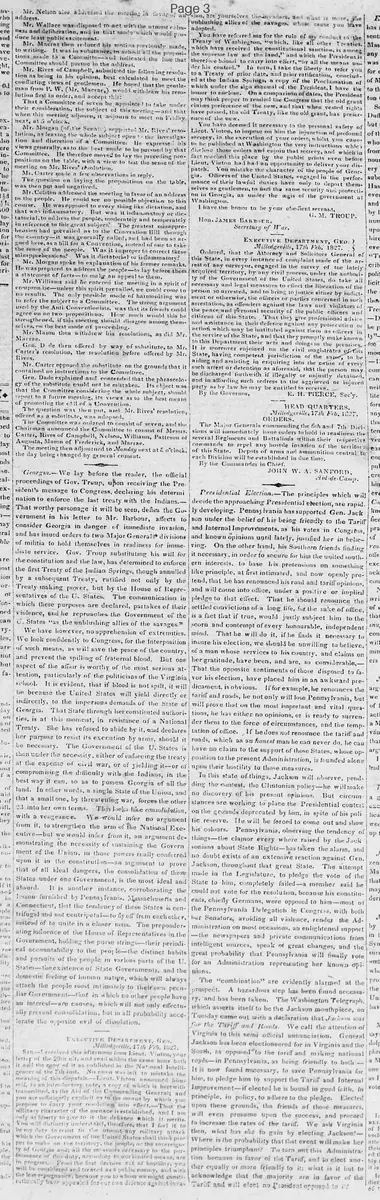
We have however, no apprehension of extremities. We look confidently to Congress, for the interposition of such means, as will save the peace of the country, and prevent the spilling of fraternal blood. But one aspect of the affair is worthy of the most serious attention, particularly of the politicians of the Virginia school. It is evident, that if blood is not spilt, it will be because the United States will yield directly or indirectly, to the imperious demands of the State of Georgia. That State through her constituted authorities, is at this moment, in resistance of a National Treaty. She has refused to abide by it, and declares her purpose to resist its execution by arms, should it be necessary. The Government of the U. States is then under the necessity, either of enforcing the treaty at the expense of civil war, or of yielding it—or of compromising the difficulty with the Indians, in the best way it can, so as to possess Georgia of all the land. In other words, a single State of the Union, and that a small one, by threatening war, forces the other 23 into her own terms. This looks like consolidation, with a vengeance. We would infer no argument from it, to strengthen the arm of the National Executive—but we would infer from it, an argument demonstrating the necessity of sustaining the Government of the Union, in those powers really conferred upon it in the constitution—an argument to prove that of all ideal dangers, the consolidation of these States under one Government, is the most ideal and absurd. It is another instance, corroborating the lesson furnished by Pennsylvania, Massachusetts and Connecticut, that the tendency of these States is centrifugal and not centripetal—to fly off from each other, instead of to unite in a closer mass. The preponderating influence of the House of Representatives in the Government, holding the purse strings—their periodical accountability to the people—the distinct habits and pursuits of the people in various parts of the U. States—the existence of State Governments, and the domestic feeling of human nature, which will always attach the people most intimately to their own peculiar Government—that in which no other people have an interest—are causes, which will not only effectually prevent consolidation, but in all probability accelerate the opposite evil of dissolution.
EXECUTIVE DEPARTMENT, GEO.
Milledgeville, 17th Feb. 1827.
Sir—I received this afternoon from Lieut. Vinton, your letter of the 20th ult. and read within the same hour both it and the copy of it as published in the National Intelligencer of the 7th inst. No room was left to mistake the meaning of this dispatch.—Lieut. Vinton announced himself, in an introductory note, a copy of which is herewith transmitted, as the Aid of the Commanding General; and you are sufficiently explicit as to the means by which you propose to carry your resolution into effect.—Thus the military character of the menace is established, and I am only at liberty to give to it the defiance which it merits. You will distinctly understand, therefore, that I feel it to be my duty to resist to the utmost any military attack which the Government of the United States shall think proper to make on the territory, the people, or the sovereignty of Georgia and; all the measures necessary to the performance of this duty, according to our limited means, are in progress. From the first decisive act of hostility, you will be considered and treated as a public enemy, and with the less repugnance, because you to whom we might constitutionally have appealed for our own defence against invasion, are yourselves the invaders, and what is more, the unblushing allies of the savages, whose cause you have adopted.
You have referred me for the rule of my conduct to the Treaty of Washington, "which, like all other Treaties which have received the constitutional sanction, is among the supreme laws of the land," and which the President is therefore bound to carry into effect, "by all the means under his control." In turn, I take the liberty to refer you to a Treaty of prior date, and prior ratification, concluded at the Indian Springs, a copy of the Proclamation of which under the sign manual of the President, I have the honor to enclose. On a comparison of dates, the President may think proper to remind the Congress that the old grant claims preference of the new, and that when vested rights have passed, the old Treaty, like the old grant, has preference of the new.
You have deemed it necessary to the personal safety of Lieut. Vinton, to impose on him the injunction of profound secrecy, in the execution of your orders, whilst you cause to be published at Washington the very instructions which disclose those orders and enjoin that secrecy, and which in fact reached this place by the public prints even before Lieut. Vinton had had an opportunity to deliver your dispatch. You mistake the character of the people of Georgia. Officers of the United States, engaged in the performance of their lawful duties have only to deport themselves as gentlemen, to find the same security and protection in Georgia, as under the wings of the government at Washington.
I have the honor to be your obedient servant,
G. M. TROUP.
Hon. JAMES BARBOUR,
Secretary of War.
EXECUTIVE DEPARTMENT, GEO.?
Milledgeville, 17th Feb. 1827. .S
Ordered, that the Attorney and Solicitors General of this State, in every instance of complaint made of the arrest of any surveyor, engaged in the survey of the lately acquired territory, by any civil process, under the authority of the Government of the United States, do take all necessary and legal measures to effect the liberation of the person so arrested, and to bring to justice either by indictment or otherwise, the officers or parties concerned in such arrestation, as offenders against the laws and violators of the peace and personal security of the public officers and citizens of this State. That they give professional advice and assistance in their defence against any prosecution or action which may be instituted against them as officers in the service of the State, and that they promptly make known to this Department their acts and doings in the premises. It is moreover enjoined on the civil magistrates of this State, having competent jurisdiction of the same, to be aiding and assisting in enquiring into the cause of every such arrest or detention as aforesaid, that the person may be discharged forthwith if illegally or unjustly detained. and in affording such redress to the aggrieved or injured party as by law he may be entitled to receive.
By the Governor,
E. H. PIERCE, Sec'y.
HEAD QUARTERS.
Milledgeville, 17th Feb. 1827.
ORDERS.
The Major Generals commanding the 6th and 8th Divisions will immediately issue orders to hold in readiness the several Regiments and Battalions within their respective commands to repel any hostile invasion of the territory of this State. Depots of arms and ammunition central to each Division will be established in due time.
By the Commander in Chief.
JOHN W. A. SANFORD,
Aid-de-Camp.
What sub-type of article is it?
What keywords are associated?
What entities or persons were involved?
Where did it happen?
Domestic News Details
Primary Location
Georgia
Event Date
17th Feb. 1827
Key Persons
Outcome
no immediate casualties; orders issued to resist federal enforcement of treaty, prepare militia, and protect state surveyors from federal arrests.
Event Details
Governor Troup defies the U.S. Government by insisting on the prior Indian Springs Treaty over the later Washington Treaty, declares resistance to federal military enforcement, accuses the federal government of allying with savages, and issues orders to mobilize militia divisions, protect state surveyors, and prosecute federal interferers.