Thank you for visiting SNEWPapers!
Sign up free
The National Intelligencer And Washington Advertiser
Washington, District Of Columbia
What is this article about?
U.S. House of Representatives debate on February 27-28, 1807, over repealing the salt duty due to its oppressive impact, while linking it to continuing the Mediterranean fund. Includes speeches by Burwell, Lyon, J. Randolph, votes (Yeas 60-Nays 40 on inquiry, etc.), quorum issues, and bill referral.
Clipping
OCR Quality
Full Text
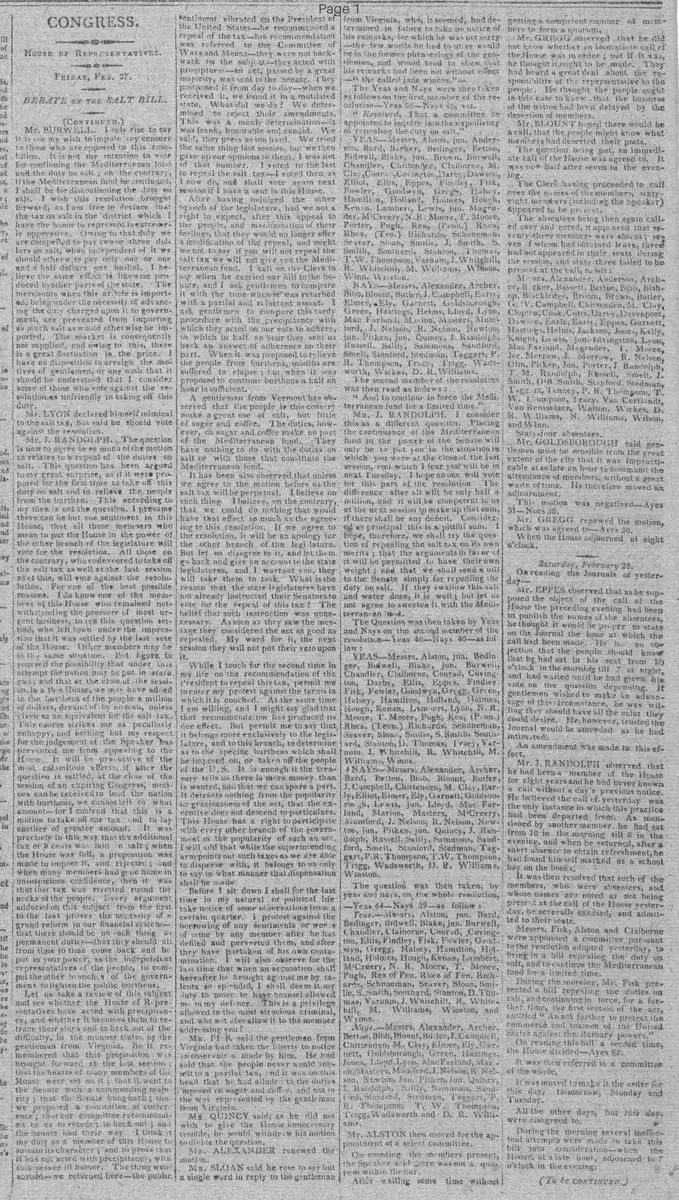
HOUSE OF REPRESENTATIVES.
FRIDAY, FEB. 27.
DEBATE ON THE SALT BILL.
(CONTINUED.)
Mr. BURWELL. I only rise to say it is not my wish to impute any censure to those who are opposed to this resolution. It is not my intention to vote for continuing the Mediterranean fund and the duty on salt ; on the contrary, if the Mediterranean fund be continued, I shall be for discontinuing the duty on salt. I wish this resolution brought forward, as I am free to declare that the tax on salt in the district which I have the honor to represent is extremely oppressive. Owing to that duty we are compelled to pay two or three dollars on salt, when independent of it we should otherwise pay only one or one and a half dollars per bushel. I believe the same effect is likewise produced in other parts of the state. The merchants when this article is imported, being under the necessity of advancing the duty charged upon it to government, are prevented from importing as much salt as would otherwise be imported. The market is consequently not supplied, and owing to this, there is a great fluctuation in the price. I have no disposition to arraign the motives of gentlemen. or any wish that it should be understood that I consider some of those who vote against the resolution as unfriendly to taking off this duty.
Mr. LYON declared himself inimical to the salt tax, but said he should vote against the resolution.
Mr. J. RANDOLPH.. The question is now to agree to so much of the motion as relates to a repeal of the duties on salt. This question has been argued to my great surprise, as if it were proposed for the first time to take off this duty on salt and to relieve the people from the burthen. This according to my idea is not the question. I presume there can be but one sentiment in this House, that all those members who mean to put the House in the power of the other branch of the legislature will vote for the resolution. All those on the contrary, who endeavored to take off the salt tax as well at the last session as at this, will vote against the resolution. For one of the best possible reasons.. I do know one of the members of this House who remained notwithstanding the pressure of most urgent business, to see this question settled, who left town under the impression that it was settled by the last vote of the House. Other members may be in the same situation. Hot figure to yourself the possibility that under this attempt the nation may be put in statu quo; and that at the close of the session, in a thin House, we may have added to the burthens of the people a million of dollars, dreamt of by no man, unless given as an equivalent for the salt tax. This course strikes me as peculiarly unhappy, and nothing but my respect for the judgement of the Speaker has prevented me from appealing to the House. It will be productive of the most calamitous effects, if after the question is settled, at the close of the session of an expiring Congress, motions can be received to load the nation with burthens, we cannot tell to what amount-for I contend that this is a motion to take off one tax and to lay another of greater amount, It was precisely in this way that the additional tax of 8 cents was laid on salt; when the House was full, a proposition was made to impose it, and rejected; and when many members had gone home in unsuspicious confidence, then it was that this tax was rivetted round the necks of the people. Every argument adduced on this subject from the first to the last proves the necessity of a grand reform in our financial system- that there should be no such thing as permanent duties--that they should all from time to time come back and be put in your power, as the independent representatives of the people, to compel the other branches of the government to lighten the public burthens.
Let us take a review of this subject and see whether the House of Representatives have acted with precipitancy, and whether it becomes them to retrace their steps and to back out of the difficulty, in the manner stated, by the gentleman from Virginia. Be it remembered that this proposition was brought forward. at the last session ; that the hearts of many members of the House were set on it : that it went to the Senate with a commanding majority ; that the Senate hung back; that we proposed a committee of conference ; that our committee recommended to us to recede; to back out ; and the Senate had their way I think it my duty as a member of this House to sustain its character ; and to prove that it has not acted with precipitancy, with sulkiness or ill humor. The thing went abroad--we returned here-the public sentiment vibrated on the President of the United States-he recommended a repeal of the tax—his recommendation was referred to the Committee of Ways and Means-they were not backward on the subject-they acted with promptness-an act, passed by a great majority, was sent to the Senate. They postponed it from day to day--when we received it, we found it in a mutilated state. What did we do? We determined to reject their amendments. This was a manly determination-it was frank, honorable and candid. We said, they press us too hard. We tried the same thing last session, but we then gave up our opinions to them. I was not of that number. I voted to the last to repeal the salt tax--I voted then as I now do. and shall vote again next session if I have a seat in this House.
After having indulged the other branch of the legislature, had we not a right to expect, after this appeal to the people, and manifestation of their feelings, that they would no longer offer a modification of the repeal, and ought we not to say if you will not repeal the salt tax we will not give you the Mediterranean fund. I call on the Clerk to say when he carried our bill to the Senate, and I ask gentlemen to compare it with the time when it was returned with a partial and reluctant assent. I ask gentlemen to compare this tardy procedure with the precipitancy with which they acted on our vote to adhere, to which in half an hour they sent us back an answer of adherence on their part. When it was proposed to relieve the people from burthens, months are suffered to elapse : but when it was proposed to continue burthens a half an hour is sufficient.
A gentleman from Vermont has observed that the people in this country make a great use of salt, but little of sugar and coffee. The duties, however, on sugar and coffee make no part of the Mediterranean fund. They have nothing to do with the duties on salt or with those that constitute the Mediterranean fund.
It has been also observed that unless we agree to the motion before us the salt tax will be perpetual. I believe no such thing. I believe, on the contrary, that we could do nothing that would have that effect so much as the agreeing to this resolution. If we agree to the resolution, it will be an apology for the other branch of the legislature. But let us disagree to it, and let them go back and give an account to the state legislatures, and I warrant you, they will take them to task. What is the reason that the state legislatures have not already instructed their Senators to vote for the repeal of this tax ? The belief that such instruction was unnecessary. As soon as they saw the message they considered the act as good as repealed. My word for it, the next session they will not put their veto upon it.
While I touch for the second time in my life on the recommendation of the President to repeal this tax, permit me to enter my protest against the terms in which it is couched. At the same time I am willing, and I might say glad that that recommendation has produced its due effect. But permit me to say that it belongs more exclusively to the legislature, and to this branch, to determine as to the specific burthens which shall be imposed on, or taken off the people of the U. S. It is enough if the treasury tells us there is more money than is wanted, and that we can spare a part. It detracts nothing from the popularity or graciousness of the act, that the executive does not descend to particulars. This House has a right to participate with every other branch of the government in the popularity of such an act. I will add that while the superintending arm points out such taxes as we are able to dispense with, it belongs to us only to say in what manner that dispensation shall be made.
Before I sit down I shall for the last time in my natural or political life take notice of some observations from a certain quarter. I protest against the borrowing of any sentiments or words of mine by any member after he has defiled and perverted them, and after they have partaken of his own contamination. I will also observe for the last time that when an accusation shall hereafter be brought against me by talents so splendid, I shall deem it my duty to move to have counsel allowed me in my defence. This is a privilege allowed to the most atrocious criminal, and why not also allow it to the member addressing you?
Mr. FF K said the gentleman from Virginia had taken the liberty to notice an observation made by him. He had said that the people never would submit to a partial tax, and it was on this head that he had alluded to the duties imposed on sugar and coffee, and not in the way represented by the gentleman from Virginia.
Mr. QUINCY said, as he did not wish to give the House unnecessary trouble, he would withdraw his motion to divide the question.
MR. ALEXANDER renewed the motion.
MR. SLOAN said he rose to say but a single word in reply to the gentleman from Virginia, who. it seemed. had determined in future to take no notice of his remarks, for which he was not sorry -the few words he had to utter would be in the former phraseology of the gentleman, and would tend to shew that his remarks had been not without effect " the called jade winces."
The Yeas and Nays were then taken as follows on the first member of the resolution--Yeas 60--Nays 40, viz.
" Resolved, That a committee be appointed to inquire into the expediency of repealing the duty on salt."
YEAS--Messrs. Alston, jun. Anderson. Bard, Barker, Bedinger, Betton, Bidwell, Blake, jun. Brown, Burwell, Chandler, Chittenden, Claiborne, M. Clay, Conrad, Covington, Darby, Dawson, Elliot, Ellis, Eppes, Findley, Fisk, Fowler, Goodwyn, Gregg, Halsey, Hamilton, Holland, Holmes, Hough, Kenan, Lambert, Lewis, jun. Magruder, M'Creery, N.R. Moore, T. Moore, Porter, Pugh, Rea, (Penn.) Rhea, Rhea, (Ten.) Richards, Schuneman, Seaver, Sloan, Smilie, J. Smith, S. Smith, Southard, Stanton, Thomas, T. W. Thompson, Varnum, J. Whitehill, R. Whitehill, M. Williams, Wilson, Winn, Winston.
NAYS--Messrs. Alexander, Archer. Bibb, Blount, Butler, J. Campbell, Early, Elmer, Ely, Garnett, Goldsborough, Green, Hastings, Helms, Lloyd, Lyon, Mac Farland, Marion, Masters, Mumford, J. Nelson, R. Nelson, Newton jun. Pitkin, jun. Quincy, J. Randolph, Russell. Sailly, Sammons, Sandford, Smelt, Stanford, Stedman, Taggart, P. R. Thompson, Tracy, Trigg, Wadsworth, Wickes, D. R. Williams.
The second member of the resolution was then read as follows :
" And to continue in force the Mediterranean fund for a limited time."
MR. L. RANDOLPH. I consider this as a different question. Placing the continuance of the Mediterranean fund in the power of the Senate will only be to put you in the situation in which you were at the close of the last session, and which I fear you will be in next Tuesday. I hope no one will vote for this part of the resolution The difference after all will be only half a million, and it will be competent to us at the next session to make up that sum, if there shall be any deficit. Considered as principal this is a, pitiful sum. I hope, therefore, we shall try the question of repealing the salt tax on its own merits ; that the arguments in favor of it will be permitted to have their own weight ; and that we shall send a bill to the Senate simply for repealing the duty on salt. If they swallow this salt and water dose, it is well : but let us not agree to sweeten it with the Mediterranean fund.
The Question was then taken by Yeas and Nays on the second member of the resolution--Yeas 46--Nays 43--as follows:
YEAS--Messrs. Alston, jun. Bedinger, Bidwell, Blake, jun. Burwell, Chandler, Claiborne, Conrad, Covington, Darby, Ellis, Eppes, Findley, Fisk, Fowler, Goodwyn, Gregg, Green, Halsey, Hamilton, Holland, Holmes, Hough, Kenan, Lambert, Lyon, N. R. Moore, T. Moore, Pugh; Rea, (Penn.) Rhea, (Tenn.) Richards, Schuneman, Seaver, Sloan, Smilie, S.Smith, Southard, Stanton, D. Thomas, Tracy, Varnum, J. Whitehill, R. Whitehill, M. Williams, Wynns,
NAYS--Messrs. Alexander, Archer, Bard, Betton, Bibb, Blount, Butler, J. Campbell, Chittenden, M. Clay, Early, Elliot, Elmer, Ely, Garnett, Goldsborough, Lewis, jun. Lloyd, Mac Farland, Marion, Masters, M-Creery. Mumford, J. Nelson, R. Nelson, Newton, jun. Pitkin, jun. Quincy, J. Randolph, Russell, Sailly, Sammons, Sandford, Smelt, Stanford, Stedman, Taggart, P.R. Thompson, T.W. Thompson, Trigg, Wadsworth, D. R. Williams, Winston.
The question was then taken, by yeas and nays, on the whole resolution, -Yeas 44-Nays 39-as follow:
Yeas.--Messrs. Alston, jun. Bard. Bedinger, Bidwell, Blake, jun. Burwell, Chandler, Claiborne, Conrad, Covington, Ellis, Findley, Fisk, Fowler, Goodwyn, Gregg, Halsey, Hamilton, Holland, Holmes, Hough, Kenan, Lambert, M'Creery, N. R. Moore, T. Moore, Pugh, Rea of Pen. Rhea of Ten. Richards, Schuneman, Seaver, Sloan, Smilie, S. Smith, Southard. Stanton, D.Thomas. Varnum, J. Whitehill, R. Whitehill, M. Williams, Winston, and Wynns.
Nays.--Messrs. Alexander, Archer, Betton, Bibb, Blount, Butler, J. Campbell, Chittenden, M. Clay, Elmer, Ely, Garnett, Goldsborough, Green, Hastings, Jones, Lloyd, Lyon, MacFarland, Marion, Masters, Mumford, J.Nelson, R. Nelson, Newton, Jun. Pitkin, Jun. Quincy, J. Randolph, Sailly, Sammons, Sandford, Stanford, Stedman, Taggart, P. R. Thompson; T. W.Thompson, Trigg, Wadsworth and D. R. Williams,
Mr. ALSTON then moved for the appointment of a select committee.
On counting the members present, the Speaker said there was not a quorum within the bar.
After waiting some time without getting a competent number of members to form a quorum,
Mr. GREGG observed that he did not know whether an immediate call of the House was in order ; but if it was, he thought it ought to be made. They had heard a great deal about the responsibility of the representative to the people. He thought the people ought in this case to know , that the business of the nation had been delayed by the desertion of members.
Mr. BLOUNT hoped there would be a call, that the people might know what members had deserted their posts.
The question being put, an immediate call of the House was agreed to. It was now half after seven in the evening.
The Clerk having proceeded to call over the names of the members, sixty-eight members (including the Speaker) appeared to be present.
The absentees being then again called over and noted, it appeared that seventy-three members were absent; seven of whom had obtained leave, three had not appeared in their seats during the session, and sixty three failed to be present at the call, to wit :
Messrs. Alexander. Anderson, Archer, Barker, Bassett, Betton, Bibb, Bishop, Blackledge, Broom, Brown, Butler. G. W. Campbell, Chittenden, M. Clay, Clopton, Cook, Cutts, Darby, Davenport, Dawson, Earle, Early, Eppes, Garnett, Hastings, Helms, Jackson, Jones, Kelly, Knight, Lewis, jun. Livingston, Lyon, Mac Farland, Magruder, T. Moore, Jer. Morrow, J. Morrow, R. Nelson, Olin, Pitkin, Jun. Porter, J. Randolph, T. M. Randolph, Russell, Smelt, J. Smith, O'B Smith, Stanford, Stedman, Taggart, Tenney, P. R. Thompson, T. W. Thompson, Tracy, Van Cortlandt Van Rensselaer, Walton, Wickes, D. R. Williams, N. Williams, Wilson. and Winn.
Sixty-four absentees.
Mr. GOLDSBOROUGH said gentlemen must be sensible from the great extent of the city that it was impracticable at so late an hour to command the attendance of members, without a great waste of time. He therefore moved an adjournment.
This motion was negatived--Ayes 31--Noes 36.
Mr. GREGG renewed the motion, which was agreed to--Ayes 50.
When the House adjourned at eight o'clock.
Saturday, February 28.
On reading the Journals of yesterday-
Mr. EPPES observed that as he supposed the object of the call of the House the preceding evening had been to publish the names of the absentees, he thought it would be proper to state on the Journal the hour at which the call had been made, He had no objection that the people should know that he had sat in his seat from 10 o'clock in the morning till 7 at night, and had waited until he had given his vote on the question depending. If gentlemen wished to make an advantage of this circumstance. he was willing they should have all the eclat they could desire. He, however, trusted the Journal would be amended as he had intimated.
An amendment was made to this effect.
Mr. J. RANDOLPH observed that he had been a member of the House for eight years and he had never known a call without a day's previous notice. He believed the call of yesterday was the only instance in which this practice had been departed from. As mentioned by another member, he had sat from 10 in the morning till 8 in the evening, and when he returned, after a short absence to obtain refreshment, he had found himself marked as a school boy on the books.
It was then resolved that such of the members, who were absentees, and whose names are noted as not being present at the call of the House yesterday, be severally excused, and admitted to their seats.
Messrs. Fisk, Alston and Claiborne were appointed a committee pursuant to the resolution adopted yesterday, to bring in a bill repealing the duty on salt. and to continue the Mediterranean fund for a limited time.
During the morning, Mr. Fisk presented a bill repealing the duties on salt, and continuing in force, for a further time, the first section of the act. entitled " An act further to protect the commerce and seamen of the United States against the Barbary powers."
On reading this bill a second time, the House divided--Ayes 65.
It was then referred to a committee of the whole.
It was moved to make it the order for this day, to-morrow, Monday and Tuesday.
All the other days, but this day, were disagreed to.
During the morning several ineffectual attempts were made to take this bill into consideration--when the House, at a late hour, adjourned to 7 o'clock in the evening.
(TO BE CONTINUED.)
What sub-type of article is it?
What themes does it cover?
What keywords are associated?
What entities or persons were involved?
Where did it happen?
Story Details
Key Persons
Location
House Of Representatives
Event Date
Friday, Feb. 27; Saturday, February 28
Story Details
Debate on resolution to appoint committee for repealing salt duty and continuing Mediterranean fund; speeches highlight tax oppressiveness and legislative tactics; votes pass inquiry (60-40), fund continuation (46-43), whole resolution (44-39); quorum call reveals absentees; bill introduced and referred.