Thank you for visiting SNEWPapers!
Sign up free
The Baltimore County Union
Towson, Baltimore County, Maryland
What is this article about?
In a meeting, a delegation of Black men led by Frederick Douglass urged President Johnson to grant voting rights to freedmen. Johnson explained obstacles to immediate enfranchisement, emphasizing Southern prejudices. The delegation later published a rebuttal, drawing criticism for ingratitude in this editorial.
Clipping
OCR Quality
Full Text
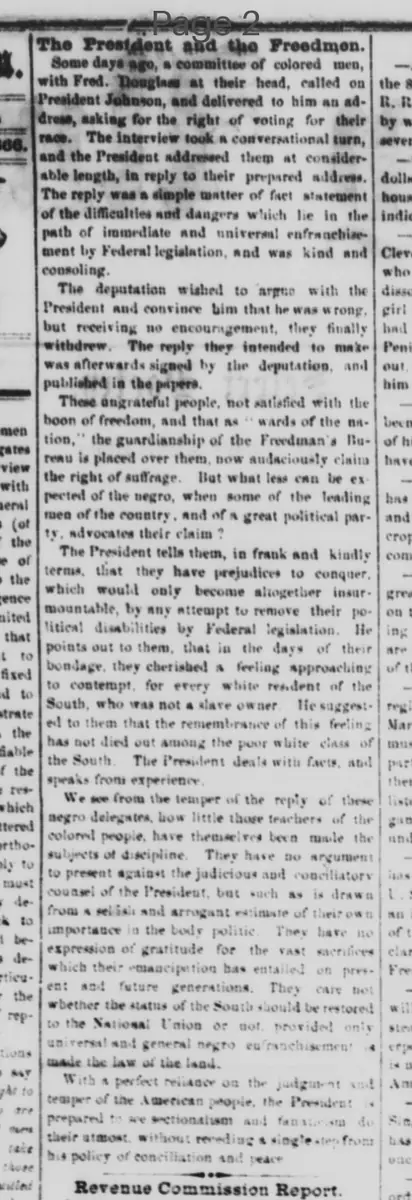
Some days ago, a committee of colored men, with Fred. Douglass at their head, called on President Johnson, and delivered to him an address, asking for the right of voting for their race. The interview took a conversational turn, and the President addressed them at considerable length, in reply to their prepared address. The reply was a simple matter of fact statement of the difficulties and dangers which lie in the path of immediate and universal enfranchisement by Federal legislation, and was kind and consoling.
The deputation wished to argue with the President and convince him that he was wrong, but receiving no encouragement, they finally withdrew. The reply they intended to make was afterwards signed by the deputation, and published in the papers.
These ungrateful people, not satisfied with the boon of freedom, and that as "wards of the nation," the guardianship of the Freedman's Bureau is placed over them, now audaciously claim the right of suffrage. But what less can be expected of the negro, when some of the leading men of the country, and of a great political party, advocate their claim?
The President tells them, in frank and kindly terms, that they have prejudices to conquer, which would only become altogether insurmountable, by any attempt to remove their political disabilities by Federal legislation. He points out to them, that in the days of their bondage, they cherished a feeling approaching to contempt, for every white resident of the South, who was not a slave owner. He suggested to them that the remembrance of this feeling has not died out among the poor white class of the South. The President deals with facts, and speaks from experience.
We see from the temper of the reply of these negro delegates, how little those teachers of the colored people, have themselves been made the subjects of discipline. They have no arguments to present against the judicious and conciliatory counsel of the President, but such as is drawn from a selfish and arrogant estimate of their own importance in the body politic. They have no expression of gratitude for the vast sacrifices which their emancipation has entailed on present and future generations. They care not whether the status of the South should be restored to the National Union or not provided only universal and general negro enfranchisement is made the law of the land.
With a perfect reliance on the judgment and temper of the American people, the President has prepared as sectionalism and fanaticism to their utmost without receding a single step from his policy of conciliation and peace.
What sub-type of article is it?
What themes does it cover?
What keywords are associated?
What entities or persons were involved?
Story Details
Key Persons
Event Date
Some Days Ago
Story Details
A committee of colored men led by Fred. Douglass met with President Johnson to request voting rights for their race. The President responded kindly, outlining difficulties of immediate enfranchisement. The deputation withdrew without arguing and later published their intended reply. The article criticizes the deputation's ingratitude and supports the President's conciliatory policy.