Thank you for visiting SNEWPapers!
Sign up free
Gazette Of The United States, & Philadelphia Daily Advertiser
Philadelphia, Philadelphia County, Pennsylvania
What is this article about?
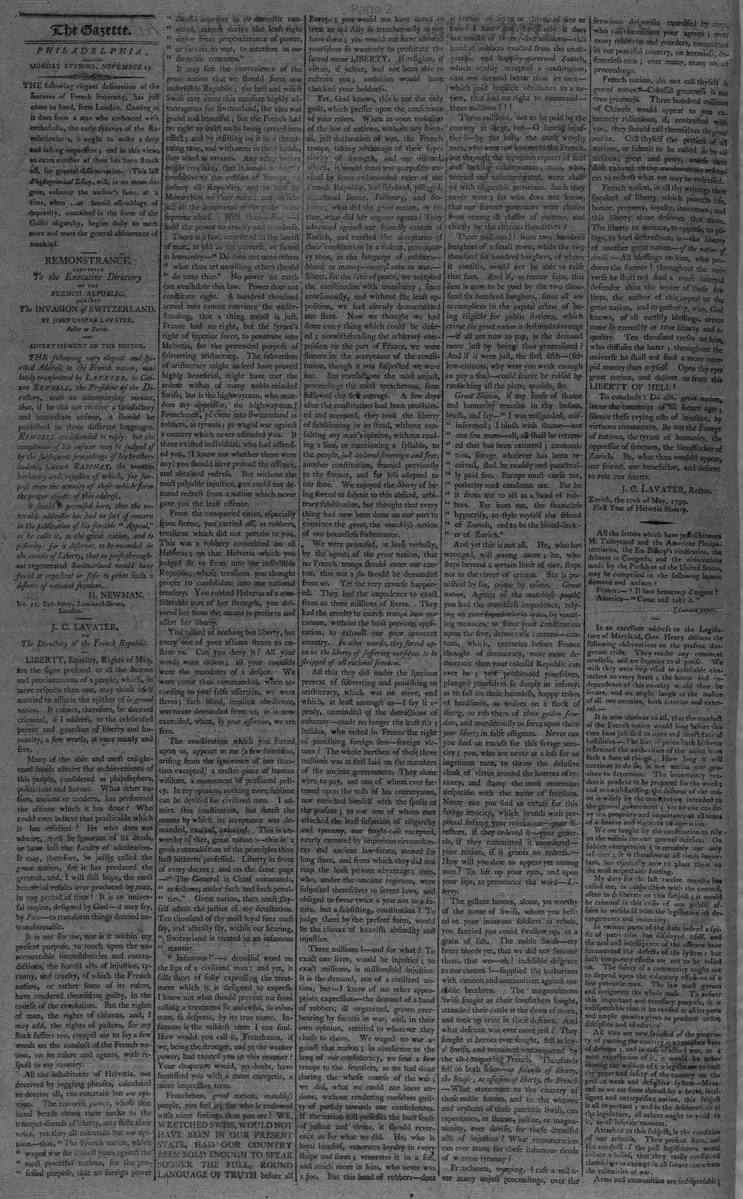
Swiss rector J.C. Lavater's May 1798 remonstrance to French Directory denounces invasion of Switzerland, forced constitution, exactions, and battles, accusing France of tyranny despite liberty rhetoric. Published in Philadelphia Gazette Nov 19.
Clipping
OCR Quality
Full Text
PHILADELPHIA.
MONDAY EVENING, NOVEMBER 19.
THE following elegant delineation of the Features of French fraternity, has just come to hand, from London. Coming as it does from a man who embraced with enthusiasm, the early theories of the Revolutionizers, it ought to make a deep and lasting impression; and in this view, an extra number of them has been struck off, for general dissemination. This last Physiognomical Essay, will, in no mean degree, enhance the author's fame, at a time, when that horrid assemblage of depravity, contained in the form of the Gallic oligarchy, begins daily to meet more and more the general abhorrence of mankind.
REMONSTRANCE,
ADDRESSED
To the Executive Directory
OF THE
FRENCH REPUBLIC,
AGAINST
The INVASION of SWITZERLAND.
BY JOHN CASPAR LAVATER,
Rector at Zurich.
ADVERTISEMENT OF THE EDITOR.
THE following very elegant and spirited Address to the French nation, was lately transmitted by LAVATER, to Citizen REUBELL, the President of the Directory, with an accompanying menace, that, if he did not receive a satisfactory and immediate answer, it should be published in three different languages. REUBELL condescended to reply; but the complexion of his answer may be judged of by the subsequent proceedings of his brother-in-law, Citizen RAPINAT, the wanton barbarity and injustice of which, far surpass even the atrocity of those which form the proper objects of this address.
It should be premised here, that the venerable addresser has had no sort of concern in the publication of his forcible "Appeal," as he calls it, to the great nation, and to posterity: for it deserves to be recorded in the annals of Liberty, that no press throughout regenerated Switzerland would have found it expedient or safe to print such a defence of rational freedom,
H. NEWMAN.
No. 11, Ball-Alley, Lombard-Street,
London.
J. C. LAVATER,
TO
The Directory of the French Republic.
LIBERTY, Equality, Rights of Man, are the signs prefixed to all the decrees and proclamations of a people, which, in more respects than one, may think itself entitled to assume the epithet of la grand nation. It cannot, therefore, be deemed criminal, if I address, to the celebrated parent and guardian of liberty and humanity, a few words, at once manly and free.
Many of the ablest and most enlightened heads admire the achievements of this people, considered as philosophers, politicians and heroes. What other nation, ancient or modern, has performed the actions which it has done? Who could even believe that practicable which it has effected? He who does not admire, must be ignorant of its deeds, or have lost the faculty of admiration.
It may, therefore, be justly, called the great nation, for it has produced the greatest, and, I will still hope, the most beneficial results ever produced by man, in any period of time! It is an universal engine, designed by God—it may say, by Fate—to transform things deemed untransformable.
It is not for me, nor is it within my present purpose, to touch upon the unaccountable inconsistencies and contradictions, the horrid acts of injustice, tyranny, and cruelty, of which the French nation, or rather some of its rulers, have rendered themselves guilty, in the course of the revolution. But the rights of man, the rights of citizens, and, I may add, the rights of pastors, for my flock suffers too, compel me to say a few words on the conduct of the French nation, on its rulers and agents, with respect to my country.
All the inhabitants of Helvetia, not deceived by juggling phrases, calculated to deceive all, can entertain but one opinion. The terrorist power, whose iron hand bends down their necks to the trumpet-sounds of liberty, may stifle their voice, yet they all entertain but one opinion—that, "The French nation, which waged war for several years against the most powerful nations, for the professed purpose, that no foreign power should interfere in its domestic concerns, cannot derive the least right either from preponderance of power, or success in war, to interfere in our domestic concerns."
It may suit the convenience of the great nation that we should form one indivisible Republic; the best and wisest Swiss may deem this measure highly advantageous for Switzerland, the idea was grand and beautiful; but the French had no right to insist on its being carried into effect; and by insisting on it in a threatening tone, and with arms in their hands, they acted as tyrants. Any other nation might conceive, that it would be highly conducive to the welfare of Europe, to destroy all Republics, and to rear up Monarchies on their ruins; nay, to subject all the dominions of the globe to one supreme chief. Well then—Fiat!—I hold the power to crucify and to release.
There is a law, imprinted in the breast of man, as old as the universe, as sacred as humanity—"Do thou not unto others what thou art unwilling others should do unto thee." No power on earth can annihilate this law. Power does not constitute right. A hundred thousand armed men cannot convince the understanding, that a thing unjust is just.
France had no right, but the tyrant's right of superior force, to penetrate into Helvetia, for the pretended purpose of subverting aristocracy. The subversion of aristocracy might indeed have proved highly beneficial, might have met the ardent wishes of many noble-minded Swiss; but is the highwayman, who murders my oppressor, no highwayman?
Frenchmen, ye came into Switzerland as robbers, as tyrants; ye waged war against a country which never offended you. If there existed individuals who had offended you, (I know not whether there were any) you should have proved the offence, and obtained redress. But without the most palpable injustice, you could not demand redress from a nation which never gave you the least offence.
From the conquered cities, especially from Berne, you carried off, as robbers, treasures which did not pertain to you. This was a robbery committed on all Helvetia; on that Helvetia which you judged fit to form into one indivisible Republic, whose treasures you thought proper to consolidate into one national treasury. You robbed Helvetia of a considerable part of her strength, you delivered her from the means to preserve and assert her liberty.
You talked of nothing but liberty, but every one of your actions strove to enslave us. Can you deny it? All your words were orders; all your counsels were the mandates of a despot.—We were never thus commanded, when according to your false assertion, we were slaves; such blind, implicit obedience, was never demanded from us, as is now exercised, when, by your assertion, we are free.
The constitution which you forced upon us, appears to me (a few solecisms arising from the ignorance of our situation excepted) a master-piece of human wisdom, a monument of profound policy. In my opinion, nothing more sublime can be devised for civilized men. I admire this constitution, but detest the means by which its acceptance was demanded, exacted, extorted. This is unworthy of thee, great nation:—this is a gross contradiction of the principles thou hast hitherto professed. Liberty in front of every decree; and on the same page "The General in Chief commands, as follows; under such and such penalties." Great nation, thou must thyself admit the justice of my detestation.
Ten thousand of thy most loyal sons must say, and actually say, within our hearing, "Switzerland is treated in an infamous manner."
"Infamous!"—a dreadful word on the lips of a civilized man; and yet, it falls short of fully expressing the treatment which it is designed to express.
I know not what should prevent me from calling a treatment so unlawful, so inhuman, so despotic, by its true name. Infamous is the mildest term I can find.
How would you call it, Frenchmen, if we, being the stronger, and ye the weaker power, had treated you in this manner? Your eloquence would, no doubt, have furnished you with a more energetic, a more impressive term.
Frenchmen, great nation, matchless people, you feel it; for who is endowed with nicer feelings than you are? WE, WRETCHED SWISS, WOULD NOT HAVE BEEN IN OUR PRESENT STATE, HAD OUR COUNTRY BEEN BOLD ENOUGH TO SPEAK SOONER THE FULL, ROUND LANGUAGE OF TRUTH before all Europe; you would not have dared to treat an old Ally so treacherously as you have done; you would not have allowed yourselves so wantonly to prostitute the sacred name LIBERTY. If religion, if virtue, if justice, had not been able to restrain you; ambition would have checked your boldness.
Yet, God knows, this is not the only guilt, which presses upon the conscience of your rulers. When in open violation of the law of nations, without any formal, just declaration of war, the French troops, taking advantage of their superiority of strength, and our discord, which, it would seem was purposely excited by some evil-minded ruler of the French Republic, had subdued, pillaged, devastated Berne, Fribourg, and Soleure; what did the great nation, or rather, what did her ungrateful agents? They advanced against our friendly canton of Zurich, and exacted the acceptance of their constitution in a violent, peremptory tone, in the language of robbers—blood or money—acceptance or war.—
Silent, for the sake of peace, we accepted the constitution with unanimity; since unanimously, and without the least opposition, we had already democratized our state. Now we thought we had done every thing which could be desired; notwithstanding the arbitrary compulsion on the part of France, we were sincere in the acceptance of the constitution, though it was suspected we were not. But transactions the most unjust, proceedings the most treacherous, soon followed the first outrage. A few days after the constitution had been proclaimed and accepted, they took the liberty of substituting in its stead, without consulting any man's opinion, without reading a line, or mentioning a syllable, to the people, just declared sovereign and free, another constitution, framed previously to the former, and far less adapted to our state. We enjoyed the liberty of being forced to submit to this absurd, arbitrary substitution, but thought that every thing had now been done on our part to convince the great, the matchless nation of our boundless forbearance.
We were promised, at least verbally, by the agents of the great nation, that no French troops should enter our canton, that not a sou should be demanded from us. Yet the very reverse happened. They had the impudence to exact from us three millions of livres. They had the cruelty to march troops into our canton, without the least previous application, to exhaust our poor innocent country. In other words, they forced upon us the liberty of suffering ourselves to be stripped of all rational freedom.
All this they did under the precious pretext of subverting and punishing an aristocracy, which was no more, and which, at least amongst us—I say it openly, unmindful of the detractions of calumny—made no longer the least stir; besides, who vested in France the right of punishing foreign ins—foreign virtues? The whole burthen of these three millions was at first laid on the members of the ancient government. They alone were to pay, not one of whom ever fastened upon the toils of his countrymen, nor enriched himself with the spoils of the peasant; to not one of whom ever attached the least suspicion of oligarchy and tyranny, one single case excepted, nearly extorted by imperious circumstances and ancient law-forms, atoned for long since, and from which they did not reap the least private advantage; men, who, under the ancient regimen, were subjected themselves to severe laws, and obliged to swear twice a year not to a future, but a subsisting, constitution! To judge them by the present form, would be the climax of knavish absurdity and injustice.
Three millions!—and for what? To exact one livre, would be injustice; to exact millions, is millionfold injustice. It is the demand, not of a civilized nation, but—I know of no other appropriate expression—the demand of a band of robbers, ill organized, grown overbearing by success in war, and, in their own opinion, entitled to whatever they choose to claim. We waged no war against that nation; in obedience to the laws of our confederacy, we sent a few troops to the frontiers, as we had done during the—whose course of the war; we did, what we could not leave undone, without rendering ourselves guilty of perfidy towards our confederates.
If the nation still possesses the least sense of justice and virtue, it should reverence us for what we did. He, who is loyal himself, venerates loyalty in every shape and form; venerates it in a foe, and much more in him, who never was a foe. But this band of robbers—does it consist of seven or three, of five or two? I know not; but surely it does not consist of twenty-five millions—this band of robbers exacted from the unoligarchic and happily-governed Zurich which readily accepted a constitution, that was deemed better than its own—which paid implicit obedience to a nation, that had no right to command—three millions!!!
Three millions, not to be paid by the country at large, but—O horrid injustice!—by the best, the most worthy men, who were not known to the French, but through the atrocious reports of foul and lurking calumniators; men, who, untried and uninterrogated, were classed with oligarchic patricians. Such they never were; for who does not know, that our former governors were chosen from among all classes of citizens, and chiefly by the citizens themselves?
Three millions!! from two hundred burghers of a small town, while the two thousand six hundred burghers, of whom it consists, would not be able to raise that sum. And if, as rumor says, this sum is now to be paid by the two thousand six hundred burghers, since all are accomplices in the capital crime of being eligible for public stations, which crime the great nation is destined to avenge—if all are now to pay, is the demand more just by being thus generalized? And if it were just, the first fifth—(fellow-citizens, why were you weak enough to pay a sou)—could scarce be raised by ransacking all the plate, medals, &c.
Great Nation, if any sense of shame and humanity remains in thy bosom, blush, and say—“I was misguided, misinformed; I blush with shame—not one sou more—all, all shall be returned that has been extorted; ammunition, forage, whatever has been received, shall be readily and punctually paid for. Europe must excuse me, posterity must condemn me. Far be it from me to act as a band of robbers. Far from me, the shameless hypocrisy, to style myself the friend of Zurich, and to be the blood-sucker of Zurich.”
And yet this is not all. He, who has wronged, will wrong more; he, who steps beyond a certain limit of vice, stops not in the career of crimes. Sin is punished by sin, crime by crime. Great nation, Agents of the matchless people; you had the matchless impudence, relying on your superiority in arms, by vaunting menaces, to force your constitution upon the free, democratic cantons—cantons, which, centuries before France thought of democracy, were more democratic than your colossal Republic can ever be; you prostituted yourselves, plunged yourselves so deeply in infamy, as to fall on these harmless, happy tribes of herdsmen, as wolves on a flock of sheep, to rob them of their golden freedom, and murderously to force upon them your liberty in false assignats. Never can you find an excuse for this savage atrocity; you, who are never at a loss for an ingenious turn, to throw the delusive cloak of virtue around the horrors of tyranny, and stamp the most enormous despotism with the name of freedom.
Never can you find an excuse for this savage atrocity, which brands with perpetual infamy your revolution—your directors, if they ordered it—your generals, if they committed it unordered—your nation, if it grants no redress.—How will you dare to appear yet among men? To lift up your eyes, and open your lips, to pronounce the word—Liberty.
The gallant heroes, alone, yet worthy of the name of Swiss, whom you belied to your innocent soldiers as rebels, you fancied you could swallow up, as a grain of salt. The noble Swiss—my heart bleeds yet, that we did not succour them, that we—oh! indelible disgrace to our canton!—supplied the barbarians with cannon and ammunition against our noble brethren. The magnanimous Swiss fought as their forefathers fought, attended their cattle at the dawn of morn, and took up arms in their defence. And what defence was ever more just? They fought as heroes ever fought, fell as loyal Swiss, and remained unconquered by the all-conquering French. Thousands fell on both sides—as friends of liberty, the Swiss; as assassins of liberty, the French—What atonement to the country of these noble heroes, and to the widows and orphans of these patriotic Swiss, can repentance, or shame, justice, or magnanimity, ever devise, for these dreadful acts of injustice? What remuneration can ever atone for these infamous deeds of wanton tyranny?
Frenchmen, weeping, I cast a veil over many unjust proceedings, over the ferocious despotism exercised by men, who call themselves your agents; over many robberies and murders, committed in our peaceful country, on harmless, defenceless men; over many, many unjust proceedings.
French nation, do not call thyself la grand nation.—Colossal greatness is not true greatness. Three hundred millions of Chinese would appear to you extremely ridiculous, if, contrasted with you, they should call themselves the great nation. Call thyself the pettiest of all nations, or submit to be called so by all nations; great and petty, unless thou dost exhaust all thy inexhaustible resources to redress what yet may be redressed.
French nation, in all thy writings thou speakest of liberty which protects life, honor, property, loyalty, innocence; and this liberty alone deserves that name. The liberty to menace, to oppress, to pillage, to hurl destruction, is—the liberty of another great nation—of the nation of devils.—All blessings on him, who produces the former! throughout the universe he shall not find a more intrepid defender than the writer of these few lines, the author of this appeal to the great nation, and to posterity, who, God knows, or all earthly dwellings, craves none so earnestly as true liberty and equality. Ten thousand curses on him, who diffuses the latter; throughout the universe he shall not find a more intrepid enemy than myself. Open thy eyes great nation, and deliver us from this LIBERTY OF HELL!
To conclude: Do not, great nation, incur the contempt of all future ages; silence these crying acts of injustice, by virtuous atonements. Be not the scourge of nations, the tyrant of humanity, the oppressor of freemen, the bloodsucker of Zurich. Be, what thou wouldst appear, our friend, our benefactor, and deserve to rule our hearts.
J. C. LAVATER, Rector.
Zurich, the 10th of May, 1798.
First Year of Helvetic Slavery.
What sub-type of article is it?
What keywords are associated?
What entities or persons were involved?
Where did it happen?
Foreign News Details
Primary Location
Switzerland
Event Date
1798 05 10
Key Persons
Outcome
thousands fell on both sides in battles; french imposed constitution on switzerland, exacted three million livres from zurich, carried off treasures from berne, devastated cities; swiss accepted constitution under duress but faced further impositions and treachery.
Event Details
John Caspar Lavater, Rector at Zurich, addresses a remonstrance to the French Directory protesting the invasion of Switzerland, imposition of the Helvetic Republic constitution by force, robbery of treasures, exaction of money, and military actions including battles where Swiss fought against French forces; he condemns the hypocrisy of French claims to liberty while acting as tyrants.