Thank you for visiting SNEWPapers!
Sign up free
Story
September 1, 1774
The Virginia Gazette
Richmond, Williamsburg, Richmond County, Virginia
What is this article about?
Lord Lyttelton defends the Quebec Bill against Lord Chatham's objections, advocating for religious toleration for Canadian Catholics, lenity in governance, and suitability of the bill's policy to the region's character, while dismissing fears of it aiding American rebellion.
Clipping
OCR Quality
95%
Excellent
Full Text
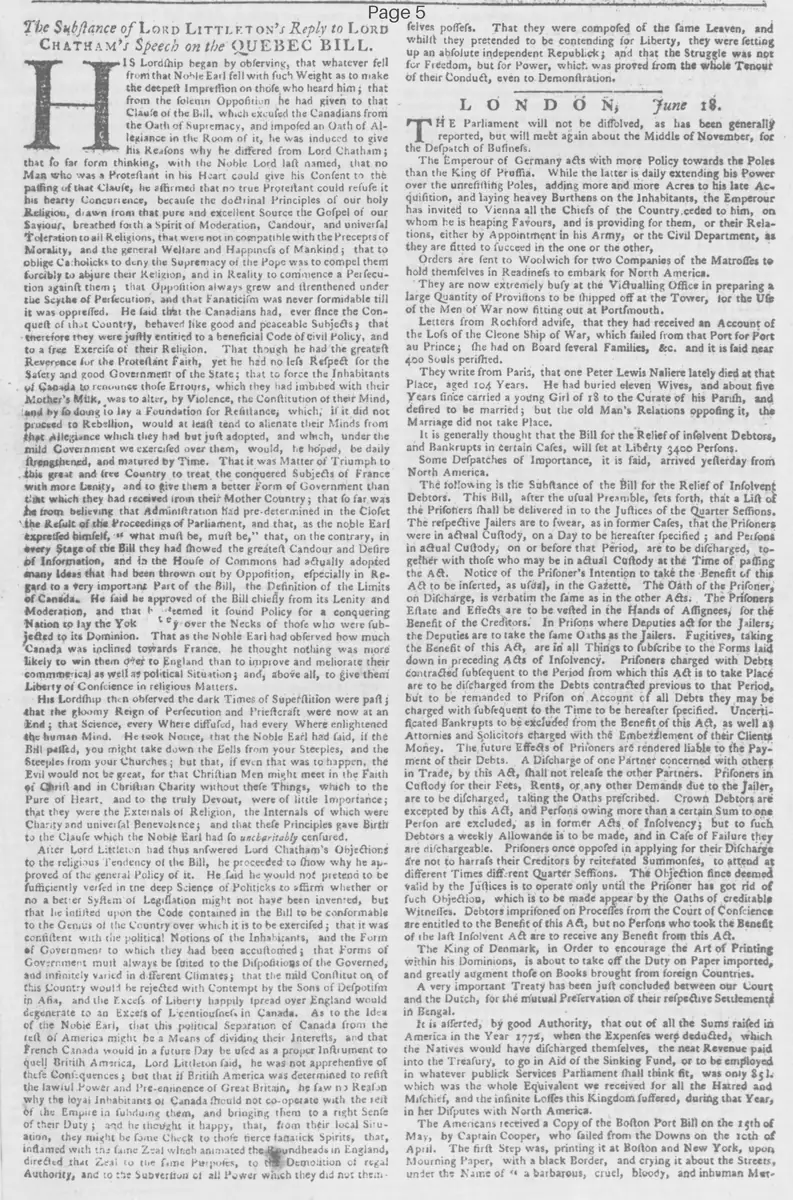
The Substance of Lord Lyttelton's Reply to Lord Chatham's Speech on the Quebec Bill.
His Lordship began by observing, that whatever fell from that Noble Earl fell with such Weight as to make the deepest Impression on those who heard him; that from the solemn Opposition he had given to that Clause of the Bill, which excused the Canadians from the Oath of Supremacy, and imposed an Oath of Allegiance in the Room of it, he was induced to give his Reasons why he differed from Lord Chatham; that so far from thinking, with the Noble Lord last named, that no Man who was a Protestant in his Heart could give his Consent to the passing of that Clause, he affirmed that no true Protestant could refuse it his hearty Concurrence, because the doctrinal Principles of our holy Religion, drawn from that pure and excellent Source the Gospel of our Saviour, breathed forth a Spirit of Moderation, Candour, and universal Toleration to all Religions, that were not incompatible with the Precepts of Morality, and the general Welfare and Happiness of Mankind; that to oblige Catholics to deny the Supremacy of the Pope was to compel them forcibly to abjure their Religion, and in Reality to commence a Persecution against them; that Opposition always grew and strengthened under the Scythe of Persecution, and that Fanaticism was never formidable till it was oppressed. He said that the Canadians had, ever since the Conquest of that Country, behaved like good and peaceable Subjects that therefore they were justly entitled to a beneficial Code of civil Policy, and to a free Exercise of their Religion. That though he had the greatest Reverence for the Protestant Faith, yet he had no less Respect for the Safety and good Government of the State; that to force the Inhabitants of Canada to renounce those Errors, which they had imbibed with their Mother's Milk, was to alter, by Violence, the Constitution of their Mind, and by so doing to lay a Foundation for Resistance, which, if it did not proceed to Rebellion, would at least tend to alienate their Minds from that Allegiance which they had but just adopted, and which, under the mild Government we exercised over them, would, he hoped, be daily strengthened, and matured by Time. That it was Matter of Triumph to this great and free Country to treat the conquered Subjects of France with more Lenity, and to give them a better Form of Government than that which they had received from their Mother Country; that so far was he from believing that Administration had pre-determined in the Closet the Result of this Proceedings of Parliament, and that, as the noble Earl expressed himself, "what must be, must be," that, on the contrary, in every Stage of this Bill they had shown the greatest Candour and Desire of Information, and in the House of Commons had actually adopted many Ideas that had been thrown out by Opposition, especially in regard to a very important Part of the Bill, the Definition of the Limits of Canada. He said he approved of the Bill chiefly from its Lenity and Moderation, and that he deemed it sound Policy for a conquering Nation to lay the Yoke easy over the Necks of those who were subjected to its Dominion. That as the Noble Earl had observed how much Canada was inclined towards France, he thought nothing was more likely to win them over to England than to improve and meliorate their commercial as well as political Situation; and, above all, to give them Liberty of Conscience in religious Matters.
His Lordship then observed the dark Times of Superstition were past; that the gloomy Reign of Persecution and Priestcraft were now at an End; that Science, every Where diffused, had every Where enlightened the human Mind. He took Notice, that the Noble Earl had said, if the Bill passed, you might take down the Bells from your Steeples, and the Steeples from your Churches; but that, if even that was to happen, the Evil would not be great, for that Christian Men might meet in the Faith of Christ and in Christian Charity without these Things, which to the Pure of Heart, and to the truly Devout, were of little Importance; that they were the Externals of Religion, the Internals of which were Charity and universal Benevolence; and that these Principles gave Birth to the Clause which the Noble Earl had so uncharitably censured.
After Lord Lyttelton had thus answered Lord Chatham's Objections to the religious Tendency of the Bill, he proceeded to show why he approved of the general Policy of it. He said he would not pretend to be sufficiently versed in the deep Science of Politics to affirm whether or no a better System of Legislation might not have been invented, but that he insisted upon the Code contained in the Bill to be conformable to the Genius of the Country over which it is to be exercised; that it was consistent with the political Notions of the Inhabitants, and the Form of Government to which they had been accustomed; that Forms of Government must always be suited to the Dispositions of the Governed, and infinitely varied in different Climates; that the mild Constitution of this Country would be rejected with Contempt by the Sons of Despotism in Asia, and the Excess of Liberty happily spread over England would degenerate to an Excess of Licentiousness in Canada. As to the Idea of the Noble Earl, that this political Separation of Canada from the rest of America might be a Means of dividing their Interests, and that French Canada would in a future Day be used as a proper Instrument to quell British America, Lord Lyttelton said, he was not apprehensive of these Consequences; but that if British America was determined to resist the lawful Power and Pre-eminence of Great Britain, he saw no Reason why the loyal Inhabitants of Canada should not co-operate with the rest of the Empire in subduing them, and bringing them to a right Sense of their Duty; and he thought it happy, that, from their local Situation, they might be some Check to those fierce fanatic Spirits, that, inflamed with the same Zeal which animated the Roundheads in England, directed that Zeal to the same Purposes, to the Demolition of regal Authority, and to the Subversion of all Power which they did not themselves possess. That they were composed of the same Leaven, and whilst they pretended to be contending for Liberty, they were setting up an absolute independent Republick; and that the Struggle was not for Freedom, but for Power, which was proved from the whole Tenour of their Conduct, even to Demonstration.
His Lordship began by observing, that whatever fell from that Noble Earl fell with such Weight as to make the deepest Impression on those who heard him; that from the solemn Opposition he had given to that Clause of the Bill, which excused the Canadians from the Oath of Supremacy, and imposed an Oath of Allegiance in the Room of it, he was induced to give his Reasons why he differed from Lord Chatham; that so far from thinking, with the Noble Lord last named, that no Man who was a Protestant in his Heart could give his Consent to the passing of that Clause, he affirmed that no true Protestant could refuse it his hearty Concurrence, because the doctrinal Principles of our holy Religion, drawn from that pure and excellent Source the Gospel of our Saviour, breathed forth a Spirit of Moderation, Candour, and universal Toleration to all Religions, that were not incompatible with the Precepts of Morality, and the general Welfare and Happiness of Mankind; that to oblige Catholics to deny the Supremacy of the Pope was to compel them forcibly to abjure their Religion, and in Reality to commence a Persecution against them; that Opposition always grew and strengthened under the Scythe of Persecution, and that Fanaticism was never formidable till it was oppressed. He said that the Canadians had, ever since the Conquest of that Country, behaved like good and peaceable Subjects that therefore they were justly entitled to a beneficial Code of civil Policy, and to a free Exercise of their Religion. That though he had the greatest Reverence for the Protestant Faith, yet he had no less Respect for the Safety and good Government of the State; that to force the Inhabitants of Canada to renounce those Errors, which they had imbibed with their Mother's Milk, was to alter, by Violence, the Constitution of their Mind, and by so doing to lay a Foundation for Resistance, which, if it did not proceed to Rebellion, would at least tend to alienate their Minds from that Allegiance which they had but just adopted, and which, under the mild Government we exercised over them, would, he hoped, be daily strengthened, and matured by Time. That it was Matter of Triumph to this great and free Country to treat the conquered Subjects of France with more Lenity, and to give them a better Form of Government than that which they had received from their Mother Country; that so far was he from believing that Administration had pre-determined in the Closet the Result of this Proceedings of Parliament, and that, as the noble Earl expressed himself, "what must be, must be," that, on the contrary, in every Stage of this Bill they had shown the greatest Candour and Desire of Information, and in the House of Commons had actually adopted many Ideas that had been thrown out by Opposition, especially in regard to a very important Part of the Bill, the Definition of the Limits of Canada. He said he approved of the Bill chiefly from its Lenity and Moderation, and that he deemed it sound Policy for a conquering Nation to lay the Yoke easy over the Necks of those who were subjected to its Dominion. That as the Noble Earl had observed how much Canada was inclined towards France, he thought nothing was more likely to win them over to England than to improve and meliorate their commercial as well as political Situation; and, above all, to give them Liberty of Conscience in religious Matters.
His Lordship then observed the dark Times of Superstition were past; that the gloomy Reign of Persecution and Priestcraft were now at an End; that Science, every Where diffused, had every Where enlightened the human Mind. He took Notice, that the Noble Earl had said, if the Bill passed, you might take down the Bells from your Steeples, and the Steeples from your Churches; but that, if even that was to happen, the Evil would not be great, for that Christian Men might meet in the Faith of Christ and in Christian Charity without these Things, which to the Pure of Heart, and to the truly Devout, were of little Importance; that they were the Externals of Religion, the Internals of which were Charity and universal Benevolence; and that these Principles gave Birth to the Clause which the Noble Earl had so uncharitably censured.
After Lord Lyttelton had thus answered Lord Chatham's Objections to the religious Tendency of the Bill, he proceeded to show why he approved of the general Policy of it. He said he would not pretend to be sufficiently versed in the deep Science of Politics to affirm whether or no a better System of Legislation might not have been invented, but that he insisted upon the Code contained in the Bill to be conformable to the Genius of the Country over which it is to be exercised; that it was consistent with the political Notions of the Inhabitants, and the Form of Government to which they had been accustomed; that Forms of Government must always be suited to the Dispositions of the Governed, and infinitely varied in different Climates; that the mild Constitution of this Country would be rejected with Contempt by the Sons of Despotism in Asia, and the Excess of Liberty happily spread over England would degenerate to an Excess of Licentiousness in Canada. As to the Idea of the Noble Earl, that this political Separation of Canada from the rest of America might be a Means of dividing their Interests, and that French Canada would in a future Day be used as a proper Instrument to quell British America, Lord Lyttelton said, he was not apprehensive of these Consequences; but that if British America was determined to resist the lawful Power and Pre-eminence of Great Britain, he saw no Reason why the loyal Inhabitants of Canada should not co-operate with the rest of the Empire in subduing them, and bringing them to a right Sense of their Duty; and he thought it happy, that, from their local Situation, they might be some Check to those fierce fanatic Spirits, that, inflamed with the same Zeal which animated the Roundheads in England, directed that Zeal to the same Purposes, to the Demolition of regal Authority, and to the Subversion of all Power which they did not themselves possess. That they were composed of the same Leaven, and whilst they pretended to be contending for Liberty, they were setting up an absolute independent Republick; and that the Struggle was not for Freedom, but for Power, which was proved from the whole Tenour of their Conduct, even to Demonstration.
What sub-type of article is it?
Historical Event
What themes does it cover?
Moral Virtue
Justice
What keywords are associated?
Quebec Bill
Religious Toleration
Lord Lyttelton
Lord Chatham
Canadian Allegiance
Parliamentary Debate
What entities or persons were involved?
Lord Lyttelton
Lord Chatham
Where did it happen?
Canada
Story Details
Key Persons
Lord Lyttelton
Lord Chatham
Location
Canada
Story Details
Lord Lyttelton argues in favor of the Quebec Bill's clause allowing Catholics to take an oath of allegiance instead of supremacy, promoting religious toleration and mild governance to secure Canadian loyalty, countering Lord Chatham's opposition and addressing broader policy implications for British America.