Thank you for visiting SNEWPapers!
Sign up free
The New Hampshire Gazette And Historical Chronicle
Portsmouth, Greenland, Rockingham County, New Hampshire
What is this article about?
Extract from London letter dated March 14 details House of Commons debates concluding on March 13 regarding a bill to tax America per resolutions of March 10. Modifications to duties on sugars, molasses, wine, linens, and calicoes discussed; opposition efforts partially successful. Stamp duty likely next session unless Americans assent. William Allen opposed it effectively.
Merged-components note: These two components form a single continuous foreign news article from a letter dated London, March 14, discussing parliamentary debates on taxing America; the text flows directly from one to the next.
Clipping
OCR Quality
Full Text
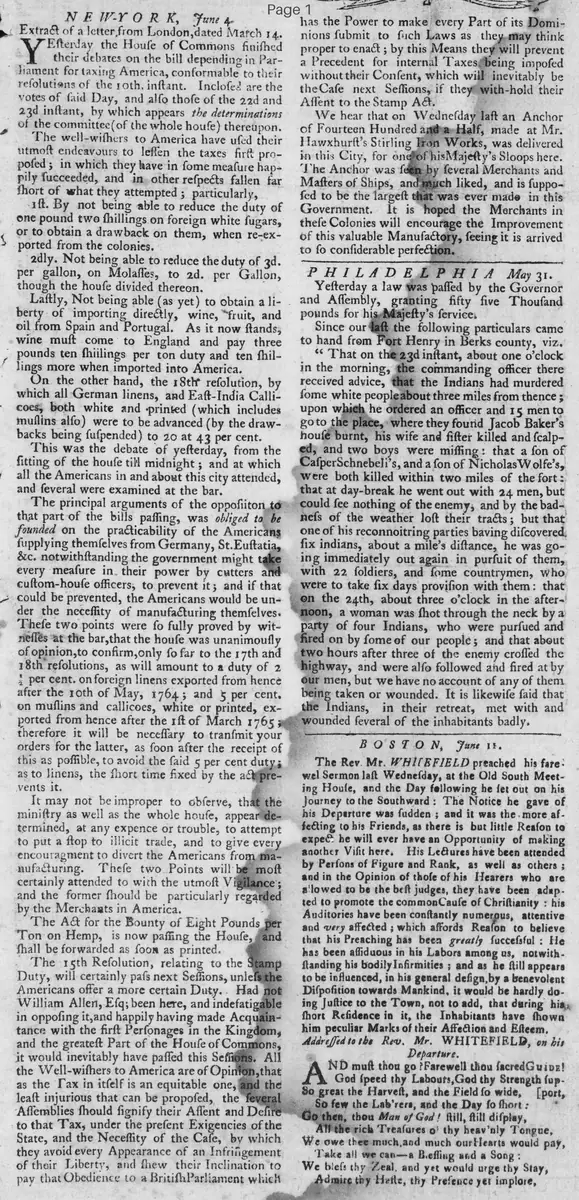
Extract of a letter from London, dated March 14.
Yesterday the House of Commons finished their debates on the bill depending in Parliament for taxing America, conformable to their resolutions of the 10th instant. Enclosed are the votes of said Day, and also those of the 22d and 23d instant, by which appears the determinations of the committee (of the whole house) thereupon.
The well-wishers to America have used their utmost endeavours to lessen the taxes first proposed; in which they have in some measure happily succeeded, and in other respects fallen far short of what they attempted; particularly,
1st. By not being able to reduce the duty of one pound two shillings on foreign white sugars, or to obtain a drawback on them, when re-exported from the colonies.
2dly. Not being able to reduce the duty of 3d. per gallon, on Molasses, to 2d. per Gallon, though the house divided thereon.
Lastly, Not being able (as yet) to obtain a liberty of importing directly, wine, fruit, and oil from Spain and Portugal. As it now stands, wine must come to England and pay three pounds ten shillings per ton duty and ten shillings more when imported into America.
On the other hand, the 18th resolution, by which all German linens and East-India Callicoes, both white and printed (which includes muslins also) were to be advanced (by the drawbacks being suspended) to 20 at 43 per cent.
This was the debate of yesterday, from the sitting of the house till midnight; and at which all the Americans in and about this city attended, and several were examined at the bar.
The principal arguments of the opposition to that part of the bills passing, was obliged to be founded on the practicability of the Americans supplying themselves from Germany, St. Eustatia, &c. notwithstanding the government might take every measure in their power by cutters and custom-house officers, to prevent it; and if that could be prevented, the Americans would be under the necessity of manufacturing themselves.
These two points were so fully proved by witnesses at the bar, that the house was unanimously of opinion, to confirm, only so far to the 17th and 18th resolutions, as will amount to a duty of 22 per cent. on foreign linens exported from hence after the 10th of May, 1764; and 5 per cent. on muslins and callicoes, white or printed, exported from hence after the 1st of March 1765;
therefore it will be necessary to transmit your orders for the latter, as soon after the receipt of this as possible, to avoid the said 5 per cent duty; as to linens, the short time fixed by the act prevents it.
It may not be improper to observe, that the ministry as well as the whole house, appear determined, at any expense or trouble, to attempt to put a stop to illicit trade, and to give every encouragement to divert the Americans from manufacturing. These two Points will be most certainly attended to with the utmost Vigilance; and the former should be particularly regarded by the Merchants in America.
The Act for the Bounty of Eight Pounds per Ton on Hemp, is now passing the House, and shall be forwarded as soon as printed.
The 15th Resolution, relating to the Stamp Duty, will certainly pass next Session, unless the Americans offer a more certain Duty. Had not William Allen, Esq; been here, and indefatigable in opposing it, and happily having made Acquaintance with the first Personages in the Kingdom, and the greatest Part of the House of Commons, it would inevitably have passed this Session. All the Well-wishers to America are of Opinion, that as the Tax in itself is an equitable one, and the least injurious that can be proposed, the several Assemblies should signify their Assent and Desire to that Tax, under the present Exigencies of the State, and the Necessity of the Case, by which they avoid every Appearance of an Infringement of their Liberty, and shew their Inclination to pay that Obedience to a British Parliament which
has the Power to make every Part of its Dominions submit to such Laws as they may think proper to enact; by this Means they will prevent a Precedent for internal Taxes being imposed without their Consent, which will inevitably be the Case next Session, if they with-hold their Assent to the Stamp Act.
What sub-type of article is it?
What keywords are associated?
What entities or persons were involved?
Where did it happen?
Foreign News Details
Primary Location
London
Event Date
March 14
Key Persons
Outcome
debates concluded with partial reductions in proposed duties on linens and calicoes to 22% and 5% respectively; duties on sugars, molasses, and wine imports unchanged; stamp duty deferred to next session unless americans assent; determination to curb illicit trade and discourage american manufacturing.
Event Details
House of Commons finished debates on bill for taxing America per resolutions of the 10th instant. Well-wishers to America partially succeeded in lessening taxes but failed on sugars (one pound two shillings duty, no drawback), molasses (3d. per gallon unchanged), and direct imports of wine, fruit, oil from Spain and Portugal. Opposition argued Americans could source from Germany, St. Eustatia despite enforcement; house confirmed modified duties on linens (22% after May 10, 1764) and muslins/calicoes (5% after March 1, 1765). Americans attended and were examined. Ministry aims to stop illicit trade and prevent manufacturing. Hemp bounty act passing. Stamp duty to pass next session without American alternative.