Thank you for visiting SNEWPapers!
Sign up free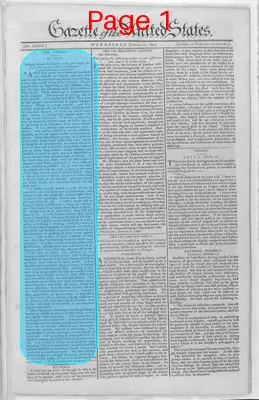
Literary
January 13, 1790
Gazette Of The United States
New York, New York County, New York
What is this article about?
Continuation of an essay critiquing overcrowded schools and ineffective teaching practices. It argues for smaller classes (20-25 students), individual attention to pronunciation and emphasis, fostering emulation and love of learning through incentives rather than punishment or reasoning, and using dialogue to improve reading and speaking.
Clipping
OCR Quality
98%
Excellent
Full Text
THE TABLET.
No. LXXIX.
"Nothing should be thought cheap, that badly answers the end for which it is designed."
(Continuation from the last number.)
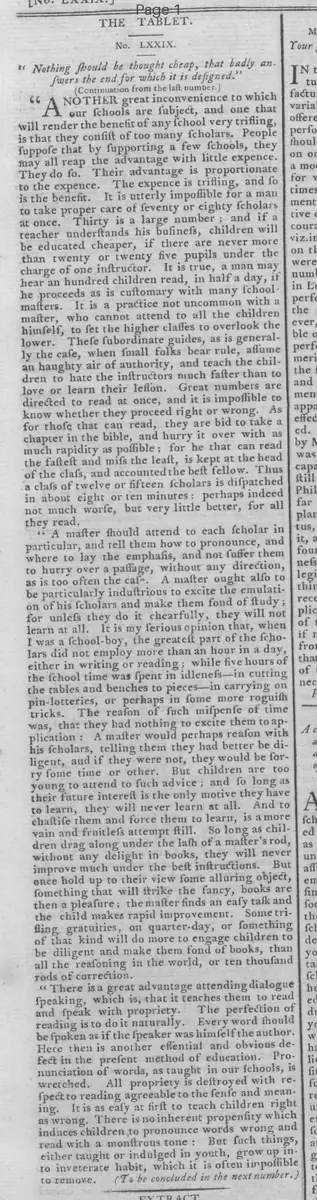
ANOTHER great inconvenience to which our schools are subject, and one that will render the benefit of any school very trifling, is that they consist of too many scholars. People suppose that by supporting a few schools, they may all reap the advantage with little expense. They do so. Their advantage is proportionate to the expense. The expense is trifling, and so is the benefit. It is utterly impossible for a man to take proper care of seventy or eighty scholars at once. Thirty is a large number; and if a teacher understands his business, children will be educated cheaper, if there are never more than twenty or twenty five pupils under the charge of one instructor. It is true, a man may hear an hundred children read, in half a day, if he proceeds as is customary with many school-masters. It is a practice not uncommon with a master, who cannot attend to all the children himself, to set the higher classes to overlook the lower. These subordinate guides, as is generally the case, when small folks bear rule, assume an haughty air of authority, and teach the children to hate the instructors much faster than to love or learn their lesson. Great numbers are directed to read at once, and it is impossible to know whether they proceed right or wrong. As for those that can read, they are bid to take a chapter in the bible, and hurry it over with as much rapidity as possible; for he that can read the fastest and mis the least, is kept at the head of the class, and accounted the best fellow. Thus a class of twelve or fifteen scholars is dispatched in about eight or ten minutes: perhaps indeed not much worse, but very little better, for all they read.
"A master should attend to each scholar in particular, and tell them how to pronounce, and where to lay the emphasis, and not suffer them to hurry over a passage, without any direction, as is too often the case. A master ought also to be particularly industrious to excite the emulation of his scholars and make them fond of study; for unless they do it cheerfully, they will not learn at all. It is my serious opinion that, when I was a school-boy, the greatest part of the scholars did not employ more than an hour in a day, either in writing or reading; while five hours of the school time was spent in idleness—in cutting the tables and benches to pieces—in carrying on pin-lotteries, or perhaps in some more roguish tricks. The reason of such mispence of time was, that they had nothing to excite them to application: A master would perhaps reason with his scholars, telling them they had better be diligent, and if they were not, they would be sorry some time or other. But children are too young to attend to such advice; and so long as their future interest is the only motive they have to learn, they will never learn at all. And to chastise them and force them to learn, is a more vain and fruitless attempt still. So long as children drag along under the lash of a master's rod, without any delight in books, they will never improve much under the best instructions. But once hold up to their view some alluring object, something that will strike the fancy, books are then a pleasure; the master finds an easy task and the child makes rapid improvement. Some trifling gratuities, on quarter-day, or something of that kind will do more to engage children to be diligent and make them fond of books, than all the reasoning in the world, or ten thousand rods of correction.
"There is a great advantage attending dialogue speaking, which is, that it teaches them to read and speak with propriety. The perfection of reading is to do it naturally. Every word should be spoken as if the speaker was himself the author. Here then is another essential and obvious defect in the present method of education. Pronunciation of words, as taught in our schools, is wretched. All propriety is destroyed with reading. It is as easy at first to teach children right as wrong. There is no inherent propensity which induces children to pronounce words wrong and read with a monstrous tone: But such things, either taught or indulged in youth, grow up into inveterate habit, which it is often impossible to remove."
(To be concluded in the next number.)
No. LXXIX.
"Nothing should be thought cheap, that badly answers the end for which it is designed."
(Continuation from the last number.)
ANOTHER great inconvenience to which our schools are subject, and one that will render the benefit of any school very trifling, is that they consist of too many scholars. People suppose that by supporting a few schools, they may all reap the advantage with little expense. They do so. Their advantage is proportionate to the expense. The expense is trifling, and so is the benefit. It is utterly impossible for a man to take proper care of seventy or eighty scholars at once. Thirty is a large number; and if a teacher understands his business, children will be educated cheaper, if there are never more than twenty or twenty five pupils under the charge of one instructor. It is true, a man may hear an hundred children read, in half a day, if he proceeds as is customary with many school-masters. It is a practice not uncommon with a master, who cannot attend to all the children himself, to set the higher classes to overlook the lower. These subordinate guides, as is generally the case, when small folks bear rule, assume an haughty air of authority, and teach the children to hate the instructors much faster than to love or learn their lesson. Great numbers are directed to read at once, and it is impossible to know whether they proceed right or wrong. As for those that can read, they are bid to take a chapter in the bible, and hurry it over with as much rapidity as possible; for he that can read the fastest and mis the least, is kept at the head of the class, and accounted the best fellow. Thus a class of twelve or fifteen scholars is dispatched in about eight or ten minutes: perhaps indeed not much worse, but very little better, for all they read.
"A master should attend to each scholar in particular, and tell them how to pronounce, and where to lay the emphasis, and not suffer them to hurry over a passage, without any direction, as is too often the case. A master ought also to be particularly industrious to excite the emulation of his scholars and make them fond of study; for unless they do it cheerfully, they will not learn at all. It is my serious opinion that, when I was a school-boy, the greatest part of the scholars did not employ more than an hour in a day, either in writing or reading; while five hours of the school time was spent in idleness—in cutting the tables and benches to pieces—in carrying on pin-lotteries, or perhaps in some more roguish tricks. The reason of such mispence of time was, that they had nothing to excite them to application: A master would perhaps reason with his scholars, telling them they had better be diligent, and if they were not, they would be sorry some time or other. But children are too young to attend to such advice; and so long as their future interest is the only motive they have to learn, they will never learn at all. And to chastise them and force them to learn, is a more vain and fruitless attempt still. So long as children drag along under the lash of a master's rod, without any delight in books, they will never improve much under the best instructions. But once hold up to their view some alluring object, something that will strike the fancy, books are then a pleasure; the master finds an easy task and the child makes rapid improvement. Some trifling gratuities, on quarter-day, or something of that kind will do more to engage children to be diligent and make them fond of books, than all the reasoning in the world, or ten thousand rods of correction.
"There is a great advantage attending dialogue speaking, which is, that it teaches them to read and speak with propriety. The perfection of reading is to do it naturally. Every word should be spoken as if the speaker was himself the author. Here then is another essential and obvious defect in the present method of education. Pronunciation of words, as taught in our schools, is wretched. All propriety is destroyed with reading. It is as easy at first to teach children right as wrong. There is no inherent propensity which induces children to pronounce words wrong and read with a monstrous tone: But such things, either taught or indulged in youth, grow up into inveterate habit, which it is often impossible to remove."
(To be concluded in the next number.)
What sub-type of article is it?
Essay
What themes does it cover?
Moral Virtue
What keywords are associated?
School Overcrowding
Teaching Methods
Child Education
Emulation
Pronunciation
Incentives Over Punishment
Literary Details
Key Lines
"A Master Should Attend To Each Scholar In Particular, And Tell Them How To Pronounce, And Where To Lay The Emphasis, And Not Suffer Them To Hurry Over A Passage, Without Any Direction, As Is Too Often The Case."
"Some Trifling Gratuities, On Quarter Day, Or Something Of That Kind Will Do More To Engage Children To Be Diligent And Make Them Fond Of Books, Than All The Reasoning In The World, Or Ten Thousand Rods Of Correction."
"There Is A Great Advantage Attending Dialogue Speaking, Which Is, That It Teaches Them To Read And Speak With Propriety."