Thank you for visiting SNEWPapers!
Sign up free
Alexandria Advertiser And Commercial Intelligencer
Alexandria, Virginia
What is this article about?
The Council of Commerce of Bordeaux publishes a report on custom-house duties, authored by Citizen Desfourniel, praising its insights. Focusing on tobacco, it recommends reducing import duties on American tobacco to 15 francs per cwt in foreign vessels and 10 in French to encourage trade, noting French soil's inferiority for quality tobacco production. Deliberated February 15, 1802.
Clipping
OCR Quality
Full Text
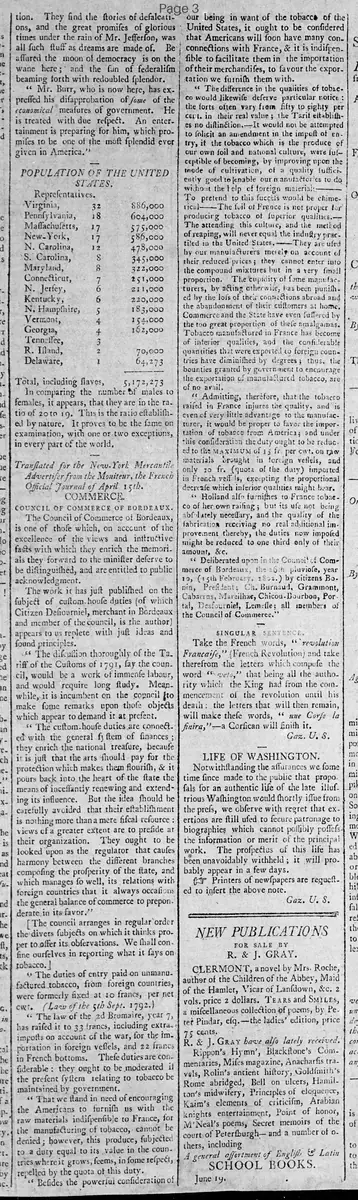
COMMERCE.
COUNCIL OF COMMERCE OF BORDEAUX.
The Council of Commerce of Bordeaux, is one of those which, on account of the excellence of the views and instructive facts with which they enrich the memorials they forward to the minister deserve to be distinguished, and are entitled to public acknowledgment.
The work it has just published on the subject of custom-house duties (of which Citizen Desfourniel, merchant in Bordeaux and member of the council, is the author) appears to us replete with just ideas and sound principles.
"The discussion thoroughly of the Tariff of the Customs of 1791, say the council, would be a work of immense labour, and would require long study. Meanwhile, it is incumbent on the council to make some remarks upon those objects which appear to demand it at present.
"The custom-house duties are connected with the general system of finances; they enrich the national treasure, because it is just that the arts should pay for the protection which makes them flourish, & it pours back into the heart of the state the means of incessantly renewing and extending its influence. But the idea should be carefully avoided that their establishment is nothing more than a mere fiscal resource: views of a greater extent are to preside at their organization. They ought to be looked upon as the regulator that causes harmony between the different branches composing the prosperity of the state, and which manages so well, its relations with foreign countries that it always occasions the general balance of commerce to preponderate in its favor."
[The council arranges in regular order the divers subjects on which it thinks proper to offer its observations. We shall confine ourselves in reporting what it says on tobacco.]
"The duties of entry paid on unmanufactured tobacco, from foreign countries, were formerly fixed at 10 francs, per net cwt. (Law of the 5th Sept. 1792.)
"The law of the 2d Brumaire, year 7, has raised it to 33 francs, including extraordinary imposts on account of the war, for the importation in foreign vessels, and 22 francs in French bottoms. These duties are considerable: they ought to be moderated if the present system relating to tobacco be maintained by government.
"That we stand in need of encouraging the Americans to furnish us with the raw materials indispensable to France, for the manufacturing of tobacco, cannot be denied; however, this produce, subjected to a duty equal to its value in the countries where it grows, seems, in some respect, repelled by the quota of this duty.
"Besides the powerful consideration of our being in want of the tobacco of the United States, it ought to be considered that Americans will soon have many commercial connections with France, & it is indispensable to facilitate them in the importation of their merchandises, to favour the exportation we furnish them with.
"The difference in the qualities of tobacco would likewise deserve particular notice: the sorts often vary from fifty to eighty per cent. in their real value; the Tariff establishes no distinction.--It would not be attempted to solicit an amendment in the impost of entry, if the tobacco which is the produce of our own soil and national culture, were susceptible of becoming, by improving upon the mode of cultivation, of a quality sufficiently good to enable our manufactories to do without the help of foreign materials.
To pretend to this success would be chimerical--The soil of France is not proper for producing tobacco of superior qualities.--The attending this culture, and the method of reaping, will never equal the industry practiced in the United States.--They are used by our manufacturers merely on account of their reduced prices; they cannot enter into the compound mixtures but in a very small proportion. The cupidity of some manufacturers, by acting otherwise, has been punished by the loss of their connections abroad and the abandonment of their customers at home.
Commerce and the State have even suffered by the too great proportion of these amalgamas. Tobacco manufactured in France has become of inferior qualities, and the considerable quantities that were exported to foreign countries have diminished by degrees; thus. the bounties granted by government to encourage the exportation of manufactured tobacco, are of no avail.
"Admitting, therefore, that the tobacco raised in France injures the quality, and is even of very little advantage to the manufacturer, it would be proper to favor the importation of tobacco from America; and under this consideration the duty ought to be reduced to the MAXIMUM of 15 fr. per cwt. on raw materials brought in foreign vessels, and only 10 fr. (quota of the duty) imported in French vessels, excepting the proportional decrease which inferior qualities might bear.
"Holland also furnishes to France tobacco of her own raising; but its use not being absolutely necessary, and the quality of the fabrication receiving no real additional improvement thereby, the duties now imposed might be reduced to one third only of their amount, &c.
"Deliberated upon in the Council of Commerce of Bordeaux, the 26th pluviose, year 10, (15th February. 1802.) by citizens Bonin, President; Ch. Burnaud. Grammont, Cabarrus, Marseille, Chicou-Bourbon, Portal, Desfourniel, Lemeffe; all members of the Council of Commerce."
What sub-type of article is it?
What keywords are associated?
What entities or persons were involved?
Where did it happen?
Foreign News Details
Primary Location
Bordeaux
Event Date
15th February 1802
Key Persons
Outcome
recommendations to reduce import duties on american tobacco to a maximum of 15 francs per cwt in foreign vessels and 10 francs in french vessels to encourage trade and improve quality; reduce dutch tobacco duties to one third.
Event Details
The Council of Commerce of Bordeaux, in a report authored by Citizen Desfourniel, discusses custom-house duties, emphasizing their role beyond fiscal resources to regulate commerce and favor balance with foreign countries. Focusing on tobacco, it notes high current duties (33 francs in foreign vessels, 22 in French) deter imports from the United States, crucial for French manufacturing due to inferior domestic production. It argues for duty reductions to facilitate trade, considering quality variations and the need to encourage American suppliers.