Thank you for visiting SNEWPapers!
Sign up free
Editorial
August 3, 1811
Alexandria Daily Gazette, Commercial & Political
Alexandria, Virginia
What is this article about?
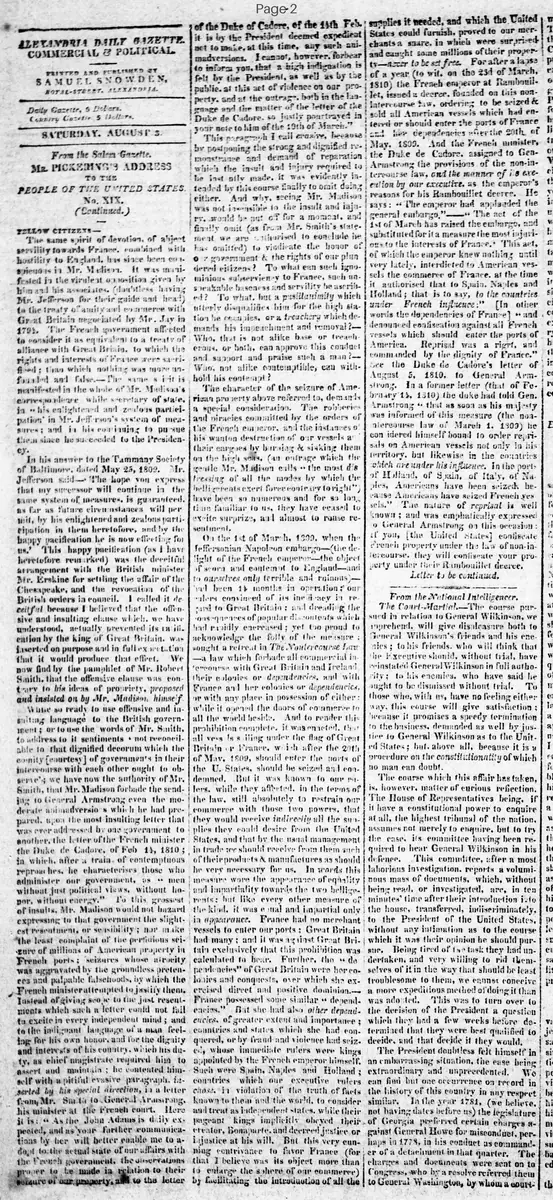
In this installment of Timothy Pickering's address, he criticizes James Madison's foreign policy as subservient to France and hostile to Britain, citing opposition to Jay's 1795 treaty, the deceitful Erskine agreement on the Chesapeake affair, mild response to French insults by Duke de Cadore, and the Non-Intercourse Act of 1809 that provoked French seizures of American vessels under the Rambouillet Decree.
Clipping
OCR Quality
90%
Excellent
Full Text
From the Salem Gazette.
MR. PICKERING'S ADDRESS
TO THE
PEOPLE OF THE UNITED STATES.
No. XIX.
(Continued.)
FELLOW CITIZENS--
The same spirit of devotion, of abject
servility towards France, combined with
hostility to England, has since been con-
spicuous in Mr. Madison. It was mani-
fested in the virulent opposition given by
him and his associates, (doubtless having
Mr. Jefferson for their guide and head)
to the treaty of amity and commerce with
Great Britain negotiated by Mr. Jay in
1795. The French government affected
to consider it as equivalent to a treaty of
alliance with Great Britain, to which the
rights and interests of France were sacri-
ficed; than which nothing was more un-
founded and false-- Mr. same spirit is
manifested in the whole of Mr. Madison's
correspondence while secretary of state.
in his enlightened and zealous partici-
pation in Mr. Jefferson's system of mea-
sures; and in his continuing to pursue
them since he succeeded to the Presiden-
cy.
In his answer to the Tammany Society
of Baltimore, dated May 25, 1809. Mr.
Jefferson said--: The hope you express
that my successor will continue in the
same system of measures, is guaranteed.
as far as future circumstances will per-
mit, by his enlightened and zealous parti-
cipation in them heretofore, and by the
happy pacification he is now effecting for
us.? This happy pacification (as I have
heretofore remarked) was the deceitful
arrangement with the British minister
Mr. Erskine for settling the affair of the
Chesapeake, and the revocation of the
British orders in council. I called it de-
ceitful because I believed that the offen-
sive and insulting clause which we have
understood, actually prevented its ratifi-
cation by the king of Great Britain. was
inserted on purpose and in full ex pect..tion
that it would produce that effect. We
now know by the pamphlet of Mr. Robert
Smith. that the offensive clause was con-
trary to his ideas of propriety, proposed
and insisted on by Mr. Madison himself
Who so ready to use offensive and in-
sulting language to the British govern-
ment; or to use the words of Mr. Smith,
to address to it sentiments not reconcil-
able to that dignified decorum which the
comity [courtesy] of governments in their
intercourse with each other ought to ob-
serve; we have now the authority of Mr.
Smith, that Mr. Madison forbade the send-
ing to General Armstrong even the mo-
derate animadversions which he had pre-
pared. upon the most insulting letter that
was ever addressed by one government to
another, the letter of the French minister
the Duke de Cadore, of Feb 14, 1810 :
in which, after a train of contemptuous
reproaches. he characterises those who
administer our government, as " men
without just political views, without ho-
nor. without energy." To this grossest
of insults. Mr. Madison would not hazard
expressing to that government the slight-
est resentment, or sensibility; nor make
the least complaint of the perfidious sei-
zure of millions of American property in
French ports; seizures whose atrocity
was aggravated by the groundless preten-
sions and palpable falsehoods, by which the
French minister attempted to justify them.
Instead of giving scope to the just resent-
ments which such a letter could not fail
to excite in every independent mind ; and
to the indignant language of a man feel-
ing for his own honor. and for the dignity
and interests of his country. which his du-
ty, as chief magistrate required him to
assert and maintain ; he contented him-
self with a pitiful evasive paragraph. in-
serted by his special direction, in a letter
from Mr. Smith to General Armstrong.
his minister at the French court. Here
it is:" As the John Adams is daily ex-
pected, and as your further communica-
tions by her will better enable me to a-
dopt the actual state of our affairs with
the French government, the observations
proper to be made in relation to their
seizure of our property. as to the letter
of the Duke of Cadore, of the 5th Feb
last- it is by the President deemed expedient
not to make. at this time, any such ani-
madversions. I cannot, however. forbear
to inform you. that a high indignation is
felt by the President, as well as by the
public.at this act of violence on our pro-
perly. and at the outrage, both in the lan-
guage and the matter of the letter of the
Duke de Cadore. so justly pourtrayed in
your note to him of the 10th of March."
This paragraph I call evasive, because
by postponing the strong and dignified re-
monstrance and demand of reparation
which the insult and injury required to
be instantly made. it was evidently in-
tended by this course finally to omit doing
either. And why, seeing Mr. Madison
was not insensible to the insult and inju-
ry. would he not of for a moment, and
finally omit (as from Mr. Smith's state-
ment we are authorized to conclude he
has omitted) to vindicate the honor of
our government & the rights of our plun-
dered citizens? To what can such igno-
minious subserviency to France, such un-
speakable baseness and servility be ascrib-
ed? To what. but a pusillanimity which
utterly disqualifies him for the high sta-
tion he occupies. or a treachery which de-
mands his impeachment and removal?--
Who, that is not alike base or treach-
erous. or both, can approve this conduct
and support and praise such a man?-
Who: not alike contemptible, can with-
hold his contempt?
The character of the seizure of Ame-
rican property above referred to, demands
a special consideration. The robberies
and piracies committed by the orders of
the French emperor. and the instances o'
his wanton destruction of our vessels a'
their cargoes by burning & sinking them
on the high seas. (an outrage which the
gentle Mr. Madison calls . the most dis
tressing of all the modes by which the
belligerents exert force contrary to right".
have been so numerous and for so long,
that being familiar to us. they have ceased to
excite surprize, and almost to rouse re-
sentment.
On the 1st of March. 1809. when the
Jeffersonian Napoleon embargo-(the de-
light of the French emperor--the object
of scorn and contempt to England-and
to ourselves only terrible and ruinous)-
had been 14 months in operation; our
rulers convinced of its inefficacy in re-
gard to Great Britain : and dreading the
consequences of popular discontents which
had rapidly increased; yet too proud to
acknowledge the folly of the measure :
sought a retreat in The Nonintercourse Law
—a law which forbade all commercial in-
tercourse with Great Britain and Ireland
their colonies or dependencies. and with
France and her colonies or dependencies.
or with any place in possession of either :
while it opened the doors of commerce to
all the world beside. And to render this
prohibition complete. it was enacted. that
all vessels sailing under the flag of Great
Britain or France. which after the 20th
of May, 1809, should enter the ports of
the U. States. should be seized and con-
demned. But it was known to our ru-
lers. while they affected. in the terms of
the law. still absolutely to restrain our
commerce with those two powers, that
they would receive indirectly all the sup-
plies they could desire from the United
States, and that by the usual management
in trade we should receive from them such
of their products & manufactures as should
be very necessary for us. In words this
measure wore the appearance of equality
and impartiality towards the two bellige-
rents; but like every other measure of
the kind. it was equal and impartial only
in appearance. France had no merchant
vessels to enter our ports : Great Britain
had many; and it was against Great Bri-
tain exclusively that this prohibition was
calculated to bear. Further. the " de
pendencies" of Great Britain were her co-
lonies and conquests, over which she ex-
ereised direct and positive dominion.--
France possessed some similar " depend-
encies."
But she had also other depend-
encies. of greater extent and importance ;
countries and states which she had con-
quered, or by fraud and violence had seiz-
ed, whose immediate rulers were kings
appointed by the French emperor himself.
Such were Spain, Naples and Holland :
countries which our executive rulers
chose. in violation of the truth of facts
known to them and the world. to consider
and treat as independent states. while their
pageant kings implicitly obeyed their
creator, Bonaparte. and decreed justice or
injustice at his will. But this very cun-
ning contrivance to favor France (for
that I believe was its object more than
to enlarge the sphere of our commerce)
by facilitating the introduction of all the
supplies it needed. and which the United
States could furnish, proved to our mer-
chants a snare. in which were surprised
and caught some millions of their proper-
ty never to be set free. For after a lapse
of a year (to wit. on the 23d of March.
1810) the French emperor at Rambouil-
let. issued a decree. founded on this non-
intercourse law, ordering to be seized &
sold all American vessels which had en-
tered or should enter the ports of France
and her dependencies either before the 20th of
May. 1809. And the French minister,
the Duke de Cadore. assigned to Gen-
Armstrong the provisions of the non-in-
tercourse law, and the manner of its exe-
cution by our executive, as the emperor's
reasons for his Rambouillet decree. He
says: .The emperor had concluded the
general embargo.
The act of the
1st of March has raised the embargo, and
substituted for it a measure the most injurious to the interests of France. This act,
of which the emperor knew nothing until
very lately. interdicted to American ves-
sels the commerce of France. at the time
it authorised that to Spain. Naples and
Holland; that is to say, to the countries
under French influence:" [In other
words the dependencies of France]" and
denounced confiscation against all French
vessels which should enter the ports of
America. Retaliation was a right. and
commanded by the dignity of France."
See the Duke de Cadore's letter of
August 5. 1810. to General Arm-
strong. In a former letter (that of Feb-
ruary 2d. 1810) the duke had told Gen.
Armstrong . that as soon as his majesty
was informed of this measure (the non-
intercourse law of March 1. 1809) he
considered himself bound to order retalia-
tion on American vessels not only in his
territory. but likewise in the countries
which are under his influence. in the ports
of Holland. of Spain. of Italy. of Na-
ples, Americans have been seized. be-
cause Americans have seized French ves-
sels." The nature of retaliation is well
known; and was emphatically expressed
to General Armstrong on this occasion :
if you, [the United States] confiscate
French property under the law of non-in-
tercourse, they will confiscate your pro-
perty under their Rambouillet decree.
Letter to be continued.
MR. PICKERING'S ADDRESS
TO THE
PEOPLE OF THE UNITED STATES.
No. XIX.
(Continued.)
FELLOW CITIZENS--
The same spirit of devotion, of abject
servility towards France, combined with
hostility to England, has since been con-
spicuous in Mr. Madison. It was mani-
fested in the virulent opposition given by
him and his associates, (doubtless having
Mr. Jefferson for their guide and head)
to the treaty of amity and commerce with
Great Britain negotiated by Mr. Jay in
1795. The French government affected
to consider it as equivalent to a treaty of
alliance with Great Britain, to which the
rights and interests of France were sacri-
ficed; than which nothing was more un-
founded and false-- Mr. same spirit is
manifested in the whole of Mr. Madison's
correspondence while secretary of state.
in his enlightened and zealous partici-
pation in Mr. Jefferson's system of mea-
sures; and in his continuing to pursue
them since he succeeded to the Presiden-
cy.
In his answer to the Tammany Society
of Baltimore, dated May 25, 1809. Mr.
Jefferson said--: The hope you express
that my successor will continue in the
same system of measures, is guaranteed.
as far as future circumstances will per-
mit, by his enlightened and zealous parti-
cipation in them heretofore, and by the
happy pacification he is now effecting for
us.? This happy pacification (as I have
heretofore remarked) was the deceitful
arrangement with the British minister
Mr. Erskine for settling the affair of the
Chesapeake, and the revocation of the
British orders in council. I called it de-
ceitful because I believed that the offen-
sive and insulting clause which we have
understood, actually prevented its ratifi-
cation by the king of Great Britain. was
inserted on purpose and in full ex pect..tion
that it would produce that effect. We
now know by the pamphlet of Mr. Robert
Smith. that the offensive clause was con-
trary to his ideas of propriety, proposed
and insisted on by Mr. Madison himself
Who so ready to use offensive and in-
sulting language to the British govern-
ment; or to use the words of Mr. Smith,
to address to it sentiments not reconcil-
able to that dignified decorum which the
comity [courtesy] of governments in their
intercourse with each other ought to ob-
serve; we have now the authority of Mr.
Smith, that Mr. Madison forbade the send-
ing to General Armstrong even the mo-
derate animadversions which he had pre-
pared. upon the most insulting letter that
was ever addressed by one government to
another, the letter of the French minister
the Duke de Cadore, of Feb 14, 1810 :
in which, after a train of contemptuous
reproaches. he characterises those who
administer our government, as " men
without just political views, without ho-
nor. without energy." To this grossest
of insults. Mr. Madison would not hazard
expressing to that government the slight-
est resentment, or sensibility; nor make
the least complaint of the perfidious sei-
zure of millions of American property in
French ports; seizures whose atrocity
was aggravated by the groundless preten-
sions and palpable falsehoods, by which the
French minister attempted to justify them.
Instead of giving scope to the just resent-
ments which such a letter could not fail
to excite in every independent mind ; and
to the indignant language of a man feel-
ing for his own honor. and for the dignity
and interests of his country. which his du-
ty, as chief magistrate required him to
assert and maintain ; he contented him-
self with a pitiful evasive paragraph. in-
serted by his special direction, in a letter
from Mr. Smith to General Armstrong.
his minister at the French court. Here
it is:" As the John Adams is daily ex-
pected, and as your further communica-
tions by her will better enable me to a-
dopt the actual state of our affairs with
the French government, the observations
proper to be made in relation to their
seizure of our property. as to the letter
of the Duke of Cadore, of the 5th Feb
last- it is by the President deemed expedient
not to make. at this time, any such ani-
madversions. I cannot, however. forbear
to inform you. that a high indignation is
felt by the President, as well as by the
public.at this act of violence on our pro-
perly. and at the outrage, both in the lan-
guage and the matter of the letter of the
Duke de Cadore. so justly pourtrayed in
your note to him of the 10th of March."
This paragraph I call evasive, because
by postponing the strong and dignified re-
monstrance and demand of reparation
which the insult and injury required to
be instantly made. it was evidently in-
tended by this course finally to omit doing
either. And why, seeing Mr. Madison
was not insensible to the insult and inju-
ry. would he not of for a moment, and
finally omit (as from Mr. Smith's state-
ment we are authorized to conclude he
has omitted) to vindicate the honor of
our government & the rights of our plun-
dered citizens? To what can such igno-
minious subserviency to France, such un-
speakable baseness and servility be ascrib-
ed? To what. but a pusillanimity which
utterly disqualifies him for the high sta-
tion he occupies. or a treachery which de-
mands his impeachment and removal?--
Who, that is not alike base or treach-
erous. or both, can approve this conduct
and support and praise such a man?-
Who: not alike contemptible, can with-
hold his contempt?
The character of the seizure of Ame-
rican property above referred to, demands
a special consideration. The robberies
and piracies committed by the orders of
the French emperor. and the instances o'
his wanton destruction of our vessels a'
their cargoes by burning & sinking them
on the high seas. (an outrage which the
gentle Mr. Madison calls . the most dis
tressing of all the modes by which the
belligerents exert force contrary to right".
have been so numerous and for so long,
that being familiar to us. they have ceased to
excite surprize, and almost to rouse re-
sentment.
On the 1st of March. 1809. when the
Jeffersonian Napoleon embargo-(the de-
light of the French emperor--the object
of scorn and contempt to England-and
to ourselves only terrible and ruinous)-
had been 14 months in operation; our
rulers convinced of its inefficacy in re-
gard to Great Britain : and dreading the
consequences of popular discontents which
had rapidly increased; yet too proud to
acknowledge the folly of the measure :
sought a retreat in The Nonintercourse Law
—a law which forbade all commercial in-
tercourse with Great Britain and Ireland
their colonies or dependencies. and with
France and her colonies or dependencies.
or with any place in possession of either :
while it opened the doors of commerce to
all the world beside. And to render this
prohibition complete. it was enacted. that
all vessels sailing under the flag of Great
Britain or France. which after the 20th
of May, 1809, should enter the ports of
the U. States. should be seized and con-
demned. But it was known to our ru-
lers. while they affected. in the terms of
the law. still absolutely to restrain our
commerce with those two powers, that
they would receive indirectly all the sup-
plies they could desire from the United
States, and that by the usual management
in trade we should receive from them such
of their products & manufactures as should
be very necessary for us. In words this
measure wore the appearance of equality
and impartiality towards the two bellige-
rents; but like every other measure of
the kind. it was equal and impartial only
in appearance. France had no merchant
vessels to enter our ports : Great Britain
had many; and it was against Great Bri-
tain exclusively that this prohibition was
calculated to bear. Further. the " de
pendencies" of Great Britain were her co-
lonies and conquests, over which she ex-
ereised direct and positive dominion.--
France possessed some similar " depend-
encies."
But she had also other depend-
encies. of greater extent and importance ;
countries and states which she had con-
quered, or by fraud and violence had seiz-
ed, whose immediate rulers were kings
appointed by the French emperor himself.
Such were Spain, Naples and Holland :
countries which our executive rulers
chose. in violation of the truth of facts
known to them and the world. to consider
and treat as independent states. while their
pageant kings implicitly obeyed their
creator, Bonaparte. and decreed justice or
injustice at his will. But this very cun-
ning contrivance to favor France (for
that I believe was its object more than
to enlarge the sphere of our commerce)
by facilitating the introduction of all the
supplies it needed. and which the United
States could furnish, proved to our mer-
chants a snare. in which were surprised
and caught some millions of their proper-
ty never to be set free. For after a lapse
of a year (to wit. on the 23d of March.
1810) the French emperor at Rambouil-
let. issued a decree. founded on this non-
intercourse law, ordering to be seized &
sold all American vessels which had en-
tered or should enter the ports of France
and her dependencies either before the 20th of
May. 1809. And the French minister,
the Duke de Cadore. assigned to Gen-
Armstrong the provisions of the non-in-
tercourse law, and the manner of its exe-
cution by our executive, as the emperor's
reasons for his Rambouillet decree. He
says: .The emperor had concluded the
general embargo.
The act of the
1st of March has raised the embargo, and
substituted for it a measure the most injurious to the interests of France. This act,
of which the emperor knew nothing until
very lately. interdicted to American ves-
sels the commerce of France. at the time
it authorised that to Spain. Naples and
Holland; that is to say, to the countries
under French influence:" [In other
words the dependencies of France]" and
denounced confiscation against all French
vessels which should enter the ports of
America. Retaliation was a right. and
commanded by the dignity of France."
See the Duke de Cadore's letter of
August 5. 1810. to General Arm-
strong. In a former letter (that of Feb-
ruary 2d. 1810) the duke had told Gen.
Armstrong . that as soon as his majesty
was informed of this measure (the non-
intercourse law of March 1. 1809) he
considered himself bound to order retalia-
tion on American vessels not only in his
territory. but likewise in the countries
which are under his influence. in the ports
of Holland. of Spain. of Italy. of Na-
ples, Americans have been seized. be-
cause Americans have seized French ves-
sels." The nature of retaliation is well
known; and was emphatically expressed
to General Armstrong on this occasion :
if you, [the United States] confiscate
French property under the law of non-in-
tercourse, they will confiscate your pro-
perty under their Rambouillet decree.
Letter to be continued.
What sub-type of article is it?
Foreign Affairs
Partisan Politics
Economic Policy
What keywords are associated?
Madison Criticism
French Subservience
Jay Treaty Opposition
Non Intercourse Law
Rambouillet Decree
Chesapeake Affair
Duke De Cadore
American Seizures
What entities or persons were involved?
Mr. Madison
Mr. Jefferson
Mr. Pickering
Duke De Cadore
General Armstrong
Mr. Erskine
Mr. Robert Smith
French Emperor
Great Britain
Editorial Details
Primary Topic
Criticism Of Madison's Subservience To France In Foreign Policy
Stance / Tone
Accusatory And Condemnatory Of Madison's Pro French Bias
Key Figures
Mr. Madison
Mr. Jefferson
Mr. Pickering
Duke De Cadore
General Armstrong
Mr. Erskine
Mr. Robert Smith
French Emperor
Great Britain
Key Arguments
Madison's Opposition To Jay's 1795 Treaty Showed Servility To France
Deceitful Erskine Agreement On Chesapeake Prevented British Ratification
Madison Insisted On Offensive Clause In Erskine Deal
Madison Forbade Strong Response To Duke De Cadore's Insulting Letter
Evasive U.S. Reaction To French Seizures Of American Property
Non Intercourse Act Of 1809 Favored France And Provoked Rambouillet Decree
French Retaliation Justified By U.S. Law But Exposed Policy Bias
Madison's Pusillanimity Disqualifies Him From Presidency