Thank you for visiting SNEWPapers!
Sign up free
Fowle's New Hampshire Gazette And General Advertiser
Portsmouth, Rockingham County, New Hampshire
What is this article about?
John Sullivan responds to 'Honestus' in the New-Hampshire Gazette, defending his Revolutionary War loyalty against accusations of pro-British leanings and bribery. He challenges Honestus to provide evidence and counters with proofs of his accuser's associate's disloyalty, including town records, threats, and letters.
Clipping
OCR Quality
Full Text
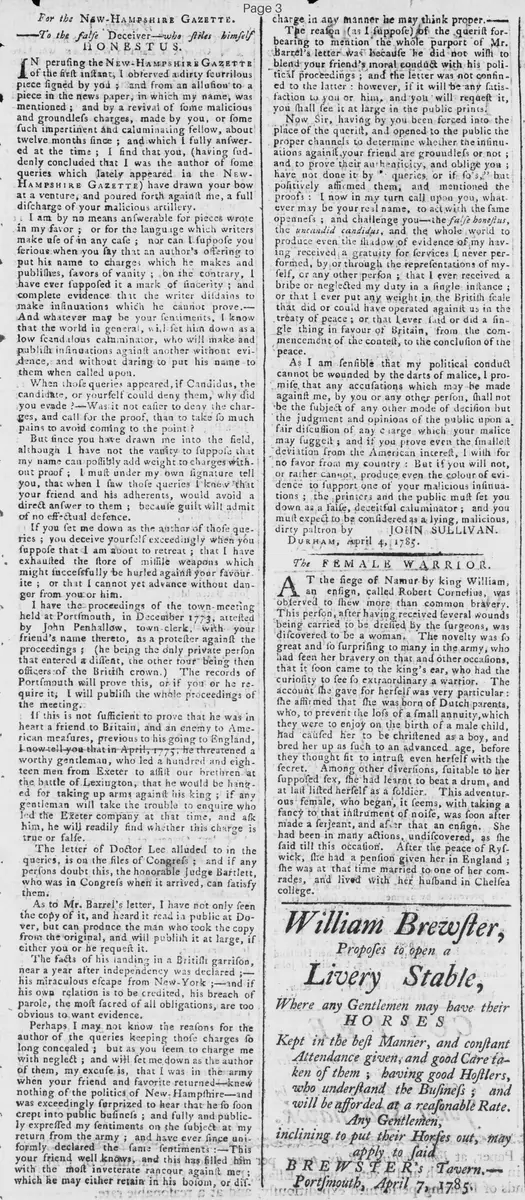
To the false Deceiver, who styles himself HONESTUS.
In perusing the New-Hampshire Gazette of the first instant, I observed a dirty currilous piece signed by you; and from an allusion to a piece in the news paper, in which my name was mentioned; and by a revival of some malicious and groundless charges, made by you, or some such impertinent and calumniating fellow, about twelve months since: and which I fully answered at the time; I find that you, (having suddenly concluded that I was the author of some queries which lately appeared in the New-Hampshire Gazette) have drawn your bow at a venture, and poured forth against me, a full discharge of your malicious artillery.
I am by no means answerable for pieces wrote in my favor; or for the language which writers make use of in any case; nor can I suppose you serious when you say that an author's offering to put his name to charges which he makes and publishes, savors of vanity; on the contrary, I have ever supposed it a mark of sincerity; and complete evidence that the writer disdains to make insinuations which he cannot prove.
And whatever may be your sentiments, I know that the world in general, will set him down as a low scandalous calumniator, who will make and publish insinuations against another without evidence, and without daring to put his name to them when called upon.
When those queries appeared, if Candidus, the candidate, or yourself could deny them, why did you evade? Was it not easier to deny the charges, and call for the proof, than to take so much pains to avoid coming to the point?
But since you have drawn me into the field, although I have not the vanity to suppose that my name can possibly add weight to charges without proof; I must under my own signature tell you, that when I saw those queries I knew that your friend and his adherents, would avoid a direct answer to them: because guilt will admit of no effectual defence.
If you set me down as the author of those queries; you deceive yourself exceedingly when you suppose that I am about to retreat; that I have exhausted the store of missile weapons which might successfully be hurled against your favorite; or that I cannot yet advance without danger from you or him.
I have the proceedings of the town-meeting held at Portsmouth, in December 1773, attested by John Penhallow, town-clerk, with your friend's name thereto, as a protester against the proceedings; (he being the only private person that entered a dissent, the other four being then officers of the British crown.) The records of Portsmouth will prove this. or if you or he require it; I will publish the whole proceedings of the meeting.
If this is not sufficient to prove that he was in heart a friend to Britain, and an enemy to American measures, previous to his going to England, I now tell you that in April, 1775, he threatened a worthy gentleman, who led a hundred and eighteen men from Exeter to assist our brethren at the battle of Lexington, that he would be hanged for taking up arms against his king; if any gentleman will take the trouble to enquire who led the Exeter company at that time, and ask him, he will readily find whether this charge is true or false.
The letter of Doctor Lee alluded to in the queries, is on the files of Congress; and if any persons doubt this, the honorable Judge Bartlett, who was in Congress when it arrived, can satisfy them.
As to Mr. Barrel's letter, I have not only seen the copy of it, and heard it read in public at Dover, but can produce the man who took the copy from the original, and will publish it at large, if either you or he request it.
The facts of his landing in a British garrison, near a year after independency was declared; his miraculous escape from New-York: and if his own relation is to be credited, his breach of parole, the most sacred of all obligations, are too obvious to want evidence.
Perhaps I may not know the reasons for the author of the queries keeping those charges so long concealed; but as you seem to charge me with neglect; and will set me down as the author of them, my excuse is, that I was in the army when your friend and favorite returned knew nothing of the politics of New-Hampshire and was exceedingly surprised to hear that he so soon crept into public business; and fully and publicly expressed my sentiments on the subject at my return from the army; and have ever since uniformly declared the same sentiments: This your friend well knows, and this has filled him with the most inveterate rancour against me; which he may either retain in his bosom, or discharge in any manner he may think proper.
The reason (as I suppose) of the querist for-bearing to mention the whole purport of Mr. Barrel's letter was because he did not wish to blend your friend's moral conduct with his political proceedings: and the letter was not confined to the latter: however, if it will be any satisfaction to you or him, and you will request it, you shall see it at large in the public prints.
Now Sir, having by you been forced into the place of the querist, and opened to the public the proper channels to determine whether the insinuations against your friend are groundless or not; and to prove their authenticity, and oblige you; have not done it by queries, or if so, but positively affirmed them, and mentioned the proofs: I now in my turn call upon you, whatever may be your real name, to act with the same openness: and challenge you the false honestus, the uncandid candidus, and the whole world to produce even the shadow of evidence of my having received a gratuity for services I never performed, by or through the representations of myself, or any other person: that I ever received a bribe or neglected my duty in a single instance; or that I ever put any weight in the British scale that did or could have operated against us in the treaty of peace; or that I ever said or did a single thing in favour of Britain, from the commencement of the contest, to the conclusion of the peace.
As I am sensible that my political conduct cannot be wounded by the darts of malice, I promise that any accusations which may be made against me, by you or any other person, shall not be the subject of any other mode of decision but the judgment and opinions of the public upon a fair discussion of any charge which your malice may suggest; and if you prove even the smallest deviation from the American interest, I wish for no favor from my country: But if you will not, or rather cannot, produce even the colour of evidence to support one of your malicious insinuations; the printers and the public must set you down as a false, deceitful calumniator; and you must expect to be considered as a lying, malicious, dirty poltroon by
JOHN SULLIVAN.
Durham, April 4, 1785.
What sub-type of article is it?
What themes does it cover?
What keywords are associated?
What entities or persons were involved?
Letter to Editor Details
Author
John Sullivan
Recipient
Honestus
Main Argument
john sullivan defends his unwavering loyalty to the american cause during the revolution against honestus's accusations of bribery and pro-british actions, challenging him to provide evidence while presenting proofs of his accuser's friend's disloyalty through historical records and testimonies.
Notable Details