Thank you for visiting SNEWPapers!
Sign up free
The Enquirer
Richmond, Henrico County, Virginia
What is this article about?
In December 1808, at the US District Court in Norfolk, the government sued Indian Deer, Hipkins, and others for forfeiting a $1200 bond over the schooner Caroline's unlicensed voyage to Antigua. Defendants' counsel successfully argued the bond's condition violated statutes, resulting in dismissal.
Clipping
OCR Quality
Full Text
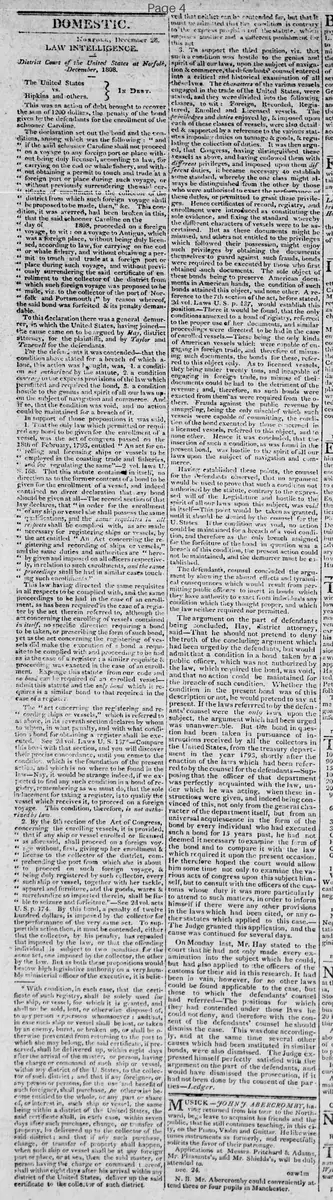
Norfolk, December 28.
LAW INTELLIGENCE.
District Court of the United States at Norfolk, December, 1808.
The United States vs. Indian Deer, Hipkins and others.
This was an action of debt brought to recover the sum of 1200 dollars, the penalty of the bond given by the defendants for the enrollment of the schooner Caroline.
The declaration set out the bond and the conditions, among which was the following: "and if the said schooner Caroline shall not proceed on a voyage to any foreign port or place without being duly licensed, according to law, for carrying on the cod or whale fishery, and without obtaining a permit to touch and trade at a foreign port or place during such voyage, or without previously surrendering the said certificate of enrollment to the collector of the district from which such foreign voyage shall be proposed to be made, then," &c. This condition, it was averred, had been broken in this, "that the said schooner Caroline on the day of 1808, proceeded on a foreign voyage, to wit: on a voyage to Antigua, which was a foreign place, without being duly licensed, according to law, for carrying on the cod or whale fishery, and without obtaining a permit to touch and trade at a foreign port or place during such voyage, and without previously surrendering the said certificate of enrollment to the collector of the district from which such foreign voyage was proposed to be made, viz. to the collector of the port of Norfolk and Portsmouth;" by reason whereof, the said bond was forfeited & its penalty demandable.
To this declaration there was a general demurrer, in which the United States, having joined—the cause came on to be argued by Ray, district attorney, for the plaintiffs, and by Taylor and Tazewell for the defendants.
For the defendants it was contended—that the condition above stated for a breach of which alone, this action was brought, was, 1. a condition not authorized by the statute, 2. a condition contrary to the express provisions of the law which permitted and required the bond, 3. a condition hostile to the genius and spirit of all our laws upon the subject of navigation and commerce. And if so, that the condition was void, and no action could be maintained for a breach of it.
In support of those propositions it was said, 1. That the only law which permitted or required any bond to be given for the enrollment of a vessel, was the act of congress passed on the 18th of February, 1793, entitled "An act for enrolling and licensing ships or vessels to be employed in the coasting trade and fisheries, and for regulating the same"—2 vol. laws U. S. 168. That this statute contained in itself, no direction as to the form or contents of a bond to be given for the enrollment of a vessel, and indeed contained no direct declaration that any bond should be given at all—The second section of that law declares, that "in order for the enrollment of any ship or vessel she shall possess the same qualifications, and the same requisites in all respects shall be complied with, as are made necessary for registering ships or vessels, by the act entitled "An Act concerning the registering and recording of ships or vessels," and the same duties and authorities are "hereby given and imposed on all officers respectively, in relation to such enrollments, and the same proceedings shall be had in similar cases touching such enrollments."
This law having directed the same requisites in all respects to be complied with, and the same proceedings to be had in the case of an enrollment, as has been required in the case of a register by the act therein referred to, although the act concerning the enrolling of vessels contained in itself, no specific direction requiring a bond to be taken, or prescribing the form of such bond, yet as the act concerning the registering of vessels did make the execution of a bond a requisite to be complied with and proceeding to be had as in the case of a register; a similar requisite & proceeding was exacted in the case of an enrollment. Expunge this statute from our code and no bond can be required of an enrolled vessel—admit this statute and the only bond which it requires is a similar bond to that required in the case of a register.
The "act concerning the registering and recording ships or vessels," which is referred to as above, in its seventh section declares by whom to whom, in what penalty, and with what condition a bond for obtaining a register shall be executed. See 2d vol. Laws U. S. 137—Compare this bond with that section, and you will discover their precise concordance, until you come to the condition, which is the foundation of the present action, and which is no where to be found in the law—Nay, it would be strange indeed, if we expected to find any such condition in a bond of registry, remembering as we must do, that the sole inducement for taking a register, is to qualify the vessel which receives it, to proceed on a foreign voyage. This condition, therefore, is not authorized by law.
2. By the 8th section of the Act of Congress, concerning the enrolling vessels, it is provided, that if any ship or vessel enrolled or licensed as aforesaid, shall proceed on a foreign voyage without, first, giving up her enrollment & license to the collector of the district, comprehending the port from which she is about to proceed on such foreign voyage, & being duly registered by such collector, every such ship or vessel, together with her tackle, apparel and furniture, and the goods, wares & merchandize so imported therein, shall be liable to seizure and forfeiture. See 2d vol. acts U.S. p. 174. By this bond, a penalty of twelve hundred dollars, is imposed by the collector for the performance of the very same act. To support this action then, it must be contended, either that the collector, by his penalty, has repealed that imposed by the law, or that the offending individual is subject to two penalties for the same act, one imposed by the collector, the other by the law. But as both these propositions would bestow high legislative authority on a very humble ministerial officer of the executive, it is believed that neither can be contended for. but that it must be admitted that the condition is contrary to the express provisions of the statute, which expresses another and a different punishment for this act
3. To support the third position, viz. that such a condition was hostile to the genius and spirit of all our laws, upon the subject of navigation & commerce, the defendants' counsel entered into a critical and historical examination of all these laws. The characters of the various vessels engaged in the trade of the United States, were stated, and they were divided into the following classes, to wit: Foreign, Recorded, Registered, Enrolled and Licensed vessels. The privileges and duties enjoyed by, & imposed upon each of these classes of vessels, were also detailed & supported by a reference to the various statutes imposing duties on tonnage & goods, & regulating the collection of duties. It was then argued, that Congress, having distinguished these vessels as above, and having endowed them with different privileges, and imposed upon them different duties, it became necessary to establish some standard, whereby the one class might always be distinguished from the other by those who were authorised to exact the performance of these duties, or permitted to grant these privileges. Hence certificates of record, registry, and enrollment were introduced as constituting the sole evidence, and fixing the standard whereby the different characters of vessels were to be ascertained. But as these documents might be misused, and others not entitled to the privileges which followed their possession, might enjoy such privileges by obtaining the documents themselves to guard against such frauds, bonds were required to be executed by those who first obtained such documents. The sole object of these bonds being to preserve American documents in American hands, the condition of such bonds attained this object, and none other. A reference to the 7th section of the act, before stated, 2d vol. Laws U. S. p. 137. would establish this position.—There it would be found, that the only conditions annexed to a bond of registry, referred to the proper use of her documents, and similar proceedings were directed to be had in the case of enrolled vessels.—These being the only kinds of American vessels which were capable of engaging in foreign trade, and therefore of misusing such documents, the bonds for these, referred to this object only. As to licensed vessels, they being under twenty tons, and incapable of engaging in foreign trade, no misuse of their documents could be had to the detriment of the revenue; and, therefore, no such bonds were exacted from them as were required from the others. Frauds against the public revenue by smuggling, being the only mischief which such vessels were capable of committing, the condition of the bond executed by those concerned in a licensed vessels, referred to this object, and to none other. Hence it was concluded, that the insertion of such a condition, as was found in the present bond, was hostile to the spirit of all our laws upon the subject of navigation and commerce.
Having established these points, the counsel for the defendants observed, that no argument would be used to prove that such a condition not authorised by the statute, contrary to the expressed will of the Legislature and hostile to the spirit of all our laws upon this subject, was void in itself—This point would be taken as granted, until it should be denied by the counsel for the U. States. If the condition was void, no action could be maintained for a breach of a void condition, and therefore as the only breach assigned for the forfeiture of the bond in question was a breach of this condition, the present action could not be maintained, and the demurrer must be established.
The defendants' counsel concluded the argument by shewing the absurd effects and tyrannical consequences which would result from permitting public officers to insert in bonds which they have authority to exact from individuals any condition which they thought proper, and which the law neither required nor permitted.
The argument on the part of defendants being concluded, Hay, district attorney, said—That he should not pretend to deny the truth of the concluding argument which had been urged by the defendants, but would admit that a condition in a bond taken by a public officer, which was not authorized by the law, which required the bond, was void, and that no action could be maintained for the breach of such condition. Whether the condition in the present bond was of this description or not, he would pretend to say at present. If the laws referred to by the defendants' counsel were the only laws upon the subject, the argument which had been urged was unanswerable. But—the bond in question had been taken in pursuance of instructions received by all the collectors in the United States, from the treasury department in the year 1793, shortly after the enactment of the laws which had been referred to by the counsel for the defendants—Supposing that the officer of that department was perfectly acquainted with the law, under which he was acting, when these instructions were given, and indeed being convinced of this, not only from the general character of the department itself, but from a universal acquiescence in the form of the bond by every individual who had executed such a bond for 15 years past, he had not deemed it necessary to examine the form of the bond and to compare it with the law which required it upon the present occasion.
He therefore hoped the court would allow him some time not only to examine the various acts of congress upon this subject himself, but to consult with the officers of the customs whose duty it was more particularly to attend to such matters, in order to inform himself if there were any other provisions in the laws which had been cited, or any other statutes which applied to this case.—
The Judge granted this application, and the cause was continued for several days.
On Monday last, Mr. Hay stated to the court that he had not only made every examination into the subject which he could, but had also applied to the officers of the customs for their aid in this research. It had been in vain, however, for no other laws could be found applicable to the case, but those to which the defendants' counsel had referred—The positions for which they had contended under those laws he could not deny, and therefore with the consent of the defendants' counsel he should dismiss the case. This was done accordingly, and at the same time several other causes which had been instituted in similar bonds, were also dismissed. The Judge expressed himself perfectly satisfied with the argument on the part of the defendants, and would have dismissed the prosecution, if it had not been done by the consent of the parties—Ledger.
What sub-type of article is it?
What themes does it cover?
What keywords are associated?
What entities or persons were involved?
Where did it happen?
Story Details
Key Persons
Location
Norfolk
Event Date
December 1808
Story Details
The United States sued Indian Deer, Hipkins, and others for $1200 bond penalty due to the schooner Caroline's unauthorized voyage to Antigua without proper licensing or surrender of enrollment certificate. Defendants argued the bond condition was unauthorized by statute, contrary to law, and hostile to navigation laws, leading to the case's dismissal after the district attorney's concession.