Thank you for visiting SNEWPapers!
Sign up free
Alexandria Gazette & Daily Advertiser
Alexandria, Virginia
What is this article about?
On Dec. 11, 1817, the U.S. House of Representatives passed a resolution admitting Mississippi as a state. A resolution by Mr. Forsyth to investigate congressmen's office holdings passed on a tie vote. The House debated and advanced a bill to abolish internal duties, rejecting an amendment on auction duties.
Clipping
OCR Quality
Full Text
FRIDAY, DECEMBER 12, 1817.
FROM OUR CORRESPONDENT.
CONGRESS:
HOUSE OF REPRESENTATIVES,
Washington, Thursday, Dec. 11.
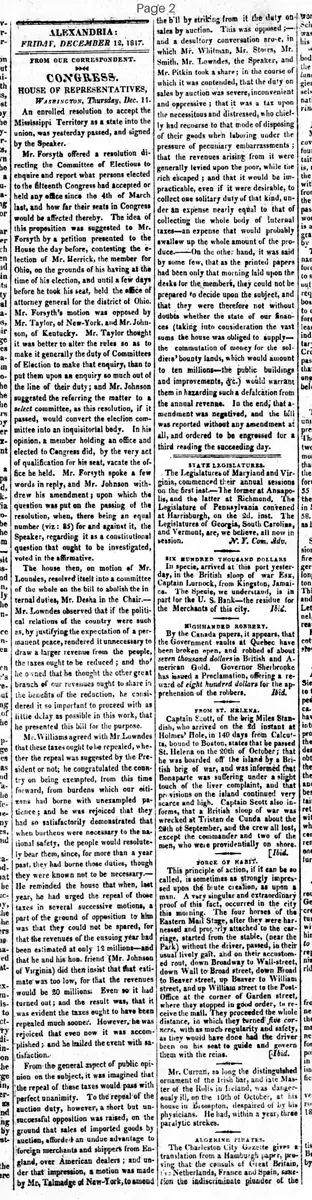
An enrolled resolution to accept the Mississippi Territory as a state into the union, was yesterday passed, and signed by the Speaker.
Mr. Forsyth offered a resolution directing the Committee of Elections to enquire and report what persons elected to the fifteenth Congress had accepted or held any office since the 4th of March last, and how far their seats in Congress would be affected thereby. The idea of this proposition was suggested to Mr. Forsyth by a petition presented to the House the day before, contesting the election of Mr. Herrick, the member for Ohio, on the grounds of his having at the time of his election, and until a few days before he took his seat, held the office of attorney general for the district of Ohio:
Mr. Forsyth's motion was opposed by Mr. Taylor, of New-York, and Mr. Johnson, of Kentucky. Mr. Taylor thought it was better to alter the rules so as to make it generally the duty of Committees of Election to make that enquiry, than to put them upon an enquiry so much out of the line of their duty; and Mr. Johnson suggested the referring the matter to a select committee, as this resolution if it passed, would convert the election committee into an inquisitorial body. In his opinion, a member holding an office and elected to Congress did, by the very act of qualification for his seat, vacate the office he held. Mr. Forsyth spoke a few words in reply, and Mr. Johnson withdrew his amendment; upon which the question was put on the passing of the resolution, when, there being an equal number (viz: 85) for and against it, the Speaker, regarding it as a constitutional question that ought to be investigated, voted in the affirmative.
The house then, on motion of Mr. Lowndes, resolved itself into a committee of the whole on the bill to abolish the internal duties, Mr. Desha in the Chair.
Mr. Lowndes observed that if the political relations of the country were such as, by justifying the expectation of a permanent peace, rendered it unnecessary to draw a larger revenue from the people, the taxes ought to be reduced; and tho' he owned that he thought the other great branch of our revenues ought to share in the benefits of the reduction, he considered it so important to proceed with as little delay as possible in this work, that he presented this bill for the purpose.
Mr. Williams agreed with Mr. Lowndes that these taxes ought to be repealed, whether the repeal was suggested by the President or not; he congratulated the country on being exempted, from this time forward, from burdens which our citizens had borne with unexampled patience; and he was rejoiced that they had so satisfactorily demonstrated that when burdens were necessary to the national safety, the people would resolutely bear them, since, for more than a year past, they had borne those duties, though they were known not to be necessary.
He reminded the house that when, last year, he had urged the repeal of those taxes in several successive motions, a part of the ground of opposition to him was that they could not be spared, for that the revenues of the ensuing year had been estimated at only 1 millions-and that he and his hon. friend (Mr. Johnson of Virginia) did then insist that that estimate was too low, for that the revenues would be 20 millions? Even so it had turned out; and the result was, that it was evident the taxes ought to have been repealed much sooner. However, he was rejoiced that even now it was accomplished; and he hailed the event with satisfaction.
From the general aspect of public opinion on the subject, it was imagined that the repeal of these taxes would pass with perfect unanimity. To the repeal of the auction duty, however, a short but unsuccessful opposition was raised, on the ground that sales of imported goods by auction, afforded an undue advantage to foreign merchants and shippers from England, over American dealers; and under that impression, a motion was made by Mr. Talmadge of New-York, to amend the bill by striking from it the duty on sales by auction. This was opposed; and a desultory conversation arose, in which Mr. Whitman, Mr. Storrs, Mr. Smith, Mr. Lowndes, the Speaker, and Mr. Pitkin took a share; in the course of which it was contended, that the duty on sales by auction was severe, inconvenient and oppressive; that it was a tax upon the necessitous and distressed, who chiefly had recourse to that mode of disposing of their goods when laboring under the pressure of pecuniary embarrassments; that the revenues arising from it were generally levied upon the poor, while the rich escaped; and that it would be impracticable, even if it were desirable, to collect one solitary duty of that kind, under an expense nearly equal to that of collecting the whole body of internal taxes-an expense that would probably swallow up the whole amount of the produce. On the other hand, it was said by some few, that as the printed papers had been only that morning laid upon the desks for the members, they could not be prepared to decide upon the subject, and that they were therefore not without doubts whether the state of our finances (taking into consideration the vast sums the house was obliged to supply-the commutation of money for the soldiers' bounty lands, which would amount to ten millions-the public buildings and improvements, &c.) would warrant them in hazarding such a defalcation from the annual revenue. In the end, that amendment was negatived, and the bill was reported without any amendment at all, and ordered to be engrossed for a third reading the succeeding day.
What sub-type of article is it?
What keywords are associated?
What entities or persons were involved?
Where did it happen?
Domestic News Details
Primary Location
Washington
Event Date
Thursday, Dec. 11
Key Persons
Outcome
resolution admitting mississippi as a state passed and signed. forsyth's resolution on office holdings passed 85-85 with speaker's affirmative vote. bill to abolish internal duties reported without amendment and ordered engrossed for third reading.
Event Details
House passed resolution accepting Mississippi Territory as a state. Forsyth proposed resolution for Committee of Elections to check if fifteenth Congress members held offices post-March 4, prompted by petition against Herrick for holding Ohio attorney general post. Debate ensued; resolution passed on tie. House entered committee on bill abolishing internal duties; Lowndes and Williams supported repeal. Talmadge's amendment to strike auction duty failed after discussion; bill advanced unamended.