Thank you for visiting SNEWPapers!
Sign up free
Story
November 7, 1873
Pioche Daily Record
Pioche, Lincoln County, Nevada
What is this article about?
Former San Franciscan Joseph Hugel murders his daughter Caroline by stabbing her on a New Orleans wharf as their ship arrives, motivated by her perceived misconduct and defiance during the voyage from Europe. He is arrested; passengers dispute his claims of her behavior. (214 characters)
Clipping
OCR Quality
95%
Excellent
Full Text
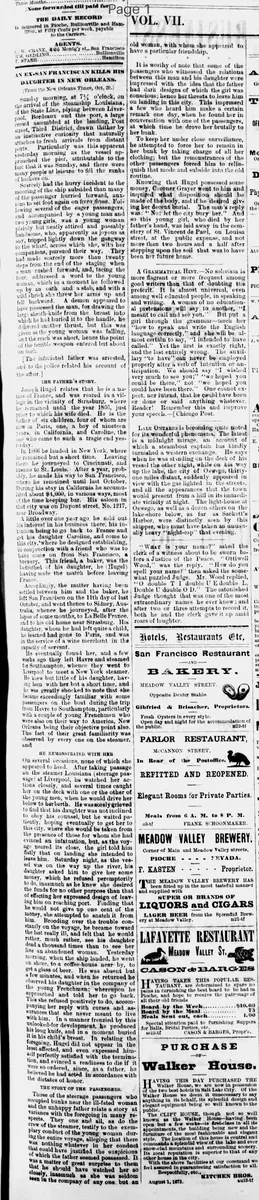
AN EX-SAN FRANCISCAN KILLS HIS DAUGHTER IN NEW ORLEANS.
[From the New Orleans Times, Oct. 20.]
Sunday morning, at 7 o'clock, on the arrival of the steamship Louisiana, of the State Line, plying between Liverpool, Bordeaux and this port, a large crowd assembled at the landing, Post street, Third District, drawn thither by an instinctive curiosity that naturally attaches to fresh arrivals from distant ports.
Particularly was this apparent yesterday morning as the vessel approached the pier, attributable to the fact that it was Sunday, and there were many people at leisure to fill the ranks of lookers on.
Scarcely had the hurry incident to the mooring of the ship subsided than many of the passengers hurried forward, anxious to set foot again on terra firma. Following several of the eager passengers, and accompanied by a young man and two young girls, was a young woman plainly but neatly attired and passably handsome, who, apparently as joyous as any, tripped lightly down the gangway to the wharf, across which she, with her companions, pursued their way. They had made scarcely more than twenty steps from the end of the staging when a man rushed forward, and, facing the four, addressed a word to the young woman, which in a moment he followed up by an oath and a stab, and with a wild shriek she threw her arms up and fell backward. A demon appeared to have possessed the man, for drawing the large sheath-knife from the breast into which he had buried it to the handle, he delivered another thrust, but this was given as the young woman was falling, and the reach was short, hence the point of the terrible weapon entered but about an inch.
[The infuriated father was arrested and to the police related his account of the affair.]
THE FATHER'S STORY.
Joseph Hugel relates that he is a native of France, and was reared in a village in the vicinity of Strasburg, where he remained until the year 1866, just prior to which his wife died. He is the father of six children, four of whom are now in Paris, one, a boy of nineteen years, in California, and Caroline, the one who came to such a tragic end yesterday.
In 1866 he landed in New York, where he remained but a short time. Leaving there he journeyed to Cincinnati, and thence to St. Louis. After a year, probably, he made his way to San Francisco, where he remained until last October.
During his stay in California he accumulated about $4,000, in various ways, most of the time keeping bar. His saloon in that city was on Dupont street, No. 1217, near Broadway.
A little over one year ago he sold out his interest in his business there, his intention being to go back to France and get his daughter Caroline, and come to this city, where he designed establishing, in conjunction with a friend who was to have come on from San Francisco, a brewery. This friend, a baker, was the betrothed of his daughter, he (Hugel) having made the match before leaving France.
Accordingly, the matter having been settled between him and the baker, he left San Francisco on the 11th day of last October, and went thence to Sidney, Australia, whence he journeyed, after the lapse of some months, to La Belle France, and to his old home near Strasburg. His daughter, whom he had left quite a child, he learned had gone to Paris, and was in the service of a wine merchant in the capacity of servant.
He eventually found her, and a few weeks ago they left Havre and steamed for Southampton, whence they went to Liverpool to meet a New York steamer.
He knew but little of his daughter, having been with her but a short time, and he was greatly shocked to note that she became exceedingly familiar with some passengers on the boat during the trip from Havre to Southampton, particularly with a couple of young Frenchmen who were also on their way to America, New Orleans being their objective point also.
The fact of their great familiarity was observed by every one on the steamer, and HE REMONSTRATED WITH HER on several occasions, none of which she appeared to heed. After taking passage on the steamer Louisiana (steerage passage) at Liverpool, he watched her actions closely, and several times caught her on the deck with one or the other of the young men, when he would drive her below to her berth. He was sorely grieved to find that his daughter was not inclined to obey his counsel, but he waited patiently, hoping eventually to get her to this city, where she would be taken from the presence of those for whom she had evinced an infatuation, but, as the voyage neared its close, the girl told him flatly that on landing she intended to leave him. Saturday night, as the vessel was on the way up the river, his daughter asked him to give her some money, which he refused peremptorily to do, inasmuch as he knew she desired the funds for no other purpose than that of effecting her expressed design of leaving him on reaching port. Finding that he would not give up one cent of the money, she attempted to snatch it from him. Brooding over the trouble constantly on the voyage, he became toward the last really ill, and felt that he would rather, much rather, see his daughter dead a thousand times than to see her live an abandoned woman. Yesterday morning, when the ship landed, he went on shore, to a coffee-house near by, to get a glass of beer. He was absent but a few minutes, and when he returned he observed his daughter in the company of the young Frenchman; whereupon he approached and told her to go back. This she refused positively to do, accompanying her reply with curses and assurances that she never meant to live with him. In a manner frenzied by this unlooked-for development, he produced his long knife, and in a moment buried it in his child's breast. In relating the foregoing, Hugel did not appear in the least affected, and even expressed himself perfectly satisfied with the termination, and evinced a readiness to die if it were so ordered, since, as a father, he believed he had acted in accordance with the dictates of honor.
THE STORY OF THE PASSENGERS.
Those of the steerage passengers who occupied bunks near the ill-fated woman and the unhappy father relate a story at variance with the foregoing in many respects. They one and all, as do the crew of the steamer, testify to the exemplary conduct of the young woman during the entire voyage, alleging that there was nothing whatever in her conduct that could have justified the suspicions of which the father seemed possessed. It was a matter of great surprise to them that he should have watched her so closely, inasmuch as she was seldom seen in the company of any one but an old woman, with whom she appeared to have a particular friendship.
It is worthy of note that some of the passengers who witnessed the relations between this man and his daughter were impressed with the idea that the father had dark designs of which the girl was conscious; hence her threats to leave him on landing in this city. This impressed a few who heard him make a certain remark one day, when he found her in conversation with one of the passengers, at which time he drove her brutally to her bunk.
To keep her under close surveillance, he attempted to force her to remain in her bunk by taking charge of all her clothing; but the remonstrances of the other passengers forced him to relinquish that mode and subside into the old routine.
Knowing that Hugel possessed some money, Coroner Grayer went to him and inquired what disposition should be made of the body, and if he desired giving her decent burial. The man's reply was: "No; let the city bury her." And so this young girl, who died by her father's hand, was laid away in the cemetery of St. Vincent de Paul, on Louisa street, at the public expense, and not more than two hours and a half after stepping upon the soil that was to have been her future home.
[From the New Orleans Times, Oct. 20.]
Sunday morning, at 7 o'clock, on the arrival of the steamship Louisiana, of the State Line, plying between Liverpool, Bordeaux and this port, a large crowd assembled at the landing, Post street, Third District, drawn thither by an instinctive curiosity that naturally attaches to fresh arrivals from distant ports.
Particularly was this apparent yesterday morning as the vessel approached the pier, attributable to the fact that it was Sunday, and there were many people at leisure to fill the ranks of lookers on.
Scarcely had the hurry incident to the mooring of the ship subsided than many of the passengers hurried forward, anxious to set foot again on terra firma. Following several of the eager passengers, and accompanied by a young man and two young girls, was a young woman plainly but neatly attired and passably handsome, who, apparently as joyous as any, tripped lightly down the gangway to the wharf, across which she, with her companions, pursued their way. They had made scarcely more than twenty steps from the end of the staging when a man rushed forward, and, facing the four, addressed a word to the young woman, which in a moment he followed up by an oath and a stab, and with a wild shriek she threw her arms up and fell backward. A demon appeared to have possessed the man, for drawing the large sheath-knife from the breast into which he had buried it to the handle, he delivered another thrust, but this was given as the young woman was falling, and the reach was short, hence the point of the terrible weapon entered but about an inch.
[The infuriated father was arrested and to the police related his account of the affair.]
THE FATHER'S STORY.
Joseph Hugel relates that he is a native of France, and was reared in a village in the vicinity of Strasburg, where he remained until the year 1866, just prior to which his wife died. He is the father of six children, four of whom are now in Paris, one, a boy of nineteen years, in California, and Caroline, the one who came to such a tragic end yesterday.
In 1866 he landed in New York, where he remained but a short time. Leaving there he journeyed to Cincinnati, and thence to St. Louis. After a year, probably, he made his way to San Francisco, where he remained until last October.
During his stay in California he accumulated about $4,000, in various ways, most of the time keeping bar. His saloon in that city was on Dupont street, No. 1217, near Broadway.
A little over one year ago he sold out his interest in his business there, his intention being to go back to France and get his daughter Caroline, and come to this city, where he designed establishing, in conjunction with a friend who was to have come on from San Francisco, a brewery. This friend, a baker, was the betrothed of his daughter, he (Hugel) having made the match before leaving France.
Accordingly, the matter having been settled between him and the baker, he left San Francisco on the 11th day of last October, and went thence to Sidney, Australia, whence he journeyed, after the lapse of some months, to La Belle France, and to his old home near Strasburg. His daughter, whom he had left quite a child, he learned had gone to Paris, and was in the service of a wine merchant in the capacity of servant.
He eventually found her, and a few weeks ago they left Havre and steamed for Southampton, whence they went to Liverpool to meet a New York steamer.
He knew but little of his daughter, having been with her but a short time, and he was greatly shocked to note that she became exceedingly familiar with some passengers on the boat during the trip from Havre to Southampton, particularly with a couple of young Frenchmen who were also on their way to America, New Orleans being their objective point also.
The fact of their great familiarity was observed by every one on the steamer, and HE REMONSTRATED WITH HER on several occasions, none of which she appeared to heed. After taking passage on the steamer Louisiana (steerage passage) at Liverpool, he watched her actions closely, and several times caught her on the deck with one or the other of the young men, when he would drive her below to her berth. He was sorely grieved to find that his daughter was not inclined to obey his counsel, but he waited patiently, hoping eventually to get her to this city, where she would be taken from the presence of those for whom she had evinced an infatuation, but, as the voyage neared its close, the girl told him flatly that on landing she intended to leave him. Saturday night, as the vessel was on the way up the river, his daughter asked him to give her some money, which he refused peremptorily to do, inasmuch as he knew she desired the funds for no other purpose than that of effecting her expressed design of leaving him on reaching port. Finding that he would not give up one cent of the money, she attempted to snatch it from him. Brooding over the trouble constantly on the voyage, he became toward the last really ill, and felt that he would rather, much rather, see his daughter dead a thousand times than to see her live an abandoned woman. Yesterday morning, when the ship landed, he went on shore, to a coffee-house near by, to get a glass of beer. He was absent but a few minutes, and when he returned he observed his daughter in the company of the young Frenchman; whereupon he approached and told her to go back. This she refused positively to do, accompanying her reply with curses and assurances that she never meant to live with him. In a manner frenzied by this unlooked-for development, he produced his long knife, and in a moment buried it in his child's breast. In relating the foregoing, Hugel did not appear in the least affected, and even expressed himself perfectly satisfied with the termination, and evinced a readiness to die if it were so ordered, since, as a father, he believed he had acted in accordance with the dictates of honor.
THE STORY OF THE PASSENGERS.
Those of the steerage passengers who occupied bunks near the ill-fated woman and the unhappy father relate a story at variance with the foregoing in many respects. They one and all, as do the crew of the steamer, testify to the exemplary conduct of the young woman during the entire voyage, alleging that there was nothing whatever in her conduct that could have justified the suspicions of which the father seemed possessed. It was a matter of great surprise to them that he should have watched her so closely, inasmuch as she was seldom seen in the company of any one but an old woman, with whom she appeared to have a particular friendship.
It is worthy of note that some of the passengers who witnessed the relations between this man and his daughter were impressed with the idea that the father had dark designs of which the girl was conscious; hence her threats to leave him on landing in this city. This impressed a few who heard him make a certain remark one day, when he found her in conversation with one of the passengers, at which time he drove her brutally to her bunk.
To keep her under close surveillance, he attempted to force her to remain in her bunk by taking charge of all her clothing; but the remonstrances of the other passengers forced him to relinquish that mode and subside into the old routine.
Knowing that Hugel possessed some money, Coroner Grayer went to him and inquired what disposition should be made of the body, and if he desired giving her decent burial. The man's reply was: "No; let the city bury her." And so this young girl, who died by her father's hand, was laid away in the cemetery of St. Vincent de Paul, on Louisa street, at the public expense, and not more than two hours and a half after stepping upon the soil that was to have been her future home.
What sub-type of article is it?
Crime Story
Family Drama
Tragedy
What themes does it cover?
Family
Tragedy
Crime Punishment
What keywords are associated?
Father Kills Daughter
Immigrant Murder
New Orleans Wharf
Family Honor
Steamer Arrival
What entities or persons were involved?
Joseph Hugel
Caroline
Where did it happen?
New Orleans, Post Street, Third District
Story Details
Key Persons
Joseph Hugel
Caroline
Location
New Orleans, Post Street, Third District
Event Date
Sunday Morning, Oct. 20
Story Details
Joseph Hugel, a former San Franciscan, stabs his daughter Caroline to death on the wharf in New Orleans upon the arrival of the steamship Louisiana, driven by suspicions of her improper conduct during the voyage and her refusal to obey him.