Thank you for visiting SNEWPapers!
Sign up free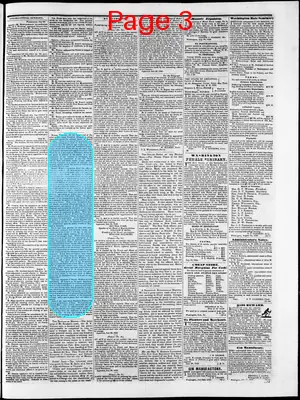
Editorial
August 21, 1850
Washington Telegraph
Washington, Hempstead County, Arkansas
What is this article about?
This editorial lauds Daniel Webster's appointment as Secretary of State by President Fillmore, emphasizing his intellectual stature, diplomatic successes with England, and recent Senate defense of national unity against sectionalism and fanaticism.
Clipping
OCR Quality
98%
Excellent
Full Text
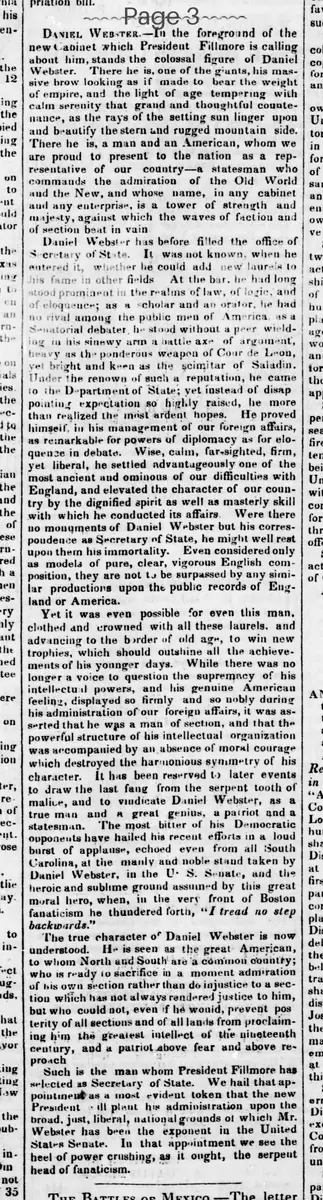
DANIEL WEBSTER.—In the foreground of the new Cabinet which President Fillmore is calling about him, stands the colossal figure of Daniel Webster. There he is, one of the giants, his massive brow looking as if made to bear the weight of empire, and the light of age tempering with calm serenity that grand and thoughtful countenance, as the rays of the setting sun linger upon and beautify the stern and rugged mountain side.
There he is, a man and an American, whom we are proud to present to the nation as a representative of our country—a statesman who commands the admiration of the Old World and the New, and whose name, in any cabinet and any enterprise, is a tower of strength and majesty, against which the waves of faction and of section beat in vain.
Daniel Webster has before filled the office of Secretary of State. It was not known, when he entered it, whether he could add new laurels to his fame in other fields. At the bar, he had long stood prominent in the realms of law, of logic, and of eloquence; as a scholar and an orator, he had no rival among the public men of America; as a Senatorial debater, he stood without a peer wielding in his sinewy arm a battle axe of argument, heavy as the ponderous weapon of Cour de Leon, yet bright and keen as the scimitar of Saladin.
Under the renown of such a reputation, he came to the Department of State; yet instead of disappointing expectation so highly raised, he more than realized the most ardent hopes. He proved himself, in his management of our foreign affairs, as remarkable for powers of diplomacy as for eloquence in debate. Wise, calm, far-sighted, firm, yet liberal, he settled advantageously one of the most ancient and ominous of our difficulties with England, and elevated the character of our country by the dignified spirit as well as masterly skill with which he conducted its affairs. Were there no monuments of Daniel Webster but his correspondence as Secretary of State, he might well rest upon them his immortality. Even considered only as models of pure, clear, vigorous English composition, they are not to be surpassed by any similar productions upon the public records of England or America.
Yet it was even possible for even this man, clothed and crowned with all these laurels, and advancing to the border of old age, to win new trophies, which should outshine all the achievements of his younger days. While there was no longer a voice to question the supremacy of his intellectual powers, and his genuine American feeling, displayed so firmly and so nobly during his administration of our foreign affairs, it was asserted that he was a man of section, and that the powerful structure of his intellectual organization was accompanied by an absence of moral courage which destroyed the harmonious symmetry of his character. It has been reserved to later events to draw the last fang from the serpent tooth of malice, and to vindicate Daniel Webster, as a true man and a great genius, a patriot and a statesman. The most bitter of his Democratic opponents have hailed his recent efforts in a loud burst of applause, echoed even from all South Carolina, at the manly and noble stand taken by Daniel Webster, in the U. S. Senate, and the heroic and sublime ground assumed by this great moral hero, when, in the very front of Boston fanaticism he thundered forth, "I tread no step backwards."
The true character of Daniel Webster is now understood. He is seen as the great American, to whom North and South are a common country; who is ready to sacrifice in a moment admiration of his own section rather than do injustice to a section which has not always rendered justice to him, but who could not, even if he would, prevent posterity of all sections and of all lands from proclaiming him the greatest intellect of the nineteenth century, and a patriot above fear and above reproach.
Such is the man whom President Fillmore has selected as Secretary of State. We hail that appointment as a most evident token that the new President will plant his administration upon the broad, just, liberal, national grounds of which Mr. Webster has been the exponent in the United States Senate. In that appointment we see the heel of power crushing, as it ought, the serpent head of fanaticism.
There he is, a man and an American, whom we are proud to present to the nation as a representative of our country—a statesman who commands the admiration of the Old World and the New, and whose name, in any cabinet and any enterprise, is a tower of strength and majesty, against which the waves of faction and of section beat in vain.
Daniel Webster has before filled the office of Secretary of State. It was not known, when he entered it, whether he could add new laurels to his fame in other fields. At the bar, he had long stood prominent in the realms of law, of logic, and of eloquence; as a scholar and an orator, he had no rival among the public men of America; as a Senatorial debater, he stood without a peer wielding in his sinewy arm a battle axe of argument, heavy as the ponderous weapon of Cour de Leon, yet bright and keen as the scimitar of Saladin.
Under the renown of such a reputation, he came to the Department of State; yet instead of disappointing expectation so highly raised, he more than realized the most ardent hopes. He proved himself, in his management of our foreign affairs, as remarkable for powers of diplomacy as for eloquence in debate. Wise, calm, far-sighted, firm, yet liberal, he settled advantageously one of the most ancient and ominous of our difficulties with England, and elevated the character of our country by the dignified spirit as well as masterly skill with which he conducted its affairs. Were there no monuments of Daniel Webster but his correspondence as Secretary of State, he might well rest upon them his immortality. Even considered only as models of pure, clear, vigorous English composition, they are not to be surpassed by any similar productions upon the public records of England or America.
Yet it was even possible for even this man, clothed and crowned with all these laurels, and advancing to the border of old age, to win new trophies, which should outshine all the achievements of his younger days. While there was no longer a voice to question the supremacy of his intellectual powers, and his genuine American feeling, displayed so firmly and so nobly during his administration of our foreign affairs, it was asserted that he was a man of section, and that the powerful structure of his intellectual organization was accompanied by an absence of moral courage which destroyed the harmonious symmetry of his character. It has been reserved to later events to draw the last fang from the serpent tooth of malice, and to vindicate Daniel Webster, as a true man and a great genius, a patriot and a statesman. The most bitter of his Democratic opponents have hailed his recent efforts in a loud burst of applause, echoed even from all South Carolina, at the manly and noble stand taken by Daniel Webster, in the U. S. Senate, and the heroic and sublime ground assumed by this great moral hero, when, in the very front of Boston fanaticism he thundered forth, "I tread no step backwards."
The true character of Daniel Webster is now understood. He is seen as the great American, to whom North and South are a common country; who is ready to sacrifice in a moment admiration of his own section rather than do injustice to a section which has not always rendered justice to him, but who could not, even if he would, prevent posterity of all sections and of all lands from proclaiming him the greatest intellect of the nineteenth century, and a patriot above fear and above reproach.
Such is the man whom President Fillmore has selected as Secretary of State. We hail that appointment as a most evident token that the new President will plant his administration upon the broad, just, liberal, national grounds of which Mr. Webster has been the exponent in the United States Senate. In that appointment we see the heel of power crushing, as it ought, the serpent head of fanaticism.
What sub-type of article is it?
Partisan Politics
Foreign Affairs
What keywords are associated?
Daniel Webster
Secretary Of State
President Fillmore
National Unity
Sectionalism
Foreign Diplomacy
Senate Speech
What entities or persons were involved?
Daniel Webster
President Fillmore
England
U. S. Senate
South Carolina
Boston Fanaticism
Editorial Details
Primary Topic
Praise For Daniel Webster's Appointment As Secretary Of State And Defense Of His National Patriotism
Stance / Tone
Strongly Supportive And Laudatory Of Webster's Character And Policies
Key Figures
Daniel Webster
President Fillmore
England
U. S. Senate
South Carolina
Boston Fanaticism
Key Arguments
Webster's Unmatched Eloquence And Legal Prowess
Successful Diplomacy Resolving Issues With England
Vindication Against Accusations Of Sectionalism And Lack Of Moral Courage
Commitment To National Unity Over Sectional Interests
Appointment Signals Fillmore's National Administration
Crushing Of Fanaticism Through Webster's Leadership