Thank you for visiting SNEWPapers!
Sign up free
Editorial
October 23, 1863
Delaware Gazette
Wilmington, New Castle County, Delaware
What is this article about?
Bishop Hopkins defends Southern slavery biblically, rejecting Declaration of Independence's equality as inapplicable to negroes, refuting objections on cruelty, immorality, property in man, and liberty, arguing it promotes happiness, order, and aligns with divine will over abolitionist views.
Clipping
OCR Quality
95%
Excellent
Full Text
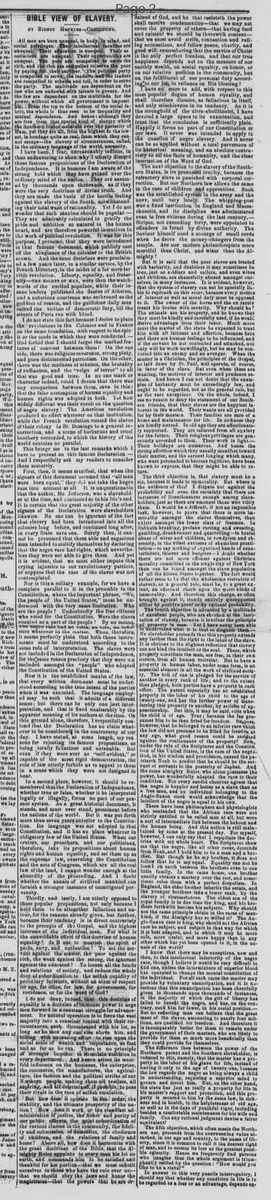
BIBLE VIEW OF SLAVERY.
BY BISHOP HOPKINS—CONCLUDED.
All men are born unequal, in body, in mind, and social privileges. Their intellectual faculties are unequal. Their education is unequal. Their associations are unequal. Their opportunities are unequal. The poor are compelled to serve the rich, and the rich are compelled to serve the poor by paying for their services. The political party is compelled to serve the leaders, and the leaders are compelled to scheme and toil, in order to serve the party. The multitude are dependent on the few who are endowed with talents to govern. And the few are dependent on the multitude, for the power, without which all government is impossible. From the top to the bottom of the social fabric, the whole is thus seen to be inequality and mutual dependence. And hence: although they are free from that special kind of slavery which the Southern States maintain over the posterity of Ham, yet they are all, from the highest to the lowest, in bondage quite as real, from which they can not escape—the slavery of circumstances, called, in the ordinary language of the world, necessity.
I have been, I fear, unreasonably tedious, in thus endeavoring to show why I utterly discard these famous propositions of the Declaration of Independence. It is because I am aware of the strong hold which they have gained over the ordinary mind of the nation. They are assumed by thousands upon thousands, as if they were the very doctrines of divine truth. And they are made the basis of the hostile feeling against the slavery of the South, notwithstanding their total want of rationality. Yet I do not wonder that such maxims should be popular.—They are admirably calculated to gratify the pride and ambition so natural to the human heart, and are therefore powerful incentives in the work of political revolution. It was for this purpose, I presume, that they were introduced in that famous document, which publicly cast off the allegiance of the colonies to the British crown. And the same doctrines were proclaimed a few years later, in a similar service, by the French Directory, in the midst of a far more terrible revolution. Liberty, equality, and fraternity—THE RIGHTS OF MAN, were then the watch-words of the excited populace, while their insane leaders published the decree of Atheism, and a notorious courtesan was enthroned as the goddess of reason, and the guillotine daily massacred the victims of democratic fury, till the streets of Paris ran with blood.
I do not state this fact because I desire to place the revolutions in the Colonies and in France on the same foundation, with respect to the spirit or the mode in which they were conducted.—God forbid that I should forget the marked features of contrast between them! On the one side, there was religious reverence, strong piety, and pure disinterested patriotism. On the other, there was the madness of atheism, the brutality of ruffianism, and the "reign of terror" to all that was good and true. In no one mark or character indeed, could I dream that there was any comparison between them, save in this: that the false assumption of human equality and human rights was adopted in both. Yet how widely different was their result on the question of negro slavery! The American revolution produced no effect whatever on that institution; while the French revolution roused the slaves of their colony in St. Domingo to a general insurrection, and a scene of barbarous and cruel butchery succeeded, to which the history of the world contains no parallel.
This brings me to the last remarks which I have to present on this famous Declaration—And I respectfully ask my readers to consider them maturely
First, then, it seems manifest, that when the signers of this document assumed that all men were born equal," they did not take the negro race into account at all. It is unquestionable that the author, Mr. Jefferson, was a slaveholder at the time, and continued so to his life's end. It is certain that the great majority of the other signers of the Declaration were slaveholders likewise. No one can be ignorant of the fact that slavery had been introduced into all the colonies long before, and continued long after, in every State save one. Surely then, it cannot be presumed that these able and sagacious men intended to stultify themselves by declaring that the negro race had rights, which nevertheless they were not able to give them. ·And yet it is evident, that we must either impute this crying injustice to our revolutionary patriots, or suppose that the case of the slaves was not contemplated.
Nor is this a solitary example, for we have a complete parallel to it in the preamble to the Constitution, where the important phrase, "We, the people of the United States," must be understood with the very same limitation. Who are the people? Undoubtedly the free citizens who voted for the Constitution. Were the slaves counted as a part of the people? By no means. The negro race had no voice, no vote, no influence whatever in the matter. Thus, therefore it seems perfectly plain that both those instruments must be understood according to the same rule of interpretation. The slaves were not included in the Declaration of Independence, for the same reason precisely that they were not included amongst the "people" who adopted the Constitution of the United States.
Now it is the established maxim of the law that every written document must be understood according to the true intent of the parties when it was executed. The language employed may be such that it admits of a different sense; but there can be only one just interpretation, and that is fixed unalterably by the apparent meaning of its authors at the time. On this ground alone, therefore, I respectfully contend that the Declaration has no claim whatever to be considered in the controversy of our day. I have stated, at some length, my reasons for rejecting its famous propositions, as being totally fallacious and untenable. But even if they were ever so "self evident," or capable of the most rigid demonstration, the rule of law utterly forbids us to appeal to them in a sense which they were not designed to bear.
In a second place, however, it should be remembered that the Declaration of Independence, whether true or false, whether it be interpreted legally or illegally, forms no part of our present system. As a great historical document, it stands, and must ever stand, prominent before the nations of the world. But it was put forth more than seven years anterior to the Constitution. Its language was not adopted in that Constitution, and it has no place whatever in the obligatory law of the United States. When our orators, our preachers, and our politicians, therefore, take its propositions about human rights and human equality, and set them up as the supreme law, overruling the Constitution and the acts of Congress, which are all the real law of the land, I cannot wonder enough at the absurdity of the proceeding. And I doubt whether the annals of civilized mankind can furnish a stronger instance of unmitigated perversity.
Thirdly, and lastly, I am utterly opposed to those popular propositions, not only because I hold them to be altogether fallacious and untrue, for the reasons already given, but further, because their tendency is in direct contrariety to the precepts of the Gospel, and the highest interests of the individual man. For what is the unavoidable effect of this doctrine of human equality? Is it not to nourish the spirit of pride, envy, and contention? To set the servant against the master, the poor against the rich, the weak against the strong, the ignorant against the educated? To loosen all the bonds and relations of society, and reduce the whole duty of subordination to the selfish cupidity of pecuniary interests, without an atom of respect for age, for office, for law, for government, for providence, or for the word of God?
I do not deny, indeed, that this doctrine of equality is a doctrine of immense power to urge men forward in a constant struggle for advancement. Its natural operation is to force the vast majority into a ceaseless contest with their circumstances, each discontented with his lot, so long as he sees any one else above him, and toiling with unceasing effort to rise upon the social scale of wealth and importance, as fast and as far as he can. There is no principle of stronger impulse to stimulate ambition in every department. And hence arises its manifold influence on the business, the enterprise, the commerce, the manufactures, the agriculture, the fashion and the political strifes of our Northern people, making them all restless, all aspiring, and all determined, if possible, to pass their rivals in the race of selfish emulation.
But how does it operate in the order, the stability, and the ultimate prosperity of the nation? How does it work on the steadfast administration of justice, the honor and purity of our public officers, the quiet subordination of the various classes in the community, the fidelity and submission of domestics, the obedience of children, and the relations of family and home? Above all, how does it harmonize with the great doctrines of the Bible, that the Almighty Ruler appoints to every man his lot on earth, and commands him to be satisfied and thankful for his portion—that we must submit ourselves to those who have the rule over us—that we should obey the laws and honor the powers that be, ordained of God, and he that resisteth the power shall receive condemnation—that we may not covet the property of others—that having food and raiment we should be therewith content—that we must avoid strife, contention and railing accusations, and follow peace, charity, and good will, remembering that the service of Christ is the only perfect freedom, and that our true happiness depends not on the measure of our earthly wealth, on social equality, on honor, or on our relative position in the community, but on the fulfillment of our personal duty according to our lot, in reliance on His blessing?
I have no more to add, with respect to this most popular dogma of human equality, and shall therefore dismiss, as fallacious in itself, and only mischievous in its tendency. As it is the stronghold of the ultra-abolitionist, I have devoted a large space to its examination, and trust that the conclusion is sufficiently plain. Happily it forms no part of our Constitution or our laws. It never was intended to apply to the question of negro slavery. And it never can be so applied without a total perversion of its historical meaning, and an absolute contrariety to all the facts of humanity, and the clear instruction of the Word of God.
The next objection to the slavery of the Southern States, is its presumed cruelty, because the refractory slave is punished with corporal correction. But our Northern law allows the same in the case of children and apprentices. Such was the established system in the army and the navy, until very lately. The whipping-post was a fixed institution in England and Massachusetts, and its discipline was administered even to free citizens during the last century.—Stripes, not exceeding forty, were appointed to offenders in Israel by divine authority. The Saviour himself used a scourge of small cords when he drove the money-changers from the temple. Are our modern philanthropists more merciful than Christ, and wiser than the Almighty?
But it is said that the poor slaves are treated with barbarity, and doubtless it may sometimes be true, just as soldiers and sailors, and even wives and children, are shamefully abused amongst ourselves, in many instances. It is evident, however, that the system of slavery can not be specially liable to reproach on this score, because every motive of interest as well as moral duty must be opposed to it. The owner of the horse and the ox rarely treats his brutes with severity. Why should he? The animals are his property, and he knows that they must be kindly and carefully used, if he would derive advantage from their labor. Much more must the master of the slave be expected to treat him with all fairness and affection, because here and there are human feelings to be influenced, and if the servant be not contented and attached, not only will he work unwillingly, but he may be converted into an enemy and an avenger. When the master is a Christian, the principles of the Gospel, as laid down by St. Paul, will operate, of course, in favor of the slave. But even when these are wanting, the motives of interest and prudence remain. And hence I can not doubt that the examples of barbarity must be exceedingly few, and ought to be regarded, not as the general rule, but as the rare exceptions. On the whole, indeed, I see no reason to deny the statement of our Southern friends, that their slaves are the happiest laborers in the world. Their wants are all provided for by their masters. Their families are sure of a home and maintenance for life. In sickness they are kindly nursed. In old age they are affectionately supported. They are relieved from all anxiety for the future. Their religious privileges are generously accorded to them. Their work is light.—Their holidays are numerous. And hence the strong affection which they usually manifest toward their master, and the earnest longing which many, who were persuaded to become fugitives, have been known to express, that they might be able to return.
The third objection is, that slavery must be a sin, because it leads to immorality. But where is the evidence of this? I dispute not against the probability and even the certainty that there are instances of licentiousness enough among slaveholders, just as there are amongst those who vilify them. It would be a difficult, if not an impossible task, however, to prove that there is more immorality amongst the slaves themselves, than exists amongst the lower class of freemen. In Sabbath-breaking, profane cursing and swearing, gambling, drunkenness and quarreling—in brutal abuse of wives and children, in rowdyism and obscenity, in the vilest excesses of shameless prostitution—to say nothing of organized bands of counterfeiters, thieves and burglars—I doubt whether there are not more offenses against Christian morality committed in the single city of New York than can be found amongst the slave population of all the fifteen States together. The fact would rather seem to be that the wholesome restraints of slavery, as a general rule, must be, to a great extent, an effectual check upon the worst kinds of immorality. And therefore this charge, so often brought against it, stands entirely unsupported either by positive proof or by rational probability.
The fourth objection is advanced by a multitude of excellent people, who are shocked at the institution of slavery, because it involves the principle of property in man. Yet I have never been able to understand what it is that so disgusts them.—No slaveholder pretends that this property extends any farther than the right to the labor of the slave. It is obvious to the slightest reflection that slavery can not bind the intellect or the soul. These, which properly constitute the man, are free, in their own nature, from all human restraint. But to have a property in human labor, under some form, is an essential element in all the work of civilized society. The toil of one is pledged for the service of another in every rank of life; and to the extent thus pledged, both parties have a property in each other. The parent especially has an established property in the labor of his child to the age of twenty-one, and has the further power of transferring this property to another, by articles of apprenticeship. But this, it may be said, ends when the child is of age.
True; because the law presumes him to be then fitted for freedom. Suppose, however, that he belonged to an inferior race which the law did not presume to be fitted for freedom at any age, what good reason could be assigned against the continuance of the property? Such, under the rule of the Scriptures and the Constitution of the United States, is the case of the negro. God, in his wisdom and providence, caused the patriarch Noah to predict that he should be the servant of servants to the posterity of Japhet. And the same almighty Ruler, who alone possesses the power, has wonderfully adapted the race to their condition. For every candid observer agrees that the negro is happier and better as a slave than as free man, and no individual belonging to the Anglo-Saxon stock would acknowledge that the intellect of the negro is equal to his own.
There have been philosophers and physiologists who contended that the African race were not strictly entitled to be called men at all, but were a sort of intermediate link between the baboon and the human being. And this notion is still maintained by some at the present day. For myself, however, I can only say that I repudiate the doctrine with my whole heart. The Scriptures show me that the negro, like all other races, descends from Noah, and I hold him to be a man and a brother. But though he be my brother, it does not follow that he is my equal. Equality can not be found on earth between the brothers even in one little family. In the same house, one brother usually obtains a mastery over the rest, and sometimes rules them with a perfect despotism. In England, the elder brother inherits the estate, and the younger brothers take a lower rank, by the slavery of circumstances. The eldest son of the royal family is in due time the king, and his brothers forthwith become his subjects. Why should not the same principle obtain in the races of mankind, if the Almighty has so willed it? The Anglo-Saxon race is king, why should not the African race be subject, and subject in that way for which it is best adapted, and in which it may be more safe, more useful, and more happy than in any other which has yet been opened to it, in the annals of the world?
I know that there may be exceptions, now and then, to this intellectual inferiority of the negro race, though I believe it would be very difficult to find one, unless the intermixture of superior blood has operated to change the mental constitution of the individual. For all such cases the master may provide by voluntary emancipation, and it is notorious that this emancipation has been cheerfully given in thousands upon thousands of instances, in the majority of which the gift of liberty has failed to benefit the negro, and has, on the contrary, sunk him far lower, in his social position,—
But no reflecting man can believe that the great mass of the slaves, amounting to nearly four millions, are qualified for freedom. And therefore it is incomparably better for them to remain under the government of their masters, who are likely to provide for them so much more beneficially than they could provide for themselves.
The difference then between the power of the Northern parent and the Southern slaveholder, is reduced to this, namely, that the master has a property in the labor of his slave for life, instead of having it only to the age of twenty-one, govern and direct him. But, on the other hand, the law regards the negro as being always a child in understanding, requiring a superior mind to govern and direct him. But the slave has just as really a property for life in his master's support and protection, and this property is secured to him by the same law, in sickness and in health, in the helplessness of old age, as well as in the days of youthful vigor, including besides a comfortable maintenance for his wife and family. Can any rational judgment devise a fairer equivalent?
The fifth objection, which often meets the Northern ear, proceeds from the overweening value attached, in our age and country, to the name of liberty, since it is common to call it the dearest right of man, and to esteem its loss as the greatest possible calamity. Hence we frequently find persons who imagine that the whole argument is triumphantly settled by the question: "How would you like to be a slave?"
In answer to this very puerile interrogatory, I should say that whether any condition in life is to be regarded as a loss or an advantage, depends entirely upon the character and capacity of the individual. The negro, as we have seen, is much happier as a slave than as a freeman. But suppose the question to be put to me personally, I should reply that I was born a freeman, and have been educated and trained to the exercise of all the faculties and rights which belong to that condition; and therefore, to be reduced to a state of servitude, at my time of life, would be a calamity indeed. But this is no argument against the institution of slavery, any more than the fact that an old man would suffer severely from being deprived of his pension, is an argument against the justice and policy of pensions to the aged and infirm.
The ordinances of God, in the moral government of the world, are all relative and comparative. What would be a blessing to one man, would be a curse to another. The lot of the slaveholder is, in my judgment, one of the happiest and most desirable on earth. He lives amidst a simple and primitive people, who look up to him with affection and respect, and who are ever ready to minister to his comfort. He is surrounded by the charms of nature in a soft and genial climate, and has all the means of rational enjoyment within his reach. His wealth is secure, because it is invested in an unfailing property, which yields him a large income without risk or trouble. He has no anxieties about the future, no cares about the support of his family, no fears of poverty or want. And if he be a Christian man, he has the consciousness of doing good to his fellow-creatures, and of fulfilling a high and responsible trust committed to him by the Almighty.
Contrast this with the restless and feverish existence of the Northern merchant or manufacturer, who is ever on the rack of anxiety about the markets, the prices, the competition, the failures, the losses, the ups and downs of trade. Or with the professional man, who is compelled to toil from morning till night, and often far into the night, in the pursuit of his calling, with no certainty of success, and with the constant dread of poverty and dependence in his old age. Or with the laborer, who has to drudge from year to year, with scanty wages and uncertain employment, and no prospect but a miserable old age and a pauper's grave.
Which of these conditions is the most desirable? Which is the most conducive to happiness and virtue? Let any impartial man decide.
ordained of God, and he that resisteth the power shall receive condemnation—that we may not covet the property of others—that having food and raiment we should be therewith content—that we must avoid strife, contention and railing accusations, and follow peace, charity, and good will, remembering that the service of Christ is the only perfect freedom, and that our true happiness depends not on the measure of our earthly wealth, on social equality, on honor, or on our relative position in the community, but on the fulfillment of our personal duty according to our lot, in reliance on His blessing?
BY BISHOP HOPKINS—CONCLUDED.
All men are born unequal, in body, in mind, and social privileges. Their intellectual faculties are unequal. Their education is unequal. Their associations are unequal. Their opportunities are unequal. The poor are compelled to serve the rich, and the rich are compelled to serve the poor by paying for their services. The political party is compelled to serve the leaders, and the leaders are compelled to scheme and toil, in order to serve the party. The multitude are dependent on the few who are endowed with talents to govern. And the few are dependent on the multitude, for the power, without which all government is impossible. From the top to the bottom of the social fabric, the whole is thus seen to be inequality and mutual dependence. And hence: although they are free from that special kind of slavery which the Southern States maintain over the posterity of Ham, yet they are all, from the highest to the lowest, in bondage quite as real, from which they can not escape—the slavery of circumstances, called, in the ordinary language of the world, necessity.
I have been, I fear, unreasonably tedious, in thus endeavoring to show why I utterly discard these famous propositions of the Declaration of Independence. It is because I am aware of the strong hold which they have gained over the ordinary mind of the nation. They are assumed by thousands upon thousands, as if they were the very doctrines of divine truth. And they are made the basis of the hostile feeling against the slavery of the South, notwithstanding their total want of rationality. Yet I do not wonder that such maxims should be popular.—They are admirably calculated to gratify the pride and ambition so natural to the human heart, and are therefore powerful incentives in the work of political revolution. It was for this purpose, I presume, that they were introduced in that famous document, which publicly cast off the allegiance of the colonies to the British crown. And the same doctrines were proclaimed a few years later, in a similar service, by the French Directory, in the midst of a far more terrible revolution. Liberty, equality, and fraternity—THE RIGHTS OF MAN, were then the watch-words of the excited populace, while their insane leaders published the decree of Atheism, and a notorious courtesan was enthroned as the goddess of reason, and the guillotine daily massacred the victims of democratic fury, till the streets of Paris ran with blood.
I do not state this fact because I desire to place the revolutions in the Colonies and in France on the same foundation, with respect to the spirit or the mode in which they were conducted.—God forbid that I should forget the marked features of contrast between them! On the one side, there was religious reverence, strong piety, and pure disinterested patriotism. On the other, there was the madness of atheism, the brutality of ruffianism, and the "reign of terror" to all that was good and true. In no one mark or character indeed, could I dream that there was any comparison between them, save in this: that the false assumption of human equality and human rights was adopted in both. Yet how widely different was their result on the question of negro slavery! The American revolution produced no effect whatever on that institution; while the French revolution roused the slaves of their colony in St. Domingo to a general insurrection, and a scene of barbarous and cruel butchery succeeded, to which the history of the world contains no parallel.
This brings me to the last remarks which I have to present on this famous Declaration—And I respectfully ask my readers to consider them maturely
First, then, it seems manifest, that when the signers of this document assumed that all men were born equal," they did not take the negro race into account at all. It is unquestionable that the author, Mr. Jefferson, was a slaveholder at the time, and continued so to his life's end. It is certain that the great majority of the other signers of the Declaration were slaveholders likewise. No one can be ignorant of the fact that slavery had been introduced into all the colonies long before, and continued long after, in every State save one. Surely then, it cannot be presumed that these able and sagacious men intended to stultify themselves by declaring that the negro race had rights, which nevertheless they were not able to give them. ·And yet it is evident, that we must either impute this crying injustice to our revolutionary patriots, or suppose that the case of the slaves was not contemplated.
Nor is this a solitary example, for we have a complete parallel to it in the preamble to the Constitution, where the important phrase, "We, the people of the United States," must be understood with the very same limitation. Who are the people? Undoubtedly the free citizens who voted for the Constitution. Were the slaves counted as a part of the people? By no means. The negro race had no voice, no vote, no influence whatever in the matter. Thus, therefore it seems perfectly plain that both those instruments must be understood according to the same rule of interpretation. The slaves were not included in the Declaration of Independence, for the same reason precisely that they were not included amongst the "people" who adopted the Constitution of the United States.
Now it is the established maxim of the law that every written document must be understood according to the true intent of the parties when it was executed. The language employed may be such that it admits of a different sense; but there can be only one just interpretation, and that is fixed unalterably by the apparent meaning of its authors at the time. On this ground alone, therefore, I respectfully contend that the Declaration has no claim whatever to be considered in the controversy of our day. I have stated, at some length, my reasons for rejecting its famous propositions, as being totally fallacious and untenable. But even if they were ever so "self evident," or capable of the most rigid demonstration, the rule of law utterly forbids us to appeal to them in a sense which they were not designed to bear.
In a second place, however, it should be remembered that the Declaration of Independence, whether true or false, whether it be interpreted legally or illegally, forms no part of our present system. As a great historical document, it stands, and must ever stand, prominent before the nations of the world. But it was put forth more than seven years anterior to the Constitution. Its language was not adopted in that Constitution, and it has no place whatever in the obligatory law of the United States. When our orators, our preachers, and our politicians, therefore, take its propositions about human rights and human equality, and set them up as the supreme law, overruling the Constitution and the acts of Congress, which are all the real law of the land, I cannot wonder enough at the absurdity of the proceeding. And I doubt whether the annals of civilized mankind can furnish a stronger instance of unmitigated perversity.
Thirdly, and lastly, I am utterly opposed to those popular propositions, not only because I hold them to be altogether fallacious and untrue, for the reasons already given, but further, because their tendency is in direct contrariety to the precepts of the Gospel, and the highest interests of the individual man. For what is the unavoidable effect of this doctrine of human equality? Is it not to nourish the spirit of pride, envy, and contention? To set the servant against the master, the poor against the rich, the weak against the strong, the ignorant against the educated? To loosen all the bonds and relations of society, and reduce the whole duty of subordination to the selfish cupidity of pecuniary interests, without an atom of respect for age, for office, for law, for government, for providence, or for the word of God?
I do not deny, indeed, that this doctrine of equality is a doctrine of immense power to urge men forward in a constant struggle for advancement. Its natural operation is to force the vast majority into a ceaseless contest with their circumstances, each discontented with his lot, so long as he sees any one else above him, and toiling with unceasing effort to rise upon the social scale of wealth and importance, as fast and as far as he can. There is no principle of stronger impulse to stimulate ambition in every department. And hence arises its manifold influence on the business, the enterprise, the commerce, the manufactures, the agriculture, the fashion and the political strifes of our Northern people, making them all restless, all aspiring, and all determined, if possible, to pass their rivals in the race of selfish emulation.
But how does it operate in the order, the stability, and the ultimate prosperity of the nation? How does it work on the steadfast administration of justice, the honor and purity of our public officers, the quiet subordination of the various classes in the community, the fidelity and submission of domestics, the obedience of children, and the relations of family and home? Above all, how does it harmonize with the great doctrines of the Bible, that the Almighty Ruler appoints to every man his lot on earth, and commands him to be satisfied and thankful for his portion—that we must submit ourselves to those who have the rule over us—that we should obey the laws and honor the powers that be, ordained of God, and he that resisteth the power shall receive condemnation—that we may not covet the property of others—that having food and raiment we should be therewith content—that we must avoid strife, contention and railing accusations, and follow peace, charity, and good will, remembering that the service of Christ is the only perfect freedom, and that our true happiness depends not on the measure of our earthly wealth, on social equality, on honor, or on our relative position in the community, but on the fulfillment of our personal duty according to our lot, in reliance on His blessing?
I have no more to add, with respect to this most popular dogma of human equality, and shall therefore dismiss, as fallacious in itself, and only mischievous in its tendency. As it is the stronghold of the ultra-abolitionist, I have devoted a large space to its examination, and trust that the conclusion is sufficiently plain. Happily it forms no part of our Constitution or our laws. It never was intended to apply to the question of negro slavery. And it never can be so applied without a total perversion of its historical meaning, and an absolute contrariety to all the facts of humanity, and the clear instruction of the Word of God.
The next objection to the slavery of the Southern States, is its presumed cruelty, because the refractory slave is punished with corporal correction. But our Northern law allows the same in the case of children and apprentices. Such was the established system in the army and the navy, until very lately. The whipping-post was a fixed institution in England and Massachusetts, and its discipline was administered even to free citizens during the last century.—Stripes, not exceeding forty, were appointed to offenders in Israel by divine authority. The Saviour himself used a scourge of small cords when he drove the money-changers from the temple. Are our modern philanthropists more merciful than Christ, and wiser than the Almighty?
But it is said that the poor slaves are treated with barbarity, and doubtless it may sometimes be true, just as soldiers and sailors, and even wives and children, are shamefully abused amongst ourselves, in many instances. It is evident, however, that the system of slavery can not be specially liable to reproach on this score, because every motive of interest as well as moral duty must be opposed to it. The owner of the horse and the ox rarely treats his brutes with severity. Why should he? The animals are his property, and he knows that they must be kindly and carefully used, if he would derive advantage from their labor. Much more must the master of the slave be expected to treat him with all fairness and affection, because here and there are human feelings to be influenced, and if the servant be not contented and attached, not only will he work unwillingly, but he may be converted into an enemy and an avenger. When the master is a Christian, the principles of the Gospel, as laid down by St. Paul, will operate, of course, in favor of the slave. But even when these are wanting, the motives of interest and prudence remain. And hence I can not doubt that the examples of barbarity must be exceedingly few, and ought to be regarded, not as the general rule, but as the rare exceptions. On the whole, indeed, I see no reason to deny the statement of our Southern friends, that their slaves are the happiest laborers in the world. Their wants are all provided for by their masters. Their families are sure of a home and maintenance for life. In sickness they are kindly nursed. In old age they are affectionately supported. They are relieved from all anxiety for the future. Their religious privileges are generously accorded to them. Their work is light.—Their holidays are numerous. And hence the strong affection which they usually manifest toward their master, and the earnest longing which many, who were persuaded to become fugitives, have been known to express, that they might be able to return.
The third objection is, that slavery must be a sin, because it leads to immorality. But where is the evidence of this? I dispute not against the probability and even the certainty that there are instances of licentiousness enough among slaveholders, just as there are amongst those who vilify them. It would be a difficult, if not an impossible task, however, to prove that there is more immorality amongst the slaves themselves, than exists amongst the lower class of freemen. In Sabbath-breaking, profane cursing and swearing, gambling, drunkenness and quarreling—in brutal abuse of wives and children, in rowdyism and obscenity, in the vilest excesses of shameless prostitution—to say nothing of organized bands of counterfeiters, thieves and burglars—I doubt whether there are not more offenses against Christian morality committed in the single city of New York than can be found amongst the slave population of all the fifteen States together. The fact would rather seem to be that the wholesome restraints of slavery, as a general rule, must be, to a great extent, an effectual check upon the worst kinds of immorality. And therefore this charge, so often brought against it, stands entirely unsupported either by positive proof or by rational probability.
The fourth objection is advanced by a multitude of excellent people, who are shocked at the institution of slavery, because it involves the principle of property in man. Yet I have never been able to understand what it is that so disgusts them.—No slaveholder pretends that this property extends any farther than the right to the labor of the slave. It is obvious to the slightest reflection that slavery can not bind the intellect or the soul. These, which properly constitute the man, are free, in their own nature, from all human restraint. But to have a property in human labor, under some form, is an essential element in all the work of civilized society. The toil of one is pledged for the service of another in every rank of life; and to the extent thus pledged, both parties have a property in each other. The parent especially has an established property in the labor of his child to the age of twenty-one, and has the further power of transferring this property to another, by articles of apprenticeship. But this, it may be said, ends when the child is of age.
True; because the law presumes him to be then fitted for freedom. Suppose, however, that he belonged to an inferior race which the law did not presume to be fitted for freedom at any age, what good reason could be assigned against the continuance of the property? Such, under the rule of the Scriptures and the Constitution of the United States, is the case of the negro. God, in his wisdom and providence, caused the patriarch Noah to predict that he should be the servant of servants to the posterity of Japhet. And the same almighty Ruler, who alone possesses the power, has wonderfully adapted the race to their condition. For every candid observer agrees that the negro is happier and better as a slave than as free man, and no individual belonging to the Anglo-Saxon stock would acknowledge that the intellect of the negro is equal to his own.
There have been philosophers and physiologists who contended that the African race were not strictly entitled to be called men at all, but were a sort of intermediate link between the baboon and the human being. And this notion is still maintained by some at the present day. For myself, however, I can only say that I repudiate the doctrine with my whole heart. The Scriptures show me that the negro, like all other races, descends from Noah, and I hold him to be a man and a brother. But though he be my brother, it does not follow that he is my equal. Equality can not be found on earth between the brothers even in one little family. In the same house, one brother usually obtains a mastery over the rest, and sometimes rules them with a perfect despotism. In England, the elder brother inherits the estate, and the younger brothers take a lower rank, by the slavery of circumstances. The eldest son of the royal family is in due time the king, and his brothers forthwith become his subjects. Why should not the same principle obtain in the races of mankind, if the Almighty has so willed it? The Anglo-Saxon race is king, why should not the African race be subject, and subject in that way for which it is best adapted, and in which it may be more safe, more useful, and more happy than in any other which has yet been opened to it, in the annals of the world?
I know that there may be exceptions, now and then, to this intellectual inferiority of the negro race, though I believe it would be very difficult to find one, unless the intermixture of superior blood has operated to change the mental constitution of the individual. For all such cases the master may provide by voluntary emancipation, and it is notorious that this emancipation has been cheerfully given in thousands upon thousands of instances, in the majority of which the gift of liberty has failed to benefit the negro, and has, on the contrary, sunk him far lower, in his social position,—
But no reflecting man can believe that the great mass of the slaves, amounting to nearly four millions, are qualified for freedom. And therefore it is incomparably better for them to remain under the government of their masters, who are likely to provide for them so much more beneficially than they could provide for themselves.
The difference then between the power of the Northern parent and the Southern slaveholder, is reduced to this, namely, that the master has a property in the labor of his slave for life, instead of having it only to the age of twenty-one, govern and direct him. But, on the other hand, the law regards the negro as being always a child in understanding, requiring a superior mind to govern and direct him. But the slave has just as really a property for life in his master's support and protection, and this property is secured to him by the same law, in sickness and in health, in the helplessness of old age, as well as in the days of youthful vigor, including besides a comfortable maintenance for his wife and family. Can any rational judgment devise a fairer equivalent?
The fifth objection, which often meets the Northern ear, proceeds from the overweening value attached, in our age and country, to the name of liberty, since it is common to call it the dearest right of man, and to esteem its loss as the greatest possible calamity. Hence we frequently find persons who imagine that the whole argument is triumphantly settled by the question: "How would you like to be a slave?"
In answer to this very puerile interrogatory, I should say that whether any condition in life is to be regarded as a loss or an advantage, depends entirely upon the character and capacity of the individual. The negro, as we have seen, is much happier as a slave than as a freeman. But suppose the question to be put to me personally, I should reply that I was born a freeman, and have been educated and trained to the exercise of all the faculties and rights which belong to that condition; and therefore, to be reduced to a state of servitude, at my time of life, would be a calamity indeed. But this is no argument against the institution of slavery, any more than the fact that an old man would suffer severely from being deprived of his pension, is an argument against the justice and policy of pensions to the aged and infirm.
The ordinances of God, in the moral government of the world, are all relative and comparative. What would be a blessing to one man, would be a curse to another. The lot of the slaveholder is, in my judgment, one of the happiest and most desirable on earth. He lives amidst a simple and primitive people, who look up to him with affection and respect, and who are ever ready to minister to his comfort. He is surrounded by the charms of nature in a soft and genial climate, and has all the means of rational enjoyment within his reach. His wealth is secure, because it is invested in an unfailing property, which yields him a large income without risk or trouble. He has no anxieties about the future, no cares about the support of his family, no fears of poverty or want. And if he be a Christian man, he has the consciousness of doing good to his fellow-creatures, and of fulfilling a high and responsible trust committed to him by the Almighty.
Contrast this with the restless and feverish existence of the Northern merchant or manufacturer, who is ever on the rack of anxiety about the markets, the prices, the competition, the failures, the losses, the ups and downs of trade. Or with the professional man, who is compelled to toil from morning till night, and often far into the night, in the pursuit of his calling, with no certainty of success, and with the constant dread of poverty and dependence in his old age. Or with the laborer, who has to drudge from year to year, with scanty wages and uncertain employment, and no prospect but a miserable old age and a pauper's grave.
Which of these conditions is the most desirable? Which is the most conducive to happiness and virtue? Let any impartial man decide.
ordained of God, and he that resisteth the power shall receive condemnation—that we may not covet the property of others—that having food and raiment we should be therewith content—that we must avoid strife, contention and railing accusations, and follow peace, charity, and good will, remembering that the service of Christ is the only perfect freedom, and that our true happiness depends not on the measure of our earthly wealth, on social equality, on honor, or on our relative position in the community, but on the fulfillment of our personal duty according to our lot, in reliance on His blessing?
What sub-type of article is it?
Slavery Abolition
Moral Or Religious
Constitutional
What keywords are associated?
Slavery Defense
Biblical Justification
Human Inequality
Declaration Critique
Negro Servitude
Abolitionist Objections
Southern Slaves
Gospel Precepts
What entities or persons were involved?
Bishop Hopkins
Thomas Jefferson
Southern States
Negro Race
Noah
St. Paul
Southern Slaveholders
Ultra Abolitionists
Editorial Details
Primary Topic
Biblical Defense Of Southern Slavery Against Abolitionist Objections
Stance / Tone
Pro Slavery, Religiously Justified, Anti Abolitionist
Key Figures
Bishop Hopkins
Thomas Jefferson
Southern States
Negro Race
Noah
St. Paul
Southern Slaveholders
Ultra Abolitionists
Key Arguments
All Men Are Born Unequal And Interdependent, Making Slavery A Form Of Natural Necessity.
Declaration Of Independence's Equality Does Not Apply To Negro Slaves, As Signers Were Slaveholders.
Slavery Aligns With Biblical Precepts Of Subordination And Divine Appointment Of Lots.
Southern Slaves Are Happier And Better Provided For Than Northern Free Laborers.
Objections Of Cruelty, Immorality, Property In Man, And Loss Of Liberty Are Unfounded Or Comparable To Other Institutions.
French Revolution's Equality Led To Chaos, Unlike American Revolution Which Preserved Slavery.
Negro Race Is Intellectually Inferior And Suited To Servitude Per Scripture And Observation.
Emancipation Often Harms Negroes, Benefiting Masters' Governance More.
Doctrine Of Equality Fosters Pride, Envy, And Social Unrest Contrary To Gospel.
Slavery Provides Mutual Benefits: Labor For Support And Protection For Life.