Thank you for visiting SNEWPapers!
Sign up free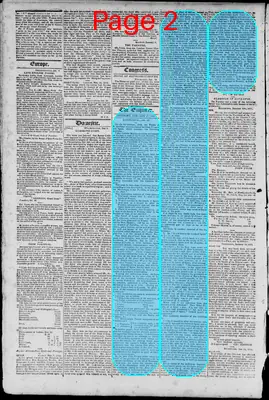
Editorial
January 17, 1811
The Enquirer
Richmond, Henrico County, Virginia
What is this article about?
This editorial, part II on Louisiana, argues that the U.S. title from the 1803 Louisiana Purchase extends east of the Mississippi to at least the Perdido River, citing the 1800 Treaty of St. Ildefonso and prior treaties among France, Spain, and Britain defining Louisiana's historical boundaries.
Clipping
OCR Quality
95%
Excellent
Full Text
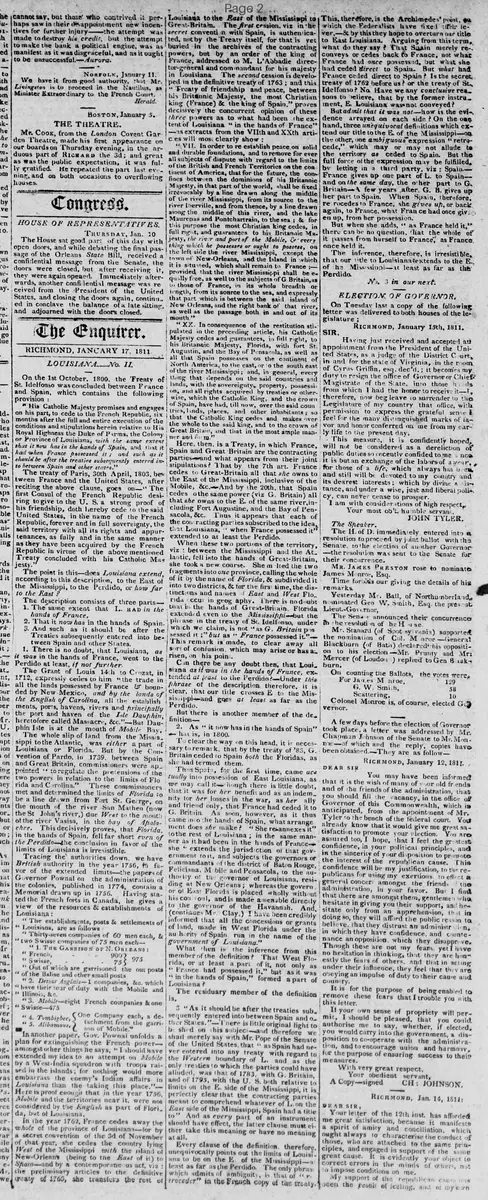
The Enquirer.
RICHMOND, JANUARY 17, 1811
LOUISIANA...NO. II.
On the 1st October, 1800, the Treaty of St. Ildefonso was concluded between France and Spain, which contains the following provision:
"His Catholic Majesty promises and engages on his part, to cede to the French Republic, six months after the full and entire execution of the conditions and stipulations herein relative to His Royal Highness the Duke of Parma, the Colony or Province of Louisiana, with the same extent that it now has in the hands of Spain, and that it had when France possessed it: and such as it should be after the treaties subsequently entered into between Spain and other states."
The treaty of Paris, 30th April, 1803, between France and the United States, after reciting the above clause, goes on "The first Consul of the French Republic desiring to give to the U. S. a strong proof of his friendship, doth hereby cede to the said United States, in the name of the French Republic, forever and in full sovereignty, the said territory with all its rights and appurtenances, as fully and in the same manner as they have been acquired by the French Republic in virtue of the above mentioned Treaty concluded with his Catholic Majesty."
The point is this—does Louisiana extend, according to this description, to the East of the Mississippi, to the Perdido, or how far to the East?
The description consists of three parts—
1. The same extent that L. had in the hands of France.
2. That it now has in the hands of Spain.
3. And such as it should be after the treaties subsequently entered into between Spain and other States.
1. There is no doubt, that Louisiana, as it was in the hands of France, went to the Perdido at least, if not further.
The Grant of Louis 14th to Crozat, in 1712, expressly cedes to him "the trade in all the lands possessed by France & bounded by New-Mexico, and by the lands of the English of Carolina, all the establishments, ports, havens, rivers and principally the port and haven of the Isle Dauphin, heretofore called Massacre, &c."—But Dauphin Isle is at the mouth of Mobile Bay.
The whole strip of land from the Mississippi to the Atlantic, was either a part of Louisiana or Florida. But by the Convention of Pardo, in 1739, between Spain and Great Britain, commissioners were appointed "to regulate the pretensions of the two powers in relation to the limits of Florida and Carolina." These commissioners met and determined the limits of Florida to be a line drawn from Fort St. George, on the mouth of the river San Mateo (now the St. John's river,) due West to the mouth of the river Apalachee, in the bay of Apalachee. This decisively proves, that Florida, in the hands of Spain, fell far short even of the Perdido—the conclusion in favor of the limits of Louisiana is irresistible.
Tracing the authorities down, we have British authority in the year 1756, in favor of the extended limits—the papers of Governor Pownal on the administration of the colonies, published in 1774, contain a Memorial drawn up in 1756. Having stated the French forts in Canada, he gives a view of the resources & establishments of Louisiana:
"The establishments, posts & settlements of Louisiana, are as follows
Thirty-seven companies of 60 men each, & two Swisse companies of 75 men each—
1. The Garrison of N. Orleans:
French 900
Swisse, 150
2. Detour Anglais—1 company, &c. which have their tour of duty with the Mobile and Illinois, &c.
3. Mobile—eight French companies & one Swisse—475
4. Tombigbee, One Company each, a detachment from the garrison of Mobile.
5. Alibamous, son of Mobile."
In another paper, Gov. Pownal unfolds a plan for extinguishing the French power—amongst other things he says, "I should have extended my idea to an attempt on Mobile by a West-India squadron with troops raised in the islands; for nothing would more embarrass the enemy's Indian affairs in Louisiana than the taking this place."
Here is proof enough that in the year 1756, Mobile and the territories near it, were not considered by the English as part of Florida, but of Louisiana.
In the year 1762, France cedes away the whole of the province of Louisiana—for by a secret convention of the 3d of November of that year, she cedes the country lying West of the Mississippi with the island of New-Orleans (being to the East of it) to Spain—and by a contemporaneous act, viz: the preliminary articles to the definitive treaty of 1763, she transfers the rest of Louisiana to the East of the Mississippi to Great-Britain. The first cession, viz in the secret convention with Spain, is authenticated, not by the Treaty itself, for that is yet buried in the archives of the contracting powers, but by an order of the king of France, addressed to M. L'Abadie director-general and commandant for his majesty in Louisiana. The second cession is developed in the definitive treaty of 1763; and this "Treaty of friendship and peace, between his Britannic Majesty, the most Christian king (France) & the king of Spain." proves decisively the concurrent opinion of these three powers as to what had been the extent of Louisiana "in the hands of France"—as extracts from the VIIth and XXth articles will most clearly show:
"VII. In order to re-establish peace on solid and durable foundations, and to remove for ever all subjects of dispute with regard to the limits of the British and French Territories on the continent of America, it is agreed that for the future, the confines between the dominions of his Britannic Majesty, in that part of the world, shall be fixed irrevocably by a line drawn along the middle of the river Mississippi, from its source to the river Iberville, and from thence, by a line drawn along the middle of this river, and the lake Maurepas and Pontchartrain, to the sea; & for this purpose the most Christian king cedes, in full right, and guarantees to his Britannic Majesty, the river and port of the Mobile, & everything which he possesses or ought to possess, on the left side the river Mississippi, except the town of New-Orleans, and the Island in which it is situated, which shall remain to France; provided that the river Mississippi shall be equally free, as well to the subjects of G. Britain, as to those of France, in its whole breadth or length, from its source to the sea, and expressly that part which is between the said island of New Orleans, and the right bank of that river, as well as the passage both in and out of its mouth."
"XX. In consequence of the restitution stipulated in the preceding article, his Catholic Majesty cedes and guarantees, in full right, to his Britannic Majesty, Florida, with Fort St. Augustin, and the Bay of Pensacola, as well as all that Spain possesses on the continent of North America, to the east, or to the south east of the river Mississippi; and, in general, everything that depends on the said countries and lands, with the sovereignty, property, possession and all rights acquired by treaties or otherwise, which the Catholic King, and the crown of Spain, have had, till now, over the said countries, lands, places, and other inhabitants; so that the Catholic King cedes and makes over the whole to the said king, and to the crown of Great Britain, and that in the most ample manner and form."
Here, then, is a Treaty, in which France, Spain and Great Britain are the contracting parties—and what appears from their joint stipulations? That by the 7th art. France cedes to Great-Britain all that she owns to the East of the Mississippi, inclusive of the Mobile, &c. And by the 20th, that Spain cedes to the same power (viz G. Britain) all that she owns to the E. of the same river, including Fort Augustine, and the Bay of Pensacola, &c. Thus it appears that each of the contracting parties subscribed to the idea, that Louisiana, "when France possessed it" extended to at least the Perdido.
When these two portions of the territory, viz: between the Mississippi and the Atlantic, fell into the hands of Great-Britain, she took a new course. She united the two fragments into one province, calling the whole of it by the name of Florida, & subdivided it into two districts, & for the first time, the distinctions and names of East and West Florida occur in geography. There is no doubt that in the hands of Great-Britain, Florida extended even to the Mississippi—but the phrase in the treaty of St. Ildefonso, under which we claim, is not "as G. Britain possessed it;" but as "France possessed it."
This remark is made, to clear away all sort of confusion, which may arise or has arisen, on this point.
Can there be any doubt then, that Louisiana as it was in the hands of France, extended at least to the Perdido?—Under this phrase of the description, therefore, it is clear, that our title crosses E to the Mississippi—and goes at least as far as the Perdido.
But there is another member of the definition—
2. As "it now has in the hands of Spain" that is, in 1800.
To clear the way on this head, it is necessary to remark, that by the treaty of '83, G. Britain ceded to Spain both the Floridas, as she had termed them.
Thus Spain, for the first time, came actually into possession of East Louisiana, as we may call it—though there is little doubt, that it was for her benefit and as an indemnity for her losses in the war, as her ally and friend only, that France had ceded it to G. Britain. As soon, however, as it thus came into the hands of Spain, what arrangement does she make? She "re-annexes it" to the rest of Louisiana; in the same manner as it had been in the hands of France—she "extends the jurisdiction of that government to it, and subjects the governors or Commandants of the district of Baton Rouge, Feliciana, Mobile and Pensacola, to the authority of the governor of Louisiana, residing at New Orleans; whereas the governor of East Florida is placed wholly without his control, and is made amenable directly to the governor of the Havannah. And, (continues Mr. Clay.) I have been credibly informed that all the concessions or grants of land, made in West Florida under the authority of Spain run in the name of the government of Louisiana."
What then is the inference from this member of the definition? That West Florida, or at least a part of it, not only as "France had possessed it," but as it was "in the hands of Spain," formed a part of Louisiana?
The residuary member of the definition is,
3 "As it should be after the treaties subsequently entered into between Spain and other States."—There is little original light to be shed on this subject—and therefore we shall merely say with Mr. Pope of the Senate of the United States, that "as Spain had never entered into any treaty with regard to the Western boundary of L. and as the only treaties to which the parties could have alluded, was that of 1783, with G. Britain, and of 1795, with the U. S. both relative to limits on the E. side of the Mississippi, it is perfectly clear that the contracting parties meant to comprehend whatever of L. on the East side of the Mississippi, Spain had a title to" And as every part of an instrument should have effect, the latter clause must either take this meaning or have no meaning at all.
Every clause of the definition, therefore, unequivocally points out the limits of Louisiana to be on the E. of the Mississippi—at least as far as the Perdido. The only phrase which admits of ambiguity, is that of "retroceder" in the French copy of the treaty.
This, therefore, is the Archimedes' point, upon which the Federalists have fixed their lever,—& by this they hope to overturn our title to East Louisiana. Arguing from this term what do they say? That Spain merely re-conveys or cedes back to France, not what France had once possessed, but what she had ceded direct to Spain. But what had France ceded direct to Spain? Is the secret treaty of 1762 before us? or the treaty of St. Ildefonso? No. Have we any conclusive reasons to believe, that by the former instrument, E. Louisiana was not conveyed?
But admit that it was not—how is the evidence arrayed on each side? On the one hand, three unequivocal definitions which extend our title to the E. of the Mississippi—on the other, one ambiguous expression "retrocede," which may or may not allude to the territory as ceded to Spain. But the full force of the expression may be fulfilled by letting in a third party, viz: Spain.—France gives up one part of L. to Spain—and on the same day, the other part to G. Britain—A few years after, G. B. gives up her part to Spain. When Spain, therefore, re-concedes to France, she gives up, or back again, to France, what France had once given up, from her possession.
But when she adds, "as France held it." there can be no question, that the whole of it passes from herself to France, as France once held it.
The inference, therefore, is irresistible, that our title to Louisiana extends to the E. of the Mississippi—at least as far as the Perdido.
RICHMOND, JANUARY 17, 1811
LOUISIANA...NO. II.
On the 1st October, 1800, the Treaty of St. Ildefonso was concluded between France and Spain, which contains the following provision:
"His Catholic Majesty promises and engages on his part, to cede to the French Republic, six months after the full and entire execution of the conditions and stipulations herein relative to His Royal Highness the Duke of Parma, the Colony or Province of Louisiana, with the same extent that it now has in the hands of Spain, and that it had when France possessed it: and such as it should be after the treaties subsequently entered into between Spain and other states."
The treaty of Paris, 30th April, 1803, between France and the United States, after reciting the above clause, goes on "The first Consul of the French Republic desiring to give to the U. S. a strong proof of his friendship, doth hereby cede to the said United States, in the name of the French Republic, forever and in full sovereignty, the said territory with all its rights and appurtenances, as fully and in the same manner as they have been acquired by the French Republic in virtue of the above mentioned Treaty concluded with his Catholic Majesty."
The point is this—does Louisiana extend, according to this description, to the East of the Mississippi, to the Perdido, or how far to the East?
The description consists of three parts—
1. The same extent that L. had in the hands of France.
2. That it now has in the hands of Spain.
3. And such as it should be after the treaties subsequently entered into between Spain and other States.
1. There is no doubt, that Louisiana, as it was in the hands of France, went to the Perdido at least, if not further.
The Grant of Louis 14th to Crozat, in 1712, expressly cedes to him "the trade in all the lands possessed by France & bounded by New-Mexico, and by the lands of the English of Carolina, all the establishments, ports, havens, rivers and principally the port and haven of the Isle Dauphin, heretofore called Massacre, &c."—But Dauphin Isle is at the mouth of Mobile Bay.
The whole strip of land from the Mississippi to the Atlantic, was either a part of Louisiana or Florida. But by the Convention of Pardo, in 1739, between Spain and Great Britain, commissioners were appointed "to regulate the pretensions of the two powers in relation to the limits of Florida and Carolina." These commissioners met and determined the limits of Florida to be a line drawn from Fort St. George, on the mouth of the river San Mateo (now the St. John's river,) due West to the mouth of the river Apalachee, in the bay of Apalachee. This decisively proves, that Florida, in the hands of Spain, fell far short even of the Perdido—the conclusion in favor of the limits of Louisiana is irresistible.
Tracing the authorities down, we have British authority in the year 1756, in favor of the extended limits—the papers of Governor Pownal on the administration of the colonies, published in 1774, contain a Memorial drawn up in 1756. Having stated the French forts in Canada, he gives a view of the resources & establishments of Louisiana:
"The establishments, posts & settlements of Louisiana, are as follows
Thirty-seven companies of 60 men each, & two Swisse companies of 75 men each—
1. The Garrison of N. Orleans:
French 900
Swisse, 150
2. Detour Anglais—1 company, &c. which have their tour of duty with the Mobile and Illinois, &c.
3. Mobile—eight French companies & one Swisse—475
4. Tombigbee, One Company each, a detachment from the garrison of Mobile.
5. Alibamous, son of Mobile."
In another paper, Gov. Pownal unfolds a plan for extinguishing the French power—amongst other things he says, "I should have extended my idea to an attempt on Mobile by a West-India squadron with troops raised in the islands; for nothing would more embarrass the enemy's Indian affairs in Louisiana than the taking this place."
Here is proof enough that in the year 1756, Mobile and the territories near it, were not considered by the English as part of Florida, but of Louisiana.
In the year 1762, France cedes away the whole of the province of Louisiana—for by a secret convention of the 3d of November of that year, she cedes the country lying West of the Mississippi with the island of New-Orleans (being to the East of it) to Spain—and by a contemporaneous act, viz: the preliminary articles to the definitive treaty of 1763, she transfers the rest of Louisiana to the East of the Mississippi to Great-Britain. The first cession, viz in the secret convention with Spain, is authenticated, not by the Treaty itself, for that is yet buried in the archives of the contracting powers, but by an order of the king of France, addressed to M. L'Abadie director-general and commandant for his majesty in Louisiana. The second cession is developed in the definitive treaty of 1763; and this "Treaty of friendship and peace, between his Britannic Majesty, the most Christian king (France) & the king of Spain." proves decisively the concurrent opinion of these three powers as to what had been the extent of Louisiana "in the hands of France"—as extracts from the VIIth and XXth articles will most clearly show:
"VII. In order to re-establish peace on solid and durable foundations, and to remove for ever all subjects of dispute with regard to the limits of the British and French Territories on the continent of America, it is agreed that for the future, the confines between the dominions of his Britannic Majesty, in that part of the world, shall be fixed irrevocably by a line drawn along the middle of the river Mississippi, from its source to the river Iberville, and from thence, by a line drawn along the middle of this river, and the lake Maurepas and Pontchartrain, to the sea; & for this purpose the most Christian king cedes, in full right, and guarantees to his Britannic Majesty, the river and port of the Mobile, & everything which he possesses or ought to possess, on the left side the river Mississippi, except the town of New-Orleans, and the Island in which it is situated, which shall remain to France; provided that the river Mississippi shall be equally free, as well to the subjects of G. Britain, as to those of France, in its whole breadth or length, from its source to the sea, and expressly that part which is between the said island of New Orleans, and the right bank of that river, as well as the passage both in and out of its mouth."
"XX. In consequence of the restitution stipulated in the preceding article, his Catholic Majesty cedes and guarantees, in full right, to his Britannic Majesty, Florida, with Fort St. Augustin, and the Bay of Pensacola, as well as all that Spain possesses on the continent of North America, to the east, or to the south east of the river Mississippi; and, in general, everything that depends on the said countries and lands, with the sovereignty, property, possession and all rights acquired by treaties or otherwise, which the Catholic King, and the crown of Spain, have had, till now, over the said countries, lands, places, and other inhabitants; so that the Catholic King cedes and makes over the whole to the said king, and to the crown of Great Britain, and that in the most ample manner and form."
Here, then, is a Treaty, in which France, Spain and Great Britain are the contracting parties—and what appears from their joint stipulations? That by the 7th art. France cedes to Great-Britain all that she owns to the East of the Mississippi, inclusive of the Mobile, &c. And by the 20th, that Spain cedes to the same power (viz G. Britain) all that she owns to the E. of the same river, including Fort Augustine, and the Bay of Pensacola, &c. Thus it appears that each of the contracting parties subscribed to the idea, that Louisiana, "when France possessed it" extended to at least the Perdido.
When these two portions of the territory, viz: between the Mississippi and the Atlantic, fell into the hands of Great-Britain, she took a new course. She united the two fragments into one province, calling the whole of it by the name of Florida, & subdivided it into two districts, & for the first time, the distinctions and names of East and West Florida occur in geography. There is no doubt that in the hands of Great-Britain, Florida extended even to the Mississippi—but the phrase in the treaty of St. Ildefonso, under which we claim, is not "as G. Britain possessed it;" but as "France possessed it."
This remark is made, to clear away all sort of confusion, which may arise or has arisen, on this point.
Can there be any doubt then, that Louisiana as it was in the hands of France, extended at least to the Perdido?—Under this phrase of the description, therefore, it is clear, that our title crosses E to the Mississippi—and goes at least as far as the Perdido.
But there is another member of the definition—
2. As "it now has in the hands of Spain" that is, in 1800.
To clear the way on this head, it is necessary to remark, that by the treaty of '83, G. Britain ceded to Spain both the Floridas, as she had termed them.
Thus Spain, for the first time, came actually into possession of East Louisiana, as we may call it—though there is little doubt, that it was for her benefit and as an indemnity for her losses in the war, as her ally and friend only, that France had ceded it to G. Britain. As soon, however, as it thus came into the hands of Spain, what arrangement does she make? She "re-annexes it" to the rest of Louisiana; in the same manner as it had been in the hands of France—she "extends the jurisdiction of that government to it, and subjects the governors or Commandants of the district of Baton Rouge, Feliciana, Mobile and Pensacola, to the authority of the governor of Louisiana, residing at New Orleans; whereas the governor of East Florida is placed wholly without his control, and is made amenable directly to the governor of the Havannah. And, (continues Mr. Clay.) I have been credibly informed that all the concessions or grants of land, made in West Florida under the authority of Spain run in the name of the government of Louisiana."
What then is the inference from this member of the definition? That West Florida, or at least a part of it, not only as "France had possessed it," but as it was "in the hands of Spain," formed a part of Louisiana?
The residuary member of the definition is,
3 "As it should be after the treaties subsequently entered into between Spain and other States."—There is little original light to be shed on this subject—and therefore we shall merely say with Mr. Pope of the Senate of the United States, that "as Spain had never entered into any treaty with regard to the Western boundary of L. and as the only treaties to which the parties could have alluded, was that of 1783, with G. Britain, and of 1795, with the U. S. both relative to limits on the E. side of the Mississippi, it is perfectly clear that the contracting parties meant to comprehend whatever of L. on the East side of the Mississippi, Spain had a title to" And as every part of an instrument should have effect, the latter clause must either take this meaning or have no meaning at all.
Every clause of the definition, therefore, unequivocally points out the limits of Louisiana to be on the E. of the Mississippi—at least as far as the Perdido. The only phrase which admits of ambiguity, is that of "retroceder" in the French copy of the treaty.
This, therefore, is the Archimedes' point, upon which the Federalists have fixed their lever,—& by this they hope to overturn our title to East Louisiana. Arguing from this term what do they say? That Spain merely re-conveys or cedes back to France, not what France had once possessed, but what she had ceded direct to Spain. But what had France ceded direct to Spain? Is the secret treaty of 1762 before us? or the treaty of St. Ildefonso? No. Have we any conclusive reasons to believe, that by the former instrument, E. Louisiana was not conveyed?
But admit that it was not—how is the evidence arrayed on each side? On the one hand, three unequivocal definitions which extend our title to the E. of the Mississippi—on the other, one ambiguous expression "retrocede," which may or may not allude to the territory as ceded to Spain. But the full force of the expression may be fulfilled by letting in a third party, viz: Spain.—France gives up one part of L. to Spain—and on the same day, the other part to G. Britain—A few years after, G. B. gives up her part to Spain. When Spain, therefore, re-concedes to France, she gives up, or back again, to France, what France had once given up, from her possession.
But when she adds, "as France held it." there can be no question, that the whole of it passes from herself to France, as France once held it.
The inference, therefore, is irresistible, that our title to Louisiana extends to the E. of the Mississippi—at least as far as the Perdido.
What sub-type of article is it?
Foreign Affairs
Imperialism
What keywords are associated?
Louisiana Boundaries
Perdido River
Treaty St Ildefonso
Mississippi River
Territorial Cession
France Spain Treaties
East Louisiana
Federalist Arguments
What entities or persons were involved?
France
Spain
Great Britain
United States
Treaty Of St. Ildefonso
Treaty Of Paris 1803
Louisiana
Editorial Details
Primary Topic
Louisiana Boundaries East Of The Mississippi To The Perdido River
Stance / Tone
Strongly Supportive Of U.S. Territorial Claims Based On Historical Treaties
Key Figures
France
Spain
Great Britain
United States
Treaty Of St. Ildefonso
Treaty Of Paris 1803
Louisiana
Key Arguments
Louisiana's Extent In France's Possession Included Territory To The Perdido River
British And Spanish Treaties Confirm Louisiana's Eastern Boundaries Beyond The Mississippi
Spain Re Annexed East Louisiana To The Louisiana Government After 1783
Subsequent Treaties With Spain Support Inclusion Of East Louisiana In The Cession
The Term 'Retrocede' Does Not Limit The Territory To What France Directly Ceded To Spain