Thank you for visiting SNEWPapers!
Sign up free
Letter to Editor
April 28, 1826
Phenix Gazette
Alexandria, Virginia
What is this article about?
An anonymous defense of Vice President Calhoun's impartiality during a Senate debate on a constitutional amendment limiting presidential terms to two. It corrects press misrepresentations of an incident where Calhoun allowed debate on a motion to table, involving Senators Randolph and Dickerson, and addresses another false story about Randolph's remarks.
Clipping
OCR Quality
98%
Excellent
Full Text
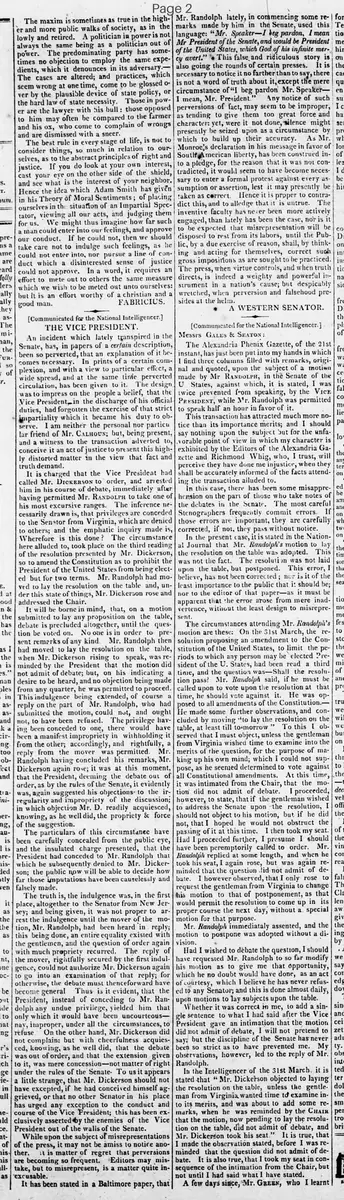
[Communicated for the National Intelligencer.]
THE VICE PRESIDENT.
An incident which lately transpired in the Senate, has, in papers of a certain description, been so perverted, that an explanation of it becomes necessary. In prints of a certain complexion, and with a view to particular effect, a wide spread, and at the same time perverted circulation, has been given to it. The design was to impress on the people a belief, that the Vice President, in the discharge of his official duties, had forgotten the exercise of that strict impartiality which it became his duty to observe. I am neither the personal nor particular friend of Mr. Calhoun; but, being present, and a witness to the transaction adverted to, conceive it an act of justice to present this highly distorted matter in the view that fact and truth demand.
It is charged that the Vice President had called Mr. Dickerson to order, and arrested him in his course of debate, immediately after having permitted Mr. Randolph to take one of his most excursive ranges. The inference necessarily drawn is, that privileges are conceded to the Senator from Virginia, which are denied to others; and the emphatic inquiry made is, Wherefore is this done? The circumstance here alluded to, took place on the third reading of the resolution presented by Mr. Dickerson, so to amend the Constitution as to prohibit the President of the United States from being elected but for two terms. Mr. Randolph had moved to lay the resolution on the table and, under this state of things, Mr. Dickerson rose and addressed the Chair.
It will be borne in mind, that, on a motion submitted to lay any proposition on the table, debate is precluded altogether, until the question be voted on. No one is in order to present remarks of any kind. Mr. Randolph then had moved to lay the resolution on the table. when Mr. Dickerson rising to speak, was reminded by the President that the motion did not admit of debate; but, on his indicating a desire to be heard, and no objection being made from any quarter, he was permitted to proceed. This indulgence being extended, of course a reply on the part of Mr. Randolph, who had submitted the motion, could not, and ought not, to have been refused. The privilege having been conceded to one, there would have been a manifest impropriety in withholding it from the other; accordingly, and rightfully, a reply from the mover was permitted. Mr. Randolph having concluded his remarks, Mr. Dickerson again rose; it was at this moment that the President, deeming the debate out of order, as by the rules of the Senate, it evidently was, again suggested his objections to the irregularity and impropriety of the discussion; in which objection Mr. D. readily acquiesced, knowing, as he well did, the propriety & force of the suggestion.
The particulars of this circumstance have been carefully concealed from the public eye, and the insulated charge presented, that the President had conceded to Mr. Randolph that which he subsequently denied to Mr. Dickerson; the public now will be able to decide how far those imputations have been causelessly and falsely made.
The truth is, the indulgence was, in the first place, altogether to the Senator from New Jersey; and being given, it was not proper to arrest the indulgence until the mover of the motion, Mr. Randolph, had been heard in reply; this being done, an entire equality existed with the gentlemen, and the question of order again with much propriety recurred. The reply of the mover, rightfully secured by the first indulgence, could not authorize Mr. Dickerson again to go into an examination of that reply; for otherwise, the debate must thenceforward have become general Thus is it evident, that the President, instead of conceding to Mr. Randolph any undue privilege, yielded him that only which it would have been uncourteous--nay, improper, under all the circumstances, to refuse On the other hand, Mr. Dickerson did not complain: but with cheerfulness acquiesced, knowing, as he well did, that the debate was out of order, and that the extension given to it, was mere concession-not matter of right under the rules of the Senate- To us it appears a little strange, that Mr. Dickerson should not have excepted, if he had conceived himself aggrieved, or that no other Senator in his place has urged any exception to the conduct and course of the Vice President; this has been exclusively asserted by the enemies of the Vice President out of the walls of the Senate.
While upon the subject of misrepresentations of the press, it may not be amiss to notice another. it is matter of regret that perversions are becoming so frequent. Editors may mistake, but to misrepresent, is a matter quite inexcusable.
It has been stated in a Baltimore paper, that Mr. Randolph lately, in commencing some remarks made by him in the Senate, used this language: "Mr. Speaker-I beg pardon, I mean Mr President of the Senate, and would be President of the United States, which God of his infinite mercy avert." This false and ridiculous story is also going the rounds of certain presses. It is necessary to notice it no farther than to say, there is not a word of truth about it, except the mere circumstance of "I beg pardon Mr. Speaker- I mean, Mr. President."
Any notice of such perversions of fact, may seem to be improper, as tending to give them too great force and character: yet, were it not done, silence might presently be seized upon as a circumstance by which to build up their accuracy. As Mr. Monroe's declaration in his message in favor of South American liberty, has been construed into a pledge, for the reason that it was not contradicted, it would seem to have become necessary to enter a formal protest against every assumption or assertion, lest it may presently be taken as correct. Hence it is proper to contradict this, and to allege that it is untrue. The inventive faculty has never been more actively engaged, than lately has been the case, nor is it to be expected that misrepresentation will be disposed to rest from its labors, until the Public, by a due exercise of reason, shall, by thinking and acting for themselves, correct such gross impositions as are sought to be practiced.
The press, when virtue controls, and when truth directs, is indeed a weighty and powerful instrument in a nation's cause; but despicably wretched, when perversion and falsehood presides at the helm.
THE VICE PRESIDENT.
An incident which lately transpired in the Senate, has, in papers of a certain description, been so perverted, that an explanation of it becomes necessary. In prints of a certain complexion, and with a view to particular effect, a wide spread, and at the same time perverted circulation, has been given to it. The design was to impress on the people a belief, that the Vice President, in the discharge of his official duties, had forgotten the exercise of that strict impartiality which it became his duty to observe. I am neither the personal nor particular friend of Mr. Calhoun; but, being present, and a witness to the transaction adverted to, conceive it an act of justice to present this highly distorted matter in the view that fact and truth demand.
It is charged that the Vice President had called Mr. Dickerson to order, and arrested him in his course of debate, immediately after having permitted Mr. Randolph to take one of his most excursive ranges. The inference necessarily drawn is, that privileges are conceded to the Senator from Virginia, which are denied to others; and the emphatic inquiry made is, Wherefore is this done? The circumstance here alluded to, took place on the third reading of the resolution presented by Mr. Dickerson, so to amend the Constitution as to prohibit the President of the United States from being elected but for two terms. Mr. Randolph had moved to lay the resolution on the table and, under this state of things, Mr. Dickerson rose and addressed the Chair.
It will be borne in mind, that, on a motion submitted to lay any proposition on the table, debate is precluded altogether, until the question be voted on. No one is in order to present remarks of any kind. Mr. Randolph then had moved to lay the resolution on the table. when Mr. Dickerson rising to speak, was reminded by the President that the motion did not admit of debate; but, on his indicating a desire to be heard, and no objection being made from any quarter, he was permitted to proceed. This indulgence being extended, of course a reply on the part of Mr. Randolph, who had submitted the motion, could not, and ought not, to have been refused. The privilege having been conceded to one, there would have been a manifest impropriety in withholding it from the other; accordingly, and rightfully, a reply from the mover was permitted. Mr. Randolph having concluded his remarks, Mr. Dickerson again rose; it was at this moment that the President, deeming the debate out of order, as by the rules of the Senate, it evidently was, again suggested his objections to the irregularity and impropriety of the discussion; in which objection Mr. D. readily acquiesced, knowing, as he well did, the propriety & force of the suggestion.
The particulars of this circumstance have been carefully concealed from the public eye, and the insulated charge presented, that the President had conceded to Mr. Randolph that which he subsequently denied to Mr. Dickerson; the public now will be able to decide how far those imputations have been causelessly and falsely made.
The truth is, the indulgence was, in the first place, altogether to the Senator from New Jersey; and being given, it was not proper to arrest the indulgence until the mover of the motion, Mr. Randolph, had been heard in reply; this being done, an entire equality existed with the gentlemen, and the question of order again with much propriety recurred. The reply of the mover, rightfully secured by the first indulgence, could not authorize Mr. Dickerson again to go into an examination of that reply; for otherwise, the debate must thenceforward have become general Thus is it evident, that the President, instead of conceding to Mr. Randolph any undue privilege, yielded him that only which it would have been uncourteous--nay, improper, under all the circumstances, to refuse On the other hand, Mr. Dickerson did not complain: but with cheerfulness acquiesced, knowing, as he well did, that the debate was out of order, and that the extension given to it, was mere concession-not matter of right under the rules of the Senate- To us it appears a little strange, that Mr. Dickerson should not have excepted, if he had conceived himself aggrieved, or that no other Senator in his place has urged any exception to the conduct and course of the Vice President; this has been exclusively asserted by the enemies of the Vice President out of the walls of the Senate.
While upon the subject of misrepresentations of the press, it may not be amiss to notice another. it is matter of regret that perversions are becoming so frequent. Editors may mistake, but to misrepresent, is a matter quite inexcusable.
It has been stated in a Baltimore paper, that Mr. Randolph lately, in commencing some remarks made by him in the Senate, used this language: "Mr. Speaker-I beg pardon, I mean Mr President of the Senate, and would be President of the United States, which God of his infinite mercy avert." This false and ridiculous story is also going the rounds of certain presses. It is necessary to notice it no farther than to say, there is not a word of truth about it, except the mere circumstance of "I beg pardon Mr. Speaker- I mean, Mr. President."
Any notice of such perversions of fact, may seem to be improper, as tending to give them too great force and character: yet, were it not done, silence might presently be seized upon as a circumstance by which to build up their accuracy. As Mr. Monroe's declaration in his message in favor of South American liberty, has been construed into a pledge, for the reason that it was not contradicted, it would seem to have become necessary to enter a formal protest against every assumption or assertion, lest it may presently be taken as correct. Hence it is proper to contradict this, and to allege that it is untrue. The inventive faculty has never been more actively engaged, than lately has been the case, nor is it to be expected that misrepresentation will be disposed to rest from its labors, until the Public, by a due exercise of reason, shall, by thinking and acting for themselves, correct such gross impositions as are sought to be practiced.
The press, when virtue controls, and when truth directs, is indeed a weighty and powerful instrument in a nation's cause; but despicably wretched, when perversion and falsehood presides at the helm.
What sub-type of article is it?
Informative
Persuasive
Political
What themes does it cover?
Politics
Press Freedom
What keywords are associated?
Vice President Calhoun
Senate Debate
Press Misrepresentation
Constitutional Amendment
Presidential Terms
Senator Randolph
Senator Dickerson
Impartiality
What entities or persons were involved?
The Printer
Letter to Editor Details
Recipient
The Printer
Main Argument
vice president calhoun maintained strict impartiality in a senate debate by allowing equal indulgence to senators dickerson and randolph on a motion to table a constitutional amendment resolution, contrary to press misrepresentations suggesting favoritism toward randolph.
Notable Details
Incident During Third Reading Of Mr. Dickerson's Resolution To Limit Presidential Terms To Two.
Mr. Randolph Moved To Lay The Resolution On The Table.
Debate Precluded By Rules But Indulgence Granted First To Dickerson, Then Reply To Randolph.
Correction Of False Story About Mr. Randolph's Slip Addressing 'Mr. Speaker' And Alleged Anti Calhoun Remark.