Thank you for visiting SNEWPapers!
Sign up free
Virginia Argus
Richmond, Virginia
What is this article about?
Captain Irby of HMS Amelia reports a fierce night engagement on February 6, 1813, off the Isles de Los near Sierra Leone against the superior French frigate L'Arethuse. After hours of close combat, the French escaped, leaving Amelia heavily damaged with 51 killed and 95 wounded.
Clipping
OCR Quality
Full Text
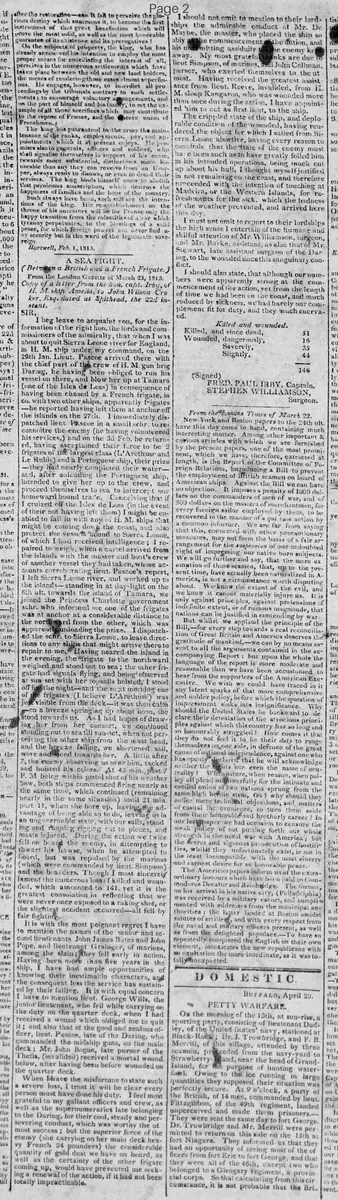
(Between a British and a French Frigate.)
From the London Gazette of March 25, 1813.
Copy of a letter from the hon. capt. Irby, of H. M. ship Amelia, to John Wilson Croker, Esq. dated at Spithead, the 22d instant.
SIR,
I beg leave to acquaint you, for the information of the right hon. the lords commissioners of the admiralty, that when I was about to quit Sierra Leone river for England, in H. M. ship under my command, on the 29th Jan. Lieut. Pascoe arrived there with the chief part of the crew of H. M. gun brig Daring. he having been obliged to run his vessel on shore, and blow her up at Tamara (one of the Isles de Loss) in consequence of having been chased by a French frigate, in co. with two other ships, apparently frigates —he reported having left them at anchor off the islands on the 27th. I immediately dispatched lieut. Pascoe in a small schr. to reconnoitre the enemy (he having volunteered his services.) and on the 3d Feb. he returned, having ascertained their force to be 2 frigates of the largest class (L'Arethuse and Le Rubis) and a Portuguese ship, their prize —they had nearly completed their water— and, after unloading the Portuguese ship, intended to give her up to the crew, and proceed themselves to sea to intercept our homeward bound trade. Conceiving that if I cruized off the Isles de Loss (in the event of their not having left them) I might be enabled to fall in with any of H. M. ships that might be coming down the coast, and also protect the vessels bound to Sierra Leone, of which I had received intelligence; I repaired to weigh, when a cartel arrived from the islands with the master and boat's crew of another vessel they had taken, whose accounts corroborating lieut. Pascoe's report, I left Sierra Leone river, and worked up to the islands—standing in at day-light on the 6th ult. towards the island of Tamara, we joined the Princess Charlotte government schr. who informed me one of the frigates was at anchor at a considerable distance to the northward from the other, which was apparently unloading the prize. I dispatched the schr. to Sierra Leone, to leave directions to any ships that might arrive there to repair to me. Having neared the island in the evening. the frigate to the northward weighed and stood out to sea; the other frigate had signals flying, and being observed at sun set with her topsails hoisted, I stood off for the night—and the next morning one of the frigates (I believe L'Arethuse) was just visible from the deck—it was then calm -on a breeze springing up about noon, she stood towards us. As I had hopes of drawing her from her consort, we continued standing out to sea till sun-set, when not perceiving the other ship from the mast head, and the breeze failing, we shortened sail, wore and stood towards her. A little after 7, the enemy observing us near him, tacked and hoisted his colors. At 45 min. past 7 P. M being within pistol shot of his weather bow, both ships commenced firing nearly at the same time, which continued (remaining nearly in the same situation) until 21 min. past 11, when she bore up, having the advantage of being able so to do, leaving us in an ungovernable state, with our sails, standing and running rigging cut to pieces, and masts injured. During the action we twice fell on board the enemy, in attempting to thwart his hawse, when he attempted to board, but was repulsed by the marines (which were commanded by lieut. Simpson) and the boarders. Though I most sincerely lament the numerous loss killed and wounded, which amounted to 141. yet it is the greatest consolation in reflecting that we were never once exposed to a raking shot, or the slightest accident occurred—all fell by fair fighting
It is with the most poignant regret I have to mention the names of the senior and second lieutenants John James Bates and John Pope, and lieutenant Granger, of marines, among the slain; they fell early in action. Having been more than five years in the ship, I have had ample opportunities of knowing their inestimable characters, and the consequent loss the service has sustained by their falling. It is with equal concern I have to mention lieut. George Wills, the junior lieutenant, who fell while carrying on the duty on the quarter deck, when I had received a wound which obliged me to quit it: and also that of the good and zealous officer, lieut. Pascoe, late of the Daring, who commanded the midship guns, on the main deck; Mr. John Bogue, late purser of the Thetis, (invalided) received a mortal wound below, after having been before wounded on the quarter deck.
When I have the misfortune to state such a severe loss, I trust it will be clear every person must have done his duty. I feel most grateful to my gallant officers and crew, as well as the supernumeraries late belonging to the Daring, for their cool, steady and persevering conduct, which was worthy the utmost success; but the superior force of the enemy (she carrying on her main deck heavy French 24 pounders) this considerable quantity of gold dust we have on board, as well as the certainty of the other frigate coming up, would have prevented me seeking a renewal of the action, if it had not been totally impracticable.
I should not omit to mention to their lordships the admirable conduct of Mr. De Mayne, the master, who placed the ship so ably at the commencement of the action, and his unremitting assiduity to the enemy kept away.
My most grateful thanks are due to lieut Simpson, of marines. and John Colman, purser, who exerted themselves to the utmost. Having received the greatest assistance from lieut. Reeve, invalided, from H. M. sloop Kangaroo, who was wounded more than once during the action, I have appointed him to act as first lieut. to the ship.
The crippled state of the ship, and deplorable condition of the wounded, having rendered the object for which I sailed from Sierra Leone abortive, having every reason to conclude that the State of the enemy must have been such as to have greatly foiled him in his intended operations, being much cut up about his hull, I thought myself justified in not remaining on the coast, and therefore proceeded with the intention of touching at Madeira. or the Western Islands. for refreshments for the sick. which the badness of the weather prevented, and arrived here this day.
I must not omit to report to their lordships the high sense I entertain of the humane and skilful attention of Mr. Williamson, surgeon, and Mr. Burke, assistant, as also that of Mr. Stewart, late assistant surgeon of the Daring, to the wounded since this sanguinary conflict.
I should also state, that although our numbers were apparently strong at the commencement of the action, yet from the length of time we had been on the coast, and much reduced by sickness, we had barely our complement fit for duty, and they much enervated.
Killed and wounded.
Killed, and since dead, 51
Wounded, dangerously 16
Severely, 35
Slightly, 44
146
(Signed)
FRED. PAUL IRBY. Captain.
STEPHEN WILLIAMSON,
Surgeon.
What sub-type of article is it?
What keywords are associated?
What entities or persons were involved?
Where did it happen?
Foreign News Details
Primary Location
Isles De Loss
Event Date
6th February 1813
Key Persons
Outcome
british: 51 killed, 16 dangerously wounded, 35 severely wounded, 44 slightly wounded (total 146). french frigate l'arethuse escaped after the engagement, leaving hms amelia damaged with rigging and masts injured; unable to pursue due to damage and threat of consort.
Event Details
HMS Amelia, under Capt. Irby, engaged the French frigate L'Arethuse off Tamara island on the evening of 6 February 1813. After reconnaissance confirming two French frigates and a prize, Amelia approached and drew L'Arethuse out to sea. Close action commenced at 7:45 PM, lasting until 11:21 PM, with ships exchanging fire at pistol range. Amelia twice boarded the enemy but was repulsed. L'Arethuse bore up and escaped, superior armament contributing to her advantage. Amelia suffered heavy casualties and damage, forcing return to Spithead.