Thank you for visiting SNEWPapers!
Sign up free
Editorial
October 22, 1805
The Enquirer
Richmond, Henrico County, Virginia
What is this article about?
An editorial urges Republicans to pursue constitutional amendments to resolve ambiguities in the U.S. Constitution, particularly regarding executive powers, treaty-making, press regulation, common law, and judicial tenure, to prevent future federalist overreach like under Adams.
Clipping
OCR Quality
95%
Excellent
Full Text
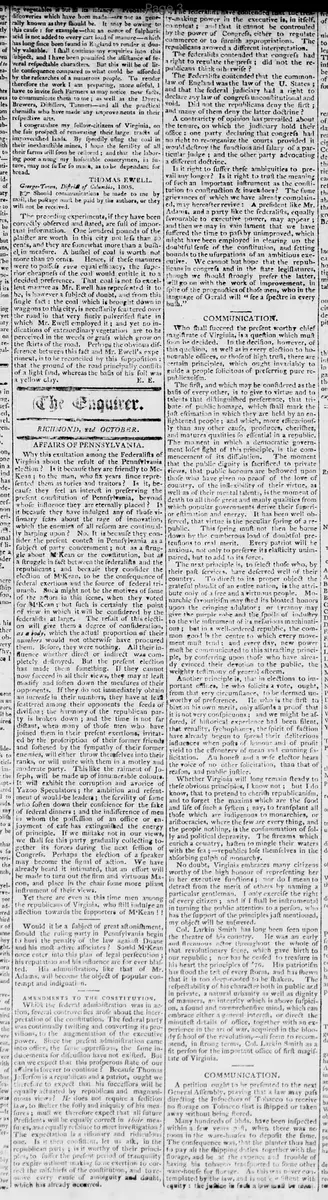
AMENDMENTS TO THE CONSTITUTION.
While the federal administration was in action, several controversies arose about the interpretation of the constitution. The federal party was continually twisting and converting its provisions, to the augmentation of the executive power. Since the present administration came into office, the same oppressions, the same inducements for discussion have not existed. But can we expect that this prosperous state of our affairs is forever to continue? Because Thomas Jefferson is a republican and a patriot, ought we therefore to expect that his successors will be equally actuated by republican and magnanimous views? He does not require a sedition law, to shelter the folly and iniquity of his measures: must we therefore expect that all future Presidents will be equally correct in their measures, and equally resolute to meet investigation? The expectation is a visionary and ridiculous one. Is it then consistent, let us ask, in the republican party ; is it worthy of their principles, to suffer the present period of tranquility to expire without making some exertion to correct the mischiefs of the constitution, and to remove every cause of ambiguity and doubt, which has already occurred.
The treaty-making power in the executive is, in itself, complete : and that it cannot be controuled by the power of Congress, either to regulate commerce or to furnish appropriations. The republicans avowed a different interpretation. The federalists contended that congress had a right to regulate the press ; did not the republicans think otherwise ? The Federalists contended that the common-law of England was the law of the U. States ; and that the federal judiciary had a right to declare any law of congress unconstitutional and void. Did not the republicans deny the first ; and many of them deny the latter doctrine ?
A contrariety of opinion has prevailed about the tenure, on which the judiciary hold their office : one party declaring that congress had no right to re-organize the courts provided it would destroy the functions and salary of a particular judge ; and the other party advocating a different doctrine.
Is it right to suffer these ambiguities to prevail any longer? Is it right to trust the meaning of such an important instrument as the constitution to construction indefinite? The same grievances of which we have already complained, may hereafter revive : A president like Mr. Adams, and a party like the federalists, equally favourable to executive power, may appear ; and then we may in vain lament that we have suffered the time to pass by unimproved, which might have been employed in clearing up the doubtful sense of the constitution, and setting bounds to the usurpations of an ambitious executive. We cannot but hope that the republicans in congress and in the state legislatures, though we should strongly prefer the latter, will go on with the work of improvement, in spite of the prognostics of those men, who in the language of Gerald will "see a spectre in every bush."
While the federal administration was in action, several controversies arose about the interpretation of the constitution. The federal party was continually twisting and converting its provisions, to the augmentation of the executive power. Since the present administration came into office, the same oppressions, the same inducements for discussion have not existed. But can we expect that this prosperous state of our affairs is forever to continue? Because Thomas Jefferson is a republican and a patriot, ought we therefore to expect that his successors will be equally actuated by republican and magnanimous views? He does not require a sedition law, to shelter the folly and iniquity of his measures: must we therefore expect that all future Presidents will be equally correct in their measures, and equally resolute to meet investigation? The expectation is a visionary and ridiculous one. Is it then consistent, let us ask, in the republican party ; is it worthy of their principles, to suffer the present period of tranquility to expire without making some exertion to correct the mischiefs of the constitution, and to remove every cause of ambiguity and doubt, which has already occurred.
The treaty-making power in the executive is, in itself, complete : and that it cannot be controuled by the power of Congress, either to regulate commerce or to furnish appropriations. The republicans avowed a different interpretation. The federalists contended that congress had a right to regulate the press ; did not the republicans think otherwise ? The Federalists contended that the common-law of England was the law of the U. States ; and that the federal judiciary had a right to declare any law of congress unconstitutional and void. Did not the republicans deny the first ; and many of them deny the latter doctrine ?
A contrariety of opinion has prevailed about the tenure, on which the judiciary hold their office : one party declaring that congress had no right to re-organize the courts provided it would destroy the functions and salary of a particular judge ; and the other party advocating a different doctrine.
Is it right to suffer these ambiguities to prevail any longer? Is it right to trust the meaning of such an important instrument as the constitution to construction indefinite? The same grievances of which we have already complained, may hereafter revive : A president like Mr. Adams, and a party like the federalists, equally favourable to executive power, may appear ; and then we may in vain lament that we have suffered the time to pass by unimproved, which might have been employed in clearing up the doubtful sense of the constitution, and setting bounds to the usurpations of an ambitious executive. We cannot but hope that the republicans in congress and in the state legislatures, though we should strongly prefer the latter, will go on with the work of improvement, in spite of the prognostics of those men, who in the language of Gerald will "see a spectre in every bush."
What sub-type of article is it?
Constitutional
Partisan Politics
Legal Reform
What keywords are associated?
Constitutional Amendments
Executive Power
Federalists
Republicans
Judiciary Tenure
Treaty Power
Press Regulation
What entities or persons were involved?
Thomas Jefferson
Mr. Adams
Federalists
Republicans
Congress
Editorial Details
Primary Topic
Need For Amendments To Clarify Constitutional Ambiguities
Stance / Tone
Urging Republicans To Amend The Constitution Against Executive Overreach
Key Figures
Thomas Jefferson
Mr. Adams
Federalists
Republicans
Congress
Key Arguments
Federalists Twisted Constitution To Augment Executive Power
Current Tranquility Under Jefferson Should Not Prevent Amendments
Clarify Treaty Making Power Not Controllable By Congress
Republicans Oppose Federalist Views On Press Regulation And Common Law
Resolve Disputes Over Judicial Tenure And Reorganization
Prevent Future Grievances Like Under Adams