Thank you for visiting SNEWPapers!
Sign up free
The Town Crier
Newington, Hartford County, Connecticut
What is this article about?
Arthur S. Somers criticizes the Newington Zoning Commission's August 11, 1960, approval of seven zoning change petitions despite objections and contrary to the Town Plan Commission's recommendations. He questions the process, highlights impacts on areas like Tom Lin Heights, and notes residents' intent to appeal in court for accountability in local governance.
Clipping
OCR Quality
Full Text
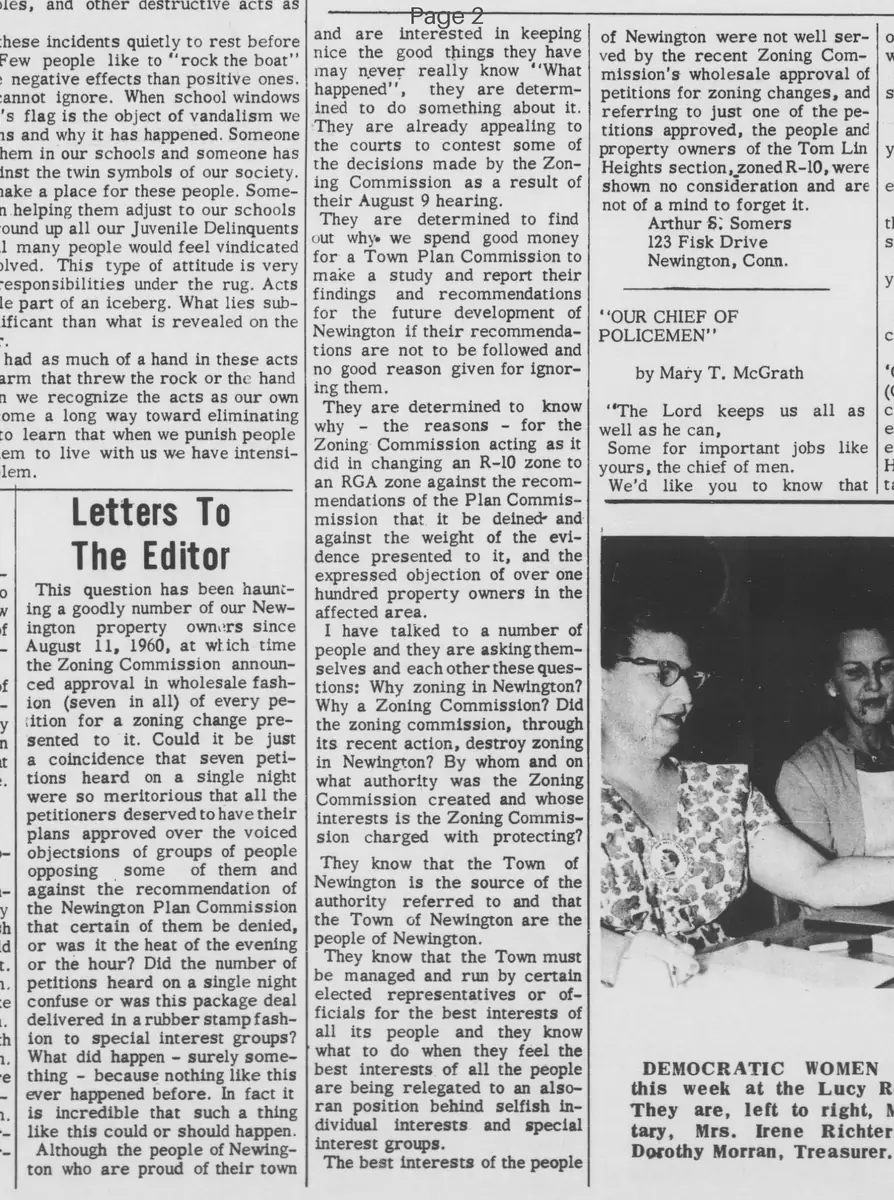
This question has been haunting a goodly number of our Newington property owners since August 11, 1960, at which time the Zoning Commission announced approval in wholesale fashion (seven in all) of every petition for a zoning change presented to it. Could it be just a coincidence that seven petitions heard on a single night were so meritorious that all the petitioners deserved to have their plans approved over the voiced objections of groups of people opposing some of them and against the recommendation of the Newington Plan Commission that certain of them be denied, or was it the heat of the evening or the hour? Did the number of petitions heard on a single night confuse or was this package deal delivered in a rubber stamp fashion to special interest groups?
What did happen - surely something - because nothing like this ever happened before. In fact it is incredible that such a thing like this could or should happen.
Although the people of Newington who are proud of their town and are interested in keeping nice the good things they have may never really know "What happened", they are determined to do something about it. They are already appealing to the courts to contest some of the decisions made by the Zoning Commission as a result of their August 9 hearing. They are determined to find out why we spend good money for a Town Plan Commission to make a study and report their findings and recommendations for the future development of Newington if their recommendations are not to be followed and no good reason given for ignoring them. They are determined to know why the Zoning Commission acting as it did in changing an R-10 zone to an RGA zone against the recommendations of the Plan Commission that it be denied and against the weight of the evidence presented to it, and the expressed objection of over one hundred property owners in the affected area.
I have talked to a number of people and they are asking themselves and each other these questions: Why zoning in Newington? Why a Zoning Commission? Did the zoning commission, through its recent action, destroy zoning in Newington? By whom and on what authority was the Zoning Commission created and whose interests is the Zoning Commission charged with protecting?
They know that the Town of Newington is the source of the authority referred to and that the Town of Newington are the people of Newington. They know that the Town must be managed and run by certain elected representatives or officials for the best interests of all its people and they know what to do when they feel the best interests of all the people are being relegated to an also-ran position behind selfish individual interests and special interest groups.
The best interests of the people of Newington were not well served by the recent Zoning Commission's wholesale approval of petitions for zoning changes, and referring to just one of the petitions approved, the people and property owners of the Tom Lin Heights section, zoned R-10, were shown no consideration and are not of a mind to forget it.
Arthur S. Somers
123 Fisk Drive
Newington, Conn.
What sub-type of article is it?
What themes does it cover?
What keywords are associated?
What entities or persons were involved?
Letter to Editor Details
Author
Arthur S. Somers
Main Argument
the newington zoning commission's approval of all seven zoning change petitions on august 11, 1960, despite objections and contrary recommendations from the town plan commission, undermines local governance and serves special interests over the community's best interests, prompting residents to appeal in court.
Notable Details