Thank you for visiting SNEWPapers!
Sign up free
Virginia Advocate
Charlottesville, Virginia
What is this article about?
Committee of Ways and Means report critiques the 1824 tariff's negative impact on foreign commerce and revenue, projecting 1828 finances. Includes Mr. Archer's debate remarks opposing internal improvements funding as unconstitutional and extravagant.
Clipping
OCR Quality
Full Text
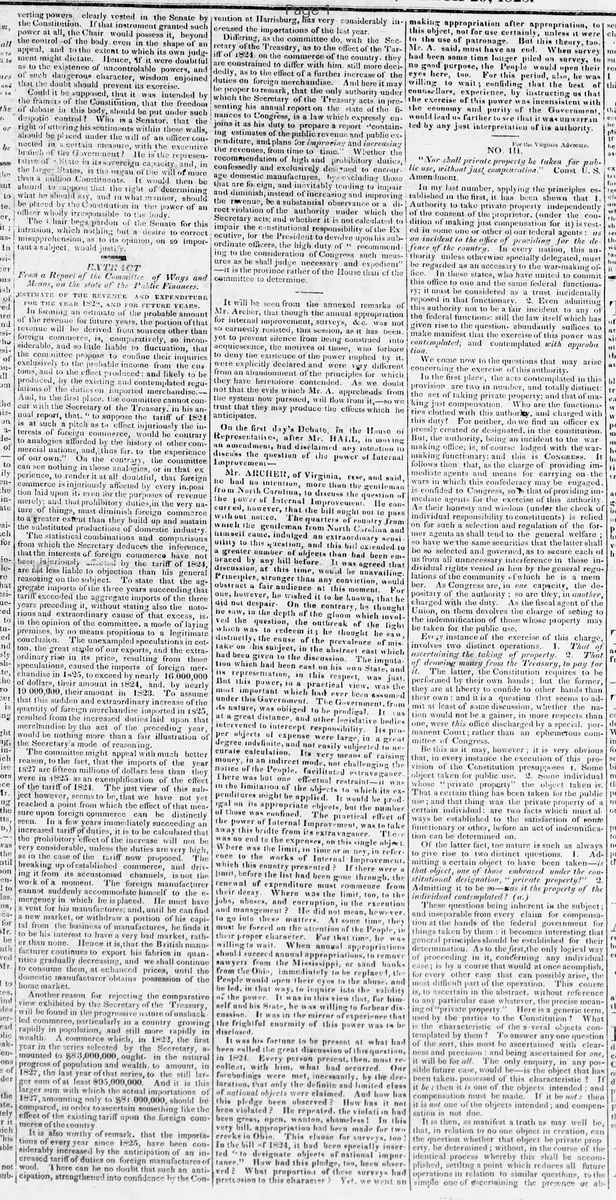
From a Report of the Committee of Ways and Means, on the state of the Public Finances.
ESTIMATE OF THE REVENUE AND EXPENDITURE FOR THE YEAR 1828, AND FOR FUTURE YEARS.
In forming an estimate of the probable amount of the revenue for future years, the portion of that revenue which will be derived from sources other than foreign commerce, is, comparatively, so inconsiderable, and so little liable to fluctuation, that the committee propose to confine their inquiries exclusively to the probable income from the customs, and to the effect produced, and likely to be produced, by the existing and contemplated regulations of the duties on imported merchandise.
And, in the first place, the committee cannot concur with the Secretary of the Treasury, in his annual report, that "to suppose the tariff of 1824 is at such a pitch as to affect injuriously the interests of foreign commerce, would be contrary to analogies afforded by the history of other commercial nations, and, thus far, to the experience of our own." On the contrary, the committee can see nothing in those analogies, or in that experience, to render it at all doubtful, that foreign commerce is injuriously affected by every imposition laid upon it, even for the purposes of revenue merely; and that prohibitory duties, in the very nature of things, must diminish foreign commerce to a greater extent than they build up and sustain the substituted productions of domestic industry.
The statistical combinations and comparisons from which the Secretary deduces the inference, that the interests of foreign commerce have not been injuriously affected by the tariff of 1824, are not less liable to objection than his general reasoning on the subject. To state that the aggregate imports of the three years succeeding that tariff exceeded the aggregate imports of the three years preceding it, without stating also the notorious and extraordinary cause of that excess, is, in the opinion of the committee, a mode of laying premises, by no means propitious to a legitimate conclusion. The unexampled speculations in cotton, the great staple of our exports, and the extraordinary rise in its price, resulting from those speculations, caused the imports of foreign merchandise in 1825, to exceed by nearly 16,000,000 of dollars, their amount in 1824, and, by nearly 19,000,000, their amount in 1823. To assume that this sudden and extraordinary increase of the quantity of foreign merchandise imported in 1825, resulted from the increased duties laid upon that merchandise by the act of the preceding year, would be nothing more than a fair illustration of the Secretary's mode of reasoning.
The committee might appeal with much better reason, to the fact, that the imports of the year 1827 are fifteen millions of dollars less than they were in 1825, as an exemplification of the effect of the tariff of 1824. The just view of this subject however, seems to be, that we have not yet reached a point from which the effect of that measure upon foreign commerce can be distinctly seen. In a few years immediately succeeding an increased tariff of duties, it is to be calculated that the prohibitory effect of the increase will not be very considerable, unless the duties are very high, as in the case of the tariff now proposed. The breaking up of established commerce, and driving it from its accustomed channels, is not the work of a moment. The foreign manufacturer cannot suddenly accommodate himself to the emergency in which he is placed. He must have a vent for his manufactures; and, until he can find a new market, or withdraw a portion of his capital from the business of manufactures, he finds it to be his interest to have a very bad market, rather than none. Hence it is, that the British manufacturer continues to export his fabrics in quantities gradually decreasing, and we shall continue to consume them, at enhanced prices, until the domestic manufacturer obtains possession of the home market.
Another reason for rejecting the comparative view exhibited by the Secretary of the Treasury, will be found in the progressive nature of unshackled commerce, particularly in a country growing rapidly in population, and still more rapidly in wealth. A commerce which, in 1822, the first year in the series selected by the Secretary, amounted to $83,000,000, ought, in the natural progress of population and wealth, to amount, in 1827, the last year of that series, to the still larger sum of at least $95,000,000. And it is this larger sum with which the actual importations of 1827, amounting only to $81,000,000, should be compared, in order to ascertain something like the effect of the existing tariff upon the foreign commerce of the country.
It is also worthy of remark, that the importations of every year since 1825, have been considerably increased by the anticipation of an increased tariff of duties on foreign manufactures of wool. There can be no doubt that such an anticipation, strengthened into confidence by the Convention at Harrisburg, has very considerably increased the importations of the last year.
Differing, as the committee do, with the Secretary of the Treasury, as to the effect of the Tariff of 1824, on the commerce of the country, they are constrained to differ with him, still more decidedly, as to the effect of a further increase of the duties on foreign merchandise. And here it may be proper to remark, that the only authority under which the Secretary of the Treasury acts, in presenting his annual report on the state of the finances to Congress, is a law which expressly enjoins it as his duty to prepare a report containing estimates of the public revenue and public expenditure, and plans for improving and increasing the revenues, from time to time. Whether the recommendation of high and prohibitory duties, confessedly and exclusively designed to encourage domestic manufactures, by excluding those that are foreign, and inevitably tending to impair and diminish, instead of increasing and improving the revenue, be a substantial observance or a direct violation of the authority under which the Secretary acts; and whether it is not calculated to impair the constitutional responsibility of the Executive, for the President to devolve upon his subordinate officers, the high duty of "recommending to the consideration of Congress such measures as he shall judge necessary and expedient"--it is the province rather of the House than of the committee to determine.
It will be seen from the annexed remarks of Mr. Archer, that though the annual appropriation for internal improvement, surveys, &c. was not so earnestly resisted, this session, as it has been, yet to prevent silence from being construed into acquiescence, the motives of those, who forbore to deny the existence of the power implied by it, were explicitly declared and were very different from an abandonment of the principles for which they have heretofore contended. As we doubt not that the evils which Mr. A. apprehends from the system now pursued, will flow from it,--so we trust that they may produce the effects which he anticipates.
On the first day's Debate, in the House of Representatives, after Mr. Hall, in moving an amendment, had disclaimed any intention to discuss the question of the power of Internal Improvement--
Mr. ARCHER, of Virginia, rose, and said, he had no intention, more than the gentleman from North Carolina, to discuss the question of the power of Internal Improvement. He concurred, however, that the bill ought not to pass without notice. The quarters of country from which the gentleman from North Carolina and himself came, indulged an extraordinary sensibility to this question, and this bill extended to a greater number of objects than had been embraced by any bill before. It was agreed that discussion, at this time, would be unavailing. Principles, stronger than any conviction, would obstruct a fair audience at this moment. For one, however, he wished it to be known, that he did not despair. On the contrary, he thought he saw, in the depth of the gloom which involved the question, the outbreak of the light which was to redeem it; he thought he saw, distinctly, the cause of the prevalence of mistake on his subject, in the abstract cast which had been given to the discussion. The imputation which had been cast on his own State, and its representation, in this respect, was just. But this power, in a practical view, was the most important which had ever been assumed under this Government. The Government, from its nature, was obliged to be prodigal. It was at a great distance, and other legislative bodies intervened to intercept responsibility. Its proper objects of expense were large, in a great degree indefinite, and not easily subjected to accurate calculation. Its very means of raising money, in an indirect mode, not challenging the notice of the People, facilitated extravagance. There was but one effectual restraint--it was in the limitation of the objects to which its expenditures might be applied. It would be prodigal on its appropriate objects, but the number of those was confined. The practical effect of the power of Internal Improvement, was to take away this bridle from its extravagance. There was no end to the expenses, on this single object. Where was the limit, in time or money, in reference to the works of Internal Improvement, which this country presented? If there were a limit, before the list had been gone through, the renewal of expenditure must commence from their decay. Where was the limit, too, to the jobs, abuses, and corruption, in the execution and management? He did not mean, however, to go into these matters. At some time, they must be forced on the attention of the People, in their proper character. For that time, he was willing to wait. When annual appropriations should succeed annual appropriations, to remove sawyers from the Mississippi, or sand banks from the Ohio, immediately to be replaced, the People would open their eyes to the abuse, and be led, in that way, to inquire into the validity of the power. It was in this view that, for himself and his State, he was willing to forbear discussion. It was in the mirror of experience that the frightful enormity of this power was to be disclosed.
It was his fortune to be present at what had been called the great discussion of this question, in 1824. Every person present, then, must recollect, with him, what had occurred. Our forebodings were met, incessantly, by the declaration, that only the definite and limited class of national objects were claimed. And how has this pledge been observed? How has it not been violated? He repeated, the violation had been gross, open, wanton, shameless! In this very bill, appropriation had been made for two creeks in Ohio. This clause for surveys, too! In the bill of 1824, it had been specially inserted "to designate objects of national importance." How had this pledge, too, been observed? What proportion of these surveys had pretension to this character? Yet, we went on making appropriation after appropriation, to this object, not for use certainly, unless it were to the use of patronage. But this theory, too, Mr. A. said, must have an end. When survey had been some time longer piled on survey, to no good purpose, the People would open their eyes here, too. For this period, also, he was willing to wait; confiding that the best of counsellors, experience, by instructing us that the exercise of this power was inconsistent with the economy and purity of the Government, would lead us farther to see that it was unwarranted by any just interpretation of its authority.
What sub-type of article is it?
What keywords are associated?
What entities or persons were involved?
Domestic News Details
Event Date
1828
Key Persons
Outcome
critique of 1824 tariff reducing imports from $95m expected to $81m in 1827; opposition to further increases and internal improvements funding as leading to extravagance and corruption.
Event Details
The Committee of Ways and Means reports on 1828 revenue estimates, disputing the Secretary of the Treasury's view that the 1824 tariff did not harm foreign commerce, attributing import fluctuations to cotton speculations and predicting long-term diminishment. Annexed are Mr. Archer's remarks in House debate, arguing against internal improvements appropriations as unconstitutional, extravagant, and prone to abuse, awaiting public realization through experience.