Thank you for visiting SNEWPapers!
Sign up free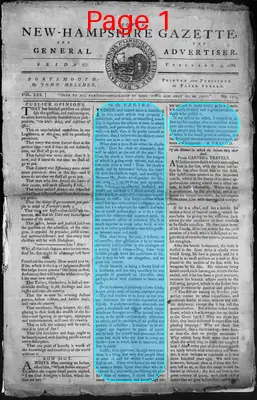
Editorial
February 3, 1786
Fowle's New Hampshire Gazette And General Advertiser
Portsmouth, Rockingham County, New Hampshire
What is this article about?
An editorial addressed 'To the Ladies' by 'A Friend' argues that men seek sensible, cultivated companions in wives, not mere beauty. It criticizes affectation, improper pride, and ignorance in women, promoting common sense, virtue, and knowledge as essential for respect, esteem, and happiness.
Clipping
OCR Quality
95%
Excellent
Full Text
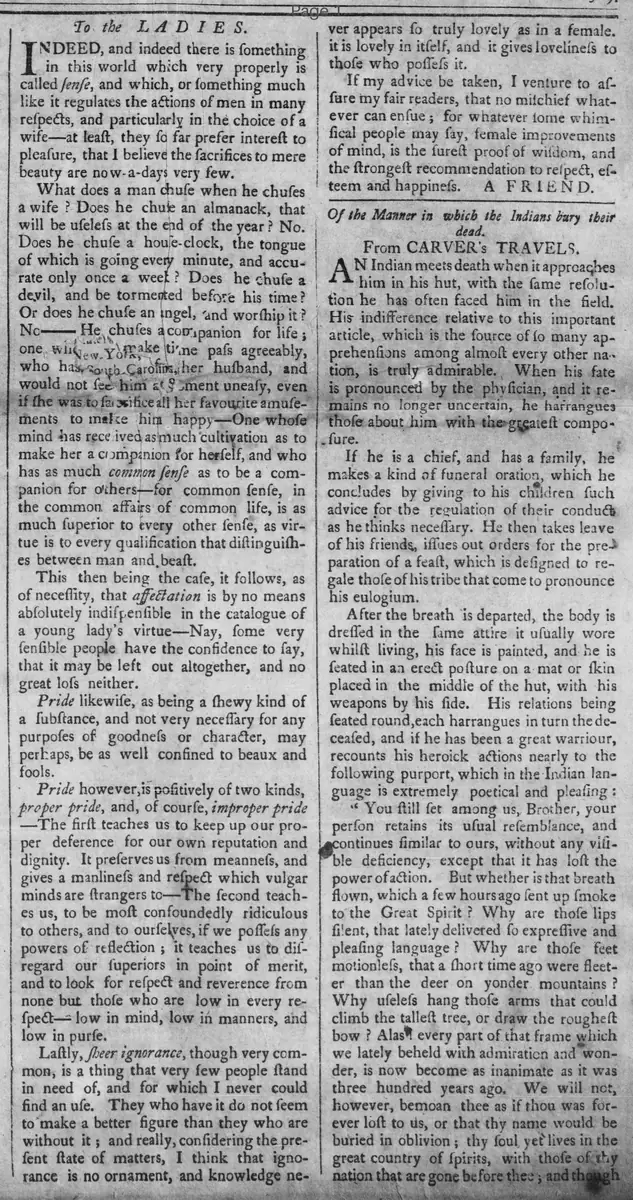
To the LADIES.
INDEED, and indeed there is something in this world which very properly is called sense, and which, or something much like it regulates the actions of men in many respects, and particularly in the choice of a wife—at least, they so far prefer interest to pleasure, that I believe the sacrifices to mere beauty are now-a-days very few.
What does a man choose when he chooses a wife? Does he chuck an almanack, that will be useless at the end of the year? No.
Does he choose a house-clock, the tongue of which is going every minute, and accurate only once a week? Does he choose a devil, and be tormented before his time?
Or does he choose an angel, and worship it?
No—He chooses a companion for life; one with whom he will take his time pass agreeably, who has so much concern for her husband, and would not see him at any time uneasy, even if she was to sacrifice all her favourite amusements to make him happy—One whose mind has received as much cultivation as to make her a companion for herself, and who has as much common sense as to be a companion for others—for common sense, in the common affairs of common life, is as much superior to every other sense, as virtue is to every qualification that distinguishes between man and beast.
This then being the case, it follows, as of necessity, that affectation is by no means absolutely indispensable in the catalogue of a young lady's virtues—Nay, some very sensible people have the confidence to say, that it may be left out altogether, and no great loss neither.
Pride likewise, as being a showy kind of a substance, and not very necessary for any purposes of goodness or character, may perhaps, be as well confined to beaux and fools.
Pride however, is positively of two kinds, proper pride, and, of course, improper pride—The first teaches us to keep up our proper deference for our own reputation and dignity. It preserves us from meanness, and gives a manliness and respect which vulgar minds are strangers to—The second teaches us, to be most confoundedly ridiculous to others, and to ourselves, if we possess any powers of reflection; it teaches us to disregard our superiors in point of merit, and to look for respect and reverence from none but those who are low in every respect—low in mind, low in manners, and low in purse.
Lastly, sheer ignorance, though very common, is a thing that very few people stand in need of, and for which I never could find an use. They who have it do not seem to make a better figure than they who are without it; and really, considering the present state of matters, I think that ignorance is no ornament, and knowledge never appears so truly lovely as in a female.
It is lovely in itself, and it gives loveliness to those who possess it.
If my advice be taken, I venture to assure my fair readers, that no mischief whatever can ensue; for whatever some whimsical people may say, female improvements of mind, is the surest proof of wisdom, and the strongest recommendation to respect, esteem and happiness.
A FRIEND.
INDEED, and indeed there is something in this world which very properly is called sense, and which, or something much like it regulates the actions of men in many respects, and particularly in the choice of a wife—at least, they so far prefer interest to pleasure, that I believe the sacrifices to mere beauty are now-a-days very few.
What does a man choose when he chooses a wife? Does he chuck an almanack, that will be useless at the end of the year? No.
Does he choose a house-clock, the tongue of which is going every minute, and accurate only once a week? Does he choose a devil, and be tormented before his time?
Or does he choose an angel, and worship it?
No—He chooses a companion for life; one with whom he will take his time pass agreeably, who has so much concern for her husband, and would not see him at any time uneasy, even if she was to sacrifice all her favourite amusements to make him happy—One whose mind has received as much cultivation as to make her a companion for herself, and who has as much common sense as to be a companion for others—for common sense, in the common affairs of common life, is as much superior to every other sense, as virtue is to every qualification that distinguishes between man and beast.
This then being the case, it follows, as of necessity, that affectation is by no means absolutely indispensable in the catalogue of a young lady's virtues—Nay, some very sensible people have the confidence to say, that it may be left out altogether, and no great loss neither.
Pride likewise, as being a showy kind of a substance, and not very necessary for any purposes of goodness or character, may perhaps, be as well confined to beaux and fools.
Pride however, is positively of two kinds, proper pride, and, of course, improper pride—The first teaches us to keep up our proper deference for our own reputation and dignity. It preserves us from meanness, and gives a manliness and respect which vulgar minds are strangers to—The second teaches us, to be most confoundedly ridiculous to others, and to ourselves, if we possess any powers of reflection; it teaches us to disregard our superiors in point of merit, and to look for respect and reverence from none but those who are low in every respect—low in mind, low in manners, and low in purse.
Lastly, sheer ignorance, though very common, is a thing that very few people stand in need of, and for which I never could find an use. They who have it do not seem to make a better figure than they who are without it; and really, considering the present state of matters, I think that ignorance is no ornament, and knowledge never appears so truly lovely as in a female.
It is lovely in itself, and it gives loveliness to those who possess it.
If my advice be taken, I venture to assure my fair readers, that no mischief whatever can ensue; for whatever some whimsical people may say, female improvements of mind, is the surest proof of wisdom, and the strongest recommendation to respect, esteem and happiness.
A FRIEND.
What sub-type of article is it?
Feminism
Education
Moral Or Religious
What keywords are associated?
Female Education
Common Sense
Marriage Companion
Women's Virtues
Intellectual Cultivation
Affectation
Pride
Ignorance
Editorial Details
Primary Topic
Advice On Female Virtues And Intellectual Cultivation For Marriage
Stance / Tone
Encouraging Sense, Knowledge, And Virtue In Women Over Affectation And Ignorance
Key Arguments
Men Prefer Sensible Companions Over Mere Beauty In Choosing Wives
Affectation Is Unnecessary And Dispensable In Women's Virtues
Proper Pride Preserves Dignity, While Improper Pride Leads To Ridicule
Ignorance Is Not An Ornament; Knowledge Enhances Female Loveliness
Cultivating The Mind Ensures Respect, Esteem, And Happiness