Thank you for visiting SNEWPapers!
Sign up free
The Washington Union
Washington, District Of Columbia
What is this article about?
John Letcher, a Democratic Congressman from Virginia, is nominated for governor by a strong majority at the state convention. The article praises his abilities and provides a detailed biography highlighting his rise from humble carpenter's son in Lexington to prominent editor, lawyer, and politician advocating for Democratic principles and Southern interests.
Clipping
OCR Quality
Full Text
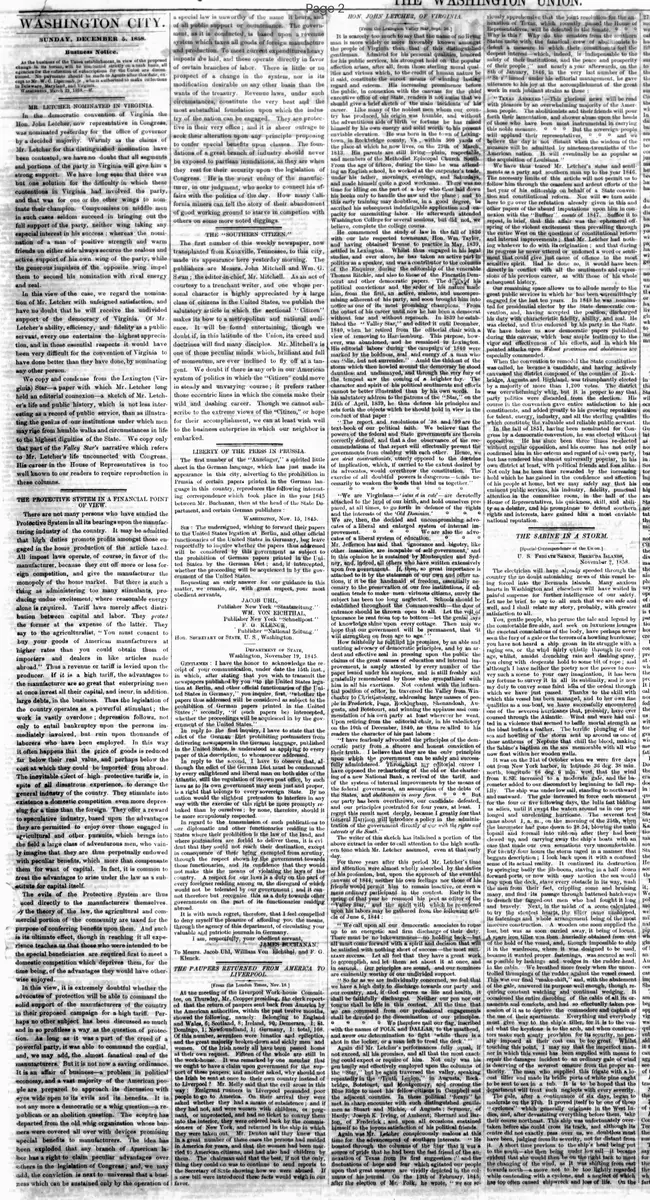
In the democratic convention of Virginia the Hon. John Letcher, now representative in Congress, was nominated yesterday for the office of governor by a decided majority. Warmly as the claims of Mr. Letcher for this distinguished nomination have been contested, we have no doubt that all segments and portions of the party in Virginia will give him a strong support. We have long seen that there was but one solution for the difficulty in which these contentions in Virginia had involved the party, and that was for one or the other wings to nominate their champion. Compromises on middle men in such cases seldom succeed in bringing out the full support of the party, neither wing taking any especial interest in his success; whereas the nomination of a man of positive strength and warm friends on either side always secures the zealous and active support of his own wing of the party, while the generous impulses of the opposite wing impel them to second his nomination with rival energy and zeal.
In this view of the case, we regard the nomination of Mr. Letcher with unfeigned satisfaction, and have no doubt that he will receive the undivided support of the democracy of Virginia. Of Mr. Letcher's ability, efficiency, and fidelity as a public servant, every one entertains the highest appreciation, and in these essential respects it would have been very difficult for the convention of Virginia to have done better than they have done, by nominating any other person.
We copy and condense from the Lexington (Virginia) Star—a paper with which Mr. Letcher long held an editorial connexion—a sketch of Mr. Letcher's life and public history, which is not less interesting as a record of public service, than as illustrating the genius of our institutions under which men may rise from humble walks and circumstances in life to the highest dignities of the State. We copy only that part of the Valley Star's narrative which refers to Mr. Letcher's life unconnected with Congress. His career in the House of Representatives is too well known to our readers to require reproduction in these columns.
HON. JOHN LETCHER, OF VIRGINIA.
[From the Lexington Valley Star, Sept. 30.]
It is scarcely too much to say that the name of no living man is more widely or more favorably known amongst the people of Virginia than that of this distinguished gentleman. Admired for his personal qualities, honored for his public services, his strongest hold on the popular affection arises, after all, from those sterling moral qualities and virtues which, to the credit of human nature be it said, constitute the surest means of winning lasting regard and esteem. His increasing prominence before the public, in connexion with the canvass for the chief executive office of our State, renders it not amiss that we should give a brief sketch of the main incidents of his career. Like many of the noblest men whom our country has produced, his origin was humble, and without the adventitious aids of birth or fortune he has raised himself by his own energy and solid worth to his present enviable elevation. He was born in the town of Lexington, in Rockbridge county, Va., within 300 yards of the place at which he now lives, on the 29th of March, 1813. His parents are still living—plain, respectable, and members of the Methodist Episcopal Church South. From the age of fifteen, during the time he was attending an English school, he worked at the carpenter's trade, under his father, mornings, evenings, and Saturdays, and made himself quite a good workman. There was no time for idling on the part of a boy who thus laid down his books only to handle the saw and the plane; and to this early training may doubtless, in a good degree, be ascribed his subsequent indefatigable application and capacity for unremitting labor. He afterwards attended Washington College for several sessions, but did not, we believe, complete the college course. He commenced the study of law in the fall of 1836 with our late respected townsman, Hon. Wm. Taylor, and having obtained license to practice in May, 1839, settled in Lexington. Whilst thus engaged in his legal studies, and ever since, he has taken an active part in politics as a speaker, and was a contributor to the columns of the Enquirer during the editorship of the venerable Thomas Ritchie, and also to those of the Fincastle Democrat and other democratic papers. The date of his political convictions and the ardor of his nature made him, from the first, an active, zealous, and uncompromising adherent of his party, and soon brought him into notice as one of its most promising champions. From the outset of his career until now he has been a democrat without fear and without reproach. In 1839 he established the 'Valley Star,' and edited it until December, 1840, when he retired from the editorial chair with a view of removing to Harrisonburg. This purpose, however, was abandoned, and he remained in Lexington. His editorial labors during the campaign of 1840 were marked by the boldness, zeal and energy of a man who can 'die, but not surrender.' Amid the thickest of the storm which then howled around the democracy he stood dauntless and undismayed, and through the very fury of the tempest saw the coming of a brighter day. The character and spirit of his political sentiments and efforts cannot be better illustrated than by his own words. In his salutatory address to the patrons of the 'Star,' on the 24th of April, 1839, he thus defines his principles and sets forth the objects which he should hold in view in the conduct of that paper:
'The report and resolutions of '98 and '99 are the text-book of our political faith. We believe that the powers of the federal and State governments are therein correctly defined, and that a due observance of the recommendations of that report will effectually prevent the governments from clashing with each other. Hence, we are strict constructionists, utterly opposed to the doctrine of implication, which, if carried to the extent desired by its advocates, would overthrow the constitution. The exercise of all doubtful powers is dangerous—tends necessarily to weaken the bonds that bind us together.'
We are Virginians—'intus et in cute'—are devotedly attached to the land of our birth, and hold ourselves prepared, at all times, to go forth in defence of the rights and the interests of the 'Old Dominion.'
We are, then, the decided and uncompromising advocates of a liberal and enlarged system of internal improvement.
We are also the advocates of a liberal system of education. Mr. Jefferson has said that ignorance and bigotry, like other insanities, are incapable of self-government,' and in this opinion he is sustained by Montesquieu and Sydney, and, indeed, all others who have written extensively upon free government. If, then, so great importance is attached to it by the statesmen of our own and other nations, if it be the handmaid of freedom, essentially necessary to the preservation of our free institutions, if education tends to make men virtuous citizens, surely the subject has been too long neglected. Schools should be established throughout the Commonwealth—the door of entrance should be thrown open to all. Let the veil of ignorance be rent from top to bottom—let the genial rays of knowledge shine upon every cottage. Then may we hope that our government will be permanent, that it will strengthen on from age to age.
How faithfully he fulfilled his promises, by an able and untiring advocacy of democratic principles, and by an ardent and effective zeal in pressing upon the public the claims of the great causes of education and internal improvement, is amply attested by every number of the paper issued under his auspices, and is still freshly and gratefully remembered by those who sympathized with him in all his exertions. Not content with the influential position of editor, he traversed the Valley from Winchester to Christiansburg, addressing large masses of people in Frederick, Page, Rockingham, Shenandoah, Augusta, and Botetourt, and winning the applause and commendation of his own party at least wherever he went. Upon retiring from the editorial chair, in his valedictory on the 10th of December, 1840, he thus recalled to his readers the character of his past labors:
'I have fearlessly advocated the principles of the democratic party from a sincere and honest conviction of their truth. I believe that they are the only principles upon which the government can be safely and successfully administered.' Throughout my editorial career I have opposed the rechartering of the old or the chartering of a new National Bank, a revival of the tariff, and of the system of internal improvements by the means of the federal government, an assumption of the debts of the States, and abolitionism in every form. ... But our party has been overthrown, our candidate defeated, and our principles prostrated for four years, at least. I regret this result most deeply, because I greatly fear that General Harrison will introduce a policy in the administration of the government directly at war with the rights and interests of the South.'
The writer of this sketch has italicised a portion of the above extract in order to call attention to the high southern tone which Mr. Letcher assumed, even at that early day.
For three years after this period Mr. Letcher's time and attention were almost wholly absorbed by the duties of his profession, but, upon the approach of the eventful canvass of 1844, neither his own feelings nor those of his friends would permit him to remain inactive, or even a mere ordinary participant in the contest. Early in the spring of that year he resumed his post as editor of the 'Valley Star,' and the spirit with which he re-entered upon his labors may be gathered from the following article of June 6, 1844:
'We call upon all our democratic associates to rouse up to an energetic and firm discharge of their duty. There must be no lukewarmness—no holding back—but all must come forward with a spirit and decision that will be satisfied with nothing short of success—the most brilliant success. Let all feel that they have a great work to accomplish, and let them set about it at once, and in earnest. Our principles are sound, and our nominees are eminently worthy of our undivided support.'
'So far as we are individually concerned, we feel that we have a high duty to discharge towards our party and our country, and, if God spares us life and health, it shall be faithfully discharged. Neither our pen nor our tongue shall be idle in this contest. All the time that we can command from our professional engagements shall be devoted to the dissemination of our principles.'
We therefore nail our flag, inscribed with the names of POLK and DALLAS, to the masthead, and avow our determination to fight 'while there is a shot in the locker, or a man left to tread the deck.'
Again did Mr. Letcher's performances fully equal, if not exceed, all his promises, and all that the most exacting could expect or require of him. Not only was his pen busily and effectively employed upon the columns of the 'Star,' but he again traversed the valley, speaking repeatedly in the Tenth Legion, in Augusta, Rockbridge, Botetourt, and Montgomery, and crossing the Blue Ridge to meet his fellow-citizens in Campbell and the adjacent counties. In these political 'forays' he met in sharp encounter with such distinguished gentlemen as Stuart and Michie, of Augusta; Seymour, of Hardy; Joseph K. Irving, of Amherst; Sherrard and Barton, of Frederick; and upon all occasions sustained himself to the joyous satisfaction of his political friends.
Again was Mr. Letcher conspicuously zealous at this time for the advancement of southern interests. He boasted through the columns of the Star that it was a source of pride that he had been the fast friend of the annexation of Texas from its first suggestion; and the fluctuations of hope and fear which agitated our people upon that great measure are vividly depicted in the columns of his journal. On the 19th of February, 1845, after the election of Mr. Polk, he wrote, 'we are seriously apprehensive that the joint resolution for the annexation of Texas, which recently passed the House of Representatives, will be defeated in the Senate. Why is this? Why do the senators from the southern States unite with the fanatical crew of abolitionists to defeat a measure in which their constituents feel the deepest interest—which, indeed, is indispensable to the safety of their institutions, and the peace and prosperity of their people;' and nearly a year afterwards, on the 8th of January, 1846, in the very last number of the 'Star' issued under his editorial management, he gave utterance to his joy at the accomplishment of the great work in such jubilant strains as these:
'TEXAS ANNEXED!—This glorious news will be read with pleasure by an overwhelming majority of the American people. The abolitionists and their friends will pour forth their lamentation, and shower abuse upon the heads of those who have been most instrumental in carrying this noble measure. ... But the sovereign people will applaud their representatives, ... and we believe the day is not distant when the wisdom of the measure will be admitted by nineteen-twentieths of the American nation. It will eventually be as popular as the acquisition of Louisiana.'
We have thus traced Mr. Letcher's status and sentiments as a party and southern man up to the year 1846. The necessary limits of this article will not permit us to follow him through the ceaseless and ardent efforts of the last year of his editorship on behalf of a State convention and constitutional reform. Nor will we turn aside here to go over the refutation already given in this and other papers of the absurd imputations upon him in connexion with the 'Ruffner' emeute of 1847. Suffice it to repeat, in brief, that this affair was the ephemeral offspring of the violent excitement then prevailing through the entire West on the questions of constitutional reform and internal improvements: that Mr. Letcher had nothing whatever to do with its origination; and that during its progress he never uttered or endorsed a word or sentiment that could give just cause of offence to the most sensitive spirit. Had he done so, it would have been directly in conflict with all the sentiments and expressions of his previous career, as with those of his whole subsequent history.
Our remaining space allows us to allude merely to the great public services in which he has been unremittingly engaged for the last ten years. In 1848 he was nominated for presidential elector by the State democratic convention, and, having accepted the position, discharged his duty with characteristic fidelity, ability, and zeal. He was elected, and thus endorsed by his party in the State. We have before us now democratic papers published during this canvass, which bear ample testimony to the vigor and effectiveness of his efforts, and in which his pointed attacks upon Wilmot provisoism and abolitionism are especially commended. When the convention to remodel the State constitution was called, he became a candidate, and having actively canvassed the district composed of the counties of Rockbridge, Augusta and Highland, was triumphantly elected by a majority of more than 1,200 votes. The district was overwhelmingly whig, but it is proper to say that party politics were discarded from the election. His course in the convention gave entire satisfaction to his constituents, and added greatly to his growing reputation for talent, energy, industry, and all the sterling qualities which constitute the valuable and reliable public servant. In the fall of 1851, having been nominated for Congress by a democratic convention, he was elected without opposition. He has since been three times re-elected without regular opposition, and his course has not only confirmed him in the esteem and regard of his own party, but has rendered him almost universally popular, in his own district at least, with political friends and foes alike. Not only has he been thus rewarded by the increasing hold which he has gained in the confidence and affection of his people at home, but we may safely say that his eminent public services, his industry, fidelity, punctual attention in the committee room, in the hall of the House of Representatives, his quickness, skill, and ability as a debater, and his promptness to defend southern rights and interests, have gained him a most enviable national reputation.
What sub-type of article is it?
What themes does it cover?
What keywords are associated?
What entities or persons were involved?
Where did it happen?
Story Details
Key Persons
Location
Lexington, Rockbridge County, Virginia
Event Date
29th Of March, 1813 (Birth); Recent Nomination (1855 Implied)
Story Details
John Letcher rises from humble carpenter's apprentice in Lexington, VA, to Democratic editor, lawyer, and Congressman, nominated for governor amid party unity; biography details his zealous advocacy for Democratic principles, education, internal improvements, and Southern interests including Texas annexation.