Thank you for visiting SNEWPapers!
Sign up free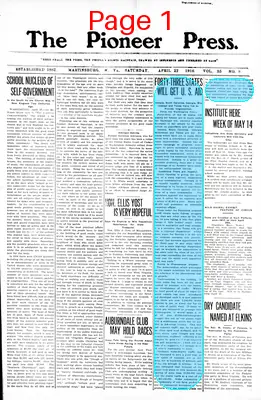
Story
April 22, 1916
Pioneer Press
Martinsburg, Berkeley County, West Virginia
What is this article about?
Forty-three of 48 U.S. states qualify for federal road aid under the Bankhead bill, while Indiana, South Carolina, Georgia, Mississippi, and Texas lack centralized highway departments. The bill highlights rapid motor vehicle growth and agricultural traffic straining roads.
Clipping
OCR Quality
95%
Excellent
Full Text
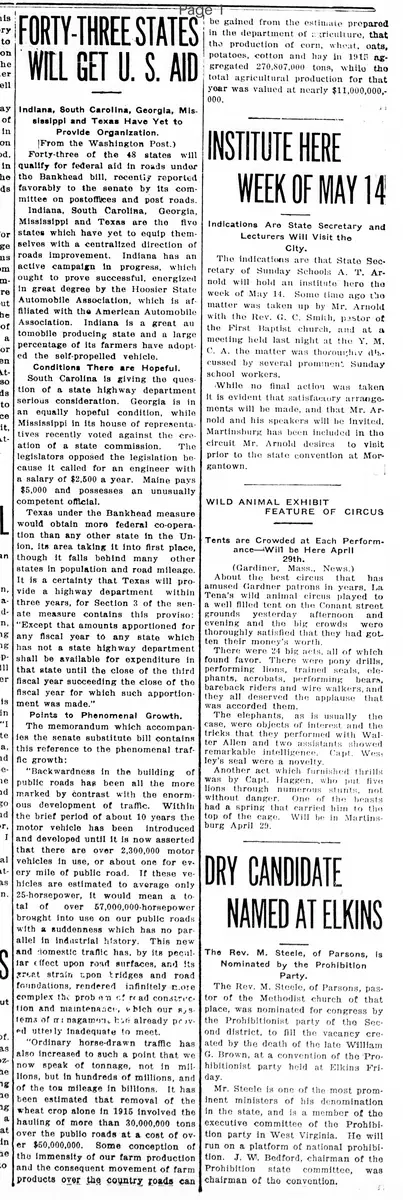
FORTY-THREE STATES WILL GET U. S. AID
Indiana, South Carolina, Georgia, Mississippi and Texas Have Yet to Provide Organization.
[From the Washington Post.]
Forty-three of the 48 states will qualify for federal aid in roads under the Bankhead bill, recently reported favorably to the senate by its committee on postoffices and post roads. Indiana, South Carolina, Georgia, Mississippi and Texas are the five states which have yet to equip themselves with a centralized direction of roads improvement. Indiana has an active campaign in progress, which ought to prove successful, energized in great degree by the Hoosier State Automobile Association, which is affiliated with the American Automobile Association. Indiana is a great automobile producing state and a large percentage of its farmers have adopted the self-propelled vehicle.
Conditions There are Hopeful.
South Carolina is giving the question of a state highway department serious consideration. Georgia is in an equally hopeful condition, while Mississippi in its house of representatives recently voted against the creation of a state commission. The legislators opposed the legislation because it called for an engineer with a salary of $2,500 a year. Maine pays $5,000 and possesses an unusually competent official.
Texas under the Bankhead measure would obtain more federal co-operation than any other state in the Union, its area taking it into first place, though it falls behind many other states in population and road mileage. It is a certainty that Texas will provide a highway department within three years, for Section 3 of the senate measure contains this proviso: "Except that amounts apportioned for any fiscal year to any state which has not a state highway department shall be available for expenditure in that state until the close of the third fiscal year succeeding the close of the fiscal year for which such apportionment was made."
Points to Phenomenal Growth.
The memorandum which accompanies the senate substitute bill contains this reference to the phenomenal traffic growth:
"Backwardness in the building of public roads has been all the more marked by contrast with the enormous development of traffic. Within the brief period of about 10 years the motor vehicle has been introduced and developed until it is now asserted that there are over 2,300,000 motor vehicles in use, or about one for every mile of public road. If these vehicles are estimated to average only 25-horsepower, it would mean a total of over 57,000,000-horsepower brought into use on our public roads with a suddenness which has no parallel in industrial history. This new and domestic traffic has, by its peculiar far effect upon road surfaces, and its great strain upon bridges and road foundations, rendered infinitely more complex the problem of road construction and maintenance, which our systems of management, far already proved utterly inadequate to meet.
"Ordinary horse-drawn traffic has also increased to such a point that we now speak of tonnage, not in millions, but in hundreds of millions, and of the ton mileage in billions. It has been estimated that removal of the wheat crop alone in 1915 involved the hauling of more than 30,000,000 tons over the public roads at a cost of over $50,000,000. Some conception of the immensity of our farm production and the consequent movement of farm products over the country roads can be gained from the estimate prepared in the department of agriculture, that the production of corn, wheat, oats, potatoes, cotton and hay in 1915 aggregated 270,807,000 tons, while the total agricultural production for that year was valued at nearly $11,000,000,000."
Indiana, South Carolina, Georgia, Mississippi and Texas Have Yet to Provide Organization.
[From the Washington Post.]
Forty-three of the 48 states will qualify for federal aid in roads under the Bankhead bill, recently reported favorably to the senate by its committee on postoffices and post roads. Indiana, South Carolina, Georgia, Mississippi and Texas are the five states which have yet to equip themselves with a centralized direction of roads improvement. Indiana has an active campaign in progress, which ought to prove successful, energized in great degree by the Hoosier State Automobile Association, which is affiliated with the American Automobile Association. Indiana is a great automobile producing state and a large percentage of its farmers have adopted the self-propelled vehicle.
Conditions There are Hopeful.
South Carolina is giving the question of a state highway department serious consideration. Georgia is in an equally hopeful condition, while Mississippi in its house of representatives recently voted against the creation of a state commission. The legislators opposed the legislation because it called for an engineer with a salary of $2,500 a year. Maine pays $5,000 and possesses an unusually competent official.
Texas under the Bankhead measure would obtain more federal co-operation than any other state in the Union, its area taking it into first place, though it falls behind many other states in population and road mileage. It is a certainty that Texas will provide a highway department within three years, for Section 3 of the senate measure contains this proviso: "Except that amounts apportioned for any fiscal year to any state which has not a state highway department shall be available for expenditure in that state until the close of the third fiscal year succeeding the close of the fiscal year for which such apportionment was made."
Points to Phenomenal Growth.
The memorandum which accompanies the senate substitute bill contains this reference to the phenomenal traffic growth:
"Backwardness in the building of public roads has been all the more marked by contrast with the enormous development of traffic. Within the brief period of about 10 years the motor vehicle has been introduced and developed until it is now asserted that there are over 2,300,000 motor vehicles in use, or about one for every mile of public road. If these vehicles are estimated to average only 25-horsepower, it would mean a total of over 57,000,000-horsepower brought into use on our public roads with a suddenness which has no parallel in industrial history. This new and domestic traffic has, by its peculiar far effect upon road surfaces, and its great strain upon bridges and road foundations, rendered infinitely more complex the problem of road construction and maintenance, which our systems of management, far already proved utterly inadequate to meet.
"Ordinary horse-drawn traffic has also increased to such a point that we now speak of tonnage, not in millions, but in hundreds of millions, and of the ton mileage in billions. It has been estimated that removal of the wheat crop alone in 1915 involved the hauling of more than 30,000,000 tons over the public roads at a cost of over $50,000,000. Some conception of the immensity of our farm production and the consequent movement of farm products over the country roads can be gained from the estimate prepared in the department of agriculture, that the production of corn, wheat, oats, potatoes, cotton and hay in 1915 aggregated 270,807,000 tons, while the total agricultural production for that year was valued at nearly $11,000,000,000."
What sub-type of article is it?
Historical Event
What themes does it cover?
Triumph
What keywords are associated?
Federal Aid
Bankhead Bill
Highway Departments
Road Improvement
Motor Vehicles
Agricultural Traffic
Where did it happen?
United States
Story Details
Location
United States
Event Date
1915 1916
Story Details
Forty-three states qualify for federal road aid under the Bankhead bill; five states lag in establishing highway departments but show progress; bill addresses rapid growth in motor vehicles and agricultural traffic straining roads.