Thank you for visiting SNEWPapers!
Sign up free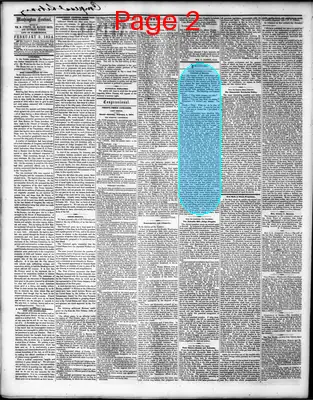
Story
February 5, 1854
Washington Sentinel
Washington, District Of Columbia
What is this article about?
An article from the Charleston News contrasts the well-fed Southern slave woman Dinah, who offers food to a starving Irish emigrant, to critique abolitionist views, portraying slavery as preferable to the hardships of freedom.
Clipping
OCR Quality
98%
Excellent
Full Text
Political.
From the Charleston (S. C.) News.
Contrasts of Slavery.
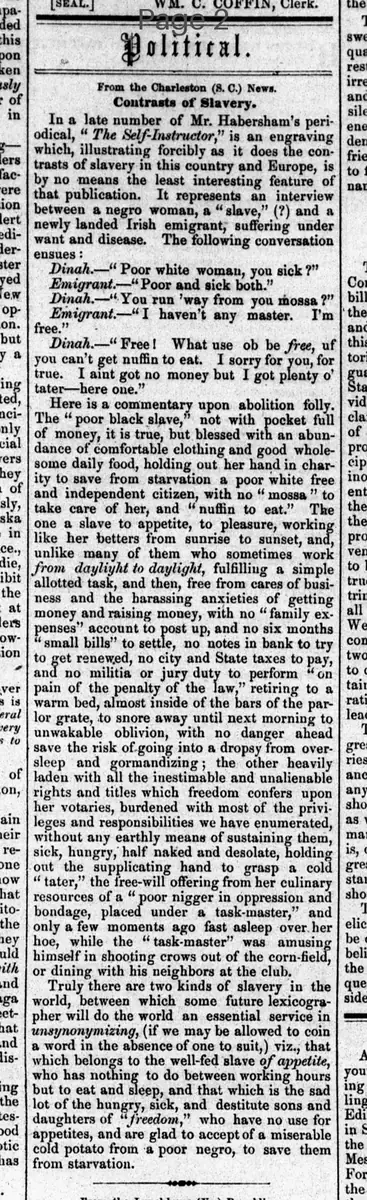
In a late number of Mr. Habersham's periodical, "The Self-Instructor," is an engraving which, illustrating forcibly as it does the contrasts of slavery in this country and Europe, is by no means the least interesting feature of that publication. It represents an interview between a negro woman, a "slave," (?) and a newly landed Irish emigrant, suffering under want and disease.
The following conversation ensues:
Dinah.—"Poor white woman, you sick?"
Emigrant.—"Poor and sick both."
Dinah.—"You run 'way from you mossa?"
Emigrant.—"I haven't any master. I'm free."
Dinah.—"Free! What use ob be free, uf you can't get nuffin to eat. I sorry for you, for true. I aint got no money but I got plenty o tater—here one."
Here is a commentary upon abolition folly. The "poor black slave," not with pocket full of money, it is true, but blessed with an abundance of comfortable clothing and good wholesome daily food, holding out her hand in charity to save from starvation a poor white free and independent citizen, with no "mossa" to take care of her, and "nusfin to eat." The one a slave to appetite, to pleasure, working like her betters from sunrise to sunset, and, unlike many of them who sometimes work from daylight to daylight, fulfilling a simple allotted task, and then, free from cares of business and the harassing anxieties of getting money and raising money, with no "family expenses" account to post up, and no six months "small bills" to settle, no notes in bank to try to get renewed, no city and State taxes to pay, and no militia or jury duty to perform "on pain of the penalty of the law," retiring to a warm bed, almost inside of the bars of the parlor grate, to snore away until next morning to unwakable oblivion, with no danger ahead save the risk of going into a dropsy from over-sleep and gormandizing; the other heavily laden with all the inestimable and unalienable rights and titles which freedom confers upon her votaries, burdened with most of the privileges and responsibilities we have enumerated, without any earthly means of sustaining them, sick, hungry, half naked and desolate, holding out the supplicating hand to grasp a cold "tater," the free-will offering from her culinary resources of a "poor nigger in oppression and bondage," and only a few moments ago fast asleep over her hoe, while the "task-master" was amusing himself in shooting crows out of the corn-field, or dining with his neighbors at the club.
Truly there are two kinds of slavery in the world, between which some future lexicographer will do the world an essential service in unsynonymizing, (if we may be allowed to coin a word in the absence of one to suit,) viz., that which belongs to the well-fed slave of appetite, who has nothing to do between working hours but to eat and sleep, and that which is the sad lot of the hungry, sick, and destitute sons and daughters of "freedom," who have no use for appetites, and are glad to accept of a miserable cold potato from a poor negro, to save them from starvation.
From the Charleston (S. C.) News.
Contrasts of Slavery.
In a late number of Mr. Habersham's periodical, "The Self-Instructor," is an engraving which, illustrating forcibly as it does the contrasts of slavery in this country and Europe, is by no means the least interesting feature of that publication. It represents an interview between a negro woman, a "slave," (?) and a newly landed Irish emigrant, suffering under want and disease.
The following conversation ensues:
Dinah.—"Poor white woman, you sick?"
Emigrant.—"Poor and sick both."
Dinah.—"You run 'way from you mossa?"
Emigrant.—"I haven't any master. I'm free."
Dinah.—"Free! What use ob be free, uf you can't get nuffin to eat. I sorry for you, for true. I aint got no money but I got plenty o tater—here one."
Here is a commentary upon abolition folly. The "poor black slave," not with pocket full of money, it is true, but blessed with an abundance of comfortable clothing and good wholesome daily food, holding out her hand in charity to save from starvation a poor white free and independent citizen, with no "mossa" to take care of her, and "nusfin to eat." The one a slave to appetite, to pleasure, working like her betters from sunrise to sunset, and, unlike many of them who sometimes work from daylight to daylight, fulfilling a simple allotted task, and then, free from cares of business and the harassing anxieties of getting money and raising money, with no "family expenses" account to post up, and no six months "small bills" to settle, no notes in bank to try to get renewed, no city and State taxes to pay, and no militia or jury duty to perform "on pain of the penalty of the law," retiring to a warm bed, almost inside of the bars of the parlor grate, to snore away until next morning to unwakable oblivion, with no danger ahead save the risk of going into a dropsy from over-sleep and gormandizing; the other heavily laden with all the inestimable and unalienable rights and titles which freedom confers upon her votaries, burdened with most of the privileges and responsibilities we have enumerated, without any earthly means of sustaining them, sick, hungry, half naked and desolate, holding out the supplicating hand to grasp a cold "tater," the free-will offering from her culinary resources of a "poor nigger in oppression and bondage," and only a few moments ago fast asleep over her hoe, while the "task-master" was amusing himself in shooting crows out of the corn-field, or dining with his neighbors at the club.
Truly there are two kinds of slavery in the world, between which some future lexicographer will do the world an essential service in unsynonymizing, (if we may be allowed to coin a word in the absence of one to suit,) viz., that which belongs to the well-fed slave of appetite, who has nothing to do between working hours but to eat and sleep, and that which is the sad lot of the hungry, sick, and destitute sons and daughters of "freedom," who have no use for appetites, and are glad to accept of a miserable cold potato from a poor negro, to save them from starvation.
What sub-type of article is it?
Curiosity
What themes does it cover?
Social Manners
Moral Virtue
What keywords are associated?
Slavery Contrasts
Abolition Folly
Irish Emigrant
Negro Slave
Freedom Hardships
What entities or persons were involved?
Dinah
Irish Emigrant
Where did it happen?
Charleston, S.C.
Story Details
Key Persons
Dinah
Irish Emigrant
Location
Charleston, S.C.
Story Details
An engraving depicts a slave woman Dinah offering a potato to a starving Irish emigrant, highlighting the supposed benefits of slavery over the freedoms leading to destitution, as a critique of abolitionism.