Thank you for visiting SNEWPapers!
Sign up free
Richmond Palladium
Richmond, Wayne County, Indiana
What is this article about?
Reports on the Indiana General Assembly session in Indianapolis from December 2-14, 1845, covering resolutions, the Governor's message, petitions, the election of Jesse D. Bright as U.S. Senator, balloting for Senate president resolved with Godlove S. Orth, and discussions on state debt, education, and infrastructure.
Clipping
OCR Quality
Full Text
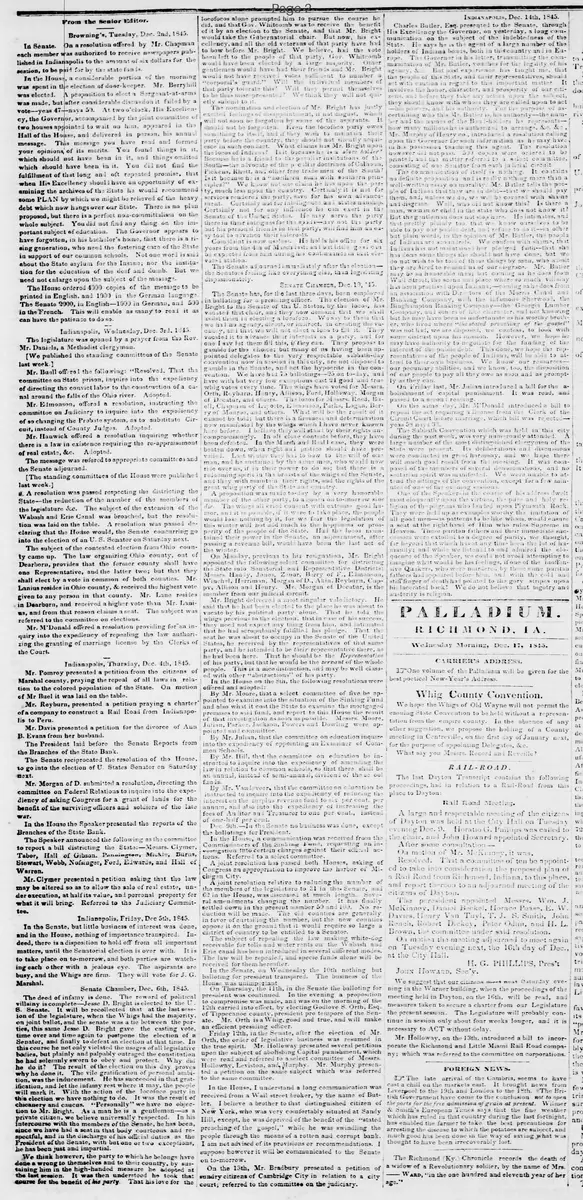
Browning's, Tuesday, Dec. 2nd, 1845.
In Senate. On a resolution offered by Mr. Chapman each member was authorized to receive newspapers published in Indianapolis to the amount of six dollars for the session, to be paid for by the state funds.
In the House, a considerable portion of the morning was spent in the election of door-keeper. Mr. Berryhill was elected. A proposition to elect a Sergeant-at-arms was made, but after considerable discussion it failed by a vote--yeas 47, nays 50. At two o'clock, His Excellency, the Governor, accompanied by the joint committee of two houses appointed to wait on him, appeared in the Hall of the House, and delivered in person, his annual message. This message you have read and formed your opinions of its merits. You found things in it, which should not have been in it, and things omitted which should have been in it. You did not find the fulfillment of that long and oft repeated promise, that when His Excellency should have an opportunity of examining the archives of the State he would recommend some PLAN by which we might be relieved of the heavy debt which now hangs over our State. There is no plan proposed, but there is a perfect non-committalism on the whole subject. You did not find any thing on the important subject of education. The Governor appears to have forgotten, in his bachelor's home, that there is a rising generation, who need the fostering care of the State in support of our common schools. Not one word is said about the State asylum for the Insane; nor the institution for the education of the deaf and dumb. But we need not enlarge upon the subject of the message.
The House ordered 4000 copies of the message to be printed in English, and 1000 in the German language.
The Senate 2000, in English--1000 in German, and 500 in the French. This will enable as many to read it as can have the patience to do so.
Indianapolis, Wednesday, Dec. 3rd, 1845.
The legislature was opened by a prayer from the Rev. Mr. Daniels, a Methodist clergyman.
[We published the standing committees of the Senate last week.]
Mr. Buell offered the following: "Resolved, That the committee on State prison, inquire into the expediency of directing the convict labor to the construction of a Canal around the falls of the Ohio river." Adopted.
Mr. Edmonson, offered a resolution, instructing the committee on Judiciary to inquire into the expediency of so changing the Probate system, as to substitute Circuit, instead of County Judges. Adopted.
Mr. Hanwick offered a resolution inquiring whether there is a law in existence requiring the re-appraisement of real estate, &c. Adopted.
The message was referred to appropriate committees and the Senate adjourned.
[The standing committees of the House were published last week.]
A resolution was passed respecting the districting the State--the reduction of the number of the members of the legislature &c. The subject of the extension of the Wabash and Erie Canal was broached, but the resolution was laid on the table. A resolution was passed declaring that the House would, the Senate concurring go into the election of an U. S. Senator on Saturday next.
The subject of the contested election from Ohio county came up. The law organizing Ohio county, out of Dearborn, provides that the former county shall have one Representative, and the latter two; but that they shall elect by a vote in common of both counties. Mr. Lanius resides in Ohio county, & received the highest vote given to any person in that county. Mr. Lane resides in Dearborn, and received a higher vote than Mr. Lanius, and from that reason claims a seat. The subject was referred to the committee on elections.
Mr. M'Donald offered a resolution providing for an inquiry into the expediency of repealing the law authorizing the granting of marriage license by the Clerks of the Court.
Indianapolis, Thursday, Dec. 4th, 1845.
Mr. Pomroy presented a petition from the citizens of Marshall county, praying the repeal of all laws in relation to the colored population of the State. On motion of Mr. Buel it was laid on the table.
Mr. Reyburn, presented a petition praying a charter of a company to construct a Rail Road from Indianapolis to Peru.
Mr. Davis presented a petition for the divorce of Ann B. Evans from her husband.
The President laid before the Senate Reports from the Branches of the State Bank.
The Senate reciprocated the resolution of the House, to go into the election of U. States Senator on Saturday next.
Mr. Morgan of D. submitted a resolution, directing the committee on Federal Relations to inquire into the expediency of asking Congress for a grant of lands for the benefit of the surviving officers and soldiers of the late war.
In the House the Speaker presented the reports of the Branches of the State Bank.
The Speaker announced the following as the committee to report a bill districting the State:--Messrs. Clymer, Tabor, Hall of Gibson, Pennington, Mickey, Burns, Stewart, Webb, Nofsinger, Ford, Edwards, and Hall of Warren.
Mr. Clymer presented a petition asking that the law may be altered so as to allow the sale of real estate, under execution, at half its value, and personal property for what it will bring.
Referred to the Judiciary Committee.
Indianapolis, Friday, Dec 5th, 1845.
In the Senate, but little business of interest was done, and in the House, nothing of importance transpired. Indeed, there is a disposition to hold off from all important matters, until the Senatorial election is over with. It is to take place to-morrow, and both parties are watching each other with a jealous eye. The aspirants are busy, and the Whigs are firm. They will vote for J. G. Marshall.
Senate Chamber, Dec. 6th, 1845.
The deed of infamy is done. The reward of political villainy is complete--Jesse D. Bright is elected to the U. S. Senate. It will be recollected that at the last session of the legislature, when the Whigs had the majority, on joint ballot, and the senate was a tie between the parties, this same Jesse D. Bright gave the casting vote, time over and time again to postpone the election of a Senator, and finally to defeat an election at that time. In this course he not only violated the usages of all legislative bodies, but plainly and palpably outraged the constitution he had solemnly sworn to obey and protect. Why did he do it? The result of the election on this day proves why he done it. The vile gratification of personal ambition, was the inducement. He has succeeded in that gratification, and let the infamy rest where it may, the people will mark it. With the action of the locofoco party in this election we have nothing to do. It was the result of chicanery and caucus. "Personally" we have no objection to Mr. Bright. As a man he is a gentleman--as a private citizen, we believe universally respected. In his intercourse with the members of the Senate, he has been, since we have had a seat in that body courteous and respectful, and in the discharge of his official duties as the President of the Senate, with but one or two exceptions, he has been just and impartial.
We think however, the party to which he belongs have done a wrong to themselves and to their country, by sustaining him in the high-handed measure he adopted at the last session. It was then understood he took that course for the benefit of his party. That his love for the locofocos alone prompted him to pursue the course he did, and that Gov. Whitcomb was to receive the benefit of it by an election to the Senate, and that Mr. Bright would take the Gubernatorial chair. But now, his excellency, and all the old veterans of that party have had to bow before Mr. Bright. We believe, had the vote been left to the people of that party, Gov. Whitcomb would have been elected by a large majority. Other gentlemen would have had their friends and Mr. Bright would not have received votes sufficient to number a "corporal's guard." Will the individual members of that party tolerate this? Will they permit themselves to be thus misrepresented? We think they will not quietly submit to it.
The nomination and election of Mr. Bright has justly excited feelings of disappointment, if not disgust, which will not soon be forgotten by some of the aspirants. It should not be forgotten. Even the locofoco party owes something to itself, and if they wish to maintain their party before the country, they should not silently acquiesce in such conduct. What claims has Mr. Bright upon the locos of Indiana? Is it because he is a slave holder? Because he is a friend to the peculiar institutions of the South--the advocate of the peculiar doctrines of Calhoun, Pickens, Rhett, and other free trade men of the South? Is it because he is a "northern man with southern principles?" We know not one claim he has upon the party, much less upon the country. Certainly it is not for services rendered the party, save for his own advancement. Certainly not for intelligence and statesmanship. Certainly not for any influence he can exert in the Senate of the United States. He may serve the party therein their intrigues for the spoils--but his personal friends in that party, will find him an easy tool to advance their interests.
Complaint is now useless. He holds his office for six years from the 4th of March last; and but little good can be expected from him during his continuance in that elevated station.
The Senate adjourned immediately after the election--the Senators feeling like everything else, than legislating dispassionately.
Senate Chamber, Dec. 10, '45.
The Senate has, for the last three days, been employed in balloting for a presiding officer. The election of Mr. Bright to the Senate of the U. States, by the locos, has vacated that chair, and they now demand that we shall assist them in electing a locofoco. We say to them that we had no agency, direct, or indirect, in creating the vacancy, and that we will not elect a loco to fill it. They vacated it to advance their interests as a party, and for one I say let them fill it, if they can. They propose to gamble for the choice; but many of us having been appointed delegates to the very respectable sabbath-day convention now in session in this city, are not disposed to gamble in the Senate, and act the hypocrite in the convention. We have had 75 ballotings--25 on to-day, and have with but very few exceptions cast 21 good and true whig votes every one. The whigs have voted for Messrs. Orth, Reyburn, Henry, Allison, Ford, Holloway, Morgan of Decatur, and others. The locos for Messrs. Reed, Buell, Chapman of Logansport, Edmonson, Parks, Logan, Berry of Monroe, and others. What will be the result of it cannot be told; but there is a firmness and determination now manifested by the whigs which I have never known here before. I believe they will stand by their rights uncompromizingly. In all close contests before, they have been defeated. "In the Marsh and Beal case, they were beaten down, when right and justice should have prevailed. Last winter they had to bow to the will of one man, and he sustained by the same men, who will now ride over us, if in their power to do so; but there is a redeeming spirit in the breasts of the whigs of the Senate, and they will maintain their rights, and the rights of the great whig party of the State and country.
A proposition was made to-day by a very honorable member of the other party, to adjourn on to-morrow sine die. The whigs all cried consent with extreme good humor, and it is possible, if it were to take place, the people would lose nothing by it, for we fear the legislation of this winter will not add much to the happiness or prosperity of the people of the State. Had the locos maintained their power in the Senate, an adjournment, after passing a revenue bill, would have been the last act of the winter.
On Monday, previous to his resignation, Mr. Bright appointed the following select committee for districting the State into Senatorial and Representative Districts: Messrs. Hanly, Jones, Zinn, Berry of F., Edmonson, Winchell, Herriman, Morgan of D., Akin, Reyburn, Cuppy, Allison and Henry. Mr. Morgan of Decatur, is the member from our judicial circuit.
Mr. Bright delivered a most singular valedictory. He said that he had been elected to the place he was about to vacate by his political party alone. That he told the whigs previous to the election, that in case of his success, they need not expect anything from him, and intimated that he had scrupulously fulfilled his pledge. That the seat he was about to occupy in the Senate of the United States, he received by the representatives of that same party, and he intended to be their representative there, as he had been here. That he should be the Representative of his party, but that he would be the servant of the whole people. This is a nice distinction, and may be well classed with other "abstractions" of his party.
In the House on the 8th, the following resolutions were offered and adopted:
By Mr. Moore, that a select committee of five be appointed to examine into the situation of the Sinking Fund and also what it cost the State to examine the mortgaged premises to said fund, and report to this House the result of that investigation as soon as possible. Messrs. Moore, Julian, Parker, Jackson, Powers and Downing were appointed said committee.
By Mr. Julian, that the committee on education inquire into the expediency of appointing an Examiner of Common Schools.
By Mr. Hill, that the committee on education be instructed to inquire into the expediency of amending the law in relation to common schools, so that there shall be an annual, instead of semi-annual, dividend of the school funds.
By Mr. Vandeveer, that the committee on education be instructed to inquire into the expediency of reducing the interest on the surplus revenue fund to six per cent. per annum, and also into the expediency of increasing the fees of Auditor and Treasurer to one per cent., instead of one-half per cent.
Dec. 9th.--In the Senate no business was done, except the ballotings for President.
In the House, a communication was received from the Commissioners of the Sinking Fund, requesting an investigation into certain charges against their official acts. Referred to a select committee.
A joint resolution has passed both Houses, asking of Congress an appropriation to improve the harbor of Michigan City.
A joint resolution relative to reducing the number of the members of the legislature to 31 in the Senate, and 62 in the House, was discussed at much length. Several amendments changing the number. It has finally settled down in the present number 50 and 100. No reduction will be made. The old counties are generally in favor of curtailing the number, but the new counties oppose it on the ground that it would require so large a district of country to be entitled to a Senator.
The subject of repealing the law making white-dog receivable for tolls and water rents on the Wabash and Erie canal has been introduced in several different modes. The law will be repealed, and specie funds alone will be received for them hereafter.
In the Senate, on Wednesday the 10th nothing but balloting for president transpired. The business of the House was unimportant.
On Thursday, the 11th, in the Senate the balloting for president was continued. In the evening a proposition to compromise was made, and was on the morning of the 12th carried into effect, by electing Godlove S. Orth, Esq. of Tippecanoe county, president pro tempore of the Senate. Mr. Orth is a Whig, good and true, and will make an efficient presiding officer.
Friday 12th, in the Senate, after the election of Mr. Orth, the order of legislative business was resumed in the true spirit. Mr. Holloway presented several petitions upon the subject of abolishing Capital punishment, which were read and referred to a select committee of Messrs. Holloway, Lewiston, and Murphy. Mr. Murphy presented a petition on the same subject which was referred to the same committee.
In the House, I understand a long communication was received from a Wall street broker, by the name of Butler. I believe a brother to that distinguished citizen of New York, who was very comfortably situated at Sandy Hill, except, he was deprived of the benefit of the "stated preaching of the gospel," while he was swindling the people through the means of a rotten and corrupt bank. I am not advised of its provisions or recommendations. I suppose however it will be communicated to the Senate on to-morrow.
On the 13th, Mr. Bradbury presented a petition of sundry citizens of Cambridge City in relation to a city court; referred to the committee on the judiciary.
Indianapolis, Dec. 14th, 1845.
Charles Butler, Esq. presented to the Senate, through His Excellency the Governor, on yesterday, a long communication on the subject of the indebtedness of the State. He says he is the agent of a large number of the holders of Indiana bonds, both in this country and in Europe. The Governor in his letter, transmitting the communication of Mr. Butler, vouches for the legality of his agency, &c. But past experience has taught me, that the people of this State, and their representatives, should act with caution in regard to this important matter. It involves the honor, character, and prosperity of our citizens, and before they take any action upon the subject, they should know with whom they are called upon to act--his powers, and his authority. For the purpose of ascertaining who this Mr. Butler is, his authority--the number and the names of the Bond-holders he represents--how many millions he is authorized to arrange, &c. &c,
Mr. Murphy of Henry co., introduced a resolution calling upon the Governor for such information as he may have in his possession touching this agent. The resolution however did not pass. 500 copies were ordered to be printed, and the matter referred to a select committee, consisting of one Senator from each judicial circuit.
The communication of itself is nothing. It contains no definite proposition and is really nothing more than a well-written essay on morality. Mr. Butler tells the people of Indiana that they are indebted--that we shall pay them, and, unless we do, will be covered with shame and disgrace. Well, who did not know this? Is there a man, woman or child in the state who does not know it? But the gentleman does not stop here. He intimates, and that pretty plainly too, that we know ourselves to be able to pay our public debt, and refuse to do it--in other but plain words, in the opinion of Mr. Butler, the people of Indiana are scoundrels. We confess with shame, that Indiana has not maintained her pledged faith--that she has done some things she should not have done, but we do not wish to be told of these things by men, who admit they are hired to remind us of our disgrace. Mr. Butler may be an honorable man; but coming as he does from Wall Street, the scene and place where so much villainy has been practiced upon Indiana,--coming as he does from an association with Directors of the Morris Canal and Banking Company, with the infamous Sherwood, the Binghampton Banking Company--the Georgia Lumber Company, and others of like character, and not knowing but he may have been as unfortunate as his worthy brother, who lived where "the stated preaching of the gospel" was not had, we are disposed, we confess, to look with some distrust upon his mission. However, we hope he may have authority to negotiate for the funding of the interest of the public debt. This done, we hope the representatives of the people of Indiana, will be able to attend to their own business. We know our resources--our pecuniary abilities, and we know, too, the disposition of our people to pay all they owe as soon and as promptly as they can.
On Friday last, Mr. Julian introduced a bill for the abolition of capital punishment. It was read, and passed to a second reading.
On the same day, Mr. M'Donald introduced a bill to repeal the act requiring a license from the Clerk of the Circuit Court before marriage, which bill was rejected--yeas 59, nays 33.
The Sabbath Convention which was held in this city during the past week, was very numerously attended. A large number of the most distinguished clergymen of the State were present. Its deliberations and discussions were conducted in great harmony, and we hope there will much good result from the meeting. It was composed of the members of several denominations, and no sectarian spirit was manifest. We were unable to attend the sittings of the convention, except for a few minutes of one of the evening sessions.
One of the Speakers in the course of his address dwelt most eloquently upon the virtues, the pure and holy religion of the pilgrims who landed upon Plymouth Rock. They were held up as examples worthy the imitation of all good men--as patterns to be like whom, would ensure a seat at the right hand of Him who rules Supreme in Heaven. These puritan fathers and their immediate successors were extolled to a degree of purity, we thought, far beyond that which has at any time been the lot of humanity; and while we listened to and admired the eloquence of the Speaker, we could not avoid attempting to imagine what would be his feelings, if one of the inoffensive Quakers, who were murdered by these same puritan fathers had appeared before him, and with the cold and stiff finger of death had pointed to the gory stripes upon his lacerated back! We do not believe that bigotry and austerity is religion.
What sub-type of article is it?
What keywords are associated?
What entities or persons were involved?
Where did it happen?
Domestic News Details
Primary Location
Indianapolis
Event Date
December 2 14, 1845
Key Persons
Outcome
jesse d. bright elected u.s. senator; godlove s. orth elected senate president pro tempore; various resolutions adopted or tabled; bill to repeal marriage license law rejected; communication on state debt referred to committee; no reduction in legislature size; law on canal tolls to be repealed.
Event Details
The Indiana General Assembly convened with opening prayer, resolutions on newspapers, door-keeper election, Governor's message delivery and printing in multiple languages. Petitions presented on colored population laws, railroad charter, divorce, state bank reports. Resolutions on canals, probate system, real estate appraisal, districting, U.S. Senator election, contested election, marriage licenses. Senatorial election resulted in Jesse D. Bright's victory amid controversy. Prolonged balloting for Senate president ended with Godlove S. Orth's election. Discussions on sinking fund, education, capital punishment abolition, state debt via Charles Butler's communication, Sabbath Convention held.