Thank you for visiting SNEWPapers!
Sign up free
Story
September 12, 1931
The Daily Worker
Chicago, Cook County, Illinois
What is this article about?
Article by John Steuben analyzes the Paterson textile strike, praising N.T.W.U.'s united front success and condemning Lovestone-Gitlow renegades for aiding A.F. of L. in breaking the strike through a rival action on August 3rd, exposing their betrayal of workers.
Clipping
OCR Quality
98%
Excellent
Full Text
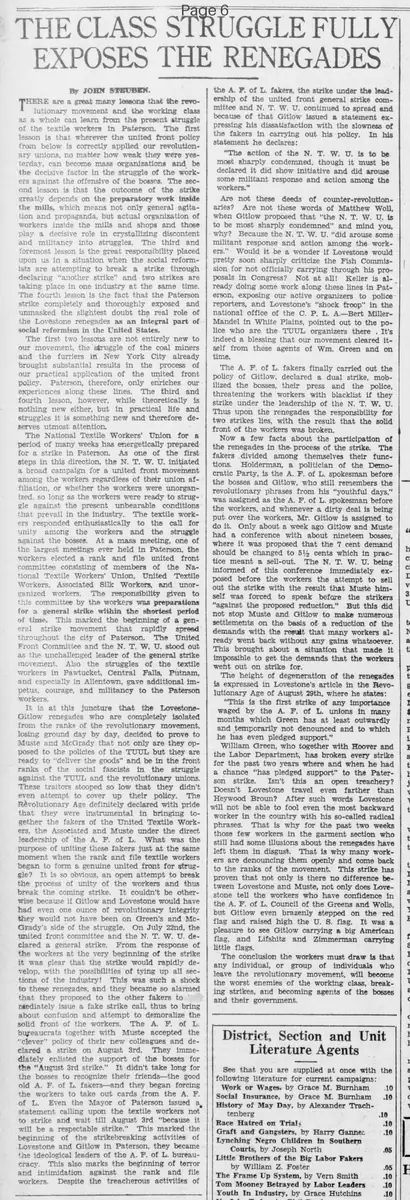
THE CLASS STRUGGLE FULLY EXPOSES THE RENEGADES
By John Steuben.
THERE are a great many lessons that the revolutionary movement and the working class as a whole can learn from the present struggle of the textile workers in Paterson. The first lesson is that wherever the united front policy from below is correctly applied our revolutionary unions, no matter how weak they were yesterday, can become mass organizations and be the decisive factor in the struggle of the workers against the offensive of the bosses. The second lesson is that the outcome of the strike greatly depends on the preparatory work inside the mills, which means not only general agitation and propaganda, but actual organization of workers inside the mills and shops and those play a decisive role in crystallizing discontent and militancy into struggles. The third and foremost lesson is the great responsibility placed upon us in a situation when the social reformists are attempting to break a strike through declaring "another strike" and two strikes are taking place in one industry at the same time. The fourth lesson is the fact that the Paterson strike completely and thoroughly exposed and unmasked the slightest doubt the real role of the Lovestone renegades as an integral part of social reformism in the United States.
The first two lessons are not entirely new to our movement, the struggle of the coal miners and the furriers in New York City already brought substantial results in the process of our practical application of the united front policy. Paterson, therefore, only enriches our experiences along these lines. The third and fourth lesson, however, while theoretically is nothing new either, but in practical life and struggles it is something new and therefore deserves utmost attention.
The National Textile Workers' Union for a period of many weeks has energetically prepared for a strike in Paterson. As one of the first steps in this direction, the N. T. W. U. initiated a broad campaign for a united front movement among the workers regardless of their union affiliation, or whether the workers were unorganized, so long as the workers were ready to struggle against the present unbearable conditions that prevail in the industry. The textile workers responded enthusiastically to the call for unity among the workers and the struggle against the bosses. At a mass meeting, one of the largest meetings ever held in Paterson, the workers elected a rank and file united front committee consisting of members of the National Textile Workers' Union, United Textile Workers, Associated Silk Workers, and unorganized workers. The responsibility given to this committee by the workers was preparations for a general strike within the shortest period of time. This marked the beginning of a general strike movement that rapidly spread throughout the city of Paterson. The United Front Committee and the N. T. W. U. stood out as the unchallenged leader of the general strike movement. Also the struggles of the textile workers in Pawtucket, Central Falls, Putnam, and especially in Allentown, gave additional impetus, courage, and militancy to the Paterson workers.
It is at this juncture that the Lovestone-Gitlow renegades who are completely isolated from the ranks of the revolutionary movement losing ground day by day, decided to prove to Muste and McGrady that not only are they opposed to the policies of the TUUL but they are ready to "deliver the goods" and be in the front ranks of the social fascists in the struggle against the TUUL and the revolutionary unions. These traitors stooped so low that they didn't even attempt to cover up their policy. The Revolutionary Age definitely declared with pride that they were instrumental in bringing together the fakers of the United Textile Workers, the Associated and Muste under the direct leadership of the A. F. of L. What was the purpose of uniting these fakers just at the same moment when the rank and file textile workers began to form a genuine united front for struggle? It is so obvious, an open attempt to break the process of unity of the workers and thus break the coming strike. It couldn't be otherwise because if Gitlow and Lovestone would have had even one ounce of revolutionary integrity they would not have been on Green's and McGrady's side of the struggle. On July 22nd, the united front committee and the N. T. W. U. declared a general strike. From the response of the workers at the very beginning of the strike it was clear that the strike would rapidly develop, with the possibilities of tying up all sections of the industry! This was such a shock to these renegades, and they became so alarmed that they proposed to the other fakers to immediately issue a fake strike call, thus to bring about confusion and attempt to demoralize the solid front of the workers. The A. F. of L. bureaucrats together with Muste accepted the "clever" policy of their new colleagues and declared a strike on August 3rd. They immediately enlisted the support of the bosses for the "August 3rd strike." It didn't take long for the bosses to recognize their friends-the good old A. F. of L. fakers-and they began forcing the workers to take out cards from the A. F. of L. Even the Mayor of Paterson issued a statement calling upon the textile workers not to strike and wait till August 3rd "because it will be a respectable strike." This marked the beginning of the strikebreaking activities of Lovestone and Gitlow in Paterson, they became the ideological leaders of the A. F. of L. bureaucracy. This also marks the beginning of terror and intimidation against the rank and file workers. Despite the treacherous activities of the A. F. of L. fakers, the strike under the leadership of the united front general strike committee and N. T. W. U. continued to spread and because of that Gitlow issued a statement expressing his dissatisfaction with the slowness of the fakers in carrying out his policy. In his statement he declares:
"The action of the N. T. W. U. is to be most sharply condemned, though it must be declared it did show initiative and did arouse some militant response and action among the workers."
Are not these deeds of counter-revolutionaries? Are not these words of Matthew Woll when Gitlow proposed that "the N. T. W. U. is to be most sharply condemned" and mind you, why? Because the N. T. W. U. "did arouse some militant response and action among the workers." Would it be a wonder if Lovestone would pretty soon sharply criticize the Fish Commission for not officially carrying through his proposals in Congress? Not at all! Keller is already doing some work along these lines in Paterson, exposing our active organizers to police reporters, and Lovestone's "shock troop" in the national office of the C. P. L. A.-Bert Miller-Mandel in White Plains, pointed out to the police who are the TUUL organizers there. It's indeed a blessing that our movement cleared itself from these agents of Wm. Green and on time.
The A. F. of L. fakers finally carried out the policy of Gitlow, declared a dual strike, mobilized the bosses, their press and the police, threatening the workers with blacklist if they strike under the leadership of the N. T. W. U. Thus upon the renegades the responsibility for two strikes lies, with the result that the solid front of the workers was broken.
Now a few facts about the participation of the renegades in the process of the strike. The fakers divided among themselves their functions, Holderman, a politician of the Democratic Party, is the A. F. of L. spokesman before the bosses and Gitlow, who still remembers the revolutionary phrases from his "youthful days," was assigned as the A. F. of L. spokesman before the workers, and whenever a dirty deal is being put over the workers, Mr. Gitlow is assigned to do it. Only about a week ago Gitlow and Muste had a conference with about nineteen bosses, where it was proposed that the 7 cent demand should be changed to 5½ cents which in practice meant a sell-out. The N. T. W. U. being informed of this conference immediately exposed before the workers the attempt to sell out the strike with the result that Muste himself was forced to speak before the strikers "against the proposed reduction." But this did not stop Muste and Gitlow to make numerous settlements on the basis of a reduction of the demands with the result that many workers already went back without any gains whatsoever. This brought about a situation that made it impossible to get the demands that the workers went out on strike for.
The height of degeneration of the renegades is expressed in Lovestone's article in the Revolutionary Age of August 29th, where he states:
"This is the first strike of any importance waged by the A. F. of L. unions in many months which Green has at least outwardly and temporarily not denounced and to which he has even pledged support."
William Green, who together with Hoover and the Labor Department, has broken every strike for the past two years where and when he had a chance "has pledged support" to the Paterson strike. Isn't this an open treachery? Doesn't Lovestone travel even farther than Heywood Broun? After such words Lovestone will not be able to fool even the most backward worker in the country with his so-called radical phrases. That is why for the past two weeks those few workers in the garment section who still had some illusions about the renegades have left them in disgust. That is why many workers are denouncing them openly and come back to the ranks of the movement. This strike has proven that not only is there no difference between Lovestone and Muste, not only does Lovestone tell the workers who have confidence in the A. F. of L. Council of the Greens and Wolls, but Gitlow even brazenly stepped on the red flag and raised high the U. S. flag. It was a pleasure to see Gitlow carrying a big American flag, and Lifshitz and Zimmerman carrying little flags.
The conclusion the workers must draw is that any individual, or group of individuals who leave the revolutionary movement, will become the worst enemies of the working class, breaking strikes, and becoming agents of the bosses and their government.
By John Steuben.
THERE are a great many lessons that the revolutionary movement and the working class as a whole can learn from the present struggle of the textile workers in Paterson. The first lesson is that wherever the united front policy from below is correctly applied our revolutionary unions, no matter how weak they were yesterday, can become mass organizations and be the decisive factor in the struggle of the workers against the offensive of the bosses. The second lesson is that the outcome of the strike greatly depends on the preparatory work inside the mills, which means not only general agitation and propaganda, but actual organization of workers inside the mills and shops and those play a decisive role in crystallizing discontent and militancy into struggles. The third and foremost lesson is the great responsibility placed upon us in a situation when the social reformists are attempting to break a strike through declaring "another strike" and two strikes are taking place in one industry at the same time. The fourth lesson is the fact that the Paterson strike completely and thoroughly exposed and unmasked the slightest doubt the real role of the Lovestone renegades as an integral part of social reformism in the United States.
The first two lessons are not entirely new to our movement, the struggle of the coal miners and the furriers in New York City already brought substantial results in the process of our practical application of the united front policy. Paterson, therefore, only enriches our experiences along these lines. The third and fourth lesson, however, while theoretically is nothing new either, but in practical life and struggles it is something new and therefore deserves utmost attention.
The National Textile Workers' Union for a period of many weeks has energetically prepared for a strike in Paterson. As one of the first steps in this direction, the N. T. W. U. initiated a broad campaign for a united front movement among the workers regardless of their union affiliation, or whether the workers were unorganized, so long as the workers were ready to struggle against the present unbearable conditions that prevail in the industry. The textile workers responded enthusiastically to the call for unity among the workers and the struggle against the bosses. At a mass meeting, one of the largest meetings ever held in Paterson, the workers elected a rank and file united front committee consisting of members of the National Textile Workers' Union, United Textile Workers, Associated Silk Workers, and unorganized workers. The responsibility given to this committee by the workers was preparations for a general strike within the shortest period of time. This marked the beginning of a general strike movement that rapidly spread throughout the city of Paterson. The United Front Committee and the N. T. W. U. stood out as the unchallenged leader of the general strike movement. Also the struggles of the textile workers in Pawtucket, Central Falls, Putnam, and especially in Allentown, gave additional impetus, courage, and militancy to the Paterson workers.
It is at this juncture that the Lovestone-Gitlow renegades who are completely isolated from the ranks of the revolutionary movement losing ground day by day, decided to prove to Muste and McGrady that not only are they opposed to the policies of the TUUL but they are ready to "deliver the goods" and be in the front ranks of the social fascists in the struggle against the TUUL and the revolutionary unions. These traitors stooped so low that they didn't even attempt to cover up their policy. The Revolutionary Age definitely declared with pride that they were instrumental in bringing together the fakers of the United Textile Workers, the Associated and Muste under the direct leadership of the A. F. of L. What was the purpose of uniting these fakers just at the same moment when the rank and file textile workers began to form a genuine united front for struggle? It is so obvious, an open attempt to break the process of unity of the workers and thus break the coming strike. It couldn't be otherwise because if Gitlow and Lovestone would have had even one ounce of revolutionary integrity they would not have been on Green's and McGrady's side of the struggle. On July 22nd, the united front committee and the N. T. W. U. declared a general strike. From the response of the workers at the very beginning of the strike it was clear that the strike would rapidly develop, with the possibilities of tying up all sections of the industry! This was such a shock to these renegades, and they became so alarmed that they proposed to the other fakers to immediately issue a fake strike call, thus to bring about confusion and attempt to demoralize the solid front of the workers. The A. F. of L. bureaucrats together with Muste accepted the "clever" policy of their new colleagues and declared a strike on August 3rd. They immediately enlisted the support of the bosses for the "August 3rd strike." It didn't take long for the bosses to recognize their friends-the good old A. F. of L. fakers-and they began forcing the workers to take out cards from the A. F. of L. Even the Mayor of Paterson issued a statement calling upon the textile workers not to strike and wait till August 3rd "because it will be a respectable strike." This marked the beginning of the strikebreaking activities of Lovestone and Gitlow in Paterson, they became the ideological leaders of the A. F. of L. bureaucracy. This also marks the beginning of terror and intimidation against the rank and file workers. Despite the treacherous activities of the A. F. of L. fakers, the strike under the leadership of the united front general strike committee and N. T. W. U. continued to spread and because of that Gitlow issued a statement expressing his dissatisfaction with the slowness of the fakers in carrying out his policy. In his statement he declares:
"The action of the N. T. W. U. is to be most sharply condemned, though it must be declared it did show initiative and did arouse some militant response and action among the workers."
Are not these deeds of counter-revolutionaries? Are not these words of Matthew Woll when Gitlow proposed that "the N. T. W. U. is to be most sharply condemned" and mind you, why? Because the N. T. W. U. "did arouse some militant response and action among the workers." Would it be a wonder if Lovestone would pretty soon sharply criticize the Fish Commission for not officially carrying through his proposals in Congress? Not at all! Keller is already doing some work along these lines in Paterson, exposing our active organizers to police reporters, and Lovestone's "shock troop" in the national office of the C. P. L. A.-Bert Miller-Mandel in White Plains, pointed out to the police who are the TUUL organizers there. It's indeed a blessing that our movement cleared itself from these agents of Wm. Green and on time.
The A. F. of L. fakers finally carried out the policy of Gitlow, declared a dual strike, mobilized the bosses, their press and the police, threatening the workers with blacklist if they strike under the leadership of the N. T. W. U. Thus upon the renegades the responsibility for two strikes lies, with the result that the solid front of the workers was broken.
Now a few facts about the participation of the renegades in the process of the strike. The fakers divided among themselves their functions, Holderman, a politician of the Democratic Party, is the A. F. of L. spokesman before the bosses and Gitlow, who still remembers the revolutionary phrases from his "youthful days," was assigned as the A. F. of L. spokesman before the workers, and whenever a dirty deal is being put over the workers, Mr. Gitlow is assigned to do it. Only about a week ago Gitlow and Muste had a conference with about nineteen bosses, where it was proposed that the 7 cent demand should be changed to 5½ cents which in practice meant a sell-out. The N. T. W. U. being informed of this conference immediately exposed before the workers the attempt to sell out the strike with the result that Muste himself was forced to speak before the strikers "against the proposed reduction." But this did not stop Muste and Gitlow to make numerous settlements on the basis of a reduction of the demands with the result that many workers already went back without any gains whatsoever. This brought about a situation that made it impossible to get the demands that the workers went out on strike for.
The height of degeneration of the renegades is expressed in Lovestone's article in the Revolutionary Age of August 29th, where he states:
"This is the first strike of any importance waged by the A. F. of L. unions in many months which Green has at least outwardly and temporarily not denounced and to which he has even pledged support."
William Green, who together with Hoover and the Labor Department, has broken every strike for the past two years where and when he had a chance "has pledged support" to the Paterson strike. Isn't this an open treachery? Doesn't Lovestone travel even farther than Heywood Broun? After such words Lovestone will not be able to fool even the most backward worker in the country with his so-called radical phrases. That is why for the past two weeks those few workers in the garment section who still had some illusions about the renegades have left them in disgust. That is why many workers are denouncing them openly and come back to the ranks of the movement. This strike has proven that not only is there no difference between Lovestone and Muste, not only does Lovestone tell the workers who have confidence in the A. F. of L. Council of the Greens and Wolls, but Gitlow even brazenly stepped on the red flag and raised high the U. S. flag. It was a pleasure to see Gitlow carrying a big American flag, and Lifshitz and Zimmerman carrying little flags.
The conclusion the workers must draw is that any individual, or group of individuals who leave the revolutionary movement, will become the worst enemies of the working class, breaking strikes, and becoming agents of the bosses and their government.
What sub-type of article is it?
Historical Event
Deception Fraud
What themes does it cover?
Betrayal
Deception
Justice
What keywords are associated?
Textile Strike
Paterson
United Front
Lovestone Renegades
Afl Fakers
Strikebreaking
Class Struggle
What entities or persons were involved?
John Steuben
Lovestone
Gitlow
Muste
William Green
Holderman
Where did it happen?
Paterson
Story Details
Key Persons
John Steuben
Lovestone
Gitlow
Muste
William Green
Holderman
Location
Paterson
Event Date
July 22nd
Story Details
The article discusses lessons from the Paterson textile workers' strike, highlighting the success of the united front policy by the National Textile Workers' Union (N.T.W.U.) and the exposure of Lovestone and Gitlow renegades as strikebreakers aligned with A.F. of L. bureaucrats and bosses, leading to a dual strike that weakened worker unity.