Thank you for visiting SNEWPapers!
Sign up free
Story
September 3, 1839
Rutland Herald
Rutland, Rutland County, Vermont
What is this article about?
During a recent trial near Boston, Judge Shaw addressed jurors' conscientious objections to capital punishment, emphasizing that individuals must enforce laws made by the legislature, without usurping its power to change them, and warned against allowing such scruples to nullify justice.
Clipping
OCR Quality
98%
Excellent
Full Text
DUTIES OF JURORS.
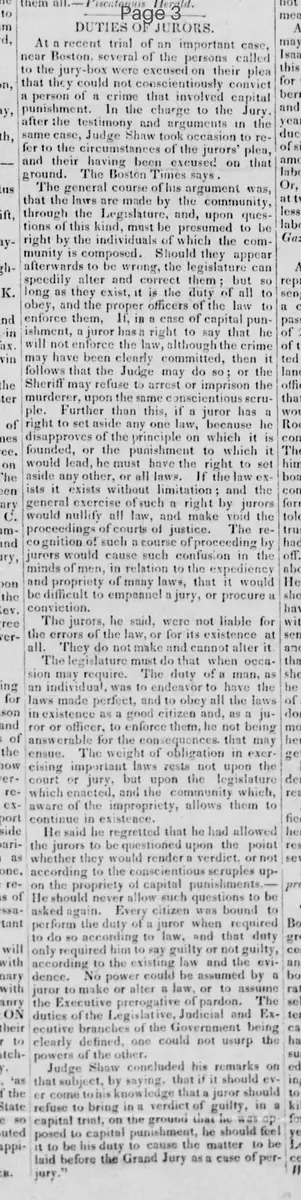
At a recent trial of an important case, near Boston, several of the persons called to the jury-box were excused on their plea that they could not conscientiously convict a person of a crime that involved capital punishment. In the charge to the Jury, after the testimony and arguments in the same case, Judge Shaw took occasion to refer to the circumstances of the jurors' plea, and their having been excused on that ground. The Boston Times says, 'The general course of his argument was, that the laws are made by the community, through the Legislature, and, upon questions of this kind, must be presumed to be right by the individuals of which the community is composed. Should they appear afterwards to be wrong, the legislature can speedily alter and correct them; but so long as they exist, it is the duty of all to obey, and the proper officers of the law to enforce them.' If, in a case of capital punishment, a juror has a right to say that he will not enforce the law, although the crime may have been clearly committed, then it follows that the Judge may do so; or the Sheriff may refuse to arrest or imprison the murderer, upon the same conscientious scruple. Further than this, if a juror has a right to set aside any one law, because he disapproves of the principle on which it is founded, or the punishment to which it would lead, he must have the right to set aside any other, or all laws. If the law exists it exists without limitation: and the general exercise of such a right by jurors would nullify all law, and make void the proceedings of courts of justice. The recognition of such a course of proceeding by jurors would cause such confusion in the minds of men, in relation to the expediency and propriety of many laws, that it would be difficult to empanel a jury, or procure a conviction. The jurors, he said, were not liable for the errors of the law, or for its existence at all. 'They do not make and cannot alter it. The legislature must do that when occasion may require. The duty of a man, as an individual, was to endeavor to have the laws made perfect, and to obey all the laws in existence as a good citizen and, as a juror or officer, to enforce them, he not being answerable for the consequences, that may ensue. The weight of obligation in exercising important laws rests not upon the court or jury, but upon the legislature which enacted, and the community which, aware of the impropriety, allows them to continue in existence.' He said he regretted that he had allowed the jurors to be questioned upon the point whether they would render a verdict, or not according to the conscientious scruples upon the propriety of capital punishments. He should never allow such questions to be asked again. Every citizen was bound to perform the duty of a juror when required to do so according to law, and that duty only required him to say guilty or not guilty, according to the existing law and the evidence. No power could be assumed by a juror to make or alter a law, or to assume the Executive prerogative of pardon. The duties of the Legislative, Judicial and Executive branches of the Government being clearly defined, one could not usurp the powers of the other. Judge Shaw concluded his remarks on that subject, by saying, that if it should ever come to his knowledge that a juror should refuse to bring in a verdict of guilty, in a capital trial, on the ground that he was opposed to capital punishment, he should feel it to be his duty to cause the matter to be laid before the Grand Jury as a case of perjury.
At a recent trial of an important case, near Boston, several of the persons called to the jury-box were excused on their plea that they could not conscientiously convict a person of a crime that involved capital punishment. In the charge to the Jury, after the testimony and arguments in the same case, Judge Shaw took occasion to refer to the circumstances of the jurors' plea, and their having been excused on that ground. The Boston Times says, 'The general course of his argument was, that the laws are made by the community, through the Legislature, and, upon questions of this kind, must be presumed to be right by the individuals of which the community is composed. Should they appear afterwards to be wrong, the legislature can speedily alter and correct them; but so long as they exist, it is the duty of all to obey, and the proper officers of the law to enforce them.' If, in a case of capital punishment, a juror has a right to say that he will not enforce the law, although the crime may have been clearly committed, then it follows that the Judge may do so; or the Sheriff may refuse to arrest or imprison the murderer, upon the same conscientious scruple. Further than this, if a juror has a right to set aside any one law, because he disapproves of the principle on which it is founded, or the punishment to which it would lead, he must have the right to set aside any other, or all laws. If the law exists it exists without limitation: and the general exercise of such a right by jurors would nullify all law, and make void the proceedings of courts of justice. The recognition of such a course of proceeding by jurors would cause such confusion in the minds of men, in relation to the expediency and propriety of many laws, that it would be difficult to empanel a jury, or procure a conviction. The jurors, he said, were not liable for the errors of the law, or for its existence at all. 'They do not make and cannot alter it. The legislature must do that when occasion may require. The duty of a man, as an individual, was to endeavor to have the laws made perfect, and to obey all the laws in existence as a good citizen and, as a juror or officer, to enforce them, he not being answerable for the consequences, that may ensue. The weight of obligation in exercising important laws rests not upon the court or jury, but upon the legislature which enacted, and the community which, aware of the impropriety, allows them to continue in existence.' He said he regretted that he had allowed the jurors to be questioned upon the point whether they would render a verdict, or not according to the conscientious scruples upon the propriety of capital punishments. He should never allow such questions to be asked again. Every citizen was bound to perform the duty of a juror when required to do so according to law, and that duty only required him to say guilty or not guilty, according to the existing law and the evidence. No power could be assumed by a juror to make or alter a law, or to assume the Executive prerogative of pardon. The duties of the Legislative, Judicial and Executive branches of the Government being clearly defined, one could not usurp the powers of the other. Judge Shaw concluded his remarks on that subject, by saying, that if it should ever come to his knowledge that a juror should refuse to bring in a verdict of guilty, in a capital trial, on the ground that he was opposed to capital punishment, he should feel it to be his duty to cause the matter to be laid before the Grand Jury as a case of perjury.
What sub-type of article is it?
Historical Event
Crime Story
What themes does it cover?
Justice
Crime Punishment
Moral Virtue
What keywords are associated?
Jurors Duties
Capital Punishment
Judge Shaw
Boston Trial
Legal Obligation
Conscientious Objection
What entities or persons were involved?
Judge Shaw
Where did it happen?
Near Boston
Story Details
Key Persons
Judge Shaw
Location
Near Boston
Event Date
Recent
Story Details
In a trial near Boston, jurors were excused for conscientious objections to capital punishment; Judge Shaw charged that jurors must enforce existing laws without personal scruples, as altering laws is the legislature's duty, and refusing to convict on such grounds could be perjury.