Thank you for visiting SNEWPapers!
Sign up free
Letter to Editor
January 8, 1827
The Virginian
Lynchburg, Virginia
What is this article about?
In a letter from Vera Cruz dated Nov. 26, 1826, David Porter defends his conduct in a 1825 incident where President John Quincy Adams snubbed him during a meeting arranged by General Lafayette, criticizing Adams' behavior and responding to press attacks from administration supporters.
Clipping
OCR Quality
95%
Excellent
Full Text
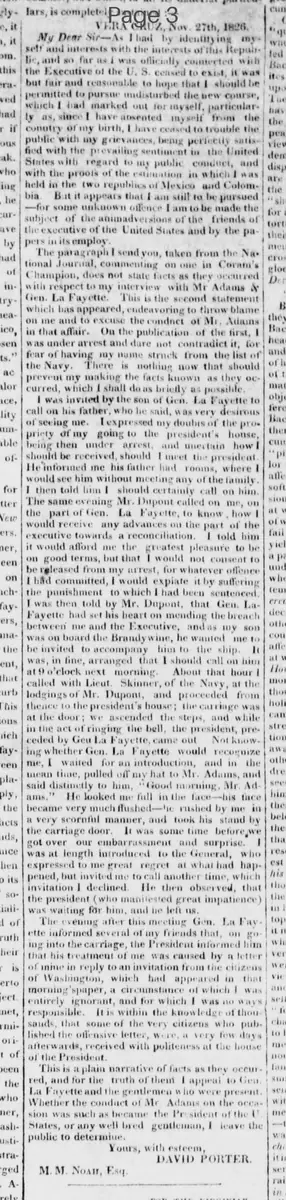
VERA CRUZ, Nov. 26, 1826
My Dear Sir—As I had by identifying myself and interests with the interests of this Republic, and so far as I was officially connected with the Executive of the U. S. ceased to exist, it was but fair and reasonable to hope that I should be permitted to pursue undisturbed the new course, which I had marked out for myself, particularly as, since I have absented myself from the country of my birth, I have ceased to trouble the public with my grievances, being perfectly satisfied with the prevailing sentiment in the United States with regard to my public conduct, and with the proofs of the estimation in which I was held in the two republics of Mexico and Columbia But it appears that I am still to be pursued—for some unknown offence I am to be made the subject of the animadversions of the friends of the executive of the United States and by the papers in its employ.
The paragraph I send you, taken from the National Journal, commenting on one in Coram's Champion, does not state facts as they occurred with respect to my interview with Mr Adams S Gen. La Fayette. This is the second statement which has appeared, endeavoring to throw blame on me and to excuse the conduct of Mr. Adams in that affair. On the publication of the first, I was under arrest and dare not contradict it, for fear of having my name struck from the list of the Navy. There is nothing now that should prevent my making the facts known as they occurred, which I shall do as briefly as possible.
I was invited by the son of Gen. La Fayette to call on his father, who he said, was very desirous of seeing me. I expressed my doubts of the propriety of my going to the president's house, being then under arrest, and uncertain how I should be received, should I meet the president He informed me his father had rooms, where I would see him without meeting any of the family. I then told him I should certainly call on him.
The same evening Mr. Dupont called on me, on the part of Gen. La Fayette, to know, how I would receive any advances on the part of the executive towards a reconciliation. I told him it would afford me the greatest pleasure to be on good terms, but that I would not consent to be released from my arrest, for whatever offence I had committed, I would expiate it by suffering the punishment to which I had been sentenced.
I was then told by Mr. Dupont, that Gen. La Fayette had set his heart on mending the breach between me and the Executive, and as my son was on board the Brandywine, he wanted me to be invited to accompany him to the ship. It was, in fine, arranged that I should call on him at 9 o'clock next morning. About that hour I called with Lieut. Skinner, of the Navy, at the lodgings of Mr. Dupont, and proceeded from thence to the president's house; the carriage was at the door; we ascended the steps, and while in the act of ringing the bell, the president, preceded by Gen La Fayette, came out Not knowing whether Gen. La Fayette would recognize me, I waited for an introduction, and in the mean time, pulled off my hat to Mr. Adams, and said distinctly to him, "Good morning, Mr. Adams." He looked me full in the face—his face became very much flushed—he rushed by me in a very scornful manner, and took his stand by the carriage door. It was some time before we got over our embarrassment and surprise. I was at length introduced to the General, who expressed to me great regret at what had happened, but invited me to call another time, which invitation I declined He then observed, that the president (who manifested great impatience) was waiting for him, and he left us.
The evening after this meeting Gen. La Fayette informed several of my friends that, on going into the carriage, the President informed him that his treatment of me was caused by a letter of mine in reply to an invitation from the citizens of Washington, which had appeared in that morning's paper, a circumstance of which I was entirely ignorant, and for which I was no ways responsible. It is within the knowledge of thousands, that some of the very citizens who published the offensive letter, were, a very few days afterwards, received with politeness at the house of the President.
This is a plain narrative of facts as they occurred, and for the truth of them I appeal to Gen La Fayette and the gentlemen who were present. Whether the conduct of Mr. Adams on the occasion was such as became the President of the United States, or any well bred gentleman, I leave the public to determine.
Yours, with esteem,
DAVID PORTER.
M.M. NOAH, Esq
My Dear Sir—As I had by identifying myself and interests with the interests of this Republic, and so far as I was officially connected with the Executive of the U. S. ceased to exist, it was but fair and reasonable to hope that I should be permitted to pursue undisturbed the new course, which I had marked out for myself, particularly as, since I have absented myself from the country of my birth, I have ceased to trouble the public with my grievances, being perfectly satisfied with the prevailing sentiment in the United States with regard to my public conduct, and with the proofs of the estimation in which I was held in the two republics of Mexico and Columbia But it appears that I am still to be pursued—for some unknown offence I am to be made the subject of the animadversions of the friends of the executive of the United States and by the papers in its employ.
The paragraph I send you, taken from the National Journal, commenting on one in Coram's Champion, does not state facts as they occurred with respect to my interview with Mr Adams S Gen. La Fayette. This is the second statement which has appeared, endeavoring to throw blame on me and to excuse the conduct of Mr. Adams in that affair. On the publication of the first, I was under arrest and dare not contradict it, for fear of having my name struck from the list of the Navy. There is nothing now that should prevent my making the facts known as they occurred, which I shall do as briefly as possible.
I was invited by the son of Gen. La Fayette to call on his father, who he said, was very desirous of seeing me. I expressed my doubts of the propriety of my going to the president's house, being then under arrest, and uncertain how I should be received, should I meet the president He informed me his father had rooms, where I would see him without meeting any of the family. I then told him I should certainly call on him.
The same evening Mr. Dupont called on me, on the part of Gen. La Fayette, to know, how I would receive any advances on the part of the executive towards a reconciliation. I told him it would afford me the greatest pleasure to be on good terms, but that I would not consent to be released from my arrest, for whatever offence I had committed, I would expiate it by suffering the punishment to which I had been sentenced.
I was then told by Mr. Dupont, that Gen. La Fayette had set his heart on mending the breach between me and the Executive, and as my son was on board the Brandywine, he wanted me to be invited to accompany him to the ship. It was, in fine, arranged that I should call on him at 9 o'clock next morning. About that hour I called with Lieut. Skinner, of the Navy, at the lodgings of Mr. Dupont, and proceeded from thence to the president's house; the carriage was at the door; we ascended the steps, and while in the act of ringing the bell, the president, preceded by Gen La Fayette, came out Not knowing whether Gen. La Fayette would recognize me, I waited for an introduction, and in the mean time, pulled off my hat to Mr. Adams, and said distinctly to him, "Good morning, Mr. Adams." He looked me full in the face—his face became very much flushed—he rushed by me in a very scornful manner, and took his stand by the carriage door. It was some time before we got over our embarrassment and surprise. I was at length introduced to the General, who expressed to me great regret at what had happened, but invited me to call another time, which invitation I declined He then observed, that the president (who manifested great impatience) was waiting for him, and he left us.
The evening after this meeting Gen. La Fayette informed several of my friends that, on going into the carriage, the President informed him that his treatment of me was caused by a letter of mine in reply to an invitation from the citizens of Washington, which had appeared in that morning's paper, a circumstance of which I was entirely ignorant, and for which I was no ways responsible. It is within the knowledge of thousands, that some of the very citizens who published the offensive letter, were, a very few days afterwards, received with politeness at the house of the President.
This is a plain narrative of facts as they occurred, and for the truth of them I appeal to Gen La Fayette and the gentlemen who were present. Whether the conduct of Mr. Adams on the occasion was such as became the President of the United States, or any well bred gentleman, I leave the public to determine.
Yours, with esteem,
DAVID PORTER.
M.M. NOAH, Esq
What sub-type of article is it?
Persuasive
Political
Reflective
What themes does it cover?
Politics
Morality
Press Freedom
What keywords are associated?
David Porter
John Quincy Adams
General Lafayette
Presidential Snub
Navy Arrest
Political Reconciliation
Press Criticism
What entities or persons were involved?
David Porter
M.M. Noah, Esq
Letter to Editor Details
Author
David Porter
Recipient
M.M. Noah, Esq
Main Argument
david porter provides a detailed account of an incident where president adams rudely snubbed him during a meeting arranged by general lafayette, defending his own courteous behavior and questioning adams' conduct as unbecoming a president or gentleman, in response to misleading press reports.
Notable Details
Invited By Lafayette's Son
Under Arrest At The Time
Accompanied By Lieut. Skinner
Adams Flushed And Rushed By Scornfully
Lafayette Expressed Regret
Adams Blamed A Letter Porter Was Unaware Of
Appeal To Lafayette And Witnesses For Truth