Thank you for visiting SNEWPapers!
Sign up free
The Cadiz Democratic Sentinel
Cadiz, Harrison County, Ohio
What is this article about?
In a letter dated May 22, 1858, Secretary of the Treasury Howell Cobb instructs Charleston Collector W.M.F. Colcock to refuse clearance for the ship Richard Cobden, owned by E. Lafitte & Co., intended to transport African 'emigrants' to the U.S., deeming it a clear evasion of federal laws prohibiting the slave trade and importation of persons of color for servitude.
Clipping
OCR Quality
Full Text
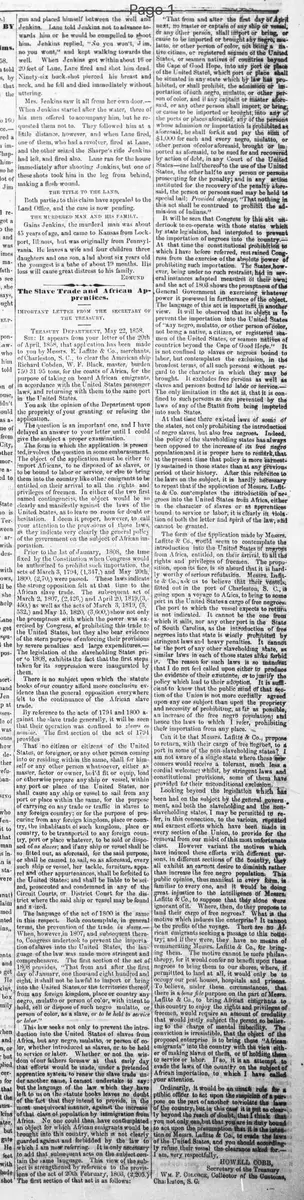
IMPORTANT LETTER FROM THE SECRETARY OF THE TREASURY.
TREASURY DEPARTMENT, May 22, 1858
Sir: It appears from your letter of the 20th of April, 1858, that application has been made to you by Messrs. E. Lafitte & Co., merchants, of Charleston, S. C., to clear the American ship Richard Cobden, W. F. Black, master, burden 750 31 95 tons, for the coasts of Africa, for the purpose of taking on board African emigrants in accordance with the United States passenger laws, and returning with them to the same port in the United States.
You ask the opinion of the Department upon the propriety of your granting or refusing the application.
The question is an important one, and I have delayed an answer to your letter until I could give the subject a proper examination.
The form in which the application is presented, involves the question in some embarrassment. The object of the application must be either to import Africans, to be disposed of as slaves, or to be bound to labor or service, or else to bring them into the country like other emigrants to be entitled on their arrival to all the rights and privileges of freemen. In either of the two first named contingencies, the object would be so clearly and manifestly against the laws of the United States, as to leave no room for doubt or hesitation. I deem it proper, however, to call your attention to the provisions of those laws as they indicate very clearly the general policy of the government on the subject of African importation.
Prior to the 1st of January, 1808, the time fixed by the Constitution when Congress would be authorized to prohibit such importation, the acts of March 3, 1794, (1,347,) and May 20th, 1800, (2,70,) were passed. These laws indicate the strong opposition felt at that time to the African slave trade. The subsequent act of March 2, 1807, (2,426,) and April 20, 1819,(3,450,) as well as the acts of March 3, 1819, (3,532) and May 15, 1820, (3,600,) show not only the promptness with which the power was exercised by Congress, of prohibiting this trade to the United States, but they also bear evidence of the stern purpose of enforcing their provisions by severe penalties and large expenditures.—
The legislation of the slaveholding States prior to 1808, exhibits the fact that the first steps taken for its suppression were inaugurated by them.
There is no subject upon which the statute books of our country afford more conclusive evidence than the general opposition everywhere felt to the continuance of the African slave trade.
By reference to the acts of 1794 and 1800 against the slave trade generally, it will be seen that their operation was confined to slaves eo nomine. The first section of the act of 1794 provides
That no citizen or citizens of the United States, or foreigner, or any other person coming into or residing within the same, shall for himself or any other person whatsoever, either as master, factor or owner, build, fit or equip, load or otherwise prepare any ship or vessel, within any port or place of the United States, nor shall cause any ship or vessel to sail from any port or place within the same, for the purpose of carrying on any trade or traffic in slaves to any foreign country; or for the purpose of procuring from any foreign kingdom, place or country, the inhabitants of such kingdom, place or country, to be transported to any foreign country, port or place whatever, to be sold or disposed of as slaves; and if any ship or vessel shall be so fitted out, as aforesaid, for the said purpose, or shall be caused to sail, so as aforesaid, every such ship or vessel, her tackle, furniture, apparel and other appurtenances, shall be forfeited to the United States; and shall be liable to be seized, prosecuted and condemned in any of the Circuit Courts, or District Court for the district where the said ship or vessel may be found and seized.
The language of the act of 1800 is the same in this respect. Both contemplate, in general terms, the prevention of the trade in slaves.—
When, however, in 1807, and subsequent thereto, Congress undertook to prevent the importation of slaves into the United States, the language of the law was made more stringent and comprehensive. The first section of the act of 1808 provides, "That from and after the first day of January, one thousand eight hundred and eight, it shall not be lawful to import or bring into the United States, or the territories thereof, from any foreign kingdom, place or country any negro, mulatto or person of color, with intent to hold, sell or dispose of such negro mulatto, or person of color, as a slave, or to be held to service or labor."
This law seeks not only to prevent the introduction into the United States of slaves from Africa, but any negro, mulatto, or person of color, whether introduced as slaves, or to be held to service or labor. Whether or not the wisdom of our fathers foresaw at that early day that efforts would be made, under a pretended apprentice system to renew the slave trade under another name, I cannot undertake to say: but the language of the law which they have left to us on the statute books leaves no doubt of the fact that they intend to provide, in the most unequivocal manner, against the increase of that class of population by immigration from Africa. No one could then have contemplated an object for which African emigrants would be brought into this country, which is not clearly guarded against and forbidden by the law to which I am now referring. It is only necessary to add that subsequent acts on the subject contain the same language. This view of the subject is strengthened by reference to the provisions of the act of 20th February, 1803, (2,205.)
The first section of that act is as follows:
"That from and after the first day of April next, to master or captain of any ship or vessel or any other person, shall import or bring, or cause to be imported or brought any negro; mulatto, or other person of color, not being a native citizen, or registered seamen of the United States, or seamen natives of countries beyond the Cape of Good Hope, into any port or place of the United States, which port or place shall be situated in any state which by law has prohibited, or shall prohibit, the admission or importation of such negro, mulatto; or other person of color, and if any captain or master aforesaid, or any other person shall import, or bring; or cause to be imported or brought; into any of the ports or places aforesaid; any of the persons whose admission or importation is prohibited as aforesaid, he shall forfeit and pay the sum of $1,000 for each and every negro, mulatto, or other person of color aforesaid, brought or imported as aforesaid, to be sued for and recovered by action of debt, in any Court of the United States—one half thereof to the use of the United States, the other half to any person or persons prosecuting for the penalty; and in any action instituted for the recovery of the penalty aforesaid, the person or persons sued may be held to special bail; Provided always, "That nothing in this act shall be construed to prohibit the admission of Indians."
It will be seen that Congress by this act undertook to co-operate with those states which by state legislation, had interposed to prevent the importation of negroes into the country.— At that time the constitutional prohibition to which I have before referred, restrained Congress from the exercise of the absolute power of prohibiting such importation. The States, however, being under no such restraint; had in several instances adopted measures of their own and the act of 1803 shows the promptness of the General Government in exercising whatever power it possessed in furtherance of the object.
The language of this act is important, in another view. It will be observed that its object is to prevent the importation into the United States of "any negro, mulatto, or other person of color, not being a native, a citizen, or registered seamen of the United States, or seamen natives of countries beyond the Cape of Good Hope." It is not confined to slaves or negroes bound to labor, but contemplates the exclusion, in the broadest terms, of all such persons without regard to the character in which they may be brought. It excludes free persons as well as slaves and persons bound to labor or service.— The only limitation in the act is, that it is confined to such persons as are prevented by the laws of any of the States from being imported into such States.
At that time there existed laws of some of the states, not only prohibiting the introduction of negro slaves, but also free negroes. Indeed, the policy of the slaveholding states has always been opposed to the increase of its free negro population; and it is proper here to remark, that at the present time that policy is more earnestly sustained in those states than at any previous period of their history. After this reference to the laws on the subject, it is hardly necessary to repeat that if the application of Messrs. Lafitte & Co. contemplates the introduction of negroes into the United States from Africa, either in the character of slaves or as apprentices bound to service or labor, it is clearly in violation of both the letter and spirit of the law; and cannot be granted.
The form of the application made by Messrs. Lafitte & Co., would seem to contemplate the introduction into the United States of negroes from Africa, entitled, on their arrival, to all the rights and privileges of freemen. The proposition, upon its face, is so absurd that it is hardly worthy of serious refutation. Messrs. Lafitte & Co., ask us to believe that their vessels fitted out in the port of Charleston, S. C., is going upon a voyage to Africa, to bring to some port in the United States a cargo of free negroes: The port to which the vessel expects to return is not indicated. It cannot be the one from which it sails, nor any other port in the State of South Carolina, as the introduction of free negroes into that state is wisely prohibited by stringent laws and heavy penalties. It cannot be the port of any other slaveholding state, as similar laws in each of those states alike forbid it. The reason for such laws is so manifest that I do not feel called upon either to produce the evidence of their existence; or to justify the policy which lead to their adoption. It is sufficient to know that the public mind of that section of the Union is not more cordially agreed upon any one subject than upon the propriety and necessity of prohibiting, as far as possible an increase of the free negro population; and hence the laws to which I refer, prohibiting their importation from any place.
Can it be that Messrs. Lafitte & Co.; propose to return, with their cargo of free negroes, to a port in some of the non-slaveholding states? I am not aware of a single state where these new comers would receive a tolerant, much less a cordial welcome; whilst, by stringent laws and constitutional provisions, some of them have provided for their unconditional exclusion;
Looking beyond the legislation which has been had on the subject by the general government, and both the slaveholding and the non-slaveholding states, I may be permitted to refer, in this connection, to the various, repeated and earnest efforts which have been made in every section of the Union, to provide for the removal from our midst of this most unfortunate class. However variant the motives which have induced these efforts with different persons, in different sections of the Country, they all exhibit an earnest desire to diminish rather than increase the free negro population: This public opinion, thus manifest in every form, is familiar to every one, and it would be doing great injustice to the intelligence of Messrs: Lafitte & Co., to suppose that they alone were ignorant of it. Where, then, do they propose to land their cargo of free negroes? What is the motive which induces the enterprise? It cannot be the profits of the voyage. There are no African emigrants seeking a passage to this country; and if they were; they have no means of remunerating Messrs. Lafitte & Co., for bringing them. The motive cannot be mere philanthropy, for it would confer no benefit upon these negroes to bring them to our shores; where, if permitted to land at all, it would only be to occupy our pest houses, hospitals and prisons.
To believe, under these circumstances, that there is a bona fide purpose on the part of Messrs. Lafitte & Co., to bring African emigrants to this country to enjoy the rights and privileges of freemen, would require an amount of credulity that would justly subject the person so believing to the charge of mental imbecility. The conviction is irresistible, that the object of the proposed enterprise is to bring these "African emigrants" into the country with the view either of making slaves of them, or of holding them to service or labor. If so, it is an attempt to evade the laws of the country on the subject of African importation, to which I have called your attention.
Ordinarily, it would be an unsafe rule for a public officer to act upon the suspicion of a purpose on the part of another to violate the laws of the country, but in this case it is so clearly beyond the reach of doubt, that I think that you not only can, but that you are in duty bound to act upon the presumption that it is the intention of Messrs. Lafitte & Co., to evade the laws of the United States, and you should accordingly refuse their vessel the clearance asked for.
I am, very respectfully,
HOWELL COBB
Secretary of the Treasury
WM. F. COLCOCK, Collector of the Customs,
Charleston, S. C.
What sub-type of article is it?
What keywords are associated?
What entities or persons were involved?
Where did it happen?
Domestic News Details
Primary Location
Charleston, S. C.
Event Date
May 22, 1858
Key Persons
Outcome
refusal of clearance for the ship richard cobden to prevent evasion of slave importation laws.
Event Details
Secretary of the Treasury Howell Cobb responds to Collector Colcock's inquiry regarding an application by E. Lafitte & Co. to clear the ship Richard Cobden for a voyage to Africa to transport African emigrants back to the U.S., concluding it is an attempt to import slaves or bound laborers in violation of U.S. laws prohibiting the African slave trade and importation of persons of color for servitude, and instructs denial of the clearance.