Thank you for visiting SNEWPapers!
Sign up free
Literary
March 9, 1824
Alexandria Gazette & Advertiser
Alexandria, Virginia
What is this article about?
An essay collecting anecdotes illustrating how individuals' ruling passions and characters manifest in their final moments, featuring deathbed scenes of figures like Lord Nelson, Gen. Lee, Napoleon’s mother, and others, emphasizing the persistence of personal traits until death.
Merged-components note: The literary essay on 'The Ruling Passion Strong in Death' continues seamlessly across the two components on page 4.
Clipping
OCR Quality
98%
Excellent
Full Text
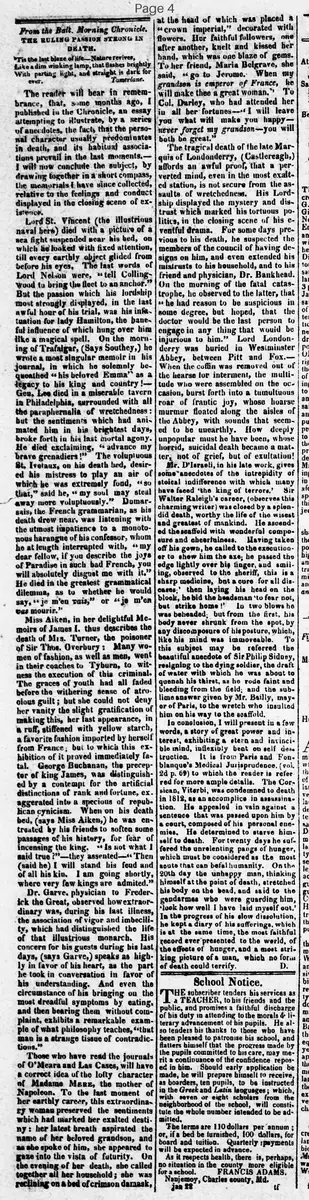
From the Balt. Morning Chronicle.
THE RULING PASSION STRONG IN DEATH.
'Tis the last blaze of life—Nature revives,
Like a dim winking lamp, that flashes brightly
With parting light, and straight is dark for
ever. Tamerlane.
The reader will bear in remembrance, that, some months ago, I published in the Chronicle, an essay attempting to illustrate, by a series of anecdotes, the fact, that the personal character usually predominates in death, and its habitual associations prevail in the last moments.—
I will now conclude the subject, by drawing together in a short compass, the memorials I have since collected, relative to the feelings and conduct displayed in the closing scene of existence.
Lord St. Vincent (the illustrious naval hero) died with a picture of a sea fight suspended near his bed, on which he looked with fixed attention, till every earthly object glided from before his eyes. The last words of Lord Nelson were, "tell Collingwood to bring the fleet to an anchor."
But the passion which his lordship most strongly displayed, in the last awful hour of his trial, was his infatuation for lady Hamilton, the baneful influence of which hung over him like a magical spell. On the morning of Trafalgar, (Says Southey,) he wrote a most singular memoir in his journal, in which he solemnly bequeathed "his beloved Emma" as a legacy to his king and country!—
Gen. Lee died in a miserable tavern in Philadelphia, surrounded with all the paraphernalia of wretchedness: but the sentiments which had animated him in his brightest days, broke forth in his last mortal agony. He died exclaiming, "advance my brave grenadiers!" The voluptuous St. Evreux, on his death bed, desired his mistress to play an air of which he was extremely fond, "so that," said he, "my soul may steal away more voluptuously." Dumarsais, the French grammarian, as his death drew near, was listening with the utmost impatience to a monotonous harangue of his confessor, whom he at length interrupted with, "my dear fellow, if you describe the joys of Paradise in such bad French, you will absolutely disgust me with it."
He died in the greatest grammatical dilemma, as to whether he would say, "je m'en vais," or "je m'en vas mourir."
Miss Aiken, in her delightful Memoirs of James I. thus describes the death of Mrs. Turner, the poisoner of Sir Thos. Overbury: Many women of fashion, as well as men, went in their coaches to Tyburn, to witness the execution of this criminal. The graces of youth had all faded before the withering sense of atrocious guilt; but she could not deny her vanity the slight gratification of making this, her last appearance, in a ruff, stiffened with yellow starch, a favorite fashion imported by herself from France; but to which this exhibition of it proved immediately fatal. George Buchanan, the preceptor of king James, was distinguished by a contempt for the artificial distinctions of rank and fortune, exaggerated into a species of republican cynicism. When on his death bed, (says Miss. Aiken,) he was entreated by his friends to soften some passages of his history, for fear of incensing the king. "Is not what I said true?"—they assented—"Then (said he) I will stand by it and all his kin. I am going shortly, where very few kings are admitted."
Dr. Garve, physician to Frederick the Great, observed how extraordinary was, during his last illness, the association of vigor and imbecility, which had distinguished the life of that illustrious monarch. His concern for his guests during his last days, (says Garve,) speaks as highly in favor of his heart, as the part he took in conversation in favor of his understanding. And even the circumstance of his bringing on the most dreadful symptoms by eating, and then bearing them without complaint, exhibits a remarkable example of what philosophy teaches, "that man is a strange tissue of contradictions."
Those who have read the journals of O'Meara and Las Cases, will have a correct idea of the lofty character of Madame Mere, the mother of Napoleon. To the last moment of her earthly career, this extraordinary woman preserved the sentiments which had marked her exalted destiny: her latest breath aspired to the name of her beloved grandson, and as she spoke of him, she appeared to gaze into the vista of futurity.—On the evening of her death, she called together all her household; she was reclining on a bed of crimson damask
at the head of which was placed a "crown imperial." decorated with flowers. Her faithful followers, one after another, knelt and kissed her hand, which was one blaze of gems. To her friend, Maria Belgrave, she said, "go to Jerome. When my grandson is emperor of France, he will make thee a great woman." To Col. Darley, who had attended her in all her fortunes—I will leave you what will make you happy—never forget my grandson—you will both be great."
The tragical death of the late Marquis of Londonderry, (Castlereagh,) affords an awful proof, that a perverted mind, even in the most exalted station, is not secure from the assaults of wretchedness. His Lordship displayed the mystery and distrust which marked his tortuous politics, in the closing scene of his eventful drama. For some days previous to his death, he suspected the members of the council of having designs on him, and even extended his mistrusts to his household, and to his friend and physician, Dr. Bankhead. On the morning of the fatal catastrophe, he observed to the latter, that "he had reason to be suspicious in some degree, but hoped, that the doctor would be the last person to engage in any thing that would be injurious to him." Lord Londonderry was buried in Westminster Abbey, between Pitt and Fox.—When the coffin was removed out of the hearse for interment, the multitude who were assembled on the occasion, burst forth into a tumultuous roar of frantic joy, whose hoarse murmur floated along the aisles of the Abbey, with sounds that seemed to be unearthly. How deeply unpopular must he have been, whose horrid, suicidal death became a matter, not of grief, but of exultation!
Mr. D'Israeli, in his late work, gives some anecdotes of the intrepidity of stoical indifference with which many have faced the king of terrors. Sir Walter Raleigh's career, (observes this charming writer) was closed by a splendid death, worthy the life of the wisest and greatest of mankind. He ascended the scaffold with wonderful composure and cheerfulness. Having taken off his gown, he called to the executioner to show him the axe: he passed the edge lightly over his finger, and smiling, observed to the sheriff, this is a sharp medicine, but a sure cure for all diseases: then laying his head on the block, he bid the headsman "to fear not, but strike home!" In two blows he was beheaded: but from the first, his body never shrunk from the spot, by any discomposure of his posture, which, like his mind was immoveable. To this subject may be referred the beautiful anecdote of Sir Philip Sidney, resigning to the dying soldier, the draught of water with which he was about to quench his thirst, as he rode faint and bleeding from the field: and the sublime answer given by Mr. Bailly, mayor of Paris, to the wretch who insulted him on his way to the scaffold.
In conclusion, I will present in a few words, a story of great power and interest, exhibiting a stern and invincible mind, inflexibly bent on self destruction. It is from Paris and Fonblanque's Medical Jurisprudence. (vol. 2d p. 69) to which the reader is referred for more ample details. The Corsican, Vitarbi, was condemned to death in 1812, as an accomplice in assassination. He appealed in vain against a sentence that was passed upon him by a court, composed of his personal enemies. He determined to starve himself to death. For twenty days he suffered the unrelenting pangs of hunger, which must be considered as the most acute that can befall humanity. On the 20th day the unhappy man, thinking himself at the point of death, stretched his body on the bed, and said to the gendarmes who were guarding him, look how well I have laid myself out. In the progress of his slow dissolution, he kept a diary of his sufferings, which is at the same time, the most faithful record ever presented to the world, of the effects of hunger, and a most striking picture of a man, which no form of death could terrify.
D.
THE RULING PASSION STRONG IN DEATH.
'Tis the last blaze of life—Nature revives,
Like a dim winking lamp, that flashes brightly
With parting light, and straight is dark for
ever. Tamerlane.
The reader will bear in remembrance, that, some months ago, I published in the Chronicle, an essay attempting to illustrate, by a series of anecdotes, the fact, that the personal character usually predominates in death, and its habitual associations prevail in the last moments.—
I will now conclude the subject, by drawing together in a short compass, the memorials I have since collected, relative to the feelings and conduct displayed in the closing scene of existence.
Lord St. Vincent (the illustrious naval hero) died with a picture of a sea fight suspended near his bed, on which he looked with fixed attention, till every earthly object glided from before his eyes. The last words of Lord Nelson were, "tell Collingwood to bring the fleet to an anchor."
But the passion which his lordship most strongly displayed, in the last awful hour of his trial, was his infatuation for lady Hamilton, the baneful influence of which hung over him like a magical spell. On the morning of Trafalgar, (Says Southey,) he wrote a most singular memoir in his journal, in which he solemnly bequeathed "his beloved Emma" as a legacy to his king and country!—
Gen. Lee died in a miserable tavern in Philadelphia, surrounded with all the paraphernalia of wretchedness: but the sentiments which had animated him in his brightest days, broke forth in his last mortal agony. He died exclaiming, "advance my brave grenadiers!" The voluptuous St. Evreux, on his death bed, desired his mistress to play an air of which he was extremely fond, "so that," said he, "my soul may steal away more voluptuously." Dumarsais, the French grammarian, as his death drew near, was listening with the utmost impatience to a monotonous harangue of his confessor, whom he at length interrupted with, "my dear fellow, if you describe the joys of Paradise in such bad French, you will absolutely disgust me with it."
He died in the greatest grammatical dilemma, as to whether he would say, "je m'en vais," or "je m'en vas mourir."
Miss Aiken, in her delightful Memoirs of James I. thus describes the death of Mrs. Turner, the poisoner of Sir Thos. Overbury: Many women of fashion, as well as men, went in their coaches to Tyburn, to witness the execution of this criminal. The graces of youth had all faded before the withering sense of atrocious guilt; but she could not deny her vanity the slight gratification of making this, her last appearance, in a ruff, stiffened with yellow starch, a favorite fashion imported by herself from France; but to which this exhibition of it proved immediately fatal. George Buchanan, the preceptor of king James, was distinguished by a contempt for the artificial distinctions of rank and fortune, exaggerated into a species of republican cynicism. When on his death bed, (says Miss. Aiken,) he was entreated by his friends to soften some passages of his history, for fear of incensing the king. "Is not what I said true?"—they assented—"Then (said he) I will stand by it and all his kin. I am going shortly, where very few kings are admitted."
Dr. Garve, physician to Frederick the Great, observed how extraordinary was, during his last illness, the association of vigor and imbecility, which had distinguished the life of that illustrious monarch. His concern for his guests during his last days, (says Garve,) speaks as highly in favor of his heart, as the part he took in conversation in favor of his understanding. And even the circumstance of his bringing on the most dreadful symptoms by eating, and then bearing them without complaint, exhibits a remarkable example of what philosophy teaches, "that man is a strange tissue of contradictions."
Those who have read the journals of O'Meara and Las Cases, will have a correct idea of the lofty character of Madame Mere, the mother of Napoleon. To the last moment of her earthly career, this extraordinary woman preserved the sentiments which had marked her exalted destiny: her latest breath aspired to the name of her beloved grandson, and as she spoke of him, she appeared to gaze into the vista of futurity.—On the evening of her death, she called together all her household; she was reclining on a bed of crimson damask
at the head of which was placed a "crown imperial." decorated with flowers. Her faithful followers, one after another, knelt and kissed her hand, which was one blaze of gems. To her friend, Maria Belgrave, she said, "go to Jerome. When my grandson is emperor of France, he will make thee a great woman." To Col. Darley, who had attended her in all her fortunes—I will leave you what will make you happy—never forget my grandson—you will both be great."
The tragical death of the late Marquis of Londonderry, (Castlereagh,) affords an awful proof, that a perverted mind, even in the most exalted station, is not secure from the assaults of wretchedness. His Lordship displayed the mystery and distrust which marked his tortuous politics, in the closing scene of his eventful drama. For some days previous to his death, he suspected the members of the council of having designs on him, and even extended his mistrusts to his household, and to his friend and physician, Dr. Bankhead. On the morning of the fatal catastrophe, he observed to the latter, that "he had reason to be suspicious in some degree, but hoped, that the doctor would be the last person to engage in any thing that would be injurious to him." Lord Londonderry was buried in Westminster Abbey, between Pitt and Fox.—When the coffin was removed out of the hearse for interment, the multitude who were assembled on the occasion, burst forth into a tumultuous roar of frantic joy, whose hoarse murmur floated along the aisles of the Abbey, with sounds that seemed to be unearthly. How deeply unpopular must he have been, whose horrid, suicidal death became a matter, not of grief, but of exultation!
Mr. D'Israeli, in his late work, gives some anecdotes of the intrepidity of stoical indifference with which many have faced the king of terrors. Sir Walter Raleigh's career, (observes this charming writer) was closed by a splendid death, worthy the life of the wisest and greatest of mankind. He ascended the scaffold with wonderful composure and cheerfulness. Having taken off his gown, he called to the executioner to show him the axe: he passed the edge lightly over his finger, and smiling, observed to the sheriff, this is a sharp medicine, but a sure cure for all diseases: then laying his head on the block, he bid the headsman "to fear not, but strike home!" In two blows he was beheaded: but from the first, his body never shrunk from the spot, by any discomposure of his posture, which, like his mind was immoveable. To this subject may be referred the beautiful anecdote of Sir Philip Sidney, resigning to the dying soldier, the draught of water with which he was about to quench his thirst, as he rode faint and bleeding from the field: and the sublime answer given by Mr. Bailly, mayor of Paris, to the wretch who insulted him on his way to the scaffold.
In conclusion, I will present in a few words, a story of great power and interest, exhibiting a stern and invincible mind, inflexibly bent on self destruction. It is from Paris and Fonblanque's Medical Jurisprudence. (vol. 2d p. 69) to which the reader is referred for more ample details. The Corsican, Vitarbi, was condemned to death in 1812, as an accomplice in assassination. He appealed in vain against a sentence that was passed upon him by a court, composed of his personal enemies. He determined to starve himself to death. For twenty days he suffered the unrelenting pangs of hunger, which must be considered as the most acute that can befall humanity. On the 20th day the unhappy man, thinking himself at the point of death, stretched his body on the bed, and said to the gendarmes who were guarding him, look how well I have laid myself out. In the progress of his slow dissolution, he kept a diary of his sufferings, which is at the same time, the most faithful record ever presented to the world, of the effects of hunger, and a most striking picture of a man, which no form of death could terrify.
D.
What sub-type of article is it?
Essay
What themes does it cover?
Death Mortality
Moral Virtue
What keywords are associated?
Ruling Passion
Deathbed Scenes
Historical Anecdotes
Last Words
Character In Death
What entities or persons were involved?
D.
Literary Details
Title
The Ruling Passion Strong In Death.
Author
D.
Subject
Illustrating Personal Character In Death Through Anecdotes
Form / Style
Essay With Historical Anecdotes
Key Lines
'Tis The Last Blaze Of Life—Nature Revives,
Like A Dim Winking Lamp, That Flashes Brightly
With Parting Light, And Straight Is Dark For
Ever.
Tell Collingwood To Bring The Fleet To An Anchor.
Advance My Brave Grenadiers!
My Dear Fellow, If You Describe The Joys Of Paradise In Such Bad French, You Will Absolutely Disgust Me With It.
I Am Going Shortly, Where Very Few Kings Are Admitted.