Thank you for visiting SNEWPapers!
Sign up free
Literary
February 11, 1915
River Falls Journal
River Falls, Saint Croix County, Pierce County, Wisconsin
What is this article about?
In the sixth installment of Jack London's 'Smoke Bellew,' Christopher 'Smoke' Bellew falls into a glacier crevasse during a trek, cuts the rope to save his companion Carson, and is rescued by Carson and Joy Gastell. Later, Smoke and Shorty encounter a starving Indian tribe mistaking copper for gold, provide food, and Smoke races for relief to Mucluc.
Merged-components note: Continuation of the serialized story 'Smoke Bellew' by Jack London from page 2 to page 8.
Clippings
1 of 2
OCR Quality
95%
Excellent
Full Text
PAGE TWO
SMOKE BELLEW
By
JACK
LONDON
Copyright, 1914, by the Wheeler Syndicate
SYNOPSIS.
Christopher Bellew, a tenderfoot, starts for the Klondike in a gold rush and pluckily works at the back-breaking toil of packing freight. He meets a beautiful girl, Joy Gastell, deserts his own party, and he and Shorty, a new acquaintance, hire out to two wealth prospectors Joy has nicknamed 'n Smoke. Smoke and Shorty befriend a man named Breck and nearly perish in attempting to cross Lake Lebarge because of the uselessness of their employers. Smoke and Shorty take command by force and get through to Dawson City. While they are discharged on Breck's tip they stampede for Squaw Creek. They overtake Joy Gastell and her father. To help the Sea Lion crowd Joy treacherously leads them away from Squaw Creek. Smoke saves the girl's feet from freezing. He and Shorty by mistake jump a rich claim and lose it. Then Smoke and Surprise Jack take the bottom of which is center with gold. Smoke is shot at, witnesses the murder of a miner by the unknown marksman, and is arrested for murder himself. Breck shows a Surprise Lake nugget. The impromptu court is stampeded and Smoke's life is saved. Smoke wins money at roulette. He continues to win and the gambler buys him off. His system was based on the discovery that the roulette wheel was warped. Prompted by Joy Gastell, Smoke enters a race for a million dollar claim against some of the best dog mushers. At a critical moment Joy supplies Smoke with a fresh dog team, and he runs a dead heat with Big Olaf for the claim. Smoke goes to Surprise Lake. He falls into a crevasse in a glacier, and a miner, Carson, makes heroic efforts to rescue him. Smoke cuts a rope to save Carson, falls himself and is caught in a pocket below from which he is rescued by Carson and Joy.
Sixth installment to Smoke Bellew. Read the synopsis and enjoy the rest of the story.
"I wish I was flat broke," he smiled up. "If ever I get out of being a millionaire this time I'll never be one again."
"It's all right," Smoke encouraged. "I've been over it before. Better let me try it first."
"And you forty pounds to the worse," the little man flashed back. "I'll be all right in a minute. I'm all right now," as his foot went out, this time to rest carefully and lightly, while the other foot was brought up and placed.
Very gently and circumspectly he continued on his way until two-thirds of the distance was covered. Here he stopped to examine a depression he must cross, at the bottom of which was a fresh crack. Smoke, watching, saw him glance to the side and down into the crevasse itself and then begin a slight swaying.
"Keep your eyes up!" Smoke commanded sharply. "Now, go on!"
The little man obeyed nor faltered on the rest of the journey. The sun-eroded slope of the farther edge of the crevasse was slippery, but not steep, and he worked his way up to a narrow ledge, faced about and sat down.
"Your turn," he called across. "But just keep a-coming, and don't look down. That's what got my goat. Just keep a-coming, that's all. And get a move on. It's almighty rotten."
Balancing his own stick horizontal, Smoke essayed the passage. That the bridge was on its last legs was patent. He felt a jar under foot, a slight movement of the mass and a heavier jar. This was followed by a single sharp crackle. Behind him he knew something was happening. If for no other reason he knew it by the strained, tense face of Carson. From beneath, thin and faint, came the murmur of running water, and Smoke's eyes involuntarily wavered to a glimpse of the shimmering depths. He jerked them back to the way before him.
Two-thirds over he came to the depression. The sharp edges of the crack, but slightly touched by the sun, showed how recent it was. His foot was lifted to make the step across when the crack began slowly widening, at the same time emitting numerous sharp snaps. He made the step quickly, increasing the stride of it, but the worn nails of his shoe skated on the farther slope of the depression. He fell on his face and without pause slipped down and into the crack, his legs hanging clear, his chest supported by the stick, which he had managed to twist crosswise as he fell.
His first sensation was the nausea caused by the sickening upleap of his pulse; his first idea was of surprise that he had fallen no farther. Behind him were crackling and jar and movement, to which the stick vibrated. From beneath, in the heart of the glacier, came the soft and hollow thunder of the dislodged masses striking bottom. And still the bridge, broken from its farthest support and ruptured in the middle, held, though the portion he had crossed tilted downward at a pitch of twenty degrees.
He could see Carson, perched on his ledge, his feet braced against the melting surface, swiftly recoiling the rope from his shoulders to his hand.
"Wait!" he cried. "Don't move, or the whole shooting match will come down!"
He calculated the distance with a quick glance, took the bandanna from his neck and tied it to the rope and increased the length by a second bandanna from his pocket. The rope, manufactured from sled lashings and short lengths of plaited rawhide knotted together, was both light and strong. The first cast was lucky as well as deft, and Smoke's fingers clutched it. He evidenced a hand-over-hand intention of crawling out of the crack. But Carson, who had re-fastened the rope around his own waist, stopped him.
"Make it fast around yourself as well," he ordered.
"If I go I'll take you with me," Smoke objected.
The little man became very peremptory.
"You shut up!" he ordered. "If I ever start going"- Smoke began.
"Shut up! You ain't going to ever start going. Now do what I say. That's right - under the shoulders. Make it fast. Now start. Get a move on, but easy as you go. I'll take in the slack. You just keep a-coming. That's it. Easy, easy."
Smoke was still a dozen feet away when the final collapse of the bridge began. Without noise, but in a jerky way, it crumbled an increasing tilt.
"Quick!" Carson called, coiling in hand over hand on the slack of the rope which Smoke's rush gave him.
When the crash came Smoke's fingers were clawing into the hard face of the wall of the crevasse, while his body dragged back with the falling bridge. Carson, sitting up, feet wide apart and braced, was heaving on the rope. This effort swung Smoke in to the side of the wall, but it jerked Carson out of his niche. Like a cat he faced about, clawing wildly for a hold on the ice and slipping down. Beneath him, with forty feet of taut rope between them, Smoke was clawing just as wildly, and ere the thunder from below announced the arrival of the bridge both men had come to rest.
Carson had achieved this first, and the several pounds of pull he was able to put on the rope had helped to bring Smoke to a stop.
Each lay in a shallow niche, but Smoke's was so shallow that, tense with the strain of the flattening and sticking, nevertheless he would have slid on had it not been for the slight assistance he took from the rope. He was on the verge of a bulge and could not see beneath him.
CHAPTER XIV.
The Knife and the Rope.
Several minutes passed, in which they took stock of the situation and made rapid strides in learning the art of sticking to wet and slippery ice. The little man was the first to speak.
"Gee!" he said, and a minute later: "If you can dig in for a moment and slack on the rope I can turn over. Try it."
Smoke made the effort, then rested on the rope again. "I can do it," he said. "Tell me when you're ready, and be quick."
"About three feet down is holding for my heels," Carson said. "It won't take a moment. Are you ready?"
"Go on!"
It was hard work to slide down a yard, turn over and sit up. But it was even harder for Smoke to remain flattened and maintain a position that from instant to instant made a greater call upon his muscles. As it was, he could feel the almost perceptible beginning of the slip when the rope tightened, and he looked up into his companion's face. Smoke noted the yellow pallor of sun tan, forsaken by the blood, and wondered what his own complexion was like. But when he saw Carson, with shaking fingers fumble for his sheath knife he decided the end had come. The man was in a funk and was going to cut the rope.
"D-don't m-mind m-m-me," the little man chattered. "I ain't scared. It's only my nerves. Gosh dang them. I'll b-b-be all right in a minute."
And Smoke watched him, doubled over, his shoulders between his knees, shivering and awkward, holding a slight tension on the rope with one hand, while with the other he hacked and gouged holes for his heels in the ice.
"Carson," he breathed up to him, "you're some bear, some bear."
The answering grin was ghastly and pathetic. "I never could stand height," Carson confessed. "It always did get me. Do you mind if I stop a minute and clear my head? Then I'll make those heel holes deeper so I can heave you up."
Smoke's heart warmed. "Look here, Carson: the thing for you to do is to cut the rope. You can never get me up, and there's no use both of us being lost. You can make it out with your knife."
"You shut up!" was the curt retort. "Who's running this?"
And Smoke could not help but see that anger was a good restorative for the other's nerves. As for himself, it was the more nerve-racking strain, lying plastered against the ice with nothing to do but strive to stick on.
A groan and a quick cry of "Hold on!" warned him. With face pressed against the ice he made a supreme sticking effort, felt the rope slacken and knew Carson was slipping toward him. He did not dare look up until he felt the rope tighten and knew the other had again come to rest.
"Gee, that was a near go!" Carson chattered. "I came down over a yard. Now, you wait. I've got to dig new holds."
Holding the few pounds of strain necessary for Smoke with his left hand, the little man jabbed and chopped at the ice with his right. Ten minutes of this passed.
"Now, I'll tell you what I've done," Carson called down. "I've made heel holds and hand holds for you alongside of me. I'm going to heave the rope in slow and easy, and you just come along sticking and not too fast. I'll tell you what, first of all, I'll take you on the rope, and you worry out of that pack. Get me?"
Smoke nodded, and with infinite care unbuckled his pack straps. With a wriggle of the shoulders he dislodged the pack, and Carson saw it slide over the bulge and out of sight.
"Now, I'm going to ditch mine," he called down. "You just take it easy and wait."
Five minutes later the upward struggle began. Smoke, after drying his hands on the insides of his arm sleeves, clawed into the climb - bellied and clung and stuck and plastered - sustained and helped by the pull of the rope. Alone, he could not have advanced.
A third of the way up, where the pitch was steeper and the ice less eroded, he felt the strain on the rope decreasing. He moved slower and slower. Here was no place to stop and remain. His most desperate effort could not prevent the stop, and he could feel the down slip beginning.
"I'm going," he called up.
"So am I," was the reply, gritted through Carson's teeth.
"Then cast loose."
Smoke felt the rope tauten in a futile effort; then the pace quickened, and as he went past his previous lodgment and over the bulge the last glimpse he caught of Carson he was turned over with madly moving hands and feet striving to overcome the downward draw.
To Smoke's surprise, as he went over the bulge, there was no sheer fall. The rope restrained him as he slid down a steeper pitch, which quickly eased until he came to a halt in another niche on the verge of another bulge. Carson was now out of sight, ensconced in the place previously occupied by Smoke.
"Gee!" he could hear Carson shiver. "Gee!"
An interval of quiet followed, and then Smoke could feel the rope agitated.
"What are you doing?" he called up.
"Making more hand and foot holds," came the trembling answer. "You just wait. I'll have you up here in a jiffy. Don't mind the way I talk. I'm just excited."
"You're holding me by main strength," Smoke argued. "Soon or late, with the ice melting, you'll slip down after me. The thing for you to do is to cut loose. Hear me! There's no use both of us going. Get that? You're the biggest little man in creation, but you've done your best. You cut loose!"
"You shut up! I'm going to make holes this time deep enough to haul up a span of horses."
Several silent minutes passed. Smoke could hear the metallic strike and hack of the knife, and occasionally driblets of ice slid over the bulge and came down to him. Thirsty, clinging on hand and foot, he caught the fragments in his mouth and melted them to water, which he swallowed.
He heard a gasp that slid into a groan of despair and felt a slackening of the rope that made him claw. Immediately the rope tightened again. Straining his eyes in an upward look along the steep slope, he stared a moment, then saw the knife, point first, slide over the verge of the bulge and down upon him. He tucked his cheek to it, shrank from the pang of cut flesh, tucked more tightly and felt the knife come to rest.
"I'm a slob!" came the wail down the crevasse.
"Cheer up, I've got it!" Smoke answered.
"Stay! Wait! I've got a lot of string in my pocket. I'll drop it down to you, and you send the knife up."
Smoke made no reply. He was battling with a sudden rush of thought.
"Hey, you! Here comes the string. Tell me when you've got it."
A small pocketknife weighted on the string slid down the ice. Smoke got it, opened the larger blade by a quick effort of his teeth and one hand and made sure that the blade was sharp. Then he tied the sheath knife to the end of the string.
"Haul away!" he called.
With strained eyes he saw the upward progress of the knife. But he saw more - a little man, afraid and indomitable, who shivered and chattered, whose head swam with giddiness and who mastered his qualms and distresses and played a hero's part. Here was a proper meat eater, eager with friendliness, generous to destruction, with a grit that shaking fear could not shake.
Then, too, he considered the situation cold-bloodedly. There was no chance for two. Steadily they were sliding into the heart of the glacier, and it was his greater weight that was dragging the little man down. The little man could stick like a fly. Alone, he could save himself.
"Bully for us!" came the voice from above, down and across the bridge of ice. "Now we'll get out of here in two shakes."
The awful struggle for good cheer and hope in Carson's voice decided Smoke.
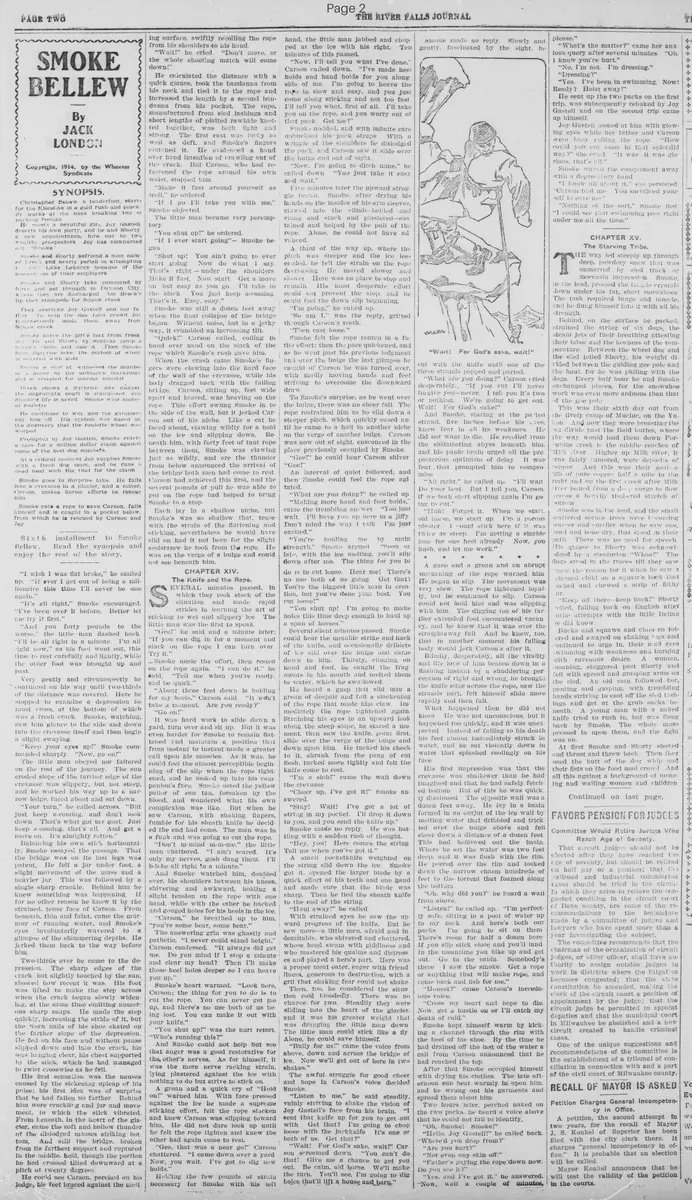
"Listen to me," he said steadily, vainly striving to shake the vision of Joy Gastell's face from his brain. "I sent that knife up for you to get out with. Get that? I'm going to chop loose with the jackknife. It's one or both of us. Get that?"
"Wait! For God's sake, wait!" Carson screamed down. "You can't do that! Give me a chance to get you out. Be calm, old horse. We'll make the turn. You'll see, I'm going to dig holes that'll lift a house and barn."
Smoke made no reply. Slowly and gently, fascinated by the sight, he cut with the knife until one of the three strands popped and parted.
"What are you doing?" Carson cried desperately. "If you cut I'll never forgive you - never. I tell you it's two or nothing. We're going to get out. Wait! For God's sake!"
And Smoke, staring at the parted strand, five inches before his eyes, knew fear in all its weakness. He did not want to die. He recoiled from the shimmering abyss beneath him, and his panic brain urged all the preposterous optimism of delay. It was fear that prompted him to compromise.
"All right," he called up. "I'll wait. Do your best. But I tell you, Carson, if we both start slipping again I'm going to cut."
"Huh! Forget it. When we start, old horse, we start up. I'm a porous plaster. I could stick here if it was twice as steep. I'm getting a sizable hole for one heel already. Now, you hush, and let me work."
A gasp and a groan and an abrupt slackening of the rope warned him. He began to slip. The movement was very slow. The rope tightened loyally, but he continued to slip. Carson could not hold him and was slipping with him. The digging toe of his farther extended foot encountered vacancy, and he knew that it was over the straightaway fall. And he knew, too, that in another moment his falling body would jerk Carson's after it.
Blindly, desperately, all the vitality and life-love of him beaten down in a flashing instant by a shuddering perception of right and wrong, he brought the knife edge across the rope, saw the strands part, felt himself slide more rapidly and then fall.
What happened then he did not know. He was not unconscious, but it happened too quickly, and it was unexpected. Instead of falling to his death his feet almost immediately struck in water, and he sat violently down in water that splashed coolingly on his face.
His first impression was that the crevasse was shallower than he had imagined and that he had safely fetched bottom. But of this he was quickly disabused. The opposite wall was a dozen feet away. He lay in a basin formed in an outjut of the ice wall by melting water that dribbled and trickled over the bulge above and fell sheer down a distance of a dozen feet. This had hollowed out the basin. Where he sat the water was two feet deep, and it was flush with the rim. He peered over the rim and looked down the narrow chasm hundreds of feet to the torrent that foamed along the bottom.
"Oh, why did you?" he heard a wail from above.
"Listen!" he called up. "I'm perfectly safe, sitting in a pool of water up to my neck. And here's both our packs. I'm going to sit on them. There's room for half a dozen here. If you slip stick close and you'll land. In the meantime you hike up and get out. Go to the cabin. Somebody's there. I saw the smoke. Get a rope or anything that will make rope, and come back and fish for me."
"Honest?" came Carson's incredulous voice.
"Cross my heart and hope to die. Now, get a hustle on or I'll catch my death of cold."
Smoke kept himself warm by kicking a channel through the rim with the heel of his shoe. By the time he had drained off the last of the water a call from Carson announced that he had reached the top.
After that Smoke occupied himself with drying his clothes. The late afternoon sun beat warmly in upon him, and he wrung out his garments and spread them about him.
Two hours later, perched naked on the two packs, he heard a voice above that he could not fail to identify.
"Oh, Smoke! Smoke!"
"Hello, Joy Gastell!" he called back. "Where'd you drop from?"
"Are you hurt?"
"Not even any skin off."
"Father's paying the rope down now. Do you see it?"
"Yes, and I've got it," he answered. "Now, wait a couple of minutes, please."
"What's the matter?" came her anxious query after several minutes. "Oh, I know you're hurt."
"No, I'm not. I'm dressing."
"Dressing?"
"Yes, I've been in swimming. Now! Ready? Hoist away!"
He sent up the two packs on the first trip, was subsequently rebuked by Joy Gastell and on the second trip came up himself.
Joy Gastell looked at him with glowing eyes while her father and Carson were busy coiling the rope. "How could you cut loose in that splendid way?" she cried. "It was - it was glorious, that's all."
Smoke waved the compliment away with a deprecatory hand.
"I know all about it," she persisted. "Carson told me. You sacrificed yourself to save me."
"Nothing of the sort," Smoke lied. "I could see that swimming pool right under me all the time."
CHAPTER XV.
The Starving Tribe.
The way led steeply up through deep, powdery snow that was unmarred by sled track or moccasin impression. Smoke, in the lead, pressed the fragile crystals down under his flat, short snowshoes. The task required lungs and muscle, and he flung himself into it with all his strength.
Behind, on the surface he packed, strained the string of six dogs, the steam jets of their breathing attesting their labor and the lowness of the temperature. Between the wheel dog and the sled toiled Shorty, his weight divided between the guiding gee pole and the haul, for he was pulling with the dogs. Every half hour he and Smoke exchanged places, for the snowshoe work was even more arduous than that of the gee pole.
This was their sixth day out from the lively camp of Muckluck, on the Yukon. And now they were breasting the Big divide past the Bald Buttes, where the way would lead them down Porcupine Creek to the middle reaches of Milk River. Higher up Milk River, it was fairly rumored, were deposits of copper. And this was their goal - a sill of pure copper half a mile to the right and on the first creek after Milk River issued from a deep gorge to flow across a heavily timbered stretch of bottom.
Smoke was in the lead, and the small scattered spruce trees were becoming scarcer and smaller when he saw one, dead and bone dry, that stood in their path. There was no need for speech. His glance to Shorty was acknowledged by a stentorian "Whoa!" The dogs stood in the traces till they saw the reason for it when he saw a wizened child on a squaw's back that sucked and chewed a strip of filthy fur.
"Keep off there - keep back!" Shorty yelled, falling back on English after futile attempts with the little Indian he did know.
Bucks and squaws and children tottered and swayed on shaking legs and continued to urge in, their pad eyes winning with weakness and burning with ravenous desire. A woman, moaning, staggered past Shorty and fell with spread and grasping arms on the sled. An old man followed her, panting and gasping, with trembling hands striving to cast off the sled lashings and get at the grub sacks beneath. A young man with a naked knife tried to rush in, but was flung back by Smoke. The whole mass pressed in upon them, and the fight was on.
At first Smoke and Shorty shoved and thrust and threw back. Then they used the butt of the dog whip and their fists on the food-mad crowd. And all this against a background of moaning and wailing women and children.
Continued on last page.
Here and there in a dozen places the sled lashings were cut. Men crawled in on their bellies, regardless of a rain of kicks and blows, and tried to drag out the grub. These had to be picked up bodily and flung back. And such was their weakness that they fell continually under the slightest pressures or shoves. Yet they made no attempt to injure the two men who defended the sled.
It was the utter weakness of the Indians that saved Smoke and Shorty from being overborne. In five minutes the wall of upstanding, on-struggling Indians had been changed to heaps of fallen ones, that moaned and gibbered in the snow and cried and sniveled as their staring, swimming eyes focused on the grub that meant life to them.
"Me Carluk, Me good Siwash," and that brought the slaver to their lips. And behind it all arose the wailing of the women and children.
"This is terrible," Smoke muttered.
"I'm all het up," Shorty replied. "I'm real sweaty. An' now what 'r we goin' to do with this ambulance outfit?"
Smoke shook his head, and then the problem was solved for him. An Indian crawled forward, his one eye fixed on Smoke instead of on the sled, and in it Smoke could see the struggle of sanity to assert itself. Shorty remembered having punched the other eye, which was already swollen shut. The Indian raised himself on his elbow and spoke:
"Me Carluk. Me good Siwash. Me savvy Boston man plenty. Me plenty hungry. All people plenty hungry. All people no savvy Boston man. Me savvy. Me eat grub now. All people eat grub now. We buy 'm grub. Got 'm plenty gold. No got 'm grub. Summer salmon no come Milk river. Winter caribou no come. No grub. Me make 'm talk all people. Me tell 'm plenty Boston man come Yukon. Boston man have plenty grub. Boston man like 'm gold. We take 'm gold. Go Yukon, Boston man give 'm grub. Plenty gold. Me savvy Boston man like 'm gold."
He began fumbling with wasted fingers at the drawstring of a pouch he took from his belt.
"Too much make 'm noise," Shorty broke in distractedly. "You tell 'm squaw, you tell 'm papoose, shut 'm up mouth."
Carluk turned and addressed the wailing women. Other bucks, listening, raised their voices authoritatively, and slowly the squaws stilled and stilled the children near to them. Carluk paused from fumbling the drawstrings and held up his fingers many times.
"Him people make 'm die," he said.
And Smoke, following the count, knew that seventy-five of the tribe had starved to death.
"Me buy 'm grub," Carluk said as he got the pouch open and drew out a large chunk of heavy metal. Others were following his example, and on every side appeared similar chunks.
Shorty stared.
"Great jiminy!" he cried. "Copper! Raw, red copper! An' they think it's gold!"
"And the poor devils banked everything on it," Smoke muttered. "Look at it. The chunk there weighs forty pounds. They've got hundreds of pounds of it, and they've carried it when they didn't have strength enough to drag themselves. Look here, Shorty. We've got to feed them."
"Huh! Sounds easy. But how about statistics? You an' me has a month's grub, which is six meals times thirty, which is 180 meals. Here's 200 In. dians, with real, full grown appetites. How can we give 'm one meal even? There's the dog grub," Smoke answered. "A couple of hundred pounds of dried salmon ought to help out. We've got to do it. They've pinned their faith on the white man, you know."
"Sure, an' we can't throw 'm down," Shorty agreed. "An' we got two nasty jobs cut out for us, each just about twict as nasty as the other. One of us has got to make a run of it to Mucluc an' raise a relief. The other has to stay here an' run the hospital an' most likely be eaten. Don't let it slip your noodle that we've been six days gettin' here, an', travelin' light an' all played out, it can't be made back in less 'n three days."
For a minute Smoke pondered the miles of the way they had come, visioning the miles in terms of time measured by his capacity for exertion.
"I can get there tomorrow night," he announced.
"All right," Shorty acquiesced cheerfully. "An, I'll stay an' be eaten."
"But I'm going to take one fish each for the dogs," Smoke explained, "and one meal for myself."
"An' you'll sure need it if you make Mucluc tomorrow night."
Smoke, through the medium of Carluk, stated the program. "Make fires, long fires, plenty fires," he concluded. "Plenty Boston man stop Mucluc. Boston man much good. Boston man plenty grub. Five sleeps I come back plenty grub. This man, his name Shorty, very good friend of mine. He stop here. He big boss-savvy?"
Carluk nodded and interpreted.
"All grub stop here. Shorty, he give 'm grub. He boss-savvy?"
Carluk interpreted, and nods and guttural cries of agreement proceeded from the men.
Smoke remained and managed until the full swing of the arrangement was under way. Those who were able crawled or staggered in the collecting of firewood. Long Indian fires were built that accommodated all. Shorty, aided by a dozen assistants, with a short club handy for the rapping of hungry knuckles, plunged into the cooking. First, a tiny piece of bacon was distributed all around and, next, a spoonful of sugar to cloy the edge of their razor appetites. Soon on a circle of fires drawn about Shorty many pots of beans were boiling, and he, with a wrathful eye for what he called the renigers, was frying and apportioning the thinnest of flapjacks.
"Me for the big cookin'," was his farewell to Smoke. "You just keep a-hikin'. Trot all the way there an' run all the way back. It'll take you today an' tomorrow to get there, and you can't be back inside three days more. Tomorrow they'll eat the last of the dogfish, an' then there'll be nary a scrap for three days. You gotta keep a-comin', Smoke; you gotta keep a-comin'."
(Continued Next Week)
SMOKE BELLEW
By
JACK
LONDON
Copyright, 1914, by the Wheeler Syndicate
SYNOPSIS.
Christopher Bellew, a tenderfoot, starts for the Klondike in a gold rush and pluckily works at the back-breaking toil of packing freight. He meets a beautiful girl, Joy Gastell, deserts his own party, and he and Shorty, a new acquaintance, hire out to two wealth prospectors Joy has nicknamed 'n Smoke. Smoke and Shorty befriend a man named Breck and nearly perish in attempting to cross Lake Lebarge because of the uselessness of their employers. Smoke and Shorty take command by force and get through to Dawson City. While they are discharged on Breck's tip they stampede for Squaw Creek. They overtake Joy Gastell and her father. To help the Sea Lion crowd Joy treacherously leads them away from Squaw Creek. Smoke saves the girl's feet from freezing. He and Shorty by mistake jump a rich claim and lose it. Then Smoke and Surprise Jack take the bottom of which is center with gold. Smoke is shot at, witnesses the murder of a miner by the unknown marksman, and is arrested for murder himself. Breck shows a Surprise Lake nugget. The impromptu court is stampeded and Smoke's life is saved. Smoke wins money at roulette. He continues to win and the gambler buys him off. His system was based on the discovery that the roulette wheel was warped. Prompted by Joy Gastell, Smoke enters a race for a million dollar claim against some of the best dog mushers. At a critical moment Joy supplies Smoke with a fresh dog team, and he runs a dead heat with Big Olaf for the claim. Smoke goes to Surprise Lake. He falls into a crevasse in a glacier, and a miner, Carson, makes heroic efforts to rescue him. Smoke cuts a rope to save Carson, falls himself and is caught in a pocket below from which he is rescued by Carson and Joy.
Sixth installment to Smoke Bellew. Read the synopsis and enjoy the rest of the story.
"I wish I was flat broke," he smiled up. "If ever I get out of being a millionaire this time I'll never be one again."
"It's all right," Smoke encouraged. "I've been over it before. Better let me try it first."
"And you forty pounds to the worse," the little man flashed back. "I'll be all right in a minute. I'm all right now," as his foot went out, this time to rest carefully and lightly, while the other foot was brought up and placed.
Very gently and circumspectly he continued on his way until two-thirds of the distance was covered. Here he stopped to examine a depression he must cross, at the bottom of which was a fresh crack. Smoke, watching, saw him glance to the side and down into the crevasse itself and then begin a slight swaying.
"Keep your eyes up!" Smoke commanded sharply. "Now, go on!"
The little man obeyed nor faltered on the rest of the journey. The sun-eroded slope of the farther edge of the crevasse was slippery, but not steep, and he worked his way up to a narrow ledge, faced about and sat down.
"Your turn," he called across. "But just keep a-coming, and don't look down. That's what got my goat. Just keep a-coming, that's all. And get a move on. It's almighty rotten."
Balancing his own stick horizontal, Smoke essayed the passage. That the bridge was on its last legs was patent. He felt a jar under foot, a slight movement of the mass and a heavier jar. This was followed by a single sharp crackle. Behind him he knew something was happening. If for no other reason he knew it by the strained, tense face of Carson. From beneath, thin and faint, came the murmur of running water, and Smoke's eyes involuntarily wavered to a glimpse of the shimmering depths. He jerked them back to the way before him.
Two-thirds over he came to the depression. The sharp edges of the crack, but slightly touched by the sun, showed how recent it was. His foot was lifted to make the step across when the crack began slowly widening, at the same time emitting numerous sharp snaps. He made the step quickly, increasing the stride of it, but the worn nails of his shoe skated on the farther slope of the depression. He fell on his face and without pause slipped down and into the crack, his legs hanging clear, his chest supported by the stick, which he had managed to twist crosswise as he fell.
His first sensation was the nausea caused by the sickening upleap of his pulse; his first idea was of surprise that he had fallen no farther. Behind him were crackling and jar and movement, to which the stick vibrated. From beneath, in the heart of the glacier, came the soft and hollow thunder of the dislodged masses striking bottom. And still the bridge, broken from its farthest support and ruptured in the middle, held, though the portion he had crossed tilted downward at a pitch of twenty degrees.
He could see Carson, perched on his ledge, his feet braced against the melting surface, swiftly recoiling the rope from his shoulders to his hand.
"Wait!" he cried. "Don't move, or the whole shooting match will come down!"
He calculated the distance with a quick glance, took the bandanna from his neck and tied it to the rope and increased the length by a second bandanna from his pocket. The rope, manufactured from sled lashings and short lengths of plaited rawhide knotted together, was both light and strong. The first cast was lucky as well as deft, and Smoke's fingers clutched it. He evidenced a hand-over-hand intention of crawling out of the crack. But Carson, who had re-fastened the rope around his own waist, stopped him.
"Make it fast around yourself as well," he ordered.
"If I go I'll take you with me," Smoke objected.
The little man became very peremptory.
"You shut up!" he ordered. "If I ever start going"- Smoke began.
"Shut up! You ain't going to ever start going. Now do what I say. That's right - under the shoulders. Make it fast. Now start. Get a move on, but easy as you go. I'll take in the slack. You just keep a-coming. That's it. Easy, easy."
Smoke was still a dozen feet away when the final collapse of the bridge began. Without noise, but in a jerky way, it crumbled an increasing tilt.
"Quick!" Carson called, coiling in hand over hand on the slack of the rope which Smoke's rush gave him.
When the crash came Smoke's fingers were clawing into the hard face of the wall of the crevasse, while his body dragged back with the falling bridge. Carson, sitting up, feet wide apart and braced, was heaving on the rope. This effort swung Smoke in to the side of the wall, but it jerked Carson out of his niche. Like a cat he faced about, clawing wildly for a hold on the ice and slipping down. Beneath him, with forty feet of taut rope between them, Smoke was clawing just as wildly, and ere the thunder from below announced the arrival of the bridge both men had come to rest.
Carson had achieved this first, and the several pounds of pull he was able to put on the rope had helped to bring Smoke to a stop.
Each lay in a shallow niche, but Smoke's was so shallow that, tense with the strain of the flattening and sticking, nevertheless he would have slid on had it not been for the slight assistance he took from the rope. He was on the verge of a bulge and could not see beneath him.
CHAPTER XIV.
The Knife and the Rope.
Several minutes passed, in which they took stock of the situation and made rapid strides in learning the art of sticking to wet and slippery ice. The little man was the first to speak.
"Gee!" he said, and a minute later: "If you can dig in for a moment and slack on the rope I can turn over. Try it."
Smoke made the effort, then rested on the rope again. "I can do it," he said. "Tell me when you're ready, and be quick."
"About three feet down is holding for my heels," Carson said. "It won't take a moment. Are you ready?"
"Go on!"
It was hard work to slide down a yard, turn over and sit up. But it was even harder for Smoke to remain flattened and maintain a position that from instant to instant made a greater call upon his muscles. As it was, he could feel the almost perceptible beginning of the slip when the rope tightened, and he looked up into his companion's face. Smoke noted the yellow pallor of sun tan, forsaken by the blood, and wondered what his own complexion was like. But when he saw Carson, with shaking fingers fumble for his sheath knife he decided the end had come. The man was in a funk and was going to cut the rope.
"D-don't m-mind m-m-me," the little man chattered. "I ain't scared. It's only my nerves. Gosh dang them. I'll b-b-be all right in a minute."
And Smoke watched him, doubled over, his shoulders between his knees, shivering and awkward, holding a slight tension on the rope with one hand, while with the other he hacked and gouged holes for his heels in the ice.
"Carson," he breathed up to him, "you're some bear, some bear."
The answering grin was ghastly and pathetic. "I never could stand height," Carson confessed. "It always did get me. Do you mind if I stop a minute and clear my head? Then I'll make those heel holes deeper so I can heave you up."
Smoke's heart warmed. "Look here, Carson: the thing for you to do is to cut the rope. You can never get me up, and there's no use both of us being lost. You can make it out with your knife."
"You shut up!" was the curt retort. "Who's running this?"
And Smoke could not help but see that anger was a good restorative for the other's nerves. As for himself, it was the more nerve-racking strain, lying plastered against the ice with nothing to do but strive to stick on.
A groan and a quick cry of "Hold on!" warned him. With face pressed against the ice he made a supreme sticking effort, felt the rope slacken and knew Carson was slipping toward him. He did not dare look up until he felt the rope tighten and knew the other had again come to rest.
"Gee, that was a near go!" Carson chattered. "I came down over a yard. Now, you wait. I've got to dig new holds."
Holding the few pounds of strain necessary for Smoke with his left hand, the little man jabbed and chopped at the ice with his right. Ten minutes of this passed.
"Now, I'll tell you what I've done," Carson called down. "I've made heel holds and hand holds for you alongside of me. I'm going to heave the rope in slow and easy, and you just come along sticking and not too fast. I'll tell you what, first of all, I'll take you on the rope, and you worry out of that pack. Get me?"
Smoke nodded, and with infinite care unbuckled his pack straps. With a wriggle of the shoulders he dislodged the pack, and Carson saw it slide over the bulge and out of sight.
"Now, I'm going to ditch mine," he called down. "You just take it easy and wait."
Five minutes later the upward struggle began. Smoke, after drying his hands on the insides of his arm sleeves, clawed into the climb - bellied and clung and stuck and plastered - sustained and helped by the pull of the rope. Alone, he could not have advanced.
A third of the way up, where the pitch was steeper and the ice less eroded, he felt the strain on the rope decreasing. He moved slower and slower. Here was no place to stop and remain. His most desperate effort could not prevent the stop, and he could feel the down slip beginning.
"I'm going," he called up.
"So am I," was the reply, gritted through Carson's teeth.
"Then cast loose."
Smoke felt the rope tauten in a futile effort; then the pace quickened, and as he went past his previous lodgment and over the bulge the last glimpse he caught of Carson he was turned over with madly moving hands and feet striving to overcome the downward draw.
To Smoke's surprise, as he went over the bulge, there was no sheer fall. The rope restrained him as he slid down a steeper pitch, which quickly eased until he came to a halt in another niche on the verge of another bulge. Carson was now out of sight, ensconced in the place previously occupied by Smoke.
"Gee!" he could hear Carson shiver. "Gee!"
An interval of quiet followed, and then Smoke could feel the rope agitated.
"What are you doing?" he called up.
"Making more hand and foot holds," came the trembling answer. "You just wait. I'll have you up here in a jiffy. Don't mind the way I talk. I'm just excited."
"You're holding me by main strength," Smoke argued. "Soon or late, with the ice melting, you'll slip down after me. The thing for you to do is to cut loose. Hear me! There's no use both of us going. Get that? You're the biggest little man in creation, but you've done your best. You cut loose!"
"You shut up! I'm going to make holes this time deep enough to haul up a span of horses."
Several silent minutes passed. Smoke could hear the metallic strike and hack of the knife, and occasionally driblets of ice slid over the bulge and came down to him. Thirsty, clinging on hand and foot, he caught the fragments in his mouth and melted them to water, which he swallowed.
He heard a gasp that slid into a groan of despair and felt a slackening of the rope that made him claw. Immediately the rope tightened again. Straining his eyes in an upward look along the steep slope, he stared a moment, then saw the knife, point first, slide over the verge of the bulge and down upon him. He tucked his cheek to it, shrank from the pang of cut flesh, tucked more tightly and felt the knife come to rest.
"I'm a slob!" came the wail down the crevasse.
"Cheer up, I've got it!" Smoke answered.
"Stay! Wait! I've got a lot of string in my pocket. I'll drop it down to you, and you send the knife up."
Smoke made no reply. He was battling with a sudden rush of thought.
"Hey, you! Here comes the string. Tell me when you've got it."
A small pocketknife weighted on the string slid down the ice. Smoke got it, opened the larger blade by a quick effort of his teeth and one hand and made sure that the blade was sharp. Then he tied the sheath knife to the end of the string.
"Haul away!" he called.
With strained eyes he saw the upward progress of the knife. But he saw more - a little man, afraid and indomitable, who shivered and chattered, whose head swam with giddiness and who mastered his qualms and distresses and played a hero's part. Here was a proper meat eater, eager with friendliness, generous to destruction, with a grit that shaking fear could not shake.
Then, too, he considered the situation cold-bloodedly. There was no chance for two. Steadily they were sliding into the heart of the glacier, and it was his greater weight that was dragging the little man down. The little man could stick like a fly. Alone, he could save himself.
"Bully for us!" came the voice from above, down and across the bridge of ice. "Now we'll get out of here in two shakes."
The awful struggle for good cheer and hope in Carson's voice decided Smoke.
"Listen to me," he said steadily, vainly striving to shake the vision of Joy Gastell's face from his brain. "I sent that knife up for you to get out with. Get that? I'm going to chop loose with the jackknife. It's one or both of us. Get that?"
"Wait! For God's sake, wait!" Carson screamed down. "You can't do that! Give me a chance to get you out. Be calm, old horse. We'll make the turn. You'll see, I'm going to dig holes that'll lift a house and barn."
Smoke made no reply. Slowly and gently, fascinated by the sight, he cut with the knife until one of the three strands popped and parted.
"What are you doing?" Carson cried desperately. "If you cut I'll never forgive you - never. I tell you it's two or nothing. We're going to get out. Wait! For God's sake!"
And Smoke, staring at the parted strand, five inches before his eyes, knew fear in all its weakness. He did not want to die. He recoiled from the shimmering abyss beneath him, and his panic brain urged all the preposterous optimism of delay. It was fear that prompted him to compromise.
"All right," he called up. "I'll wait. Do your best. But I tell you, Carson, if we both start slipping again I'm going to cut."
"Huh! Forget it. When we start, old horse, we start up. I'm a porous plaster. I could stick here if it was twice as steep. I'm getting a sizable hole for one heel already. Now, you hush, and let me work."
A gasp and a groan and an abrupt slackening of the rope warned him. He began to slip. The movement was very slow. The rope tightened loyally, but he continued to slip. Carson could not hold him and was slipping with him. The digging toe of his farther extended foot encountered vacancy, and he knew that it was over the straightaway fall. And he knew, too, that in another moment his falling body would jerk Carson's after it.
Blindly, desperately, all the vitality and life-love of him beaten down in a flashing instant by a shuddering perception of right and wrong, he brought the knife edge across the rope, saw the strands part, felt himself slide more rapidly and then fall.
What happened then he did not know. He was not unconscious, but it happened too quickly, and it was unexpected. Instead of falling to his death his feet almost immediately struck in water, and he sat violently down in water that splashed coolingly on his face.
His first impression was that the crevasse was shallower than he had imagined and that he had safely fetched bottom. But of this he was quickly disabused. The opposite wall was a dozen feet away. He lay in a basin formed in an outjut of the ice wall by melting water that dribbled and trickled over the bulge above and fell sheer down a distance of a dozen feet. This had hollowed out the basin. Where he sat the water was two feet deep, and it was flush with the rim. He peered over the rim and looked down the narrow chasm hundreds of feet to the torrent that foamed along the bottom.
"Oh, why did you?" he heard a wail from above.
"Listen!" he called up. "I'm perfectly safe, sitting in a pool of water up to my neck. And here's both our packs. I'm going to sit on them. There's room for half a dozen here. If you slip stick close and you'll land. In the meantime you hike up and get out. Go to the cabin. Somebody's there. I saw the smoke. Get a rope or anything that will make rope, and come back and fish for me."
"Honest?" came Carson's incredulous voice.
"Cross my heart and hope to die. Now, get a hustle on or I'll catch my death of cold."
Smoke kept himself warm by kicking a channel through the rim with the heel of his shoe. By the time he had drained off the last of the water a call from Carson announced that he had reached the top.
After that Smoke occupied himself with drying his clothes. The late afternoon sun beat warmly in upon him, and he wrung out his garments and spread them about him.
Two hours later, perched naked on the two packs, he heard a voice above that he could not fail to identify.
"Oh, Smoke! Smoke!"
"Hello, Joy Gastell!" he called back. "Where'd you drop from?"
"Are you hurt?"
"Not even any skin off."
"Father's paying the rope down now. Do you see it?"
"Yes, and I've got it," he answered. "Now, wait a couple of minutes, please."
"What's the matter?" came her anxious query after several minutes. "Oh, I know you're hurt."
"No, I'm not. I'm dressing."
"Dressing?"
"Yes, I've been in swimming. Now! Ready? Hoist away!"
He sent up the two packs on the first trip, was subsequently rebuked by Joy Gastell and on the second trip came up himself.
Joy Gastell looked at him with glowing eyes while her father and Carson were busy coiling the rope. "How could you cut loose in that splendid way?" she cried. "It was - it was glorious, that's all."
Smoke waved the compliment away with a deprecatory hand.
"I know all about it," she persisted. "Carson told me. You sacrificed yourself to save me."
"Nothing of the sort," Smoke lied. "I could see that swimming pool right under me all the time."
CHAPTER XV.
The Starving Tribe.
The way led steeply up through deep, powdery snow that was unmarred by sled track or moccasin impression. Smoke, in the lead, pressed the fragile crystals down under his flat, short snowshoes. The task required lungs and muscle, and he flung himself into it with all his strength.
Behind, on the surface he packed, strained the string of six dogs, the steam jets of their breathing attesting their labor and the lowness of the temperature. Between the wheel dog and the sled toiled Shorty, his weight divided between the guiding gee pole and the haul, for he was pulling with the dogs. Every half hour he and Smoke exchanged places, for the snowshoe work was even more arduous than that of the gee pole.
This was their sixth day out from the lively camp of Muckluck, on the Yukon. And now they were breasting the Big divide past the Bald Buttes, where the way would lead them down Porcupine Creek to the middle reaches of Milk River. Higher up Milk River, it was fairly rumored, were deposits of copper. And this was their goal - a sill of pure copper half a mile to the right and on the first creek after Milk River issued from a deep gorge to flow across a heavily timbered stretch of bottom.
Smoke was in the lead, and the small scattered spruce trees were becoming scarcer and smaller when he saw one, dead and bone dry, that stood in their path. There was no need for speech. His glance to Shorty was acknowledged by a stentorian "Whoa!" The dogs stood in the traces till they saw the reason for it when he saw a wizened child on a squaw's back that sucked and chewed a strip of filthy fur.
"Keep off there - keep back!" Shorty yelled, falling back on English after futile attempts with the little Indian he did know.
Bucks and squaws and children tottered and swayed on shaking legs and continued to urge in, their pad eyes winning with weakness and burning with ravenous desire. A woman, moaning, staggered past Shorty and fell with spread and grasping arms on the sled. An old man followed her, panting and gasping, with trembling hands striving to cast off the sled lashings and get at the grub sacks beneath. A young man with a naked knife tried to rush in, but was flung back by Smoke. The whole mass pressed in upon them, and the fight was on.
At first Smoke and Shorty shoved and thrust and threw back. Then they used the butt of the dog whip and their fists on the food-mad crowd. And all this against a background of moaning and wailing women and children.
Continued on last page.
Here and there in a dozen places the sled lashings were cut. Men crawled in on their bellies, regardless of a rain of kicks and blows, and tried to drag out the grub. These had to be picked up bodily and flung back. And such was their weakness that they fell continually under the slightest pressures or shoves. Yet they made no attempt to injure the two men who defended the sled.
It was the utter weakness of the Indians that saved Smoke and Shorty from being overborne. In five minutes the wall of upstanding, on-struggling Indians had been changed to heaps of fallen ones, that moaned and gibbered in the snow and cried and sniveled as their staring, swimming eyes focused on the grub that meant life to them.
"Me Carluk, Me good Siwash," and that brought the slaver to their lips. And behind it all arose the wailing of the women and children.
"This is terrible," Smoke muttered.
"I'm all het up," Shorty replied. "I'm real sweaty. An' now what 'r we goin' to do with this ambulance outfit?"
Smoke shook his head, and then the problem was solved for him. An Indian crawled forward, his one eye fixed on Smoke instead of on the sled, and in it Smoke could see the struggle of sanity to assert itself. Shorty remembered having punched the other eye, which was already swollen shut. The Indian raised himself on his elbow and spoke:
"Me Carluk. Me good Siwash. Me savvy Boston man plenty. Me plenty hungry. All people plenty hungry. All people no savvy Boston man. Me savvy. Me eat grub now. All people eat grub now. We buy 'm grub. Got 'm plenty gold. No got 'm grub. Summer salmon no come Milk river. Winter caribou no come. No grub. Me make 'm talk all people. Me tell 'm plenty Boston man come Yukon. Boston man have plenty grub. Boston man like 'm gold. We take 'm gold. Go Yukon, Boston man give 'm grub. Plenty gold. Me savvy Boston man like 'm gold."
He began fumbling with wasted fingers at the drawstring of a pouch he took from his belt.
"Too much make 'm noise," Shorty broke in distractedly. "You tell 'm squaw, you tell 'm papoose, shut 'm up mouth."
Carluk turned and addressed the wailing women. Other bucks, listening, raised their voices authoritatively, and slowly the squaws stilled and stilled the children near to them. Carluk paused from fumbling the drawstrings and held up his fingers many times.
"Him people make 'm die," he said.
And Smoke, following the count, knew that seventy-five of the tribe had starved to death.
"Me buy 'm grub," Carluk said as he got the pouch open and drew out a large chunk of heavy metal. Others were following his example, and on every side appeared similar chunks.
Shorty stared.
"Great jiminy!" he cried. "Copper! Raw, red copper! An' they think it's gold!"
"And the poor devils banked everything on it," Smoke muttered. "Look at it. The chunk there weighs forty pounds. They've got hundreds of pounds of it, and they've carried it when they didn't have strength enough to drag themselves. Look here, Shorty. We've got to feed them."
"Huh! Sounds easy. But how about statistics? You an' me has a month's grub, which is six meals times thirty, which is 180 meals. Here's 200 In. dians, with real, full grown appetites. How can we give 'm one meal even? There's the dog grub," Smoke answered. "A couple of hundred pounds of dried salmon ought to help out. We've got to do it. They've pinned their faith on the white man, you know."
"Sure, an' we can't throw 'm down," Shorty agreed. "An' we got two nasty jobs cut out for us, each just about twict as nasty as the other. One of us has got to make a run of it to Mucluc an' raise a relief. The other has to stay here an' run the hospital an' most likely be eaten. Don't let it slip your noodle that we've been six days gettin' here, an', travelin' light an' all played out, it can't be made back in less 'n three days."
For a minute Smoke pondered the miles of the way they had come, visioning the miles in terms of time measured by his capacity for exertion.
"I can get there tomorrow night," he announced.
"All right," Shorty acquiesced cheerfully. "An, I'll stay an' be eaten."
"But I'm going to take one fish each for the dogs," Smoke explained, "and one meal for myself."
"An' you'll sure need it if you make Mucluc tomorrow night."
Smoke, through the medium of Carluk, stated the program. "Make fires, long fires, plenty fires," he concluded. "Plenty Boston man stop Mucluc. Boston man much good. Boston man plenty grub. Five sleeps I come back plenty grub. This man, his name Shorty, very good friend of mine. He stop here. He big boss-savvy?"
Carluk nodded and interpreted.
"All grub stop here. Shorty, he give 'm grub. He boss-savvy?"
Carluk interpreted, and nods and guttural cries of agreement proceeded from the men.
Smoke remained and managed until the full swing of the arrangement was under way. Those who were able crawled or staggered in the collecting of firewood. Long Indian fires were built that accommodated all. Shorty, aided by a dozen assistants, with a short club handy for the rapping of hungry knuckles, plunged into the cooking. First, a tiny piece of bacon was distributed all around and, next, a spoonful of sugar to cloy the edge of their razor appetites. Soon on a circle of fires drawn about Shorty many pots of beans were boiling, and he, with a wrathful eye for what he called the renigers, was frying and apportioning the thinnest of flapjacks.
"Me for the big cookin'," was his farewell to Smoke. "You just keep a-hikin'. Trot all the way there an' run all the way back. It'll take you today an' tomorrow to get there, and you can't be back inside three days more. Tomorrow they'll eat the last of the dogfish, an' then there'll be nary a scrap for three days. You gotta keep a-comin', Smoke; you gotta keep a-comin'."
(Continued Next Week)
What sub-type of article is it?
Prose Fiction
What themes does it cover?
Friendship
Moral Virtue
Nature
What keywords are associated?
Klondike
Gold Rush
Glacier Crevasse
Starving Tribe
Heroic Rescue
Copper Nuggets
Survival
Friendship
Adventure
Jack London
What entities or persons were involved?
By Jack London
Literary Details
Title
Smoke Bellew
Author
By Jack London
Subject
Klondike Gold Rush Adventure
Key Lines
"I Wish I Was Flat Broke," He Smiled Up. "If Ever I Get Out Of Being A Millionaire This Time I'll Never Be One Again."
"You're Some Bear, Some Bear."
"How Could You Cut Loose In That Splendid Way?" She Cried. "It Was It Was Glorious, That's All."
"This Is Terrible," Smoke Muttered.
"Bully For Us!" Came The Voice From Above, Down And Across The Bridge Of Ice. "Now We'll Get Out Of Here In Two Shakes."