Thank you for visiting SNEWPapers!
Sign up free
The Rhode Island American, And General Advertiser
Providence, Providence County, Rhode Island
What is this article about?
Character sketch of Napoleon Bonaparte by Charles Phillips, portraying him as a grand yet despotic figure whose ambition led to his rise and fall, highlighting contradictions in his rule and legacy of both evil and good, including spread of free constitutions. Originally published in Paris on April 18.
Merged-components note: These components form a single continuous literary piece: the 'Character of Bonaparte' sketch, spanning across the end of page 1 and into page 2. The third component was originally labeled 'story' but fits as part of this literary work.
Clippings
1 of 2
OCR Quality
Full Text
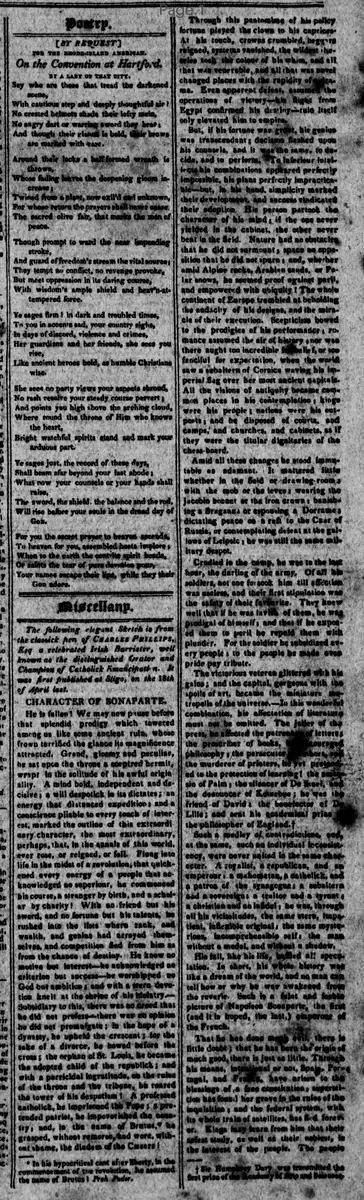
The following elegant Sketch is from the classick pen of Charles Phillips, Esq. a celebrated Irish Barrister, well known as the distinguished Orator and Champion of Catholick Emancipation. It was first published at Paris, on the 18th of April last.
CHARACTER OF BONAPARTE
He is fallen? We may now pause before that splendid prodigy which towered among us like some ancient ruin, whose frown terrified the glance its magnificence attracted. Grand, gloomy, and peculiar, he sat upon the throne, sceptred hermit wrapt in the solitude of his awful originality. A mind bold, independent and decisive; a will despotick in its dictates; an energy that distanced expedition; and a conscience pliable to every touch of interest, marked the outline of this extraordinary character, the most extraordinary, perhaps, that, in the annals of this world, ever rose, or reigned, or fell. Flung into life in the midst of a revolution that quickened every energy of a people that acknowledged no superior, he commenced his course, a stranger by birth, and a scholar by charity. With no friend but his sword, and no fortune but his talents. He rushed into the lists where rank, and wealth, and genius had arrayed themselves, and competition fled from him as from the glance of destiny. He knew no motive but interest—he acknowledged no criterion but success; he worshipped no God but ambition; and, with a servile devotion, knelt at the shrine of his idolatry. Subsidiary to this, there was no creed that he did not profess—there was no opinion he did not promulgate; in the hope of a dynasty, he upheld the crescent; for the sake of a divorce, he bowed before the Cross; the orphan of St. Louis, he became the adopted child of the republic; and, with a parricidal ingratitude, on the ruins of the throne and the tribune, he reared the tower of his despotism! A professed catholic, he imprisoned the Pope; pretended patriot, he impoverished the country; and, in the name of Brutus, he grasped, without remorse and wore, without shame, the diadem of the Caesars! In his hypocritical cant after liberty, in the commencement of the revolution, he assumed the name of Brutus! Pret. Order.
Through this pantomime of his policy fortune played the clown to his caprices. At his touch, crowns crumbled, beggars reigned, systems vanished, the wildest theories took the colour of his whim, and all that was venerable, and all that was novel changed places with the rapidity of a dream. Even apparent defect, assumed the operations of victory. His flight from Egypt confirmed his destiny—ruin itself only elevated him to empire.
But, if his fortune was great, his genius was transcendent: decision flashed upon his councils, and it was the signal to decide, and to perform. To inferior intellects his combinations appeared perfectly impossible, his plans perfectly impracticable but, in his hand, simplicity marked their development, and success vindicated their adoption. His person partook the character of his mind if the one never yielded in the cabinet, the other never bent in the field. Nature had no obstacles that he did not surmount; space no opposition that he did not conquer. And, whether amid Alpine rocks, Arabian sands, or Polar snows, he seemed proof against peril, and empowered with ubiquity! The whole continent of Europe trembled at beholding the audacity of his designs, and the miracle of their execution. Scepticism bowed to the prodigies of his performances; romance assumed the air of history (nor was there aught too incredible for belief, or too fanciful for expectation, when the world saw a subaltern of Corsica waving his imperial flag over her most ancient capitals. All the visions of antiquity became common places in his contemplation; Kings were his people, nations were his outposts; and he disposed of courts, and camps, and churches, and cabinets, as if they were the titular dignitaries of the Chess-board.
Amid all these changes he stood immutable as adamant. It mattered little whether in the field or drawing-rooms with the mob or the levées wearing the jacobin bonnet or the iron crown, banishing a Brissot, or espousing a Dorothea; dictating peace on a raft to the Czar of Russia, or contemplating defeat at the ramparts of Leipsic; he was still the same military despot.
Cradled in the camp, he was to the last hour the darling of the army. Of an army of soldiers he got one for good, him till defection was useless and their first stipulation was the safety of their favourite. They knew well that to win in with of them, he was prodigal of himself; and that if he exposed them to peril he redressed them with plunder. For the soldier he subjugated every people: to the people he made every prince tributary. The victorious veterans glittered with his gains; and the capitol, serene with the spoils of art, became the miniature of the tropic of the universe.— In this wonderful combination, his affectation of literature must not be omitted. The jailer of the press he affected the patron of letters the proscriber of books, slandered philosophy the persecutor of the press, the murderer of printers, he yet pretended to the protection of learning! the silencer of De Stael; the despoiler of Kotzebue; the friend of David; the benefactor of Lillo; and sent his academical prize the philosopher of England. Such medley of contradictions, and at the same, such an individual inconsistency, were never united in the same character. A royalist, republican, and emperor, mahometan, a catholic, and a patron of the synagogue: A subaltern and a sovereigns croitor and a tyrants a christian and an infidel; he was, through all his vicissitudes, the same stern, impatient, inflexible original; the same mysterious incomprehensible self: the man without a model, and without a shadow.
His fall, like his life, was a whirlwind in Short. his whole history w like a dream of the world, and no man can tell how or why be was awakened from the reverie. Such is a faint and feeble picture of Napoleon Bonaparte the First (and it is hoped, the last,) emperor of the French.
That he has done much evil, there is little doubt; that he has been the origin of much good, there is just as little. Through his means, intentional or not, Spain, Portugal, and France, have arisen to the blessings of a free constitution, superstition has found her grave in the ruins of the inquisition; and the federal system, with its whole train of satellites, has fled forever. Kings may learn from him that their safest study, as well as their noblest, is the happiness of the people. The people are taught by him, that there is no despotism so stupendous against which they have not a resource and to those who would rise on the ruins of both. he is living lesson that if ambition can raise him from the lowest station, it can prostrate them from the highest.
What sub-type of article is it?
What themes does it cover?
What keywords are associated?
What entities or persons were involved?
Literary Details
Title
Character Of Bonaparte
Author
Charles Phillips, Esq.
Key Lines