Thank you for visiting SNEWPapers!
Sign up free
Southern Christian Advocate
Charleston, Charleston County, South Carolina
What is this article about?
Rev. B. Jenkins writes from Hong Kong on Jan. 26, 1849, describing Chinese New Year festivities and idolatry, missionary visits to temples and villages, a Lord's Supper service, language studies, and the shipwreck death of Rev. Mr. Pohlman near Breaker's Point on Jan. 5-6, 1849, with several drownings amid local hostility.
Clipping
OCR Quality
Full Text
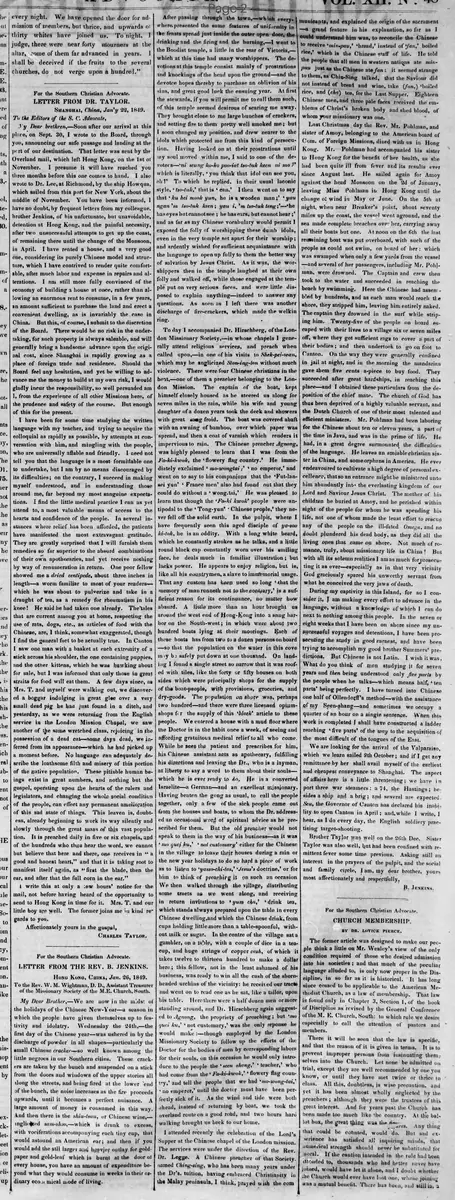
LETTER FROM THE REV. B. JENKINS.
Hong Kong, China, Jan. 26, 1849.
To the Rev. W. M. Wightman, D. D., Assistant Treasurer of the Missionary Society of the M.E. Church, South.
My Dear Brother,—We are now in the midst of the holidays of the Chinese New-Year—a season in which the people have given themselves up to festivity and idolatry. Wednesday the 24th,—the first day of the Chinese year—was ushered in by the discharge of powder in all shapes—particularly the small Chinese cracker—so well known among the little negroes in our Southern cities. These crackers are taken by the bunch and suspended on a stick from the doors and windows of the upper stories all along the streets, and being fired at the lower end of the bunch, the noise increases as the fire proceeds upwards, until it becomes a perfect nuisance. A large amount of money is consumed in this way. And then there is the shiu-tsau, or Chinese wine,—anglicized sam-shoo,—which is drunk to excess, with vociferations accompanying each tiny cup, that would astound an American ear; and then if you would add the still larger and heavier outlay for gold-paper and gold-leaf which is burnt at the door of every house, you have an amount of expenditure beyond what they would consume in weeks in their ordinary economical mode of living.
After passing through the town,—which everywhere presented the same features of uniformity in the feasts spread just inside the outer open door, the drinking and the firing and the burning,—I went to the Boodist temple, a little in the rear of Victoria,—which at this time had many worshippers. The devotions at this temple consist mainly of prostrations and knockings of the head upon the ground—and the devotee hopes thereby to purchase an oblivion of his sins, and great good luck the ensuing year. At first the stewards, if you will permit me to call them such, of this temple seemed desirous of scaring me away. They brought close to me large bunches of crackers, and setting fire to them pretty well smoked me; but I soon changed my position, and drew nearer to the idols which protected me from this kind of persecution. Having looked on at their prostrations until my soul moved within me, I said to one of the devotees—'ni seung ko-ko poo-iat tso-tuk keen ni mo ?' which is literally, 'you think that idol can see you, eh?' To which he replied, in their usual laconic style, 'tso-tuk,' that is can.' I then went on to say that ku hei mook yun, he is a wooden man;' 'yau ngan' m tso-tuk keen; yau i, 'm tso-tuk teng;'—'he has eyes but cannot see; he has ears, but cannot hear;' and as far as my Chinese vocabulary would permit I exposed the folly of worshipping these dumb idols, even in the very temple set apart for their worship; and ardently wished for sufficient acquaintance with the language to open up fully to them the better way of salvation by Jesus Christ. As it was, the worshippers then in the temple laughed at their own folly and walked off, while those engaged at the temple put on very serious faces, and were little disposed to explain anything—indeed to answer any questions. As soon as I left there was another discharge of fire-crackers, which made the welkin ring.
To day I accompanied Dr. Hirschberg, of the London Missionary Society, in whose chapels I generally attend religious services, and preach when called upon,—in one of his visits to Shek-pei-wan, which may be anglicized Stone-ing-ton without much violence. There were four Chinese christians in the boat,—one of them a preacher belonging to the London Mission. The captain of the boat, kept himself closely housed as he steered us along for seven miles in the rain, while his wife and young daughter of a dozen years took the deck and showers with great sang froid. The boat was covered abaft with an awning of bamboo, over which paper was spread, and then a coat of varnish which renders it impervious to rain. The Chinese preacher Agnong, was highly pleased to learn that I was from the Fa-ki-kwok, the 'flowery flag country.' He immediately exclaimed 'mo-wongtai;' no emperor,' and went on to say to his companions that the Fut-lan-sei yun' France men' also had found out that they could do without a 'wong.tai.'' He was pleased to learn that though the 'Fa-ki kwok' people were antipodal to the 'Tong-yun' ·Chinese people,' they never fell off the solid earth. In the pulpit, where I have frequently seen this aged disciple of ya-son ki-tok, he is an oddity. With a long white beard, which he constantly strokes as he talks, and a little round black cap constantly worn over his smiling face, he deals much in familiar illustration; but lacks power. He appears to enjoy religion, but is like all his countrymen, a slave to immemorial usage. That any custom has been used so long 'that the memory of man runneth not to the contrary,' is a sufficient reason for its continuance, no matter how absurd. A little more than an hour brought us around the west end of Hong-Kong into a snug harbor on the South-west; in which were about two hundred boats lying at their moorings. Each of these boats has from two to a dozen persons on board—so that the population on the water in this cove may be safely put down at one thousand. On landing I found a single street so narrow that it was roofed with tiles, like the forty or fifty houses on both sides which were principally shops for the supply of the boat-people, with provisions, groceries, and dry-goods. 'The population on shore was, perhaps two hundred—and there were three licensed opium-shops for the supply of this black article to these people. We entered a house with a mud floor where the Doctor is in the habit once a week, of seeing and affording gratuitous medical relief to all who come. While he sees the patient and prescribes for him, his Chinese assistant acts as apothecary, fulfilling his directions and leaving the Dr., who is a layman, at liberty to say a word to them about their souls—which he is ever ready to do. He is a converted Israelite—a German—and an excellent missionary. Having beaten the gong as usual, to call the people together, only a few of the sick people came out from the houses and boats, to whom the Dr. addressed an occasional word of spiritual advice as he prescribed for them. But the old preacher would not speak to them in the way of his business—as it was 'mo quej ku,' not customary' either for the Chinese in the village to leave their houses during a rain or the new year holidays to do so hard a piece of work as to listen to 'yasso-chi-tas,' 'Jesus's doctrine,' or for him to think of preaching it on such an occasion. We then walked through the village, distributing some tracts as we went along, and receiving in return invitations to 'yum cha, drink tea,' which stands always prepared upon the table in every Chinese dwelling, and which the Chinese drink, from cups holding little more than a table-spoonful, without milk or sugar. In the centre of the village sat a gambler, on a table, with a couple of dice in a tea-cup, and huge strings of copper cash, of which it takes twelve to thirteen hundred to make a dollar here; this fellow, not in the least ashamed of his business, was ready to win all the cash of the shorn-headed urchins of the vicinity: he received our tracts and went on to read one as he sat, like a tailor, upon his table. Here there were a half dozen men or more standing around, and Dr. Hirschberg again suggested to Agnong, the propriety of preaching; but 'mo quei ku,' 'not customary,' was the only response he would make:—though employed by the London Missionary Society to follow up the efforts of the Doctor for the bodies of men by corresponding labors for their souls, on this occasion he would only introduce to the people the 'seen shang,' 'teacher,' who had come from the 'Fa-ki-kwok,' 'flowery flag country,' and tell the people that we had 'mo-wong-tai,' 'no emperor,' until the doctor must have been perfectly sick of it. As the wind and tide were both ahead, instead of returning by boat, we took the overland route on a good road, and two hours hard walking brought us back to our home.
I attended recently the celebration of the Lord's Supper at the Chinese chapel of the London mission. The services were under the direction of the Rev. Dr. Legge. A Chinese preacher of that Society, named Ching-sing, who has been many years under the Dr's. tuition, having embraced Christianity in the Malay peninsula, I think, prayed with the communicants, and explained the origin of the sacrament—a grand feature in his explanation, so far as I could understand him was, to reconcile the Chinese to receive 'min-pau,' 'bread,' instead of fan,' boiled rice, which is the Chinese staff of life. He told the people that all men in western nations ate min-pau just as the Chinese ate fan: it seemed strange to them, as Chin-Sing talked, that the Saviour did not instead of bread and wine, take (San,) 'boiled rice, and (cha) tea, for the Last Supper. Eighteen Chinese men, and three pale faces received the emblems of Christ's broken body and shed blood, of whom your missionary was one.
Last Christmas day the Rev. Mr. Pohlman, and sister of Amoy, belonging to the American board of Com. of Foreign Missions, dined with us in Hong Kong. Mr. Pohlman had accompanied his sister to Hong Kong for the benefit of her health, as she had been quite ill from fever and its results ever since August last. He sailed again for Amoy against the head Monsoon on the 2d of January, leaving Miss Pohlman in Hong Kong until the change of wind in May or June. On the 5th at night, when near Breaker's point, about seventy miles up the coast, the vessel went aground, and the sea made complete breaches over her, carrying away all their boats but one. At noon on the 6th the last remaining boat was put overboard, with such of the people as could not swim, on board of her: which was swamped when only a few yards from the vessel—and several of her passengers, including Mr. Pohlman, were drowned. The Captain and crew then took to the water and succeeded in reaching the beach by swimming. Here the Chinese had assembled by hundreds, and as each man would reach the shore, they stripped him, leaving him entirely naked. The captain they drowned in the surf while stripping him. Twenty-five of the people on board escaped with their lives to a village six or seven miles off, where they got sufficient rags to cover a part of their bodies; and then undertook to go on foot to Canton. On the way they were generally confined in jail at night, and in the morning the mandarins gave them five cents a-piece to buy food. They succeeded after great hardships, in reaching this place—and I obtained these particulars from the deposition of the chief mate. The church of God has thus been deprived of a highly valuable servant, and the Dutch Church of one of their most talented and efficient ministers. Mr. Pohlman had been laboring for the Chinese about ten or eleven years, a part of the time in Java, and was in the prime of life. He had, in a great degree surmounted the difficulties of the language. He leaves an amiable christian sister in China, and some orphans in America. He ever endeavoured to cultivate a high degree of personal excellence, that so an entrance might be ministered unto him abundantly into the everlasting kingdom of our Lord and Saviour Jesus Christ. The mother of his children he buried at Amoy, and he perished within sight of the people for whom he was spending his life, not one of whom made the least effort to rescue any of the people on the ill-fated Omega, and no doubt plundered his dead body, as they did all the living ones that came on shore. Not much of romance, truly, about missionary life in China! But with all its solemn realities I am as much for prosecuting it as ever—especially as in that very vicinity God graciously spared his unworthy servant from what he conceived the very jaws of death.
During my captivity in this Island, for so I consider it, I am making every effort to advance in the language, without a knowledge of which I can do next to nothing among this people. In the seven or eight weeks that I have been on shore since my unsuccessful voyages and detentions, I have been prosecuting the study in good earnest, and have been trying to accomplish my good brother Summers' predictions. But Chinese is not Latin. I wish it was. What do you think of one studying it for seven years and then being understood only five parts by the people when he talks—which means half, 'ten parts' being perfectly. I have turned into Chinese one half of Ollendorff's method—with the assistance of my Seen-shang—and sometimes we occupy a quarter of an hour on a single sentence. When this work is completed I shall have constructed a ladder reaching 'five parts' of the way to the acquisition of the most difficult of the tongues of the East.
We are looking for the arrival of the Valparaiso, which we learn sailed 9th October; and if I get any remittance by her shall avail myself of the earliest and cheapest conveyance to Shanghai. The aspect of affairs here is a little threatening; we have in port three war steamers: a 74, the Hastings; besides a ship and a brig; and several are expected. Seu, the Governor of Canton has declared his inability to open Canton in April; and, while I write, I hear, as I do every day, the English soldiery practising target-shooting.
Brother Taylor was well on the 26th Dec. Sister Taylor was also well, but had been confined with remittent fever some time previous. Asking still an interest in the prayers of the pulpit, and the social and family circle, I am, my dear brother, yours most affectionately and respectfully,
B. Jenkins,
What sub-type of article is it?
What keywords are associated?
What entities or persons were involved?
Where did it happen?
Foreign News Details
Primary Location
Hong Kong, China
Event Date
Jan. 26, 1849
Key Persons
Outcome
rev. mr. pohlman and several others drowned in shipwreck of omega near breaker's point on jan. 5-6, 1849; captain drowned by locals; 25 survivors reached safety after hardships.
Event Details
Rev. B. Jenkins describes Chinese New Year festivities involving firecrackers, wine, and idol worship in Hong Kong; visits Boodist temple and challenges idolatry; accompanies Dr. Hirschberg to Shek-pei-wan for medical and missionary work amid rain and holidays; attends Lord's Supper at London Mission chapel with 18 Chinese and 3 Europeans; reports shipwreck of Rev. Mr. Pohlman returning to Amoy, resulting in drownings and survivor mistreatment by locals; notes personal language studies and tense local situation with British military presence.