Thank you for visiting SNEWPapers!
Sign up free
Gazette Of The United States And Daily Evening Advertiser
Philadelphia, Philadelphia County, Pennsylvania
What is this article about?
An editorial defends the U.S. government's moderation and peace policy amid criticisms from war advocates. It praises Congress and the Executive for caution in dealings with Britain over aggressions and the Western Posts, arguing against rash war declarations that could undermine republicanism.
Merged-components note: This is a continuation of the same editorial piece across pages 2 and 3, with sequential reading order and matching topic on U.S. policy and peace.
Clippings
1 of 2
OCR Quality
Full Text
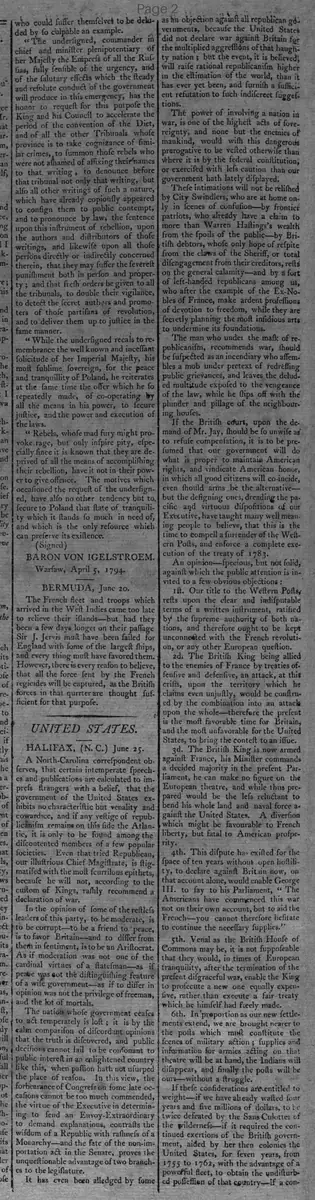
HALIFAX, (N. C.) June 25.
A North-Carolina correspondent observes, that certain intemperate speeches and publications are calculated to impress strangers with a belief, that the government of the United States exhibits no characteristic but venality and cowardice, and if any vestige of republicanism remains on this side the Atlantic, it is only to be found among the discontented members of a few popular societies. Even that tried Republican, our illustrious Chief Magistrate, is stigmatized with the most scurrilous epithets, because he will not, according to the custom of Kings, rashly recommend a declaration of war.
In the opinion of some of the restless leaders of this party, to be moderate, is to be corrupt—to be a friend to peace, is to favor Britain—and to differ from them in sentiment, is to be an Aristocrat. As if moderation was not one of the cardinal virtues of a statesman—as if peace was not the distinguishing feature of a wise government—as if to differ in opinion was not the privilege of freemen, and the lot of mortals.
The nation whose government ceases to act temperately is lost; it is by the calm comparison of discordant opinions that the truth is discovered, and public decisions cannot fail to be consonant to public interest in an enlightened country like this, when passion hath not usurped the place of reason. In this view, the forbearance of Congress on some late occasions cannot be too much commended, the virtue of the Executive in determining to send an Envoy-Extraordinary to demand explanations, contrasts the wisdom of a Republic with rashness of a Monarchy and the fate of the non-importation act in the Senate, proves the unquestionable advantage of two branches to the legislature.
It has even been alleged by some as an objection against all republican governments, because the United States did not declare war against Britain for the multiplied aggressions of that haughty nation; but the event, it is believed! will raise rational republicanism higher in the estimation of the world, than it has ever yet been, and furnish a sufficient refutation to such indiscreet suggestions.
The power of involving a nation in war, is one of the highest acts of sovereignty, and none but the enemies of mankind, would wish this dangerous prerogative to be vested otherwise than where it is by the federal constitution, or exercised with less caution than our government hath lately displayed.
These intimations will not be relished by City Swindlers, who are at home only in scenes of confusion—by frontier patriots, who already have a claim to more than Warren Hastings's wealth from the spoils of the public—by British debtors, whose only hope of respite from the claws of the Sheriff, or total disengagement from their creditors, rests on the general calamity—and by a sort of left-handed republicans among us, who after the example of the Ex-Nobles of France, make ardent professions of devotion to freedom, while they are secretly planning the most insidious arts to undermine its foundations.
The man who under the mask of republicanism, recommends war, should be suspected as an incendiary who assembles a mob under pretext of redressing public grievances, and leaves the deluded multitude exposed to the vengeance of the law, while he slips off with the plunder and pillage of the neighboring houses.
If the British court, upon the demand of Mr. Jay, should be so unwise as to refuse compensation, it is to be presumed that our government will do what is proper to maintain American rights, and vindicate American honor, in which all good citizens will coincide even should arms be the alternative—but the designing ones, dreading the pacific and virtuous dispositions of our Executive, have taught many well meaning people to believe, that this is the time to compel a surrender of the Western Posts, and enforce a complete execution of the treaty of 1783.
An opinion—specious, but not solid, against which the public attention is invited to a few obvious objections:
1st. Our title to the Western Posts, rests upon the clear and indisputable terms of a written instrument, ratified by the supreme authority of both nations, and therefore ought to be kept unconnected with the French revolution, or any other European question.
2d The British King being allied to the enemies of France by treaties of offensive and defensive, an attack, at this crisis, upon the territory which he claims even unjustly, would be construed by the combination into an attack upon the whole—therefore the present is the most favorable time for Britain, and the most unfavorable for the United States, to bring the contest to an issue.
3d. The British King is now armed against France, his Minister commands a decided majority in the present Parliament, he can make no figure on the European theatre, and while thus prepared would be the less reluctant to bend his whole land and naval force against the United States. A diversion which might be favourable to French liberty, but fatal to American property.
4th. This dispute has existed for the space of ten years without open hostility, to declare against Britain now, on that account alone, would enable George III. to say to his Parliament, "The Americans have commenced this war not on their own account, but to aid the French—you cannot therefore hesitate to continue the necessary supplies."
5th. Venal as the British House of Commons may be, it is not supposable that they would, in times of European tranquillity, after the termination of the present disgraceful war, enable the King to prosecute a new one equally expensive, rather than execute a fair treaty which he himself had freely made.
6th. In proportion as our new settlements extend, we are brought nearer to the posts which must constitute the scenes of military action; supplies and information for armies acting on that theatre will be at hand, the Indians will disappear, and finally the posts will be ours—without a struggle.
If these considerations are entitled to weight—if we have already wasted four years and five millions of dollars, to be twice defeated by the Sans Culottes of the wilderness—if it required the continued exertions of the British government, aided by her then colonies the United States, for even years, from 1755 to 1762, with the advantage of a powerful fleet, to obtain the undisturbed possession of that country—if a contest for these posts, with all their acquisitions of strength from that time to this, will now cost our infant republic two millions of dollars more than they were ever worth—if the same object can be obtained sooner by peace than war—if even years of uninterrupted prosperity will certainly bestow us these possessions without the loss of a man or a dollar—if we are growing in wealth and in numbers beyond all calculation—if war is the natural enemy of liberty, of arts, of industry, of morality—surely the present is not the most proper time to insist on a surrender of these posts, and surely the cool and steady friends of peace are the best Republicans, and the firmest friends of the United States.
What sub-type of article is it?
What keywords are associated?
What entities or persons were involved?
Editorial Details
Primary Topic
Defense Of Moderation And Peace Against War With Britain Over Western Posts
Stance / Tone
Supportive Of Republican Moderation And Caution, Critical Of War Advocates
Key Figures
Key Arguments