Thank you for visiting SNEWPapers!
Sign up free
Editorial
July 19, 1839
The Yazoo City Whig And Political Register
Yazoo City, Yazoo County, Mississippi
What is this article about?
Editorial in the Vicksburg Whig rebuts a New Orleans True American article claiming Mississippi owes millions to failed commission houses and has lost trade due to their actions. Argues Mississippi banks funded advances, no net debt exists, and direct trade benefits the state over New Orleans agencies.
Clipping
OCR Quality
95%
Excellent
Full Text
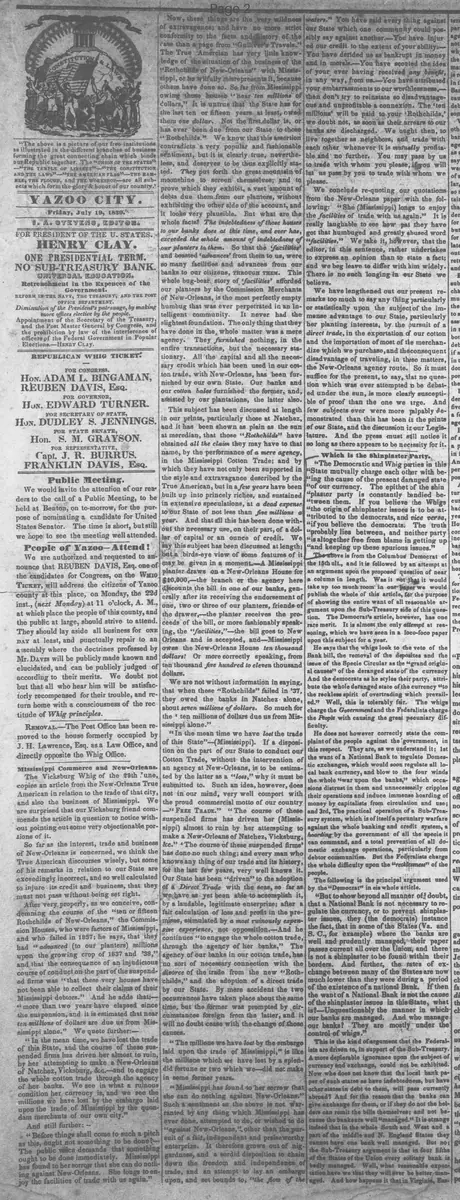
Mississippi Commerce and New-Orleans.
The Vicksburg Whig of the 29th June, copies an article from the New-Orleans True American in relation to the trade of that city, and also the business of Mississippi. We are surprised that our Vicksburg friend commends the article in question to notice without pointing out some very objectionable portions of it.
So far as the interest, trade and business of New-Orleans is concerned, we think the True American discourses wisely, but some of his remarks in relation to our State are exceedingly incorrect, and so well calculated to injure its credit and business, that they must not pass without being set right.
After very properly, as we conceive, condemning the course of the "ten or fifteen Rothchilds of New-Orleans," the Commission Houses, who were factors of Mississippi, and who failed in 1837; he says, that they had "advanced (to our planters) millions upon the growing crop of 1837 and '38," and that the consequence of an injudicious course of conduct on the part of the suspended firms was "that these very houses have not been able to collect their claims of their Mississippi debtors." And he adds that;— more than two years have elapsed since the suspension, and it is estimated that near ten-millions of dollars are due us from Mississippi alone. We quote further:—
"In the mean time, we have lost the trade of this State, and the course of these suspended firms has driven her almost to ruin, by her attempting to make a New-Orleans of Natchez, Vicksburg, &c.—and to engage the whole cotton trade through the agency of her banks. We see in what a ruinous condition her currency is, and we see the millions we have lost by the embargo laid upon the trade of Mississippi by the quondam merchants of our own city."
And still further: —
"Before things shall come to such a pitch as this, ought not something to be done— The public voice demands that something ought to be done immediately, Mississippi has found to her sorrow that she can do nothing against New-Orleans. She longs to enjoy the facilities of trade with us again."
Now, these things are the very wildness of extravagance; and have no more strict conformity to the acts and history of the case than a page from "Gulliver's Travels."
The True American has very little knowledge of the situation of the business of the "Rothchilds of New-Orleans" with Mississippi, or he wilfully misrepresents it, because others have done so. So far from Mississippi owing those houses "near ten millions of dollars," it is untrue that the State has for the last ten or fifteen years at least, owed them one dollar. Not the first dollar is, or has ever been due from our State to those "Rothchilds." We know that this assertion contradicts a very popular and fashionable sentiment, but it is clearly true, nevertheless, and deserves to be thus explicitly stated. They put forth the great mountain of moonshine to screen themselves; and to prove which they exhibit, a vast amount of debts due them from our planters, without exhibiting the other side of the account, and it looks very plausible. But what are the whole facts! The indebtedness of those houses to our banks does at this time, and ever has, exceeded the whole amount of indebtedness of our planters to them. So that the facilities and boasted 'advances' from them to us, were so many facilities and advances from our banks to our citizens, THROUGH THEM. This whole bug-bear story of 'facilities' afforded our planters by the Commission Merchants of New-Orleans, is the most perfectly empty humbug that was ever perpetrated in an intelligent community. It never had the slightest foundation. The only thing that they have done in the whole matter was a mere agency. They furnished nothing, in the entire transactions, but the necessary stationery. All the capital and all the necessary credit which has been used in our cotton trade, with New-Orleans, has been furnished by our own State. Our banks and our cotton bales furnished the former, and, assisted by our plantations, the latter also.
This subject has been discussed at length in our prints, particularly those at Natchez, and it has been shown as plain as the sun at meridian, that those "Rothchilds" have obtained all the claim they may have to that name, by the performance of a mere agency, in the Mississippi Cotton Trade; and by which they have not only been supported in the style and extravagance described by the True American, but in a few years have been built up into princely riches, and sustained in extensive speculations, at a dead expense to our State of not less than five millions a year. And that all this has been done without the necessary use, on their part, of a dollar of capital or an ounce of credit. We say this subject has been discussed at length; but a birds-eye view of some features of it may be given in a moment. A Mississippi planter draws on a New-Orleans House for $10,000,—the branch or the agency here discounts the bill in one of our banks, generally after its receiving the endorsement of one, two or three of our planters, friends of the drawer,—the planter receives the proceeds of the bill, or more fashionably speaking, the "facilities,"—the bill goes to New Orleans and is accepted, and—Mississippi owes the New-Orleans House ten thousand dollars! Or more correctly speaking, from ten thousand five hundred to eleven thousand dollars.
We are not without information in saying, that when these "Rothchilds" failed in '37, they owed the banks in Natchez alone, about seven millions of dollars. So much for the 'ten millions of dollars due us from Mississippi alone.'
"In the mean time we have lost the trade of this State"—(Mississippi). If a disposition on the part of our State to conduct our Cotton Trade, without the intervention of an agency at New-Orleans, is to be estimated by the latter as a "loss," why it must be submitted to. Such an idea, however, does not in our mind, very well comport with the proud commercial motto of our country—"FREE TRADE." "The course of these suspended firms has driven her (Mississippi) almost to ruin by her attempting to make a New-Orleans of Natchez, Vicksburg, &c." The course of these suspended firms has done no such thing; and every man who knows any thing of our trade and its history, for the last few years, very well knows it.
Our State has been "driven" to the adoption of a Direct Trade with the seas, so far as we have as yet been able to accomplish it, by a laudable, legitimate enterprize; after a fair calculation of loss and profit in the premises, stimulated by a most ruinously expensive experience, not opposition.—And he continues "to engage the whole cotton trade, through the agency of her banks." The agency of our banks in our cotton trade, has no sort of necessary connection with the divorce of the trade from the new "Rothchilds," and the adoption of a direct trade by our State. By mere accident the two occurrences have taken place about the same time, but the former was prompted by circumstances foreign from the latter, and it will no doubt cease with the change of those causes.
"The millions we have lost by the embargo laid upon the trade of Mississippi," is like the millions which we have lost by a splendid fortune or two which we did not make in some former years.
"Mississippi has found to her sorrow that she can do nothing against New-Orleans." Such a sentiment as the above is not warranted by any thing which Mississippi has ever done, attempted to do, or wished to do "against New-Orleans," other than the pursuit of a fair independent and praiseworthy enterprize. It therefore grows out of niggardness, and a sordid disposition to chain down the freedom and independence of trade, and an attempt to lay an embargo upon, and set bounds to, "the flow of the waters."
You have said every thing against our State which one community could possibly say against another.—You have injured our credit to the extent of your ability.— You have derided us as bankrupt in money and in morals.—You have scouted the idea of your ever having received any benefit, in any way, from us.—You have attributed your embarrassments to our worthlessness,— then don't try to reinstate so disadvantageous and unprofitable a connexion. The ten millions will be paid to your Rothchilds, we doubt not, as soon as their arrears to our banks are discharged. We ought then, to live together as neighbors, and trade with each other whenever it is mutually profitable and no further. You may pass by us to trade with whom you please, if you will let us pass by you to trade with whom we please.
We conclude re-quoting our quotations from the New-Orleans paper with the following: "She (Mississippi) longs to enjoy the facilities of trade with us again." It is really laughable to see how pat they have got that humbugged and greatly abused word "facilities." We take it, however, that the editor, in this sentence, rather undertakes to express an opinion than to state a fact; and we beg leave to differ with him widely.
There is no such longing in our State we believe.
We have lengthened out our present remarks too much to say any thing particularly or statistically upon the subject of the immense advantage to our State, particularly her planting interests, by the pursuit of a direct trade, in the exportation of our cotton and the importation of most of the merchandise which we purchase, and the consequent disadvantage of traveling, in these matters, the New-Orleans agency route. So it must suffice for the present, to say, that no question which was ever attempted to be debated under the sun, is more clearly susceptible of proof than the one we urge. And few subjects ever were more palpably demonstrated than this has been in the prints of our State, and the discussion in our Legislature. And the press must still notice it so long as there appears to be necessity for it.
The Vicksburg Whig of the 29th June, copies an article from the New-Orleans True American in relation to the trade of that city, and also the business of Mississippi. We are surprised that our Vicksburg friend commends the article in question to notice without pointing out some very objectionable portions of it.
So far as the interest, trade and business of New-Orleans is concerned, we think the True American discourses wisely, but some of his remarks in relation to our State are exceedingly incorrect, and so well calculated to injure its credit and business, that they must not pass without being set right.
After very properly, as we conceive, condemning the course of the "ten or fifteen Rothchilds of New-Orleans," the Commission Houses, who were factors of Mississippi, and who failed in 1837; he says, that they had "advanced (to our planters) millions upon the growing crop of 1837 and '38," and that the consequence of an injudicious course of conduct on the part of the suspended firms was "that these very houses have not been able to collect their claims of their Mississippi debtors." And he adds that;— more than two years have elapsed since the suspension, and it is estimated that near ten-millions of dollars are due us from Mississippi alone. We quote further:—
"In the mean time, we have lost the trade of this State, and the course of these suspended firms has driven her almost to ruin, by her attempting to make a New-Orleans of Natchez, Vicksburg, &c.—and to engage the whole cotton trade through the agency of her banks. We see in what a ruinous condition her currency is, and we see the millions we have lost by the embargo laid upon the trade of Mississippi by the quondam merchants of our own city."
And still further: —
"Before things shall come to such a pitch as this, ought not something to be done— The public voice demands that something ought to be done immediately, Mississippi has found to her sorrow that she can do nothing against New-Orleans. She longs to enjoy the facilities of trade with us again."
Now, these things are the very wildness of extravagance; and have no more strict conformity to the acts and history of the case than a page from "Gulliver's Travels."
The True American has very little knowledge of the situation of the business of the "Rothchilds of New-Orleans" with Mississippi, or he wilfully misrepresents it, because others have done so. So far from Mississippi owing those houses "near ten millions of dollars," it is untrue that the State has for the last ten or fifteen years at least, owed them one dollar. Not the first dollar is, or has ever been due from our State to those "Rothchilds." We know that this assertion contradicts a very popular and fashionable sentiment, but it is clearly true, nevertheless, and deserves to be thus explicitly stated. They put forth the great mountain of moonshine to screen themselves; and to prove which they exhibit, a vast amount of debts due them from our planters, without exhibiting the other side of the account, and it looks very plausible. But what are the whole facts! The indebtedness of those houses to our banks does at this time, and ever has, exceeded the whole amount of indebtedness of our planters to them. So that the facilities and boasted 'advances' from them to us, were so many facilities and advances from our banks to our citizens, THROUGH THEM. This whole bug-bear story of 'facilities' afforded our planters by the Commission Merchants of New-Orleans, is the most perfectly empty humbug that was ever perpetrated in an intelligent community. It never had the slightest foundation. The only thing that they have done in the whole matter was a mere agency. They furnished nothing, in the entire transactions, but the necessary stationery. All the capital and all the necessary credit which has been used in our cotton trade, with New-Orleans, has been furnished by our own State. Our banks and our cotton bales furnished the former, and, assisted by our plantations, the latter also.
This subject has been discussed at length in our prints, particularly those at Natchez, and it has been shown as plain as the sun at meridian, that those "Rothchilds" have obtained all the claim they may have to that name, by the performance of a mere agency, in the Mississippi Cotton Trade; and by which they have not only been supported in the style and extravagance described by the True American, but in a few years have been built up into princely riches, and sustained in extensive speculations, at a dead expense to our State of not less than five millions a year. And that all this has been done without the necessary use, on their part, of a dollar of capital or an ounce of credit. We say this subject has been discussed at length; but a birds-eye view of some features of it may be given in a moment. A Mississippi planter draws on a New-Orleans House for $10,000,—the branch or the agency here discounts the bill in one of our banks, generally after its receiving the endorsement of one, two or three of our planters, friends of the drawer,—the planter receives the proceeds of the bill, or more fashionably speaking, the "facilities,"—the bill goes to New Orleans and is accepted, and—Mississippi owes the New-Orleans House ten thousand dollars! Or more correctly speaking, from ten thousand five hundred to eleven thousand dollars.
We are not without information in saying, that when these "Rothchilds" failed in '37, they owed the banks in Natchez alone, about seven millions of dollars. So much for the 'ten millions of dollars due us from Mississippi alone.'
"In the mean time we have lost the trade of this State"—(Mississippi). If a disposition on the part of our State to conduct our Cotton Trade, without the intervention of an agency at New-Orleans, is to be estimated by the latter as a "loss," why it must be submitted to. Such an idea, however, does not in our mind, very well comport with the proud commercial motto of our country—"FREE TRADE." "The course of these suspended firms has driven her (Mississippi) almost to ruin by her attempting to make a New-Orleans of Natchez, Vicksburg, &c." The course of these suspended firms has done no such thing; and every man who knows any thing of our trade and its history, for the last few years, very well knows it.
Our State has been "driven" to the adoption of a Direct Trade with the seas, so far as we have as yet been able to accomplish it, by a laudable, legitimate enterprize; after a fair calculation of loss and profit in the premises, stimulated by a most ruinously expensive experience, not opposition.—And he continues "to engage the whole cotton trade, through the agency of her banks." The agency of our banks in our cotton trade, has no sort of necessary connection with the divorce of the trade from the new "Rothchilds," and the adoption of a direct trade by our State. By mere accident the two occurrences have taken place about the same time, but the former was prompted by circumstances foreign from the latter, and it will no doubt cease with the change of those causes.
"The millions we have lost by the embargo laid upon the trade of Mississippi," is like the millions which we have lost by a splendid fortune or two which we did not make in some former years.
"Mississippi has found to her sorrow that she can do nothing against New-Orleans." Such a sentiment as the above is not warranted by any thing which Mississippi has ever done, attempted to do, or wished to do "against New-Orleans," other than the pursuit of a fair independent and praiseworthy enterprize. It therefore grows out of niggardness, and a sordid disposition to chain down the freedom and independence of trade, and an attempt to lay an embargo upon, and set bounds to, "the flow of the waters."
You have said every thing against our State which one community could possibly say against another.—You have injured our credit to the extent of your ability.— You have derided us as bankrupt in money and in morals.—You have scouted the idea of your ever having received any benefit, in any way, from us.—You have attributed your embarrassments to our worthlessness,— then don't try to reinstate so disadvantageous and unprofitable a connexion. The ten millions will be paid to your Rothchilds, we doubt not, as soon as their arrears to our banks are discharged. We ought then, to live together as neighbors, and trade with each other whenever it is mutually profitable and no further. You may pass by us to trade with whom you please, if you will let us pass by you to trade with whom we please.
We conclude re-quoting our quotations from the New-Orleans paper with the following: "She (Mississippi) longs to enjoy the facilities of trade with us again." It is really laughable to see how pat they have got that humbugged and greatly abused word "facilities." We take it, however, that the editor, in this sentence, rather undertakes to express an opinion than to state a fact; and we beg leave to differ with him widely.
There is no such longing in our State we believe.
We have lengthened out our present remarks too much to say any thing particularly or statistically upon the subject of the immense advantage to our State, particularly her planting interests, by the pursuit of a direct trade, in the exportation of our cotton and the importation of most of the merchandise which we purchase, and the consequent disadvantage of traveling, in these matters, the New-Orleans agency route. So it must suffice for the present, to say, that no question which was ever attempted to be debated under the sun, is more clearly susceptible of proof than the one we urge. And few subjects ever were more palpably demonstrated than this has been in the prints of our State, and the discussion in our Legislature. And the press must still notice it so long as there appears to be necessity for it.
What sub-type of article is it?
Trade Or Commerce
Economic Policy
What keywords are associated?
Mississippi Commerce
New Orleans Trade
Cotton Trade
Commission Houses
Direct Trade
Economic Independence
What entities or persons were involved?
New Orleans True American
Vicksburg Whig
Rothchilds Of New Orleans
Mississippi Banks
Mississippi Planters
Editorial Details
Primary Topic
Defense Of Mississippi's Direct Cotton Trade Against New Orleans Commission Houses
Stance / Tone
Strongly Defensive Of Mississippi's Economic Independence And Critical Of New Orleans Merchants
Key Figures
New Orleans True American
Vicksburg Whig
Rothchilds Of New Orleans
Mississippi Banks
Mississippi Planters
Key Arguments
Mississippi Owes No Net Debt To New Orleans Commission Houses; Advances Were Funded By Mississippi Banks
New Orleans Article Misrepresents Facts To Injure Mississippi's Credit
Direct Trade Benefits Mississippi By Avoiding Expensive New Orleans Agencies
Commission Houses Acted Only As Agents Without Providing Capital
Mississippi Pursues Independent Trade For Mutual Profit, Not Against New Orleans